All-Time NBA Points Leaders: The Definitive Ranking and Statistical Breakdown
LeBron James holds the all-time NBA record for total regular-season points scored, surpassing Kareem Abdul-Jabbar's legacy mark of 38,387 points in February 2023 and becoming the first player to cross the 40,000-point milestone in Marc...
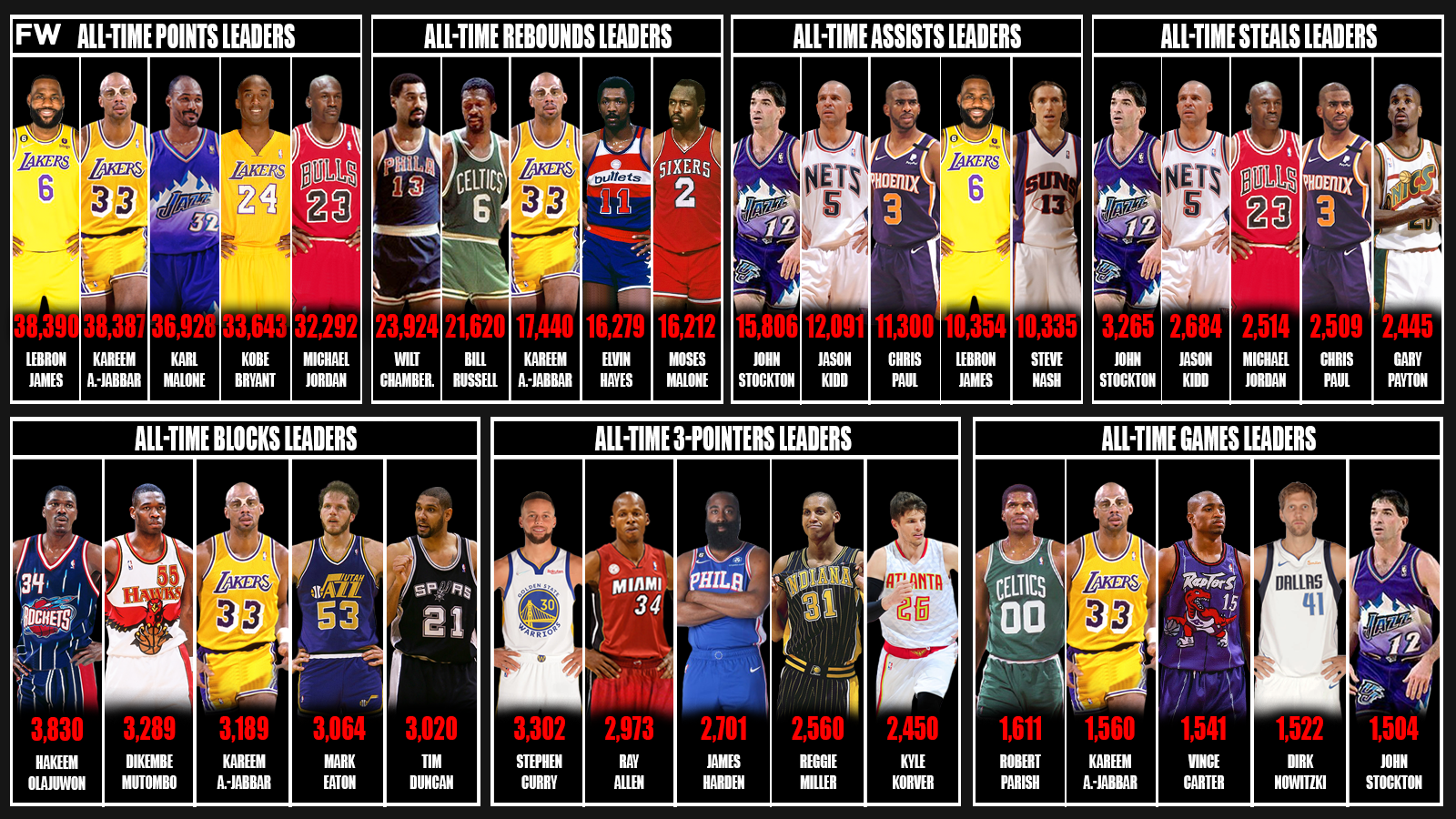
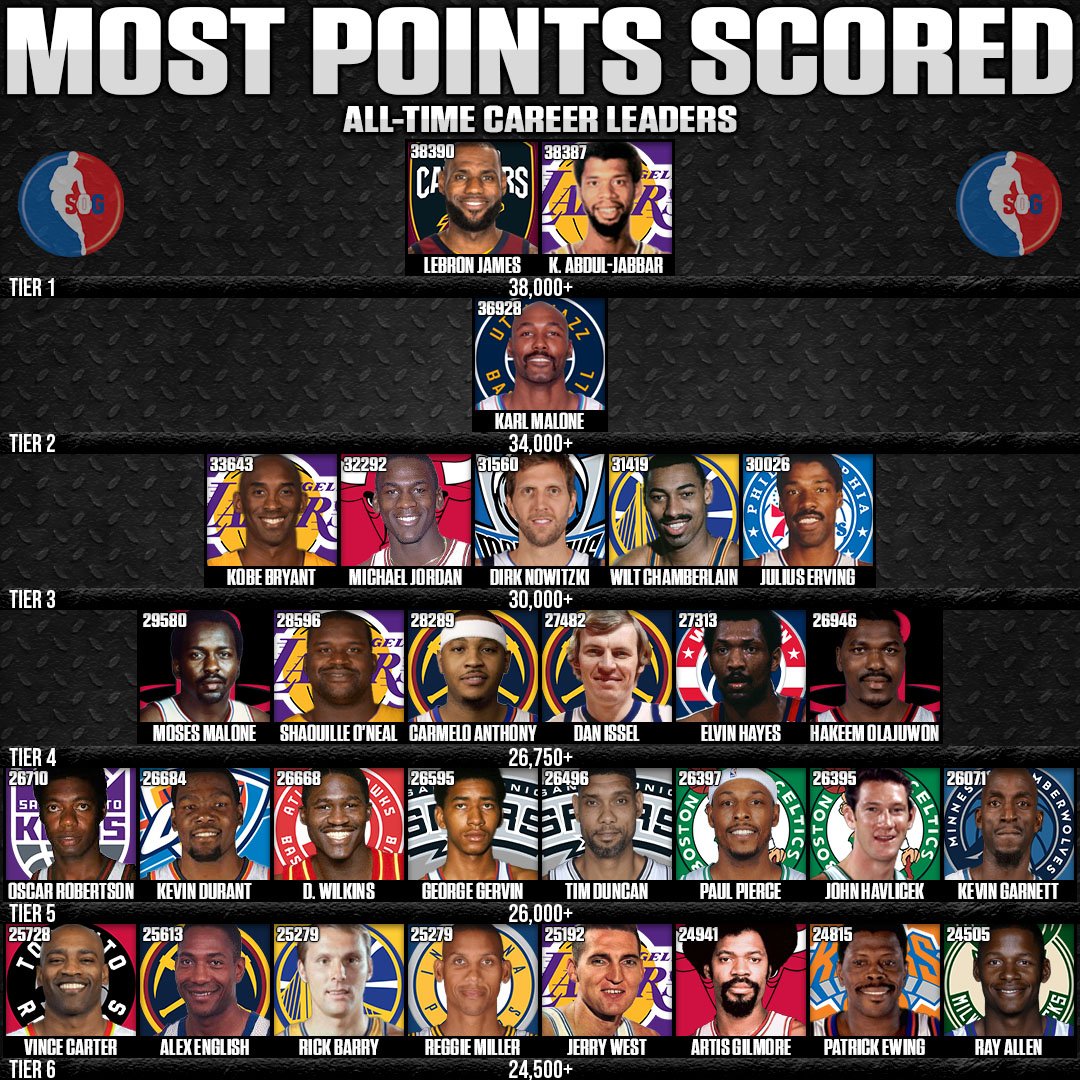
LeBron James holds the all-time NBA record for total regular-season points scored, surpassing Kareem Abdul-Jabbar's legacy mark of 38,387 points in February 2023 and becoming the first player to cross the 40,000-point milestone in March 2024. Karl Malone, Kobe Bryant, and Michael Jordan complete the top five highest scorers in professional basketball history.
Contents
The Historical Evolution of NBA Scoring
The journey to the top of the NBA all-time scoring list reflects the tactical evolution of professional basketball over the past eight decades. In the league’s early decades, scoring was concentrated around the rim. Legendary big men used footwork, rebounding, and painted-area dominance to establish scoring benchmarks.
As the game expanded past the key, perimeter shooting and backcourt scoring dynamic shifted how points were generated. The introduction of the three-point line during the 1979–80 season permanently altered offense in the NBA, though its full impact was not realized until decades later.
Tactical Era Shifts in NBA Scoring
The Interior Dominance Era (1946–1979): Scoring centered on physical post play, offensive rebounding, and high-volume close-range attempts led by dominant centers like George Mikan, Wilt Chamberlain, and Kareem Abdul-Jabbar.
The Mid-Range and Isolation Era (1980–2010): Play expanded to wing players who mastered the mid-range pull-up, footwork in the post, and fast-break points, exemplified by Michael Jordan, Kobe Bryant, and Karl Malone.
The Pace, Space, and Efficiency Era (2011–Present): Heavy analytical emphasis on True Shooting Percentage (TS%), three-point volume, rapid transition play, and drive-and-kick architectures, piloted by elite scorers like Kevin Durant, James Harden, and Stephen Curry.
Understanding these structural eras provides crucial context when comparing pure scoring output across generations. A player scoring 25 points per game in 1998 operated in an entirely different spatial and tactical environment than a player averaging 25 points per game today.
Top 10 All-Time NBA Regular Season Points Leaders
To evaluate all-time scoring supremacy, statistical organizations such as Official NBA Stats and Basketball Reference primary track regular-season totals as the official standard. Playoff statistics are kept in a separate, prestigious historical category.
The following table outlines the top 10 scoring leaders in NBA regular-season history:
| Rank | Player | Total Points | Games Played | Career PPG | Field Goals Made | Free Throws Made | Era / Primary Teams |
|---|---|---|---|---|---|---|---|
| 1 | LeBron James | 40,000+ | 1,490+ | 27.1 | 14,800+ | 8,300+ | CLE, MIA, LAL (Active) |
| 2 | Kareem Abdul-Jabbar | 38,387 | 1,560 | 24.6 | 15,837 | 6,712 | MIL, LAL (Retired) |
| 3 | Karl Malone | 36,928 | 1,476 | 25.0 | 13,528 | 9,787 | UTA, LAL (Retired) |
| 4 | Kobe Bryant | 33,643 | 1,346 | 25.0 | 11,719 | 8,378 | LAL (Retired) |
| 5 | Michael Jordan | 32,292 | 1,072 | 30.1 | 12,192 | 7,327 | CHI, WAS (Retired) |
| 6 | Dirk Nowitzki | 31,560 | 1,522 | 20.7 | 11,169 | 7,240 | DAL (Retired) |
| 7 | Wilt Chamberlain | 31,419 | 1,045 | 30.1 | 12,681 | 6,057 | PHW, PHI, LAL (Retired) |
| 8 | Kevin Durant | 30,000+ | 1,080+ | 27.3 | 10,400+ | 7,100+ | OKC, GSW, BKN, PHX (Active) |
| 9 | Shaquille O'Neal | 28,596 | 1,207 | 23.7 | 11,330 | 5,935 | ORL, LAL, MIA, et al. (Retired) |
| 10 | Carmelo Anthony | 28,289 | 1,260 | 22.5 | 10,119 | 6,358 | DEN, NYK, POR, LAL (Retired) |
Detailed Profiles of the Top NBA Scoring Giants
1. LeBron James: Longevity Meets Peak Output
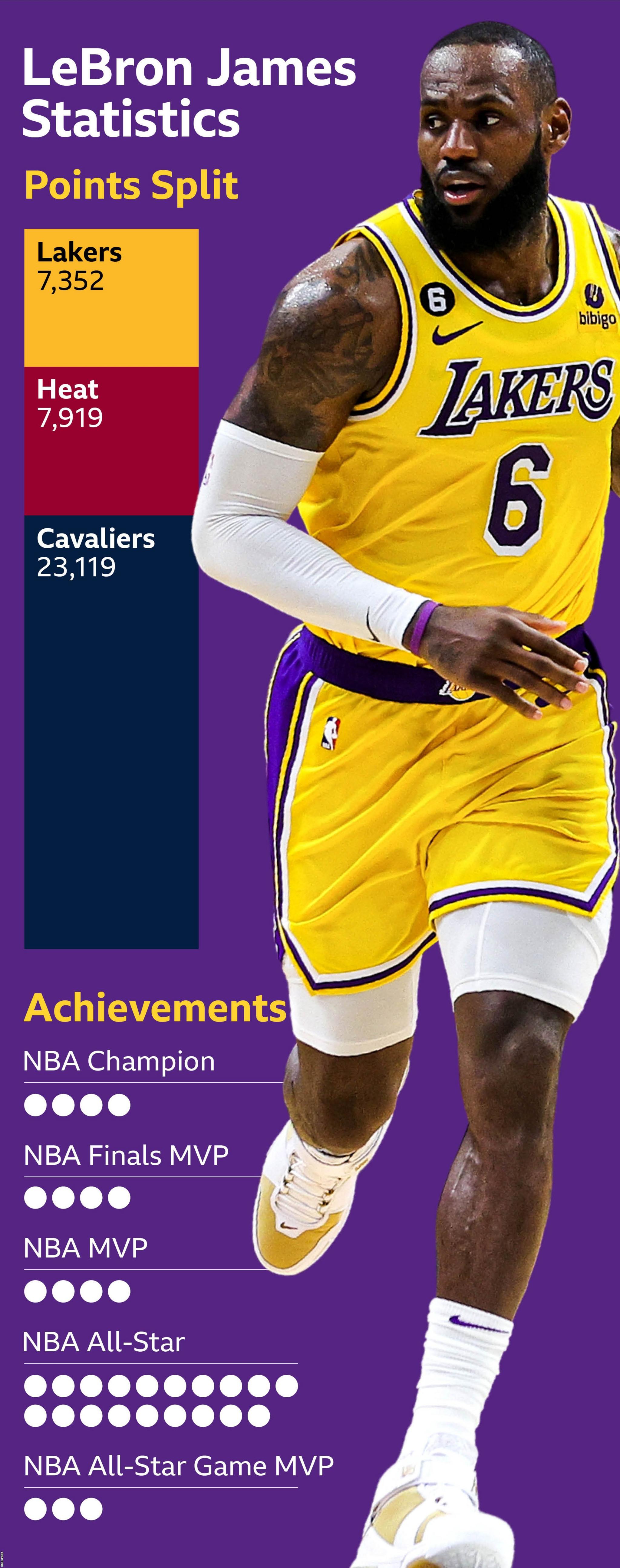
LeBron James’ position atop the all-time scoring list is built on unprecedented elite-level durability. Entering the league in 2003 as a pass-first playmaker, James maintained an average of over 25 points per game for two consecutive decades. His scoring profile evolved continuously—from pure downhill rim-attack athleticism in Cleveland to post efficiency in Miami, into high-volume perimeter and deep three-point threat capability in Los Angeles.
2. Kareem Abdul-Jabbar: The Unstoppable Skyhook
Kareem Abdul-Jabbar held the all-time scoring record for nearly 39 years, setting the standard with 38,387 points. His cornerstone weapon was the skyhook—a shot virtually immune to contesting or blocking due to his high release point and exceptional touch. Across 20 seasons with Milwaukee and Los Angeles, Kareem combined elite durability with relentless offensive efficiency, making 15,837 field goals, a record that remains unbroken.
3. Karl Malone: The Pick-and-Roll Powerhouse
Karl Malone’s placement at number three is a masterclass in relentless physical conditioning and baseline consistency. Partnered with Hall of Fame point guard John Stockton in Utah, "The Mailman" utilized a combination of mid-range execution, power finishing on the break, and elite free-throw generation. Malone scored at least 2,000 points in 12 distinct seasons.
4. Kobe Bryant: Precision Isolation and Shot Creation
Kobe Bryant scored 33,643 points purely in a Lakers uniform, building a repertoire modeled on immaculate footwork, mid-range elevation, and relentless competitive drive. Renowned for his 81-point performance against Toronto in 2006, Bryant possessed arguably the most complete isolation scoring kit in league history, converting low-efficiency, highly contested attempts into clutch offensive output.
5. Michael Jordan: Peak Scoring Rate Supremacy
While Michael Jordan sits fifth in raw total scoring due to two sabbaticals, his scoring rate is unmatched. Jordan shares the highest career scoring average in NBA history at 30.1 points per game alongside Wilt Chamberlain, while capturing a record 10 scoring titles. Combining mid-air creativity, an unshakeable mid-range fadeaway, and elite transition play, Jordan dominated defenders across multiple championship dynasties.
Regular Season vs. Playoff Scoring Records
A critical distinction in NBA history exists between regular season scoring totals and playoff scoring output. Regular-season games showcase consistency across 82-game slates, whereas playoff totals reveal a player's ability to score against hyper-focused defense, multi-game gameplans, and elite competition.
When combining regular season and playoff career points, the numbers expand dramatically:
- LeBron James: Over 48,000 combined career points (All-time Leader in playoff scoring with 8,000+ points)
- Kareem Abdul-Jabbar: 44,149 combined career points
- Karl Malone: 41,689 combined career points
- Kobe Bryant: 39,283 combined career points
- Michael Jordan: 38,279 combined career points (Holds highest playoff PPG record at 33.4 PPG)
Playoff scoring requires extreme volume alongside efficiency. Defenses eliminate primary options, forcing elite players to score on tough second-effort plays, late-clock isolation attempts, and contested rim attempts.
Evaluating Scoring Efficiency: TS% and Usage Rate
Evaluating a player's standing among the all-time scoring leaders requires assessing efficiency alongside simple point totals. Raw points reveal volume, but advanced metrics measure shot selection and spatial effectiveness:
- True Shooting Percentage (TS%): A metric taking into account field goals, three-point shots, and free throws to calculate exact offensive efficiency per shot attempt. Formula:
PTS / (2 * (FGA + 0.44 * FTA)). - Effective Field Goal Percentage (eFG%): Adjusts field goal percentage to account for the fact that a three-point field goal is worth 50% more than a two-point field goal. Formula:
(FGM + 0.5 * 3PM) / FGA. - Usage Percentage (USG%): An estimate of the percentage of team plays used by a player while they are on the floor.
Efficiency Comparison Among All-Time Leaders
High Volume / High Efficiency Specialists: Players like Kevin Durant (Career TS% ~61.5%) and LeBron James (Career TS% ~58.8%) combine massive scoring volume with remarkable shooting efficiency across three levels of the floor.
Interior Efficiency Dominators: Shaquille O'Neal (Career FG% 58.2%) and Wilt Chamberlain (Career FG% 54.0%) logged high traditional shooting percentages by dominating close-range attempts, though held back by lower career free-throw conversion rates.
High-Difficulty Volume Creators: Kobe Bryant and Allen Iverson maintained lower TS% figures (55.0% and 51.8% respectively) due to taking high-difficulty isolation shots and carrying extreme team usage loads late in shot clocks.
Active Players Climbing the All-Time Scoring Charts
As the game's scoring environment remains at historical high points in terms of pace and three-point attempt rates, modern superstars continue to accelerate their climb up the all-time scoring ladder.
Kevin Durant
Kevin Durant remains one of the most effortless scorers the league has seen. Standing 6-foot-11 with a guard's handle and elevated release, Durant surpassed legends like Carmelo Anthony, Shaquille O'Neal, and Wilt Chamberlain in recent seasons. Maintaining a career average above 27 points per game on elite shooting splits (50/40/88 territory), Durant continues to build his case as a top-five all-time efficiency-volume scorer.
Stephen Curry
While Stephen Curry sits further down the overall points ladder due to early-career injuries and four years played in college, his statistical impact is unique. As the all-time leader in three-point field goals made (surpassing 3,700+ career three-pointers), Curry redefined defensive spacing and transition mathematics, scoring high points-per-game totals with minimal ball-holding time.
James Harden & Russell Westbrook
Both former MVPs have established major historical volume marks. Harden’s iconic step-back three-pointer combined with high-volume free throw generation allowed him to record consecutive 30+ PPG seasons, crossing the 25,000-point landmark. Westbrook achieved his high point totals through coast-to-coast transition play, relentless rim penetration, and high-volume guard scoring.
How Modern Analytics Impact Scoring Longevity
The sports science and analytics movement has fundamentally altered how players approach scoring longevity, extending career horizons for modern superstars:
- Load Management and Biomechanical Tracking: Advanced tracking technology allows medical staffs to monitor muscular fatigue, force absorption, and soft tissue stress, extending high-volume scoring years into a player's late 30s.
- Shot Value Optimization: Analytics departments have shifted shot selection away from long, contested two-pointers toward high-value zones: layups, dunks, corner threes, and draw-foul scenarios.
- Pace and Transition Flow: Higher game possession counts allow players to generate 4–8 "easy" points in transition per game without expending the energy required for grind-it-out quarter-court isolation play.
Frequently Asked Questions
Who is the top all-time points scorer in NBA history?
LeBron James is the all-time leading point scorer in NBA history, having surpassed Kareem Abdul-Jabbar's 38,387 record in February 2023 and crossing 40,000 total regular-season career points in March 2024.
Who has the highest points-per-game (PPG) average in NBA history?
Michael Jordan and Wilt Chamberlain share the highest career scoring average in NBA history at 30.1 points per game. Jordan holds the edge in playoff scoring rate, averaging an all-time best 33.4 points per game in postseason competition.
Do NBA playoff points count toward the official all-time scoring leaderboards?
No, the official NBA all-time scoring leaderboard tracks regular-season points exclusively. Playoff points are tracked in a separate category, where LeBron James also holds the all-time leader title with over 8,000 postseason points.
Who scored the most points in a single NBA game?
Wilt Chamberlain holds the record for most points in a single NBA game, scoring 100 points for the Philadelphia Warriors against the New York Knicks on March 2, 1962. Kobe Bryant holds the second-highest record with 81 points against Toronto on January 22, 2006.
What is True Shooting Percentage (TS%) and why is it used to compare scorers?
True Shooting Percentage is an advanced statistic that measures a player's scoring efficiency by accounting for two-point field goals, three-point field goals, and free throws simultaneously. It provides a more accurate assessment of overall scoring value than standard field goal percentage.
The Legacy of NBA Scoring Standards
The NBA all-time points list is more than a simple counting stat; it serves as a chronicle of durable talent, tactical adaptability, and historical endurance. Reaching the upper echelons of this ranking requires a player to maintain peak scoring capability while avoiding major injuries across nearly two decades of continuous play. As perimeter play, rapid pacing, and offensive skill sets continue to advance, future generations will continue to challenge these established marks, preserving scoring excellence as basketball's definitive metric of greatness.
Image Gallery