Nickelodeon Game Show with Slime: The Ultimate Guide to Nostalgic Green Goo
Nickelodeon's iconic green slime became the flagship entertainment badge across several legendary game shows, most notably Double Dare (1986–1993, 2018–2019), What Would You Do? (1991–1993), Figure It Out (1997–1999, 2012–2013), and Sl...
Nickelodeon's iconic green slime became the flagship entertainment badge across several legendary game shows, most notably Double Dare (1986–1993, 2018–2019), What Would You Do? (1991–1993), Figure It Out (1997–1999, 2012–2013), and Slime Time Live (2000–2003). While You Can't Do That on Television introduced green slime to the network in 1979, Double Dare pioneered slime as an interactive game show penalty, obstacle course hazard, and network identity marker.
Contents
The Origins of Green Slime: From Sketch Comedy to Game Show Identity
Before green slime dominated physical game shows, it debuted on a Canadian sketch comedy series called You Can't Do That on Television, which began airing locally in 1979 and was acquired by Nickelodeon in 1981. The show established a simple running gag: whenever a cast member said the phrase "I don't know," a bucket of green slime poured from the ceiling directly onto their head.
When Nickelodeon launched its original programming push in the mid-1980s, network executives realized that messiness broke traditional television boundaries. Kids were accustomed to rigid adult authority figures and neat television sets. Slime subverted that expectation by turning messiness into a celebration of youth culture.
In 1986, producer Geoffrey Darby and host Marc Summers translated this messy aesthetic into Double Dare, Nickelodeon's first original game show. Rather than using slime merely as a comedic punchline, Double Dare transformed green goo into a tactical gameplay mechanic, physical challenge hazard, and grand prize obstacle. The success of Double Dare established slime as Nickelodeon’s trademark element, spawning an entire genre of messy studio game shows throughout the 1990s and 2000s.
The Golden Era: Legendary Nickelodeon Game Shows Featuring Slime
Over three decades, Nickelodeon developed numerous studio and location-based game shows where green slime served as penalties, rewards, or visual spectacles.
1. Double Dare (1986–1993, 2000, 2018–2019)
Hosted by Marc Summers (with executive announcer Harvey and assistant Robin Marlla), Double Dare pitted two teams of kids against each other in trivia matches and physical challenges. If a team couldn't answer a trivia question, they could "dare" the opposing team. The opposing team could "double dare" back, forcing the original team to either answer for quadrupled points or perform a timed "Physical Challenge."
Physical challenges frequently involved catching slimy items, popping giant green balloons, or wading through pools of goo. The show's grand finale, the Slime Canal or Obstacle Course, forced contestants to race through eight messy obstacles within 60 seconds. Iconic slime-heavy obstacles included:
- The Giant Nose: Contestants reached deep inside a massive human nose to pull out a orange flag amidst thick green snot.
- The Sundae Slide: Players climbed up or slid down a ramp covered in ice cream toppings, cream, and green slime.
- The Human Wok & Tank: Participants dove into giant vats of colored slime and gelatin to retrieve hidden objects.
2. What Would You Do? (1991–1993)
Also hosted by Marc Summers, What Would You Do? shifted the focus from two competing teams to spontaneous audience participation. Filmed at Universal Studios Florida, the show featured live audience members choosing how studio guests or random passersby should respond to absurd scenarios.
Slime played a central role in several recurring segments:
- The Wall of Slime: Audience members seated in designated rows were randomly chosen to get blasted with green slime coming out of wall cannons.
- The Pie Coaster: Contestants rode a roller-coaster seat down a track straight into a giant wall of cream pies and green slime.
- The Slime Bar: Participants performed unusual tasks to win prizes or end up drenched in custom-flavored slime mixtures.
3. Wild & Crazy Kids (1990–1992)
Hosted by Omar Gooding, Donnie Jeffcoat, and Annette Chavez (later Jessica Gaynes), Wild & Crazy Kids brought game show mechanics outdoors to school grounds, beaches, and parks. Large groups of kids participated in scaled-up playground games.
While not exclusively set in a studio, the show regularly featured Slime Bucket Relays, Giant Slip 'n' Slides, and messy dunk tanks where losing teams or guest coaches were dropped into massive tanks filled with green slime, mud, or chocolate syrup.
4. Figure It Out (1997–1999, 2012–2013)
Hosted by Olympic swimmer Summer Sanders, Figure It Out combined panel guessing games with secret audience talents. A panel of four Nickelodeon celebrities (such as Amanda Bynes, Danny Tamberelli, Lori Beth Denberg, and Kenan Thompson) attempted to guess a kid contestant's unique talent or achievement within three timed rounds.
The panel asked yes-or-no questions while trying to avoid the Secret Slime Action. Before each episode, a common physical action (such as "touching your head," "looking up," or "saying the word 'it'") was selected as the secret slime trigger. If a celebrity panelist performed that action, green slime poured directly onto their head from above. Additionally, if the panel failed to guess the contestant's talent by the end of the game, the entire panel was doused in slime during the final segment.
5. Slime Time Live (2000–2003)
Hosted by Dave Aizer, Jonah Travick, and Jessica Holmes, Slime Time Live was a live afternoon interstitial programming block that aired between regular Nickelodeon shows. It featured home viewers participating via telephone to play interactive interactive computer games or answer trivia questions.
Slime Time Live expanded the sheer volume of slime used on television:
- Studio Audience Slimings: Studio guests sat in a outdoor arena ("The Slime Geyser") at Universal Studios Florida.
- Guinness World Records: The show set multiple world records for simultaneous slimings, including pouring over 2,500 gallons of slime on hundreds of kids in a single live broadcast.
- Bucket Racks: Callers chose specific buckets or contestants in studio to get slimed to unlock prizes like video game consoles or theme park trips.
6. BrainSurge (2009–2011)
Hosted by Jeff Sutphen, BrainSurge modernized the slime game show for a new generation by focusing on memory, visual puzzles, and quick comprehension.
Six child contestants competed through three rounds of visual memory challenges. Contestants who were eliminated did not simply walk off set—they were sent down the Brain Drain, a steep indoor slide that shot eliminated players directly out of the studio through a wall of bright green slime.
Comparative Analysis of Nickelodeon Slime Game Shows
| Show Title | Original Broadcast Run | Primary Host(s) | Role of Slime in Gameplay | Signature Slime Element / Segment |
|---|---|---|---|---|
| Double Dare | 1986–1993; 2018–2019 | Marc Summers (Liza Koshy in 2018) | Obstacle course hazard and physical challenge penalty | The Giant Nose & Slime Canal |
| What Would You Do? | 1991–1993 | Marc Summers | Audience dare reward and visual stunt punishment | The Wall of Slime & Pie Coaster |
| Wild & Crazy Kids | 1990–1992 | Omar Gooding, Donnie Jeffcoat | Outdoor relay race hazard and dunk tank fluid | Big-Base Slime Slip 'n' Slide |
| Figure It Out | 1997–1999; 2012–2013 | Summer Sanders (Jeff Sutphen in 2012) | Penalty for celebrity panelists performing hidden actions | The Secret Slime Action |
| Slime Time Live | 2000–2003 | Dave Aizer, Jonah Travick, Jessica Holmes | Call-in reward mechanic and live studio spectacle | The Slime Geyser & Mass Slimings |
| BrainSurge | 2009–2011 | Jeff Sutphen | Elimination exit mechanism | The Brain Drain Slime Slide |
Behind the Recipe: What Was Nickelodeon Slime Actually Made Of?
The physical composition of Nickelodeon slime evolved significantly over time due to studio safety guidelines, shelf-life requirements, cleanup practicalities, and allergic considerations.
The Original 1980s Recipe (You Can't Do That on Television)
The initial slime formula created by producer Roger Price was invented accidentally. When a crew member was instructed to dump mess on an actor, the prop department mixed available cafeteria ingredients:
- Cream of Wheat or oatmeal
- Green food coloring
- Baby shampoo (to make it wash out of hair easily)
- Moldy applesauce or leftover soup (added occasionally for texture)
Production Fact: On one early occasion, the original batch was left in a studio bucket over a weekend, causing the ingredients to ferment. Producers quickly learned to standardize non-perishable, non-toxic mixes that would not irritate actors' eyes or skin.
The Golden Era Recipe (Double Dare & Figure It Out)
By the time Double Dare entered syndication, prop masters needed hundreds of gallons of non-staining, edible, and batch-consistent slime every taping day. The standard production recipe included:
- Base: Instant vanilla pudding mix (for opacity and thickness)
- Body: Applesauce (for viscous texture and chunkiness)
- Coloring: Green food dye (specifically FD&C Yellow No. 5 mixed with FD&C Blue No. 1)
- Bulk Fillers: Oatmeal, flour, or water to adjust viscosity based on the specific stunt requirement
Modern Production Recipe (2000s to Present)
For live broadcasts like Slime Time Live and annual events like the Nickelodeon Kids' Choice Awards, food-based recipes were replaced by synthetic, hypoallergenic compounds to protect celebrity wardrobes and prevent slip hazards. Modern green slime typically consists of:
- Methylcellulose (Methocel): A food-grade, water-soluble polymer thickener commonly used in binder applications and ice cream.
- Deionized Water: Ensures a smooth, bubble-free consistency.
- Non-Toxic Pigments: Washable green dyes engineered not to stain skin or hair.
- Polyethylene Oxide: Added for high-velocity sliming jets to keep the stream unified mid-air.
Safety Guidelines, Cleanup Protocols, and Set Engineering
Dumping hundreds of gallons of wet goo onto live sets presented massive technical and structural challenges for studio crews.
1. Electrical Waterproofing
Studio floors contained high-voltage cables for cameras, lighting rigs, and sound equipment. Game show sets like Double Dare were engineered with sloped drainage trenches along the perimeter, rubberized waterproof flooring, and sealed junction boxes to prevent electrical short-circuits.
2. Wardrobe Considerations
Contestants on slime shows were provided with custom clothing, including plain t-shirts, shorts, protective goggles, and non-slip athletic shoes. After tapings, contestants were immediately escorted to specialized studio shower trailers equipped with warm water to wash away residual dye.
3. Temperature Control
Because cold slime could shock young contestants on live television, prop teams heated stored slime drums to a comfortable 90°F to 95°F (32°C to 35°C) before pumping it overhead through overhead release valves.
Step-by-Step: How a Classic Double Dare Physical Challenge Worked
Executing a slime-based physical challenge on live television required tight coordination between hosts, contestants, safety crew, and prop engineers.
- STEP 1: Trivia Round Stalls / Double Dare Issued A team declines to answer a question and issues a Double Dare.
- STEP 2: Challenge Introduction & Safety Briefing Marc Summers reads the challenge rules while stagehands fit contestants with safety goggles and protective gear.
- STEP 3: Prop Positioning & Timer Activation The 30-second clock begins. Contestants interact with slime vats, launching pads, or physical obstacles to transfer items to a goal.
- STEP 4: Rule Verification & Score Awarding Floor judges verify if the required quantity of items was collected before time expired, awarding points and control of the board.
- STEP 5: Quick-Clean Reset Stage crews use squeegees and industrial wet-vacs to clear the deck for the next round within a 2-minute commercial break.
The Legacy of Slime in Pop Culture
Nickelodeon’s use of slime redefined youth television in the late 20th century. By allowing kids to engage in controlled messiness, the network created a visual language that separated its programming from traditional broadcast networks like ABC, CBS, and NBC.
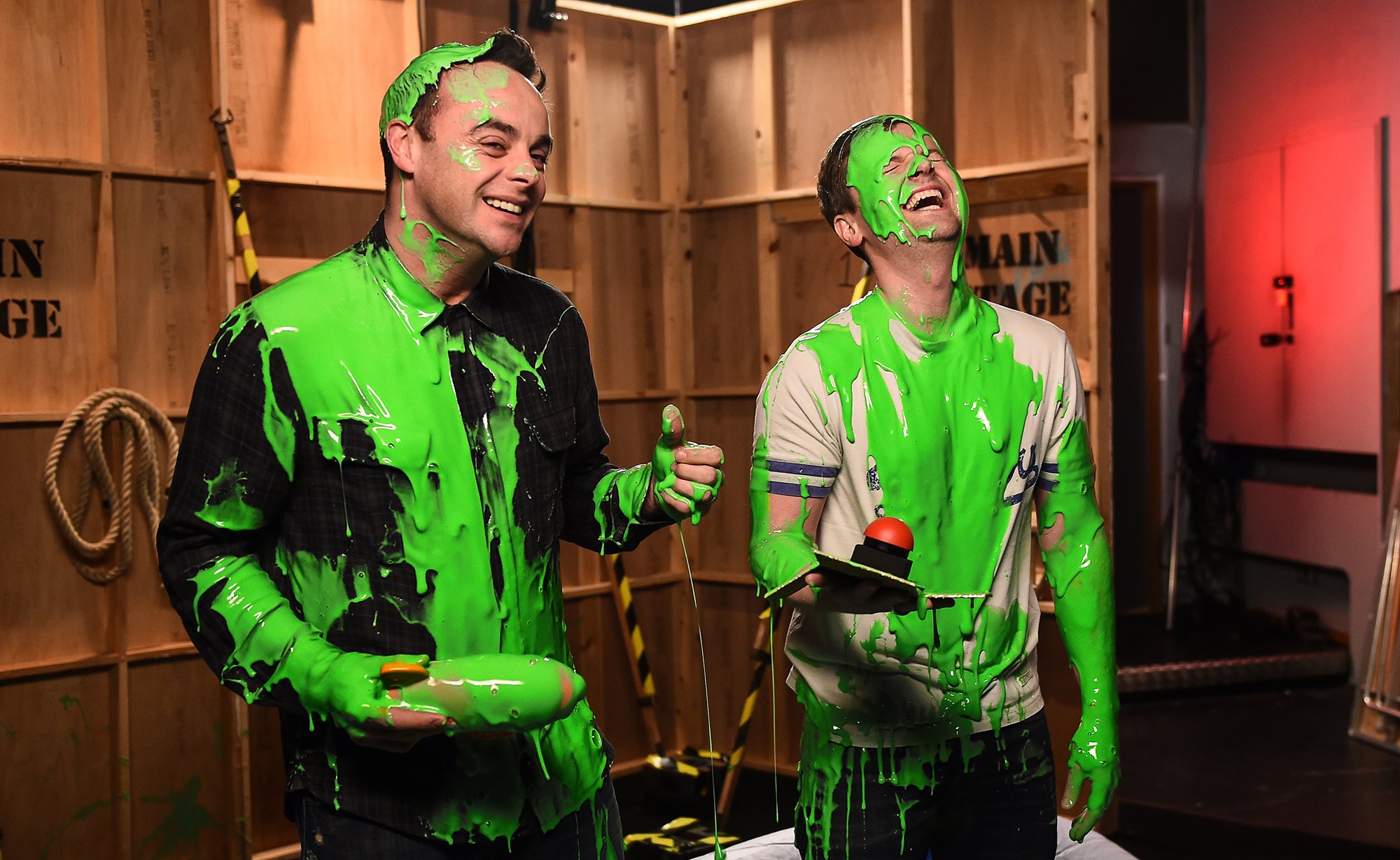
Sliming became a rite of passage for Hollywood celebrities. High-profile figures including Will Smith, Dwayne "The Rock" Johnson, Katy Perry, Harrison Ford, and Steve Carell have been doused in green goo during the annual Kids' Choice Awards.
What began as a low-budget joke on You Can't Do That on Television transformed into a global brand symbol. Today, Nickelodeon slime represents one of the most recognizable cultural icons in modern media history, demonstrating how simple interactive staging can build an enduring entertainment legacy.
Frequently Asked Questions
Which Nickelodeon game show was the first to use green slime?
Double Dare, which premiered in October 1986, was the first official Nickelodeon game show to feature green slime as a game mechanic and obstacle hazard. However, the Canadian sketch comedy show You Can't Do That on Television first introduced green slime to the network in 1981.
What was the green slime made of on Double Dare?
On Double Dare, the slime was primarily composed of instant vanilla pudding mix, unsweetened applesauce, green food coloring, and oatmeal. This mixture produced a thick, non-toxic, and washable goo that was safe for child contestants to ingest accidentally.
What happened if a panelist triggered the Secret Slime Action on Figure It Out?
When a celebrity panelist performed the pre-determined Secret Slime Action on Figure It Out, an overhead bucket tilted and poured green slime directly onto that panelist's head. The contestant also won a special prize package whenever the action was triggered.
Is Nickelodeon slime safe to ingest?
Yes, classic game show slime formulations were completely non-toxic and composed of food-grade ingredients like vanilla pudding, applesauce, gelatin, and food coloring. Modern synthetic versions used at award shows use non-toxic, hypoallergenic compounds like methylcellulose, which are safe for skin contact but not meant for consumption.
Why did Nickelodeon stop airing classic live slime game shows daily?
As television production evolved during the mid-2000s, audience viewing habits shifted toward narrative animation, live-action sitcoms, and digital content. High production costs and cleanup turnaround times for daily studio game shows led the network to reserve major sliming events for special broadcasts, revived series, and annual award shows.
Conclusion: Rediscovering Nostalgic Television History
Nickelodeon game shows proved that unscripted, high-energy entertainment could captivate generations of young viewers. From the physical obstacle courses of Double Dare to the secret triggers of Figure It Out, green slime remains the ultimate symbol of 1980s, 90s, and 2000s kids' television culture.
Whether analyzing television production history, planning a retro-themed trivia night, or recreating safe DIY slime recipes at home, exploring the history of Nickelodeon game shows offers a fascinating look into how visual branding and interactive game design shaped modern media history.
Image Gallery