Understanding the Torii Hunter Stats in Modern Baseball
Torii Hunter’s career bridges the gap between traditional baseball box scores and the modern era of advanced analytics, offering a fascinating case study for evaluating outfield defense and overall value. Evaluating Torii Hunter’s perf...
Torii Hunter’s career bridges the gap between traditional baseball box scores and the modern era of advanced analytics, offering a fascinating case study for evaluating outfield defense and overall value.
Contents
Evaluating Torii Hunter’s performance requires looking beyond traditional metrics like batting average and fielding percentage to examine modern analytical tools such as Defensive Runs Saved, Wins Above Replacement, and advanced batting statistics. Throughout his 19-year Major League Baseball career—primarily with the Minnesota Twins and Los Angeles Angels—Hunter was universally recognized as an elite defender, capturing nine consecutive Gold Glove Awards from 2001 to 2009. However, modern baseball analytics evaluate these defensive accolades through a more rigorous lens, comparing his reputation against spatial data and contemporary efficiency models.
Understanding how modern statistics view a player of Hunter's profile illuminates the evolution of baseball evaluation. While traditional numbers captured his durability, power, and run-producing capabilities, contemporary metrics quantify his range, defensive positioning, and true offensive contribution relative to league-wide run environments. By analyzing these metrics side by side, baseball analysts can paint a complete picture of Hunter's career value.
The Evolution of Baseball Statistics: Traditional vs. Modern Metrics
When Torii Hunter made his major league debut in 1997, baseball evaluation relied heavily on traditional counting stats: home runs, runs batted in, batting average, and fielding percentage. A player who hit .280 with 30 home runs, 100 RBIs, and committed few errors was considered an elite superstar. Hunter achieved these offensive thresholds multiple times, earning five All-Star selections and establishing himself as a marquee offensive threat.
Fielding percentage was the primary metric used to evaluate outfield defense. If a fielder caught every ball hit directly to them and dropped nothing catchable, their fielding percentage approached 1.000, signaling defensive excellence. However, fielding percentage suffers from a critical flaw: it only measures players on balls they actually reach. A sluggish outfielder who routinely fails to reach catchable gaps can still post a high fielding percentage simply by declining to chase difficult plays.
Modern analytics revolutionize this approach by measuring range, reaction time, and the difficulty of every defensive play. Metrics such as Defensive Runs Saved (DRS) and Ultimate Zone Rating (UZR) evaluate an outfielder's ability to cover ground across different zones of the ballpark. Similarly, offensive evaluation has shifted away from batting average and RBIs toward sabermetric staples like on-base plus slugging, weighted on-base average, and weighted runs created plus. These tools adjust for era, ballpark effects, and the value of drawing walks versus hitting for average, providing a clearer baseline for player comparison.
Deconstructing Torii Hunter’s Offensive Profile
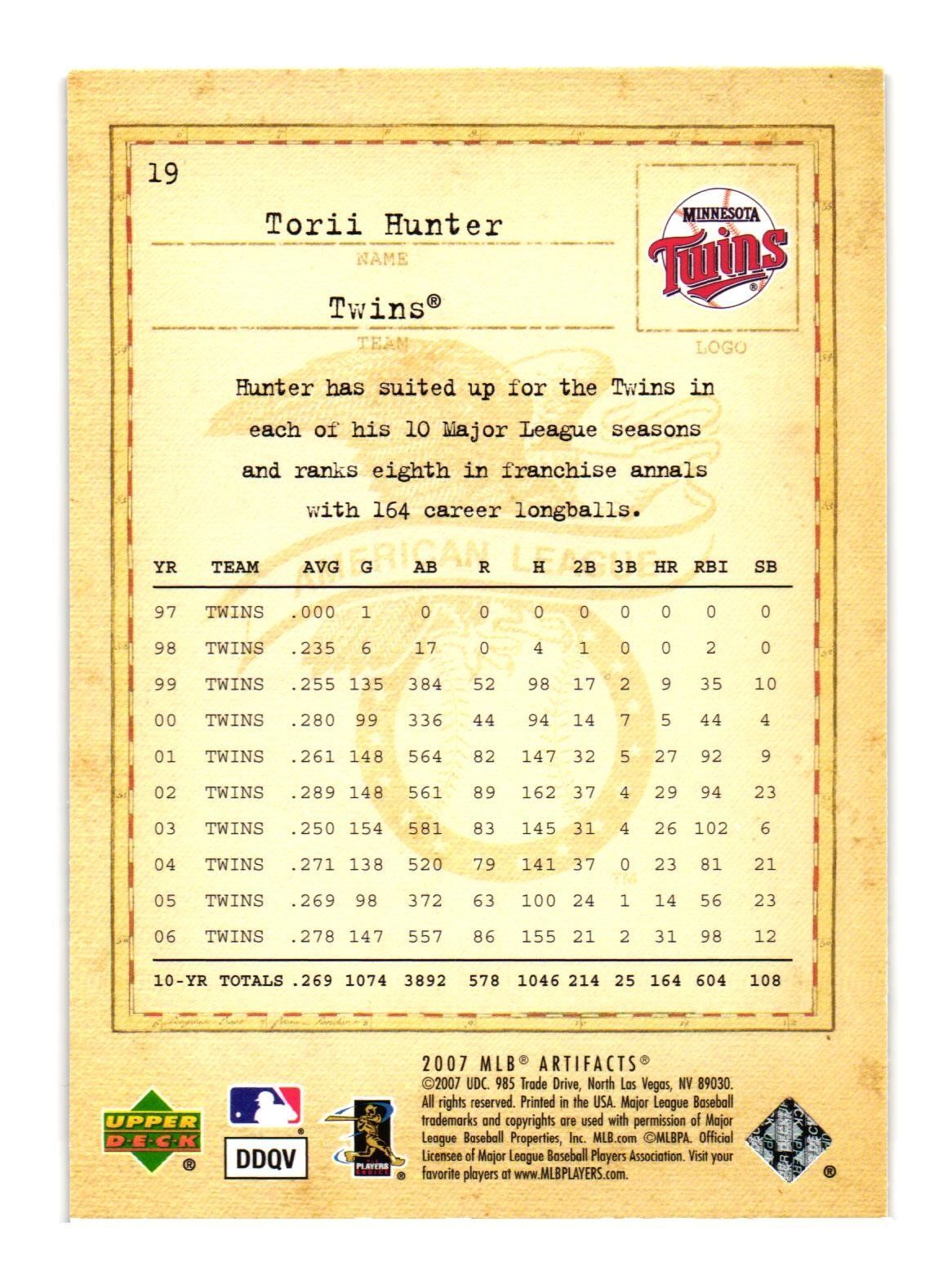
Torii Hunter was a productive, durable, and consistent offensive player over nearly two decades, yet his offensive value is often viewed differently through traditional and modern lenses. Traditional metrics highlight his five seasons with 30 or more home runs and his ability to drive in runs consistently in the middle of a lineup. His career batting average hovered around a respectable .277, and he collected 2,454 hits, showcasing remarkable longevity and durability.
Modern hitting metrics provide deeper context regarding his offensive output. Hunter was an aggressive hitter who rarely walked, which negatively affected his on-base percentage compared to contemporaries who mastered plate discipline. For instance, while Hunter hit for considerable power, his career on-base percentage sat at .331. In the modern analytical framework, on-base percentage is weighted more heavily than batting average because avoiding outs is vital to run creation.
| Metric Type | Statistic | Torii Hunter Career Value / Peak Range | Modern Analytical Interpretation |
|---|---|---|---|
| Traditional Offense | Batting Average (BA) | .277 Career / Peak .289 (2006) | Measures hit frequency per at-bat; treats all hits equally regardless of type. |
| Traditional Offense | Home Runs (HR) | 353 Career / Peak 38 (2006) | Quantifies raw power production and immediate run scoring. |
| Modern Offense | On-Base Percentage (OBP) | .331 Career / Peak .370 (2008) | Measures how often a player reaches base via hit, walk, or hit-by-pitch. |
| Modern Offense | wRC+ (Weighted Runs Created Plus) | ~104 Career Average | Measures overall offensive production adjusted for park factors and era; 100 is league average. |
When examining weighted runs created plus (wRC+), Hunter typically graded out as a slightly above-average hitter, usually hovering around 10% to 15% better than the league average offensively during his peak years. While his traditional numbers make him look like a perennial MVP candidate, modern metrics reveal a very good, durable hitter whose primary value was amplified significantly by his elite defensive reputation and durability.
Evaluating Defensive Excellence: Gold Gloves vs. Advanced Metrics
The defining hallmark of Torii Hunter’s career was his defense in center field, highlighted by his nine consecutive Gold Glove Awards. During the 2000s, Hunter was famous for robbing home runs at the outfield wall and covering vast expanses of grass with acrobatic diving catches. Voters rewarded this visible, highlight-reel defense consistently, cementing his reputation as one of the premier defensive center fielders of his generation.
In modern baseball analytics, evaluating defense requires separating reputation from spatial data. Advanced metrics like Defensive Runs Saved (DRS), which began tracking comprehensively in 2003, and Ultimate Zone Rating (UZR) attempt to calculate the exact number of runs a fielder saves or costs their team compared to an average defender at the same position.
| Evaluation Era | Primary Tool | What It Measures | Torii Hunter Assessment |
|---|---|---|---|
| Traditional Era | Fielding Percentage & Awards | Errors committed and subjective voting by managers and coaches. | Nine-time Gold Glove winner perceived as a flawless, elite center fielder. |
| Modern Era | Defensive Runs Saved (DRS) | Net runs saved through range, outfield arm, and play-making ability. | Highly rated during early peak seasons, but metrics show a natural decline as he aged. |
| Modern Era | Ultimate Zone Rating (UZR) | Spatial efficiency across specific outfield zones relative to league average. | Confirms exceptional range in his prime years with Minnesota Twins. |
During his peak years with the Minnesota Twins, metrics like UZR and DRS validate Hunter's defensive reputation, crediting him with significant positive defensive value due to his exceptional range and fearless play at the wall. However, as Hunter aged and transitioned to right field later in his career with the Los Angeles Angels and Detroit Tigers, modern metrics reveal a natural decline in range, even as his veteran instincts and positioning allowed him to remain a capable defender.
Wins Above Replacement (WAR) and Overall Career Value
Wins Above Replacement (WAR) serves as the ultimate summary statistic in modern baseball, attempting to encapsulate a player's total value to their team in one comprehensive number by combining offense, defense, baserunning, and positional adjustments. Examining Hunter’s career through WAR provides a balanced perspective on his overall impact and historical standing.
According to Baseball-Reference (bWAR), Hunter accumulated roughly 50.7 career WAR, while FanGraphs (fWAR) places his career mark closer to 43.8. The variance between the two systems stems primarily from how they calculate defensive contributions: Baseball-Reference utilizes Total Zone for earlier years (which heavily rewards his Gold Glove reputation and visible defensive prowess), while FanGraphs relies on UZR.
A career WAR in the 45-to-50 range places a player firmly in the category of a very good, borderline elite major leaguer who sustained a high level of play for well over a decade. To put this in perspective, a player averaging 4 WAR per season is considered an All-Star caliber contributor. Hunter achieved this by combining steady, durable offensive production with above-average defense and tremendous clubhouse leadership.
Common Misconceptions in Analyzing 2000s Outfielders
Analyzing players from the late 1990s and 2000s often exposes friction between traditional scouting reports and modern analytical frameworks. Understanding Torii Hunter's stats requires clearing up several common misconceptions regarding his playing style and statistical output.
- The Gold Glove Misconception: Many modern fans assume that historical Gold Glove winners were purely products of reputation voting. While defensive voting in the past occasionally favored players with high offensive profiles, Hunter’s early-career metrics strongly support his Gold Glove hardware, proving his range matched his highlight-reel reputation.
- Power vs. OBP Disconnect: Traditional analysts viewed Hunter as an elite offensive force because of his home run totals and RBIs. Modern analysts note that his low walk rate prevented him from reaching elite superstar offensive tiers, categorizing him instead as a high-floor, highly productive complementary offensive piece.
- The Aging Curve in the Outfield: When Hunter moved to right field in his later seasons, some observers assumed his defense remained elite because his error totals stayed low. Modern analytics correctly identified that declining range in the corners is masked by positioning, showing a necessary shift in how his defensive value should be measured late in his career.
Frequently Asked Questions
How many Gold Glove Awards did Torii Hunter win?
Torii Hunter won nine consecutive Gold Glove Awards in the American League as a center fielder from 2001 through 2009. This places him among the most decorated defensive outfielders in baseball history, matching the totals of legendary defenders like Willie Mays and Ken Griffey Jr.
What was Torii Hunter’s career Wins Above Replacement (WAR)?
Depending on the analytical platform, Torii Hunter’s career WAR ranges between 43.8 (FanGraphs) and 50.7 (Baseball-Reference). This differential reflects the distinct ways each system calculates defensive contributions and positional adjustments over a 19-year career.
Did modern analytics value Torii Hunter’s defense?
Yes, particularly during his peak years with the Minnesota Twins. Metrics like Ultimate Zone Rating and Defensive Runs Saved confirm that Hunter possessed exceptional range and defensive value, validating his traditional Gold Glove awards during the first half of his career.
Why do modern metrics view Hunter’s offense differently than traditional stats?
Traditional stats focus on counting stats like home runs, RBIs, and batting average, where Hunter excelled. Modern analytics emphasize on-base percentage and wRC+, noting that Hunter’s aggressive plate approach and low walk rate kept his overall offensive efficiency slightly below elite superstar levels.
How does Torii Hunter compare to other outfielders of his era?
Hunter compares favorably to contemporary outfielders of the 2000s in terms of durability and all-around play. While players like Ichiro Suzuki or Jim Edmonds excelled more drastically in specific single-discipline categories (batting average or OBP/defense respectively), Hunter provided a rare blend of power, Gold Glove defense, and durability.
Conclusion and Analytical Takeaway
Understanding Torii Hunter stats in modern baseball requires synthesizing traditional scouting wisdom with sabermetric context. Hunter was not an analytical darling who walked at a historic clip, nor was his defense entirely a myth propped up by flashy wall catches. Instead, he was a durable, highly athletic, and fiercely competitive player whose peak defensive range genuinely matched his reputation, and whose offensive power provided consistent value. By evaluating him through both lenses, modern fans can appreciate the rare combination of skill and longevity that defined his remarkable 19-year major league career.
Image Gallery