GE Centricity KP (Knowledge Portal): Enterprise Analytics, Integration, and System Guide
GE Centricity KP (Knowledge Portal) is an enterprise business intelligence and data analytics platform integrated into the GE Centricity suite—including Centricity Business and Centricity Practice Solution (CPS). It aggregates revenue...
GE Centricity KP (Knowledge Portal) is an enterprise business intelligence and data analytics platform integrated into the GE Centricity suite—including Centricity Business and Centricity Practice Solution (CPS). It aggregates revenue cycle, operational, and clinical data across healthcare delivery networks to optimize financial workflows, track key performance indicators, and support organizational decision-making.
Contents
Technical Overview: Understanding Centricity KP in Enterprise Healthcare
In enterprise healthcare IT, Centricity KP functions as the centralized reporting and data aggregation engine for healthcare systems, large medical groups, and integrated delivery networks. Designed to sit atop relational databases and transactional EHR/practice management (PM) repositories, Centricity KP transforms raw administrative and clinical transactions into structured analytics.
Healthcare organizations rely on Centricity KP to bridge the gap between transactional databases and executive reporting. By extracting data from modules such as Centricity Business (formerly IDX) and Centricity Practice Solution, the Knowledge Portal allows revenue cycle managers, compliance officers, and clinical leaders to build custom reports, track reimbursement velocity, and monitor throughput across ambulatory and inpatient settings.
Note: Depending on the enterprise environment, "KP" refers specifically to the Knowledge Portal reporting architecture within GE Centricity software ecosystems. In legacy or regional health network documentation (such as Kaiser Permanente environments), Centricity tools may interface alongside enterprise systems like Epic HealthConnect to handle specialized billing, scheduling, or clearinghouse feeds.
Core System Components
- OLAP Cube Infrastructure: Centricity KP utilizes Online Analytical Processing (OLAP) multidimensional data structures. This enables rapid querying of millions of historical claim lines, charge entries, and patient encounters without placing performance loads on primary OLTP transactional databases.
- Business Intelligence Reporting Interface: Provides custom query builders, interactive dashboards, and automated report scheduling for operational staff and financial analysts.
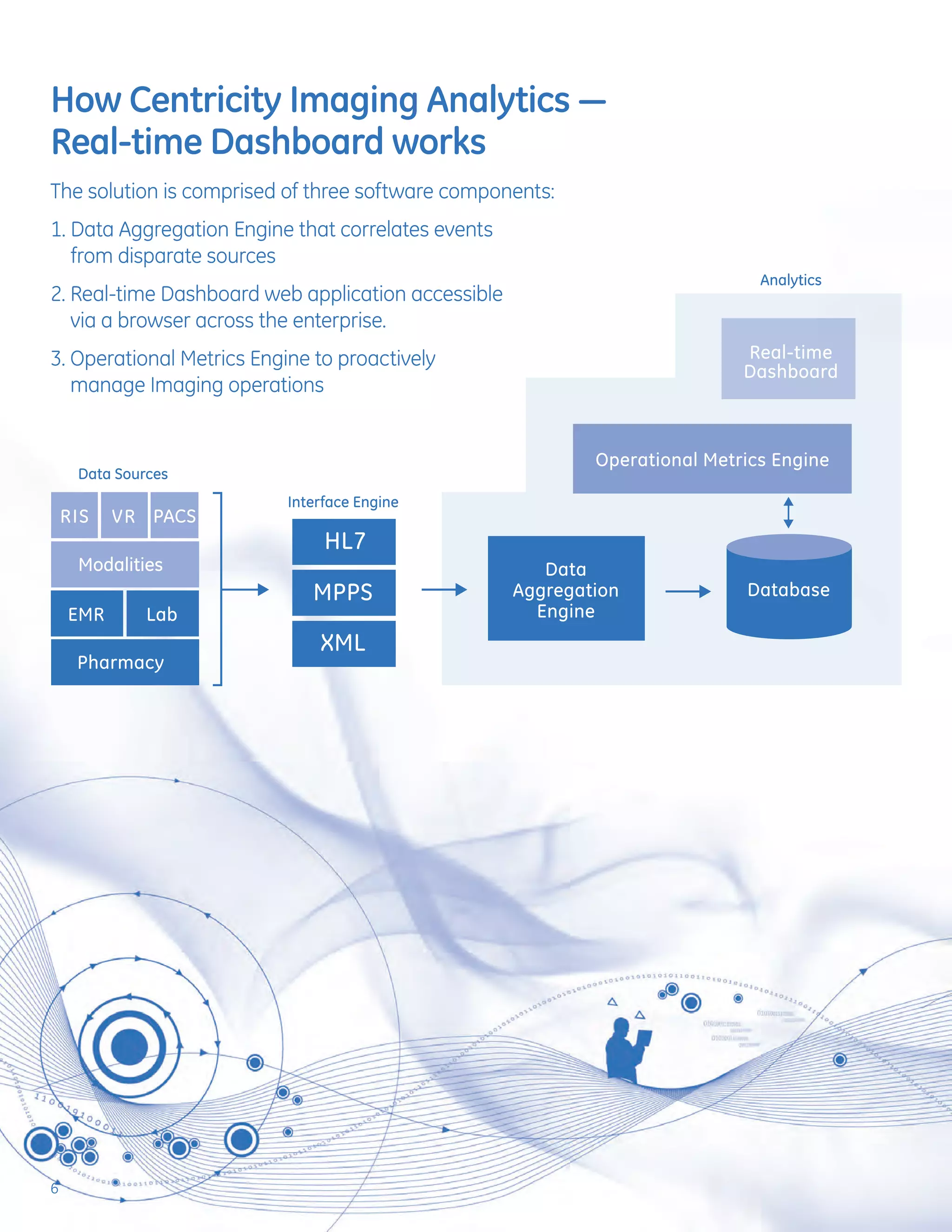
- ETL (Extract, Transform, Load) Pipeline Engine: Nightly and near-real-time data pipelines extract charge, payment, adjustment, and clinical coding data from transactional databases into the reporting data warehouse.
Operational Workflows and Analytics Capabilities
Centricity KP provides targeted analytical modules designed to solve specific operational bottlenecks in high-volume healthcare settings.
Important Operational Requirement: To maintain data integrity within Centricity KP dashboards, clinical and financial departments must strictly adhere to standardized transaction coding, accurate NPI mapping, and uniform scheduling status updates across all practice locations.
Revenue Cycle Management (RCM) & Financial Analytics
The primary driver for Centricity KP deployment is maximizing clean claim yield and shortening the revenue cycle. Key financial metrics monitored within the platform include:
- Days in Accounts Receivable (A/R): Tracking average days elapsed between service delivery and final payment receipt across payer classes (Medicare, Medicaid, Commercial, and Managed Care).
- First-Pass Denials Rate: Isolating specific clearinghouse and payer rejection codes (such as ANSI 837 edit failures) prior to final claim adjudication.
- Net Collection Ratio: Calculating total realized reimbursement against allowed amounts to highlight fee schedule leakage and unexpected contractual write-offs.
- Unbilled A/R & Claim Scrub Status: Identifying held claims resulting from missing provider documentation, unmapped ICD-10 codes, or incomplete subscriber demographic information.
Provider Productivity and Clinical Throughput
Beyond financial metrics, Centricity KP provides clinical operations leaders with detailed visibility into clinical utilization and provider efficiency:
- Relative Value Unit (RVU) Tracking: Monitoring Work RVUs (wRVUs), Malpractice RVUs, and Practice Expense RVUs by provider, specialty, and clinic site to evaluate physician productivity against contractual benchmarks.
- Patient Access & Schedule Utilization: Analyzing no-show rates, bump rates, lead times for appointment availability, and exam room turnaround times.
- Quality & Regulatory Compliance: Aggregating data elements required for CMS Merit-based Incentive Payment System (MIPS) performance categories, promoting compliance with quality measures, promoting interoperability, and improvement activities.
System Architecture, Interoperability, and Security Standards
Centricity KP operates within complex, multi-tiered enterprise IT environments. Maintaining high throughput and strict compliance requires robust data integration protocols and security controls.
Compliance Standard: Under the HIPAA Security Rule (45 CFR Part 164), access to Centricity KP reporting must be restricted using Role-Based Access Controls (RBAC) to ensure staff members only view the Minimum Necessary Protected Health Information (PHI) required for their specific administrative roles.
Data Integration Standards
Centricity KP interfaces with enterprise clearinghouses, electronic health record platforms, and third-party analytics engines using standardized healthcare messaging formats:
- HL7 v2.x & HL7 v3: Standard interfaces for Demographic (ADT), Scheduling (SIU), and Financial Transaction (DFT) messages between Centricity and core hospital systems.
- ANSI X12 Financial Standards: Ingestion and validation of 837I/837P (Claim Submissions), 835 (Electronic Remittance Advice / ERA), 270/271 (Eligibility Verification), and 276/277 (Claim Status Enquiry/Response).
- HL7 FHIR (Fast Healthcare Interoperability Resources): Modern API frameworks enabling RESTful data access for third-party reporting extensions and cloud-based analytics platforms.
Data Architecture and Database Architecture
The data pipeline driving Centricity KP leverages an enterprise Microsoft SQL Server or Oracle Database backend optimized for business intelligence workloads.
Data Pipeline Workflow: Source Transactional DB (CPS/Centricity Business) -> Staging DB via Nightly ETL -> Data Warehouse / OLAP Cubes -> Centricity KP Analytics Layer -> Executive Dashboards & Automated Export Schedules
- Transactional Extraction: Raw relational data (tables housing patient records, charge ledgers, claims queues) are queried during off-peak hours to minimize database contention.
- Data Cleansing and Transformation: Codes are normalized (e.g., mapping localized clinic appointment types to standard enterprise visit categories).
- Cube Generation: Data is aggregated across multiple dimensions (Time, Facility, Provider, Payer, Service Code) for rapid retrieval by user interface queries.
Enterprise Platform Comparison
Evaluating Centricity KP against comparable healthcare business intelligence and analytics modules highlights key performance differences, database structures, and ideal deployment scenarios across modern health IT landscapes.
| Platform / Metric | GE Centricity KP (Knowledge Portal) | Epic Cogito / SlicerDicer | Athenahealth Insights / Analytics | Oracle Health (Cerner) Lights-On Network |
|---|---|---|---|---|
| Primary Architecture | On-Premise / Hosted OLAP Cube & Data Warehouse | Hybrid Cloud / Enterprise Operational Data Store (Clarity/Caboodle) | Cloud-Native SaaS Multitenant Architecture | Cloud-Based Operational & Clinical Intelligence |
| Target User Group | Enterprise Health Systems, RCM Teams, Large Ambulatory Groups | Integrated Delivery Networks (IDNs), Enterprise Health Systems | Small to Enterprise Medical Practices & RCM Organizations | Health Systems, Integrated Delivery Networks, Academic Centers |
| Financial Analytics Focus | Advanced (Strong ANSI 837/835, AR aging, custom financial rules) | High (Integrated hospital & professional billing analytics) | High (Automated rule scrubbing, network-wide benchmark comparisons) | Moderate to High (Operational & clinical cost distribution analytics) |
| EHR Native Integration | Centricity Business, Practice Solution (CPS) | EpicCare Inpatient/Ambulatory, Resolute Billing | AthenaOne PM/EHR | Oracle Health Millennium, Soarian |
| Data Customization Flexibility | High (Deep SQL access, customizable multidimensional queries) | High (Extensive custom reporting via Caboodle & SQL) | Moderate (Pre-built reports with standard parameter tuning) | Moderate to High (Standardized domain templates with custom extensions) |
| Deployment Model | Client-Server / Hosted Data Warehouse | On-Premise / Enterprise Private Cloud | 100% Cloud SaaS | Cloud-Hosted Enterprise SaaS |
Configuration, Data Management, and Troubleshooting Guide
Optimizing Centricity KP requires active system administration, precise ETL monitoring, and regular maintenance of custom reporting views.
Step-by-Step Reporting Pipeline Configuration
- Define Business Metrics & Data Sources: Identify the target KPIs (e.g., net AR over 90 days by provider group) and map the required source tables within the Centricity database schema.
- Configure ETL Staging Schedule: Schedule automated batch extraction jobs within SQL Server Integration Services (SSIS) or Centricity's proprietary job scheduler to run during low-traffic maintenance windows (typically between 01:00 and 04:00 local time).
- Build OLAP Dimensions: Create dimensional models mapping facts (charges, payments, adjustments) to dimensions (Date, Service Facility, Financial Class, Provider NPI).
- Establish Security Roles: Map user Active Directory (AD) groups to Centricity KP security profiles, restricting PHI visibility based on regional authority and facility assignment.
- Validate Data Reconciliation: Compare financial summary totals from the Knowledge Portal against source ledger balances in Centricity Business/CPS to ensure 100% data parity.
Common Operational Issues and Remedies
| Operational Symptom | Root Cause | Technical Resolution / Remedy |
|---|---|---|
| Reports show $0 balance or missing transactions after nightly run. | ETL batch job failure or database lock contention during extraction. | Check SSIS execution logs; verify database locks; re-run delta extraction scripts manually for the affected date range. |
| Dashboard load times exceed 60 seconds for multi-year queries. | Unindexed dimension tables or fragmented OLAP cubes. | Rebuild and reorganize database indexes; run cube processing jobs (ProcessFull or ProcessAdd); implement query date parameter constraints. |
| Discrepancy between Centricity KP financial metrics and bank deposits. | Unposted payment batches or unassigned ERA (835) clearinghouse files. | Reconcile unapplied cash accounts in Centricity Business; verify clearinghouse ANSI 835 ingestion logs before pulling KP reports. |
| User receives "Access Denied / Insufficient Privilege" on KP reports. | Mismatched Active Directory (AD) group mapping or expired role permissions. | Verify LDAP sync; update user role assignments in the Centricity Security Admin console; ensure minimum-necessary PHI policy compliance. |
System Evolution: Migration, Interoperability, and Future Trends
As health systems modernize their IT infrastructure, legacy reporting platforms like Centricity KP face evolving requirements around cloud migration, API interoperability, and real-time streaming analytics.
Data Warehousing and Cloud Modernization
Many organizations operating GE Centricity ecosystems are transitioning legacy on-premise data warehouses to cloud-based enterprise platforms such as Snowflake, Microsoft Azure Synapse, or Amazon Redshift. In these modern architectures, Centricity KP historical data is extracted and consolidated into centralized enterprise data lakes alongside clinical data from inpatient EHR systems.
Enhancing Interoperability with HL7 FHIR
Modern healthcare analytics requires real-time access to patient data across disparate clinical systems. Integrating FHIR APIs alongside traditional Centricity KP reporting pipelines allows health systems to stream real-time events—such as patient check-ins or emergency department admissions—directly into operational dashboards, bypassing traditional nightly ETL delays.
Long-Term Archiving and Compliance Retention
When health systems transition from Centricity to alternative EHR/PM platforms, regulatory compliance requires historical financial and clinical reporting data to be retained for 7 to 10 years (or longer for pediatric accounts). Organizations must establish read-only instances of Centricity KP or extract complete historical data stores into HIPAA-compliant cloud archives to satisfy audit and legal requirements.
Frequently Asked Questions
What does "KP" stand for in GE Centricity KP?
In the context of GE Centricity healthcare software systems, "KP" stands for Knowledge Portal. It is the specialized reporting, business intelligence, and analytics module designed to extract, aggregate, and present financial and operational metrics from Centricity Practice Solution and Centricity Business databases.
How does Centricity KP integrate with external EHR systems like Epic or Cerner?
Centricity KP integrates with external EHR systems using standard healthcare data exchange protocols including HL7 v2 messaging (ADT, DFT), ANSI X12 EDI transactions (837, 835), and modern HL7 FHIR APIs. This allows financial and billing data from Centricity to merge with clinical data from third-party EHR systems for unified enterprise reporting.
Why do financial figures in Centricity KP sometimes differ from live practice management reports?
Discrepancies usually occur because Centricity KP relies on scheduled ETL (Extract, Transform, Load) data refreshes—often run nightly—rather than live, real-time database queries. Transactions posted in the practice management system after the latest ETL run will not appear in Knowledge Portal reports until the next processing cycle completes.
Can Centricity KP reports be customized for specific provider metrics?
Yes, administrative and financial users can build custom reports and dashboards within Centricity KP. The system supports custom filtering by Provider NPI, specialty, location, financial class, date ranges, and custom transaction codes, allowing organizations to track specific operational and clinical performance indicators.
How does Centricity KP support MIPS and regulatory quality reporting?
Centricity KP aggregates required clinical and administrative data points across patient encounters, including quality measures, promoting interoperability metrics, and improvement activities. This aggregated data can be reviewed, validated, and exported to satisfy reporting requirements for CMS programs like MIPS and MACRA.
Strategic Recommendations for Health IT Leaders
To maximize the ROI of GE Centricity KP within enterprise health IT workflows, systems administrators and revenue cycle directors should implement the following strategic practices:
- Automate Data Reconciliation: Establish automated daily cross-checks between transactional ledgers in Centricity Business/CPS and Centricity KP summary reports to detect ETL drop-offs immediately.
- Enforce Strict Role-Based Security: Conduct quarterly audits of access permissions within the Knowledge Portal to ensure compliance with HIPAA minimum-necessary access mandates and internal governance policies.
- Optimize Indexing and Cube Processing: Schedule regular database index maintenance and OLAP cube rebuilds during off-peak hours to prevent performance degradation as historical reporting volumes grow.
- Prepare an Archival and Migration Strategy: If planning an enterprise EHR/PM transition, establish a clear data retention plan for Centricity KP historical data to maintain compliance with federal and state medical record retention laws.
Image Gallery