How to Read a Yamaha Grand Piano Serial Number: Location, Age & Origin Guide
To read a Yamaha grand piano serial number, locate the 7-digit number stamped into the cast-iron plate on the treble side near the tuning pins, look for any preceding letter prefix, and cross-reference the number with Yamaha’s official...
To read a Yamaha grand piano serial number, locate the 7-digit number stamped into the cast-iron plate on the treble side near the tuning pins, look for any preceding letter prefix, and cross-reference the number with Yamaha’s official chronological production records to identify the piano's precise age, manufacturing facility, and intended export market.
Contents
Determining the exact age, origin, and market specification of a Yamaha grand piano requires more than simply finding a stamped set of numbers. Yamaha has manufactured millions of acoustic pianos across multiple decades and facilities worldwide. While the brand’s numbering system is exceptionally well-documented, interpreting it correctly involves understanding letter prefixes, factory location codes, climate-seasoning designations, and numerical progression sequences.
Whether you are evaluating a pre-owned grand piano for purchase, assessing an instrument for appraisal, or verifying the provenance of an instrument you already own, this guide provides the technical steps and historical context necessary to decode any Yamaha grand piano serial number.
1. Where to Find the Serial Number on a Yamaha Grand Piano
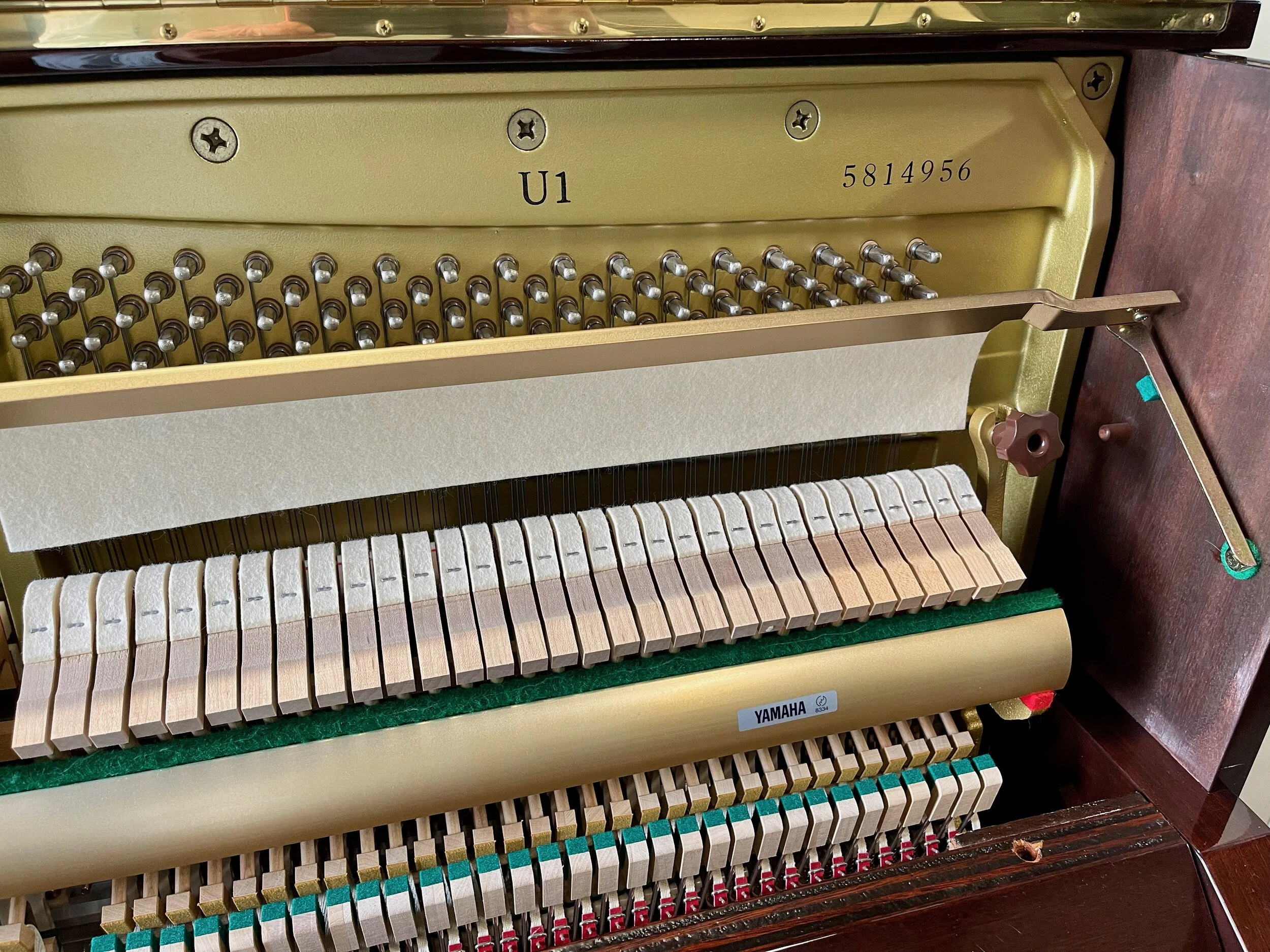
Unlike Yamaha upright pianos, which typically display their serial numbers inside the top cabinet on the wooden frame or gold iron plate, grand pianos present serial numbers in distinct, standardized locations on the instrument's interior casting.
- YAMAHA GRAND PIANO
- MUSIC DESK
- Cast-Iron Plate (Near Tuning Pins / Treble Side)
- [Model Name: e.g., C3]
- [Serial Number: e.g., 5432109] (Stamped on Cast-Iron Plate)
To locate the serial number on a Yamaha grand piano, follow these steps:
- Open the Lid: Safely raise the main prop stick to lock the grand piano lid open.
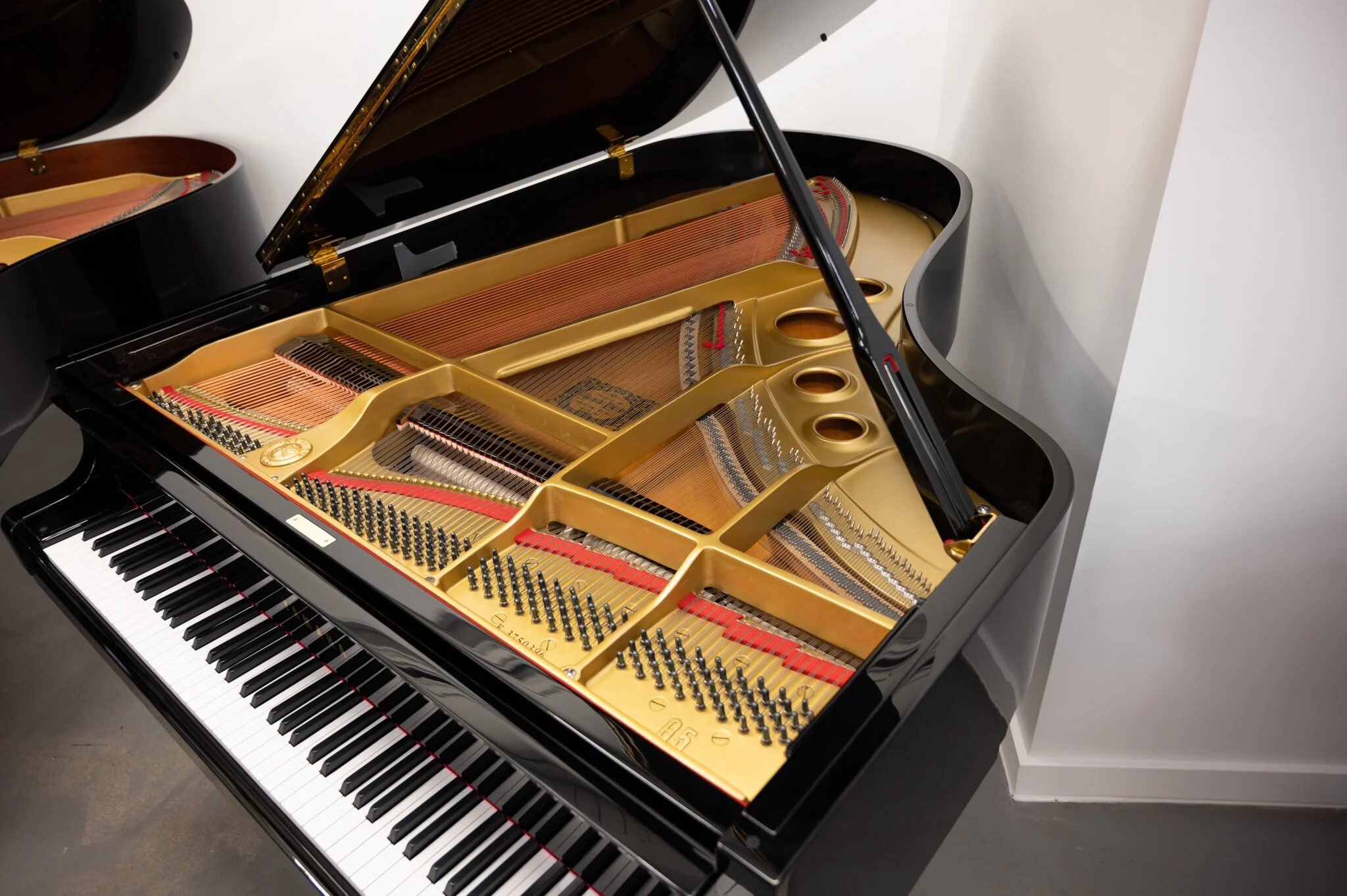
- Remove or Slide Back the Music Desk: Slide the wooden music rack (desk) forward toward you or lift it off its wooden guide tracks entirely to expose the interior cast-iron plate (harp) and pinblock.
- Inspect the Treble Side of the Iron Plate: Look at the gold-painted cast-iron frame on the right-hand side (treble area), directly behind the tuning pins and soundboard rim.
- Locate the Stamped Markings: You will see two primary painted or stamped markings in this area:
- Model Name: Stamped into the iron plate (e.g., G2, G3, C3, C7, CX series, or GB1K).
- Serial Number: A 7-digit numerical string (sometimes preceded by a single letter prefix) located immediately below or to the right of the model name.
Secondary Serial Number Locations
If the serial number on the iron frame is obscured by dust, heavy restoration, or refinishing work, piano technicians rely on secondary locations stamped during the original assembly:
- The Soundboard Rim: Stamped on the wooden inner rim near the tail or treble curve of the piano.
- The Keyframe / Action Assembly: Stamped on the underside or rear wood railing of the keybed assembly (accessible only by a qualified technician removing the key action).
- The Wooden Stretcher Bar: Stamped into the underside structural wooden beam running horizontally across the front of the case under the key cover (fallboard).
2. Deciphering Yamaha Serial Number Formats and Prefixes
A standard Yamaha grand piano serial number consists of a letter prefix (optional, depending on the facility) followed by a numerical sequence of 6 to 7 digits.
The structure of the serial number reveals three key pieces of information:
- The Production Facility: Where the piano was built.
- The Numerical Progression: The chronological order of manufacture.
- The Target Market / Climate Seasoning: Whether the instrument was built for export or domestic Japanese distribution.
Understanding Plant Codes and Prefixes
Yamaha operates primary manufacturing plants in Japan, as well as secondary facilities globally. The letter preceding the digits identifies either the specific plant or a major redesign iteration:
- No Prefix (Digits Only): Indicates the piano was manufactured at Yamaha's flagship factory in Hamamatsu, Japan. The vast majority of professional grand pianos (such as the historic G-series, classic C-series, and premium CX/SX/CF series) feature numbers without a letter prefix, following a single continuous sequence.
- T Prefix: Manufactured at the former Yamaha facility in Thomaston, Georgia, USA. (Primarily utilized for North American market vertical pianos and select grand assembly lines operating prior to the plant's closure in 2007).
- H Prefix: Manufactured at Yamaha’s joint-venture plant in Hangzhou, China.
- J Prefix: Manufactured at the PT Yamaha Indonesia plant in Jakarta, Indonesia (common on entry-level models like the GB1K).
- K Prefix: Manufactured at the Kakegawa, Japan facility (primarily modern upright lines and specific grand component streams).
- A, E, or D Prefixes: Used on specific regional sub-assemblies or specific production runs destined for North American or European markets.
Note: A letter printed in front of the model name (e.g., "C3 A" or "G2F") is a model revision code, not a serial prefix. Revision codes indicate engineering design updates (such as revised scale designs, bridge placements, or action geometry) rather than manufacturing years.
3. Yamaha Grand Piano Serial Number vs. Year Chart (Hamamatsu, Japan)
The following reference table maps Japanese-built Yamaha grand piano serial numbers (the standard continuous series produced in Hamamatsu) to their corresponding manufacturing years.
If your serial number has no letter prefix, use this table directly to determine the year of manufacture.
| Serial Number Range | Year of Manufacture | Primary Grand Models Produced |
|---|---|---|
| 100,000 – 160,000 | 1960 – 1961 | Early G-Series (G1, G2, G3) |
| 200,000 – 380,000 | 1962 – 1964 | G-Series Expansion |
| 400,000 – 890,000 | 1965 – 1969 | G1, G2, G3, G5, early Concert Grands |
| 1,000,000 – 1,900,000 | 1970 – 1974 | G-Series revisions, early C-Series introductions |
| 2,000,000 – 2,900,000 | 1975 – 1979 | G1, G2, G3, C3, C7 |
| 3,000,000 – 3,900,000 | 1980 – 1984 | C2, C3, C5, C7, G2, G3 |
| 4,000,000 – 4,950,000 | 1985 – 1990 | Modernized C-Series scale designs |
| 5,000,000 – 5,490,000 | 1991 – 1995 | C1, C2, C3, C5, C6, C7 |
| 5,500,000 – 5,990,000 | 1996 – 2001 | Conservatory C-Series (C3L, C5L) |
| 6,000,000 – 6,290,000 | 2002 – 2009 | Late C-Series, S-Series Handcrafted |
| 6,300,000 – 6,390,000 | 2010 – 2014 | Introduction of CX-Series (C1X, C3X, C7X) |
| 6,400,000 – 6,490,000 | 2015 – 2019 | CX-Series, SX-Series, CF4, CF6, CFX |
| 6,500,000 – 6,550,000+ | 2020 – 2026 | Current Production CX/SX/CF Series |
For exact, single-year lookup, cross-examine the serial digits with Yamaha Corporation's Official Piano Serial Number Lookup.
4. Identifying "Grey Market" Pianos and Destination Seasoning
When reading a Yamaha grand piano serial number, one of the most vital technical factors to evaluate—especially in North America and Europe—is whether the instrument was built for export or intended purely for the Japanese domestic market.
In the piano industry, second-hand instruments manufactured for the Japanese home market and later exported overseas by independent brokers are known as "grey market" pianos.
- YAMAHA MANUFACTURING PLANT (Hamamatsu, Japan)
- DOMESTIC JAPAN SPECIFICATION
- Wood Kiln-Dried to 12-14%
- Sold originally in Japan; later exported as secondhand ("Grey Market").
- NORTH AMERICAN/EXPORT
- Wood Kiln-Dried to 6-8%
- Distributed by Yamaha Corp. of America directly to US authorized dealerships.
- DOMESTIC JAPAN SPECIFICATION
Wood Seasoning: Dry Climates vs. Humid Climates
Yamaha seasons (kiln-dries) the wooden soundboards, rims, pinblocks, and action components of its pianos to specific moisture contents depending on the final destination climate:
- North American Market: Wood is dried to a target equilibrium moisture content (EMC) of roughly 6% to 8% to withstand low ambient humidity caused by modern indoor heating and dry seasonal variations.
- Japanese Domestic Market: Wood is dried to an EMC of 12% to 14% to accommodate the naturally higher relative humidity of the Japanese archipelago.
If a Japanese-seasoned piano is imported to a dry climate (such as the American Midwest, Mountain West, or inland Europe), the drier wood gives off moisture over time. This drying process can cause structural instability, leading to loose tuning pins, soundboard cracks, glue joint separations, and chronic tuning instability.
How to Check Destination Status via Serial Number
Yamaha Corporation of America maintains a dedicated public database to verify destination status.
- Obtain the full serial number from the iron plate.
- Input the number into Yamaha's North American serial number verification tool or contact Yamaha Customer Support directly.
- If the database returns "Made for the US Market," the piano was officially imported and seasoned for dry indoor climates.
- If the serial number is not found in the North American database, but matches the Japanese production year table, the instrument is a domestic Japanese build (grey market import).
5. Step-by-Step Walkthrough: Reading a Sample Serial Number
To demonstrate how to put this technical process into practice, let's analyze a real-world example step by step.
Example Case: Analyzing Serial Number "J 3456789" on a Model GB1K
Step 1: Identify the Location and Markings
- Removing the music rack reveals the gold iron plate.
- Model cast:
GB1K - Stamped string:
J 3456789
Step 2: Parse the Letter Prefix
- The prefix is
J. - This indicates the instrument was built at Yamaha’s manufacturing facility in Jakarta, Indonesia, not in Hamamatsu, Japan.
- The prefix is
Step 3: Reference the Specific Plant Sequence
- Because it has a
Jprefix, you must not use the standard Japanese serial chart (which applies only to prefix-free numbers). - Indonesian production runs on a separate numerical sequence established when the plant opened. Cross-referencing Indonesian production logs shows this 3-million-range number corresponds to recent production.
- Because it has a
Step 4: Verify Technical and Structural Integrity
- Confirm that the model design (
GB1K) matches the factory origin. The GB1K is Yamaha's entry-level 5'0" grand piano specifically produced in the Jakarta plant for global distribution under unified climate standards.
- Confirm that the model design (
6. Common Pitfalls When Reading Yamaha Serial Numbers
Misinterpreting serial numbers can lead to incorrect valuations, fraudulent purchases, or buying an instrument unsuited to your climate. Avoid these common mistakes:
1. Confusing Revision Letters with Serial Prefixes
Yamaha frequently updates its piano models with revision letters. For example, a cast mark reading G2 F followed by the serial number 4567890 means the model is a G2 revision F, and the serial number is 4567890 (Japan production, built around 1988). The "F" is not part of the serial number.
2. Assuming All Yamaha Serial Numbers Follow One Master Sequence
Onlyprefix-free pianos built in Hamamatsu follow the main 7-digit continuous master chart. Pianos built in Indonesia (J), China (H), or the USA (T) operate on completely separate, independent numerical ranges. Applying the main Japanese chart to a non-Japanese serial number will yield an incorrect manufacture date (often off by 20 to 30 years).
3. Misreading Refinished or Re-stamped Plates
During major piano rebuilds, the iron plate is often stripped and repainted with gold bronze powder. Unscrupulous sellers or inexperienced refinishers may fail to re-stamp the serial number or may accidentally paint over it. Always cross-check the iron plate stamp against the wooden soundboard rim or keyframe stamps to ensure all numbers match.
Frequently Asked Questions
Where is the serial number located on a Yamaha C3 or G3 grand piano?
On both the Yamaha C3 and G3 grand pianos, the serial number is stamped in black ink directly onto the gold-painted cast-iron plate on the treble side of the instrument. It is located near the tuning pins, directly behind the soundboard rim and under the removable music desk.
What does a letter prefix before a Yamaha serial number mean?
A letter prefix identifies the manufacturing plant or market region. For instance, J indicates production in Jakarta, Indonesia; H indicates Hangzhou, China; T indicates Thomaston, Georgia (USA); and K indicates Kakegawa, Japan. Pianos with no letter prefix were manufactured at Yamaha's central facility in Hamamatsu, Japan.
How do I know if my Yamaha grand piano is a "grey market" instrument?
Check your serial number against Yamaha Corporation of America’s online lookup tool. If the serial number is not listed in their official distribution database, the piano was originally sold in the Japanese domestic market and later imported second-hand. These instruments were seasoned for higher humidity levels than those typical of North American homes.
Can I determine the market value of my Yamaha grand piano using only the serial number?
The serial number provides the exact age, model class, and manufacturing origin, which are crucial baseline inputs for an appraisal. However, overall market value also depends heavily on the physical condition of the action, soundboard integrity, pinblock torque, cabinet condition, and maintenance history.
Why does my Yamaha grand piano have two different numbers on the iron plate?
One number represents the Model Name (e.g., G2, C3, CX3), while the other is the unique Serial Number (e.g., 5234567). Model names are often accompanied by design revision letters (such as C3A, C3E, or C3L), which indicate minor engineering revisions rather than individual unit serial numbers.
Practical Next Steps for Buyers and Owners
Now that you know how to locate and decode a Yamaha grand piano serial number, take these actionable steps before completing a purchase or insurance valuation:
- Document the Number: Take a high-resolution photograph of the serial number and model stamp on the cast-iron plate, as well as any secondary stamps on the wooden rim or keybed.
- Verify Destination & Age: Run the serial number through Yamaha's Official Serial Number Verification Tool to confirm its destination market and official build date.
- Hire an Independent Piano Technician: Once you have established the piano's age and market origin, hire a Registered Piano Technician (RPT) via the Piano Technicians Guild to perform an on-site structural inspection. A professional inspection ensures that the soundboard, pinblock, bridge, and action components remain in sound operating condition regardless of the instrument's age.
Image Gallery