How to Find the Best Deal for a New York Times Subscription in 2026
To find the best New York Times subscription deal in 2026, prioritize the "All Access" introductory offer, which typically costs $1 per week for the first year. Alternatively, utilize student discounts, educator rates, or free institut...
To find the best New York Times subscription deal in 2026, prioritize the "All Access" introductory offer, which typically costs $1 per week for the first year. Alternatively, utilize student discounts, educator rates, or free institutional access through local libraries and university portals to bypass standard monthly fees entirely.
Contents
The New York Times (NYT) remains a cornerstone of global journalism, but its pricing structure has become increasingly complex as it transitions into a multi-product "lifestyle bundle." In 2026, the company continues to leverage a high-volume, low-introductory-price model to attract new readers. Navigating these offers requires understanding the distinction between standalone news access and the comprehensive All Access bundle, as well as knowing when and how to negotiate your renewal rate.
Understanding New York Times Subscription Tiers in 2026
Before hunting for a deal, you must identify which "version" of the Times fits your needs. The publication has moved away from selling individual components in favor of a unified ecosystem, though specific niche apps remain available.
Digital News vs. All Access Bundle
The Digital News tier provides unlimited access to the core reporting at nytimes.com and the NYT app. However, in 2026, most promotional energy is directed toward the All Access bundle. This package includes:
- The Athletic: Comprehensive sports coverage and investigative reporting.
- NYT Cooking: Thousands of recipes and instructional videos.
- NYT Games: Access to the Crossword, Wordle, Connections, and Spelling Bee.
- Wirecutter: Independent product reviews and shopping advice.
Choosing the All Access bundle is often the better "deal" even if you only use one additional service, as the promotional pricing for the bundle is frequently identical to the price of the standalone news subscription.
Specialized Subscriptions
For users who only want recipe access or crosswords without the news, standalone subscriptions for NYT Cooking or NYT Games are still offered. These generally range from $5 to $7 per month. However, these rarely feature the aggressive $1-a-week discounts found in the broader news bundles, making them a less efficient purchase for those seeking the absolute lowest price per service.
Current Pricing and Standard Introductory Offers
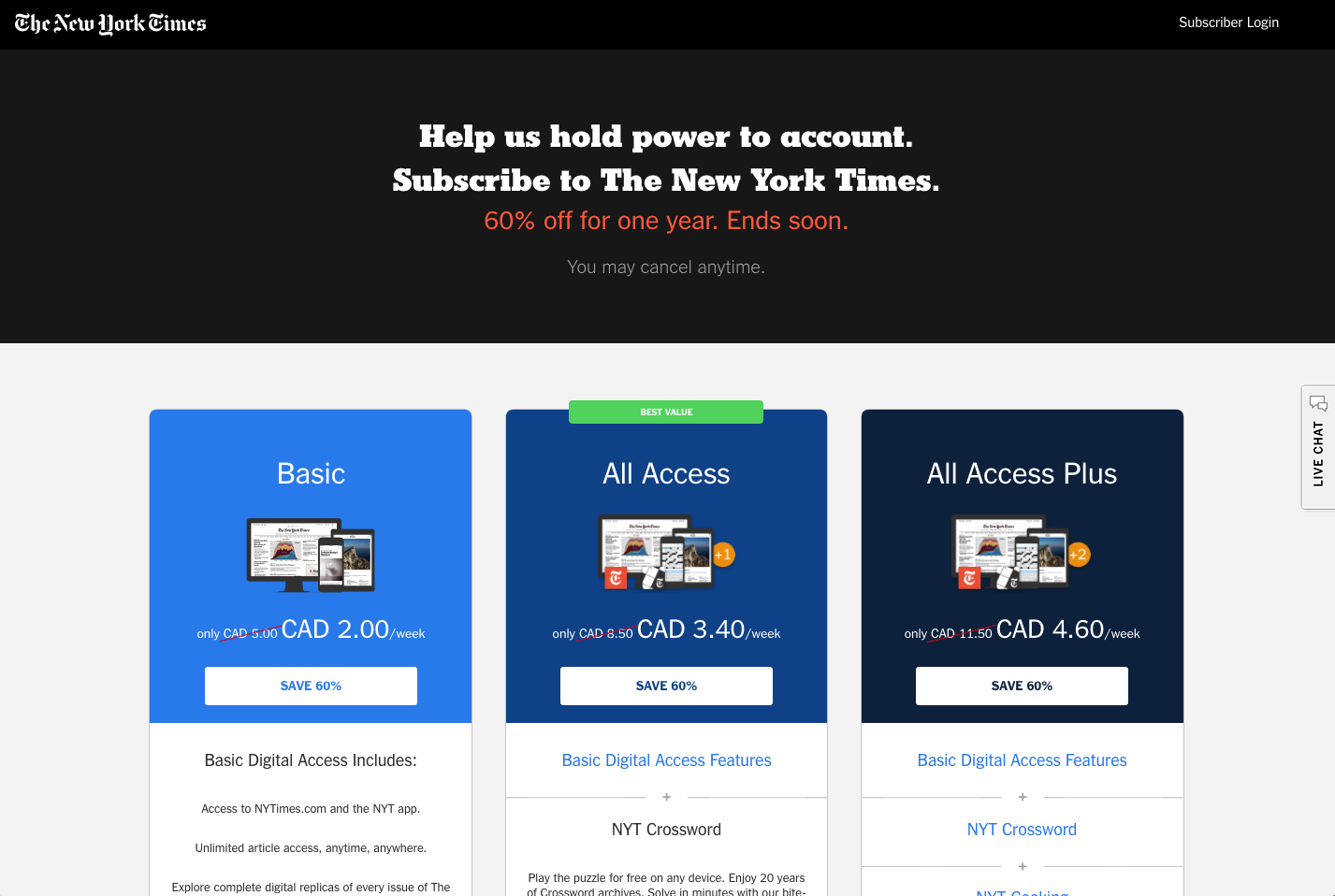
The most common deal you will encounter in 2026 is the "Introductory Digital Offer." Historically, this has hovered around $4 every four weeks (approximately $1 per week) for a duration of one year.
After the initial 52-week period, the price typically jumps to the "standard" rate, which can range from $15 to $25 every four weeks depending on the tier. The key to maintaining a "best deal" status is intervention before this price hike occurs. The New York Times uses an automated billing system, so marking the expiration date of your promotional period is the most critical step in financial management for readers.
| Subscription Tier | Promotional Price (Year 1) | Standard Rate (Post-Promo) | Key Features |
|---|---|---|---|
| News Only | ~$1.00/week | ~$15.00 - $18.00/4 weeks | Unlimited articles, News app |
| All Access Bundle | ~$1.00 - $1.50/week | ~$25.00/4 weeks | News, Games, Cooking, Wirecutter, The Athletic |
| Student | ~$2.00/month | ~$4.00/month | All Access features at a fixed low rate |
| Home Delivery | Varies by Zip Code | ~$10.00 - $18.00/week | Print delivery + All Access Digital |
Proven Strategies to Secure the Lowest Rate
Securing a deal is not just about finding the right URL; it is about timing and interaction with the subscription management platform.
The "Cancellation Discount" Strategy
One of the most effective ways to get a deal in 2026—even if you are an existing subscriber—is the cancellation workflow. When a subscriber begins the online cancellation process, the NYT system is programmed to offer a "retention rate."
Often, this mirrors the current introductory offer for new subscribers. If you find your bill has increased to $25 per month, navigating to the "Cancel Subscription" page will frequently trigger a pop-up offering a 50% to 75% discount for another 12 months. This automated retention logic is designed to prevent "churn," and savvy users leverage it annually to keep their costs low.
Seasonal Sales and Holiday Events
While $1 per week is the baseline for a good deal, the NYT occasionally runs deeper promotions during major holidays. In 2026, keep an eye out for:
- New Year’s Resolutions: Often features extended 18-month introductory periods for NYT Cooking and All Access.
- Back-to-School (August/September): The primary window for student and educator promotions.
- Black Friday/Cyber Monday: Sometimes offers the All Access bundle for as low as $0.50 per week for the first year.
Student, Educator, and Institutional Discounts
For those in academia, the New York Times offers some of the most aggressive pricing in the media industry.
Academic Verification via SheerID
Students and faculty members at accredited K-12 or higher-education institutions can access the NYT for a fraction of the standard cost. In 2026, the standard student rate remains approximately $2 per month. To qualify, you must verify your status through a third-party service like SheerID, which typically requires a valid .edu email address or current enrollment documentation.
The "Sponsor a Student" and School-Wide Access
Many universities pay for "Site Licenses." Before paying for a subscription, check your university library's website. Many institutions provide a "claiming" link where students and staff can register their personal email addresses for a free All Access account funded by the school.
Free Access Methods (Libraries and Referrals)
You do not always have to pay for a subscription to read the New York Times legally.
Public Library Digital Passes
Most major metropolitan library systems (such as the New York Public Library, LA County Library, or Chicago Public Library) offer free digital access to their patrons.
- Log in to your library's digital resource portal.
- Locate the "New York Times" link.
- Clicking the link usually generates a 72-hour pass.
- Once the pass expires, you can simply click the link again to renew it. While this requires a small manual step every few days, it provides full, legal access to the news and often the Games and Cooking sections at zero cost.
Group and Corporate Subscriptions
In 2026, many corporate benefit packages include digital subscriptions as a "wellness" or "professional development" perk. Check your employee handbook or HR portal for "Company-Paid Subscriptions." Corporations often purchase these in bulk, and you may simply need to register with your work email to activate your account.
Managing Your Subscription to Avoid Price Hikes
The "best deal" can quickly become a bad deal if you do not manage the renewal process. The New York Times uses automatic renewal by default.
Notification Settings
Under New York and California state laws (and similar regulations globally in 2026), subscription services are required to provide clear paths for cancellation and notice of price increases. However, these notifications often arrive via email and can be buried in promotional folders.
To maintain your deal, set a calendar reminder for 11 months from your start date. This gives you a one-month window to either negotiate a new promotional rate via the "cancel" workflow or to switch to a different email address to qualify for a new introductory offer (though the NYT is increasingly effective at tracking household and payment method data to prevent this).
Privacy Cards and One-Time Payments
For those wary of the "subscription trap," using a virtual credit card service (like Privacy.com or specific features offered by banks like Capital One or Citi) allows you to set a spending limit. By setting a limit of $4 per month on your NYT card, the subscription will automatically fail to renew at the $25 rate, forcing the system to contact you—at which point you can renegotiate.
Common Pitfalls and How to Avoid Them
- The "Bonus" Trap: Sometimes the NYT offers a "free" physical gift (like a tote bag) with a subscription. These offers almost always carry a much higher monthly price than the standard $1/week digital-only deal. Unless you value the merchandise highly, skip these offers.
- Third-Party Resellers: Avoid "cheap" NYT logins sold on auction sites or obscure forums. These are often fraudulent accounts created with stolen credit cards and will be banned quickly, potentially compromising your personal data in the process.
- Apple/Google In-App Purchases: Subscribing through the App Store or Google Play Store often makes it harder to access promotional rates or negotiate with the retention team. It is always better to subscribe directly through nytimes.com to ensure you have full control over your billing and discount options.
Frequently Asked Questions
Can I share my NYT subscription with family? Yes, the All Access bundle usually includes a "Bonus Subscription" that you can send to one other person at no additional cost. This effectively cuts the price of your "deal" in half if you split the cost with a friend or family member.
Is there a "Lifetime" subscription for the New York Times? No. As of 2026, the NYT does not offer a lifetime or one-time payment option. The business model is strictly recurring revenue.
Does the NYT offer a discount for seniors or military? The NYT does not have a standardized senior or military discount. However, individuals in these groups are encouraged to use the "Retention Strategy" mentioned above or look for educator discounts if they have a history in the teaching profession.
What happens to my Games and Cooking data if I cancel and resubscribe? If you cancel your subscription but keep your account (email and password), your crossword streaks and saved recipes are generally preserved. When you resubscribe using the same email, your data should be waiting for you, though it is always wise to export recipe lists if they are mission-critical.
Does the Home Delivery subscription include digital access? Yes. In 2026, all home delivery subscriptions (even if it is just the Sunday paper) include a full All Access digital subscription. Sometimes, a "Sunday Only" print deal is cheaper than a full-price digital subscription, effectively giving you the paper for free.
Practical Recommendation
For the average reader in 2026, the most efficient path to the best deal is to sign up for the $1/week All Access Digital Bundle directly on the NYT website. Set a reminder for 50 weeks in the future. When that reminder hits, initiate the cancellation process on the website to trigger a retention offer that extends your $1/week rate for another year. If you are a student or have a library card, those remain the only ways to legally secure access for less.
Image Gallery