How to Find Kp in Chemistry Step by Step: A Complete Guide for 2026
To find $K_p$, the equilibrium constant for gaseous reactions, you must first write a balanced chemical equation. Use an ICE table (Initial, Change, Equilibrium) to determine the equilibrium partial pressures of all gaseous species. Fi...
To find $K_p$, the equilibrium constant for gaseous reactions, you must first write a balanced chemical equation. Use an ICE table (Initial, Change, Equilibrium) to determine the equilibrium partial pressures of all gaseous species. Finally, substitute these values into the $K_p$ expression, which is the product of the partial pressures of the products divided by the partial pressures of the reactants, each raised to the power of their stoichiometric coefficients.
Contents
In chemical thermodynamics, understanding how substances interact at equilibrium is fundamental. While $K_c$ measures equilibrium based on molar concentrations, $K_p$ focuses specifically on the partial pressures of gases. This is particularly useful in industrial chemistry, such as the Haber process or contact process, where pressure monitoring is more practical than measuring concentration directly. By 2026, these calculations remain a cornerstone of undergraduate chemistry and engineering curricula, forming the basis for predicting reaction yields and system behavior under various environmental conditions.
Understanding the Foundations of Kp
Before diving into the calculation steps, it is essential to define what $K_p$ represents and which substances it applies to. The "p" in $K_p$ stands for partial pressure. Unlike $K_c$, which can include aqueous solutions, $K_p$ expressions exclusively involve gases. Pure solids and pure liquids are omitted from the expression because their "active mass" (density) does not change significantly with pressure changes in the system.
The partial pressure of a gas is the pressure that a single gas in a mixture would exert if it occupied the entire volume alone. According to Dalton’s Law of Partial Pressures, the total pressure of a mixture is the sum of the partial pressures of each individual gas. Mathematically, this is expressed as $P_{total} = P_A + P_B + P_C...$. Understanding this relationship is often the first step in solving $K_p$ problems where only the total pressure is provided.
Furthermore, the behavior of these gases is typically assumed to follow the Ideal Gas Law ($PV = nRT$). This assumption allows us to link pressure directly to concentration ($P = (n/V)RT$ or $P = MRT$), which provides the bridge between $K_c$ and $K_p$.
Step 1: Writing and Balancing the Chemical Equation
The first physical step in any equilibrium problem is ensuring you have a correctly balanced chemical equation. The coefficients in the balanced equation serve as the exponents in your $K_p$ expression. If the equation is not balanced, the ratios of products to reactants will be incorrect, leading to an invalid equilibrium constant.
For a generalized reaction: $$aA(g) + bB(g) \rightleftharpoons cC(g) + dD(g)$$
The lowercase letters ($a, b, c, d$) represent the stoichiometric coefficients, and the uppercase letters represent the gaseous chemical species. If a species in the reaction is marked as $(s)$ for solid or $(l)$ for liquid, it must be ignored when you move to the expression phase. Only species marked $(g)$ for gas are included.
Step 2: Setting Up the Kp Expression
Once the equation is balanced, you write the law of mass action expression for $K_p$. The general rule is Products over Reactants. Each partial pressure is raised to the power of its coefficient from the balanced equation.
For the general reaction mentioned above, the $K_p$ expression would be: $$K_p = \frac{(P_C)^c \cdot (P_D)^d}{(P_A)^a \cdot (P_B)^b}$$
In this expression:
- $P_C$ and $P_D$ are the partial pressures of the products at equilibrium.
- $P_A$ and $P_B$ are the partial pressures of the reactants at equilibrium.
- The brackets or parentheses indicate pressure units (usually atmospheres or bars).
Step 3: Determining Equilibrium Partial Pressures (The ICE Table)
In most chemistry problems, you are not given the equilibrium pressures directly. Instead, you are given initial pressures or initial moles and the total pressure. To find the values at equilibrium, chemists use an ICE Table, which stands for Initial, Change, and Equilibrium.
The Initial Row (I)
Record the starting partial pressures of all reactants and products. If the reaction starts with only reactants, the initial pressures of the products are zero.
The Change Row (C)
Define the change in pressure using a variable, typically $x$. If a reactant has a coefficient of 2, its change is $-2x$ (since it is being consumed). If a product has a coefficient of 3, its change is $+3x$ (since it is being produced). The signs (negative for reactants, positive for products) assume the reaction is moving forward.
The Equilibrium Row (E)
Combine the Initial and Change rows. For a reactant, the equilibrium pressure is $Initial - Change$. For a product, it is $Initial + Change$. These expressions in terms of $x$ are what you will eventually substitute into your $K_p$ expression.
Step 4: Converting Units and Calculating Pressures
Before substituting into the expression, ensure all pressure units are consistent. While $K_p$ is technically unitless in modern thermodynamics (referenced to a standard state of 1 bar), many instructional settings in 2026 still require specific units or use them to help students track their work.
If you are given the total pressure ($P_{total}$) and the mole fractions of the gases, use the following formula: Partial Pressure ($P_i$) = Mole Fraction ($\chi_i$) × Total Pressure ($P_{total}$)
Where the mole fraction ($\chi_i$) is the number of moles of a specific gas divided by the total moles of all gas species in the mixture. This is a common "trick" in advanced problems where molar amounts are provided instead of direct pressures.
| Feature | $K_c$ (Concentration Constant) | $K_p$ (Pressure Constant) |
|---|---|---|
| Medium | Aqueous solutions or gases | Gaseous phase only |
| Units of Measure | Moles per liter (Molarity) | Atmospheres (atm) or Bar |
| Standard Equation | $K_c = [Prod]^x / [React]^y$ | $K_p = (P_{prod})^x / (P_{react})^y$ |
| Temperature Dependent | Yes | Yes |
| Included Phases | $(g), (aq)$ | $(g)$ only |
| Omitted Phases | $(s), (l)$ | $(s), (l), (aq)$ |
Step 5: Solving for Kp or Equilibrium Pressures
With the equilibrium expressions from the ICE table and the $K_p$ formula, you now have an algebraic equation.
- Substitute the equilibrium values (in terms of $x$) into the $K_p$ expression.
- Solve for $x$. This may require the quadratic formula if the expression is a second-order polynomial, though in many "perfect square" cases, you can take the square root of both sides to simplify the math.
- Calculate individual pressures by plugging the value of $x$ back into the Equilibrium row of your ICE table.
- Finalize $K_p$. If $K_p$ was the unknown, calculate the numerical value using the resolved pressures.
Converting Between Kc and Kp
Often, you may be asked to find $K_p$ when only $K_c$ is known, or vice versa. The relationship between the two is derived from the Ideal Gas Law and is expressed as: $$K_p = K_c(RT)^{\Delta n}$$
Components of the Conversion:
- $R$ (Gas Constant): Usually $0.08206 \text{ L}\cdot\text{atm/mol}\cdot\text{K}$ or $0.08314 \text{ L}\cdot\text{bar/mol}\cdot\text{K}$. The choice depends on the pressure units used for $K_p$.
- $T$ (Temperature): This must always be in Kelvin. To convert Celsius to Kelvin, add 273.15.
- $\Delta n$ (Change in Moles of Gas): This is calculated as (moles of gaseous products) minus (moles of gaseous reactants) from the balanced equation.
Example of $\Delta n$: In the reaction $N_2(g) + 3H_2(g) \rightleftharpoons 2NH_3(g)$, the moles of gaseous product are 2, and the moles of gaseous reactant are $1 + 3 = 4$. Therefore, $\Delta n = 2 - 4 = -2$.
If $\Delta n = 0$ (meaning there are equal moles of gas on both sides), then $(RT)^0 = 1$, and $K_p = K_c$. This is a vital conceptual shortcut for exams and laboratory predictions.
Common Mistakes to Avoid
- Including Non-Gaseous Species: It is a frequent error to include aqueous ($aq$) species in a $K_p$ expression. While they appear in $K_c$, they have no partial pressure and must be excluded from $K_p$.
- Incorrect Temperature Units: Using Celsius instead of Kelvin is the most common cause of calculation errors in the conversion formula. Equilibrium is highly sensitive to temperature.
- Miscalculating $\Delta n$: Ensure you only count the coefficients of gases. If a reaction has a solid reactant and a gaseous product, do not include the solid's coefficient in your $\Delta n$ calculation.
- Ignoring Stoichiometry in the ICE Table: Remember that the "Change" row must reflect the coefficients. If you have $2A \rightleftharpoons B$, the change for $A$ is $-2x$, not just $-x$.
- Rounding Too Early: Keep at least four significant figures during intermediate steps of ICE table calculations to prevent rounding drift in the final $K_p$ value.
Troubleshooting Complex Scenarios
In some 2026 advanced chemistry modules, you might encounter "real gas" scenarios where the Ideal Gas Law doesn't perfectly apply (high pressure or very low temperature). In these cases, chemists use fugacity instead of partial pressure. However, for standard academic purposes, the partial pressure method remains the standard.
If you find that your calculated $K_p$ results in a negative pressure for one of the species, check your algebra. Partial pressure can never be negative. This usually indicates an error in the "Change" row of the ICE table or an incorrect assumption about the direction of the reaction shift (Q vs K comparison).
If the reaction quotient ($Q_p$) is greater than $K_p$, the reaction will shift to the left (toward reactants). If $Q_p$ is less than $K_p$, it shifts to the right (toward products). Comparing these two values helps you determine if your "Change" row should be positive or negative for specific species.
FAQ
Does Kp have units?
In formal thermodynamics, $K_p$ is unitless because each partial pressure is divided by a standard reference pressure ($P^\circ = 1 \text{ bar}$ or $1 \text{ atm}$). However, in many introductory chemistry courses, $K_p$ is given units such as $\text{atm}^{\Delta n}$ or $\text{bar}^{\Delta n}$. Always check with your specific curriculum guidelines to see if units are expected in your final answer.
How does temperature affect the value of Kp?
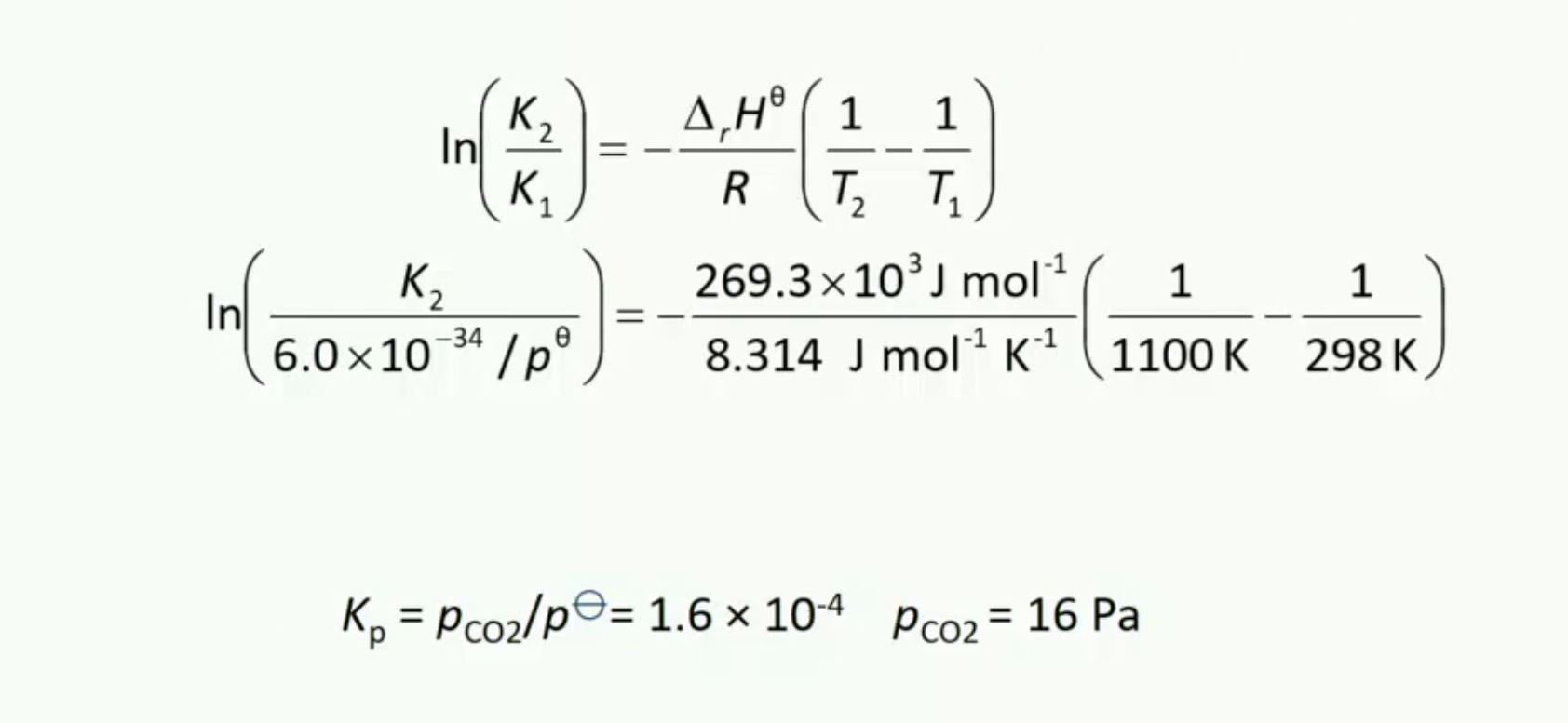
The value of $K_p$ is constant at a specific temperature. If the temperature changes, the value of $K_p$ will change. For exothermic reactions, increasing the temperature decreases $K_p$. For endothermic reactions, increasing the temperature increases $K_p$. This relationship is quantitatively described by the van 't Hoff equation.
Can Kp be used for reactions involving liquids?
No, $K_p$ is strictly for gaseous equilibrium. If a reaction involves both gases and liquids (a heterogeneous equilibrium), only the gases are included in the $K_p$ expression. The liquids are treated as having a constant activity of 1 and do not affect the pressure-based equilibrium constant.
What is the difference between P and Kp?
$P$ (or $P_i$) represents the partial pressure of an individual gas at any given moment, whereas $K_p$ is the ratio of those pressures specifically when the system has reached chemical equilibrium. $K_p$ is a fixed constant for a reaction at a set temperature, while partial pressures can vary as the system moves toward equilibrium.
When should I use the quadratic formula to find Kp?
You use the quadratic formula when solving the ICE table leads to a quadratic equation (e.g., $ax^2 + bx + c = 0$) that cannot be simplified by taking a square root. This typically happens when the $K_p$ expression involves one reactant and two products (or vice versa) with coefficients that prevent simple square rooting of both sides.
Practical Recommendation
To master $K_p$ calculations, start by mastering the ICE table technique. It is the most reliable way to organize data and avoid sign errors. Once you have the equilibrium expressions, double-check your $\Delta n$ calculation before attempting to convert between $K_p$ and $K_c$. If you are working in a laboratory setting in 2026, remember that pressure sensors often provide total pressure; you will almost always need to calculate mole fractions to find the individual partial pressures required for the $K_p$ formula.
Image Gallery