Understanding the Mold Remediation Protocol in Katy, TX: Regulations, Process, and State Compliance
In Katy, Texas, a mold remediation protocol is a legally mandated, detailed project plan written by a state-licensed Mold Assessment Consultant (MAC). Required under Texas Department of Licensing and Regulation (TDLR) rules for contami...
In Katy, Texas, a mold remediation protocol is a legally mandated, detailed project plan written by a state-licensed Mold Assessment Consultant (MAC). Required under Texas Department of Licensing and Regulation (TDLR) rules for contamination exceeding 25 contiguous square feet, it defines the exact scope, containment zones, safety controls, and clearance criteria remediation contractors must execute.
Contents
TEXAS DUAL-LICENSE FLOW CHART
- Mold Assessment Consultant (MAC)
- Inspects site & identifies source
- Drafts written Remediation Protocol
- Performs Post-Remediation Assessment
- Signs Form MDR-1 (Clearance)
- Mold Remediation Contractor (MRC)
- Files TDLR notification (5 business days prior)
- Establishes containment
- Removes mold & HEPA cleans
- PROHIBITED: Cannot be same entity
Legal Framework Governing Mold Remediation in Texas
Texas maintains some of the nation's strictest consumer protection laws regarding indoor air quality and mold remediation. State law regulates mold remediation through the Texas Occupations Code, Chapter 1958, enforced by the Texas Department of Licensing and Regulation (TDLR) under Texas Administrative Code Title 16, Part 4, Chapter 78.
The foundational rule of Texas mold law is the strict legal separation between mold assessment and mold remediation. A licensed company cannot perform both assessment and remediation on the same project. This prohibition prevents conflicts of interest, ensuring that the party determining the extent of mold damage and verifying its complete removal has no financial interest in expanding the scope of construction work.
Key Legal Definitions and Thresholds
- The 25 Contiguous Square Feet Rule: If visible mold contamination covers a contiguous area of 25 square feet or more, Texas law requires the property owner to engage licensed professionals. The project must follow a formal, written protocol. Small areas under this threshold do not statutory compel a state-filed protocol, though professional remediation standards are still recommended.
- Mold Assessment Consultant (MAC): A professional licensed by TDLR to perform mold evaluations, conduct air and surface sampling, write the official Mold Remediation Protocol (MRP), and execute the final clearance inspection.
- Mold Remediation Contractor (MRC): A professional licensed by TDLR to construct containment zones, perform structural material removal, clean affected surfaces, and apply antimicrobial treatments strictly in accordance with the MAC's written protocol.
Disclaimer: This guide provides regulatory and technical overview information. For specific legal, environmental, or insurance compliance matters, consult a licensed Texas Mold Assessment Consultant or a qualified real estate attorney.
Core Components of a Texas Mold Remediation Protocol
A Mold Remediation Protocol (MRP) is not a generic template. It is a site-specific engineering and environmental control document tailored to the structure's framing, HVAC layout, and degree of contamination. When a MAC inspects a property in Katy, the resulting protocol document outlines clear specifications across several critical functional categories.
1. Scope of Work and Contamination Mapping
The protocol pinpoints the exact locations within the building where mold removal must take place. The MAC documents the dimensions of affected drywall, subfloor, cabinetry, or HVAC ductwork, categorizing materials as salvageable or non-salvageable based on porosity and structural integrity.
2. Moisture Source Identification and Correction Requirements
Under TDLR rules, remediation cannot begin until the underlying moisture problem is identified and corrected. The protocol specifies the root cause—such as a leaking roof valley, slab plumbing leak, or high indoor relative humidity from a failing HVAC system—and requires documented repair prior to sealing containment or issuing clearance.
3. Containment Protocols and Engineering Controls
To prevent mold spores from spreading into unaffected areas of the home, the protocol specifies containment rules based on the size and location of the job:
- Critical Barriers: Sealing supply and return HVAC vents, doors, windows, and electrical outlets with 6-mil polyethylene sheeting.
- Containment Types: Mini-containments for localized work, limited containment for mid-sized areas, or full containment with airlocks and decontamination chambers for heavy contamination.
- Negative Air Pressure: Mandating the continuous operation of HEPA-filtered negative air machines (air scrubbers) to maintain a negative pressure differential (typically -0.02 inches of water column relative to outer areas), exhausting filtered air outside the home.
4. Personal Protective Equipment (PPE) & Safety Directives
The MAC establishes safety equipment levels for remediation workers, specifying half-face or full-face respirators equipped with N-100 or HEPA filters, disposable Tyvek suits, gloves, and eye protection based on the hazard level.
5. Post-Remediation Assessment and Clearance Criteria
The protocol sets clear, measurable pass/fail criteria for the final clearance inspection. This includes mandatory visual cleanliness (zero dust, debris, or visible fungal growth) and specific microbiological limits for indoor air samples compared to outdoor baseline control samples.
Local Environmental Factors Influencing Katy Properties
Katy, Texas—spanning Harris, Fort Bend, and Waller counties—presents specific environmental challenges that exacerbate mold growth and influence protocol design.
KATY, TX LOCAL RISK PROFILE
- Subtropical Climate: High Dew Points (75°F+) + Extended Summer Humidities
- Building Typology: Unconditioned Attics + Spray-Foam Envelope Traps
- Flood/Storm Risk: Severe Drainage Overflows (Cane Island / Mason Creek)
- Impact: Rapid Stachybotrys & Aspergillus Proliferation
High Humidity and Subtropical Dew Points
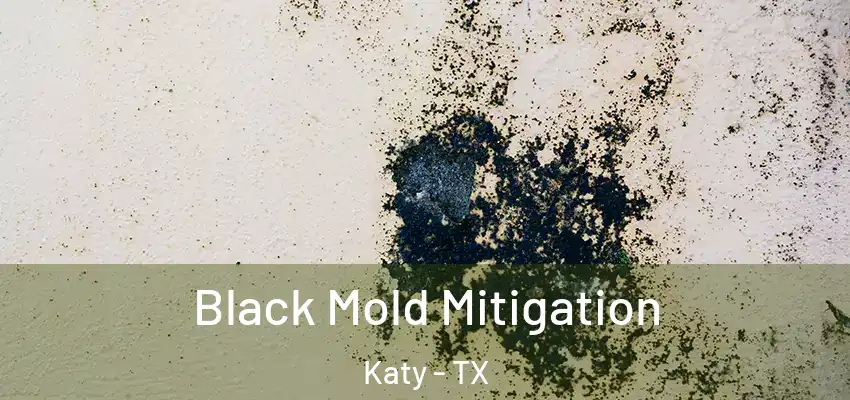
Katy experiences high humidity year-round. Ambient outdoor relative humidity frequently exceeds 80%, with summer dew points remaining above 75°F. When warm, humid air infiltrates air-conditioned building cavities, condensation forms instantly on cold drywall surfaces, metal ductwork, and structural studs, creating ideal breeding grounds for Aspergillus, Penicillium, and Stachybotrys chartarum (black mold).
Storm Water Inundation and Drainage Dynamics
The Katy region features low-lying, flat topography drained by natural waterways such as Mason Creek, Cane Island Branch, and South Mayde Creek. Major rain events, tropical storms, and localized flash floods can saturate home foundations. Floodwaters carrying organic debris require intensive protocol specifications, including the removal of all porous building materials up to 24 inches above the highest water line.
Construction Styles Common in Katy Subdivisions
Many Katy neighborhoods—from established communities like Cinco Ranch and Nottingham Country to newer master-planned developments—feature slab-on-grade concrete foundations with wood-framed walls and unconditioned attic spaces. Modern energy-efficient homes utilizing unvented spray-foam attics require precise ventilation protocols during remediation to prevent moisture entrapment within the thermal envelope.
Step-by-Step Breakdown of the Remediation Workflow
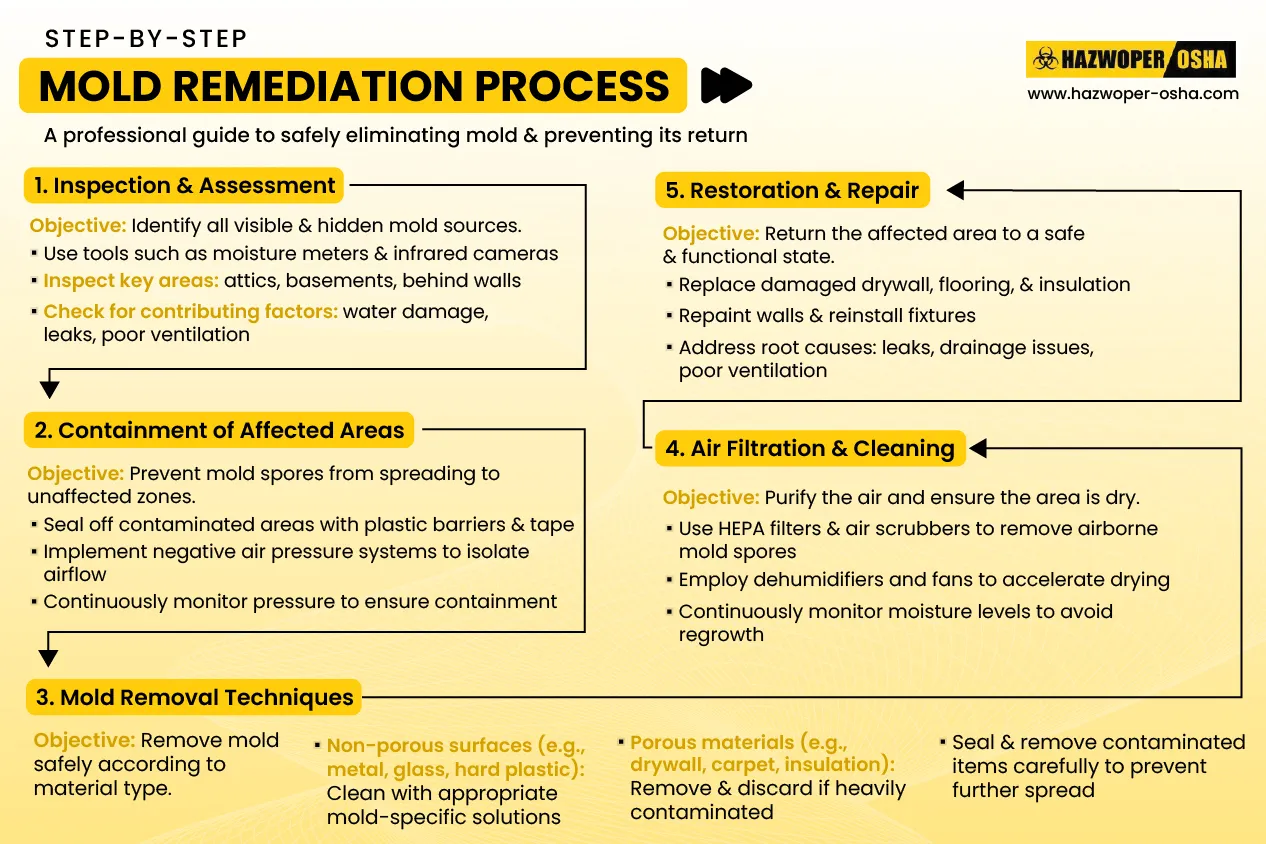
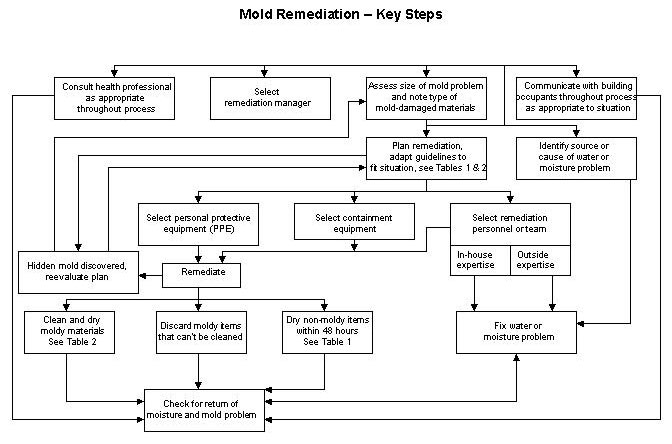
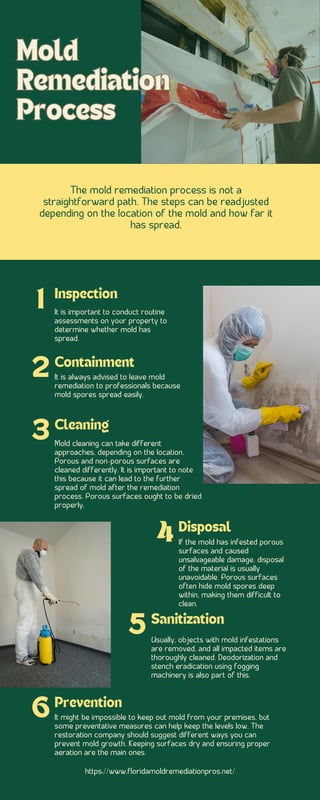
Executing a state-compliant mold remediation project in Katy follows a strict sequence to maintain legal compliance and ensure complete environmental safety.
- Assessment & Protocol Creation (MAC)
- Site inspection, moisture measurement, air sampling, protocol drafting.
- State Notification (MRC)
- State filing submitted to TDLR at least 5 business days prior to work.
- Containment & Engineering Controls (MRC)
- Polyethylene barriers, HEPA air scrubbers, negative pressure setup.
- Physical Remediation & Removal (MRC)
- Demolition of non-salvageable materials, HEPA vacuuming, damp wiping.
- Antimicrobial Treatment & Drying (MRC)
- Application of EPA-registered fungicides, commercial dehumidification.
- Post-Remediation Clearance Inspection (MAC)
- Visual checks, air sampling, particle counts; approval or rework order.
- Issuance of Form MDR-1 (MAC & MRC)
- Official certification signed, logged, and delivered to property owner.
Step 1: Initial Assessment and Protocol Creation
When visible mold or musty odors are detected, the homeowner hires a licensed Mold Assessment Consultant. The MAC conducts a baseline inspection using thermal imaging cameras, moisture meters, and air sampling cassettes. The MAC writes the formal Mold Remediation Protocol outlining the precise steps required for restoration.
Step 2: TDLR State Notification
Before physical work begins, the licensed Mold Remediation Contractor must file a formal notice with the Texas Department of Licensing and Regulation at least 5 working days prior to starting remediation, as required by Texas Administrative Code Title 16, §78.60. Emergency waivers exist for sudden plumbing bursts or active natural disasters, but standard projects must respect this state notification window.
Step 3: Containment Setup and Air Scrubbing
The contractor installs heavy-duty poly sheeting to isolate the work zone. Negative air machines equipped with true HEPA filters (capturing 99.97% of particles down to 0.3 microns) are vented outdoors, creating continuous negative air pressure to trap spores within the work zone.
Step 4: Selective Demolition and Cleaning
Remediation technicians remove compromised, non-salvageable porous materials (wet drywall, carpet padding, acoustic ceiling tiles). Semi-porous and non-porous structural elements (framing studs, concrete) are scraped, sanded, HEPA vacuumed, and wiped with EPA-registered antimicrobial solutions.
Step 5: Post-Remediation Assessment (PRA) and Clearance Testing
Once the contractor completes cleaning and drying, the original MAC returns for the mandatory Post-Remediation Assessment. The MAC conducts a rigorous visual inspection to confirm the absence of dust, moisture, and visible mold, followed by indoor air quality sampling.
To pass clearance:
- Indoor mold spore counts must be quantitatively lower than outdoor baseline samples.
- The indoor fungal flora composition must mirror healthy outdoor environments (predominantly outdoor species like Cladosporium, with negligible indoor indicators like Stachybotrys or Chaetomium).
Step 6: Issuance of Form MDR-1
Upon successful clearance testing, the MAC issues a formal Post-Remediation Clearance Report. Within 10 days of project completion, the Mold Remediation Contractor provides the property owner with the official state certificate: Certificate of Mold Damage Remediation (Form MDR-1), signed by both the MRC and the MAC.
Technical Comparison of Mold Remediation Protocol Standards
Understanding the differences between licensing, protocol stages, and legal responsibilities helps property owners navigate compliance in Texas.
| Phase / Requirement | Mold Assessment Consultant (MAC) | Mold Remediation Contractor (MRC) | State Legal Standard (TDLR) |
|---|---|---|---|
| Primary Function | Inspects, samples, writes protocol, performs final clearance testing. | Builds containment, removes damaged materials, cleans structure. | TAC Title 16, Chapter 78 |
| Legal Relationship | Independent third party; cannot have ownership ties to MRC. | Independent contractor; executes work strict to written protocol. | Strict separation mandated by Texas law. |
| State Notification | None required for assessment. | Must notify TDLR 5 business days before non-emergency work starts. | Occupations Code §1958.153 |
| Protocol Generation | Writes site-specific engineering and remediation protocol document. | Cannot draft protocol; must follow MAC's written protocol. | Required for areas $\ge 25$ contiguous sq ft. |
| Documentation Output | Inspection Report, Remediation Protocol, Clearance Certificate. | Work Logs, Waste Manifests, Form MDR-1 (Section 2). | Form MDR-1 filed with owner record. |
| Clearance Standard | Visual check + Air/Surface sampling verification against control baseline. | Passes clearance only when MAC issues passing assessment report. | Passing test required prior to containment teardown. |
Form MDR-1: Protecting Real Estate Values and Seller Liability
The Certificate of Mold Damage Remediation (Form MDR-1) is one of the most critical documents for home purchases, sales, and insurance coverage in Texas.
TEXAS FORM MDR-1 STATUTORY BENEFIT
- Completed Remediation: Form MDR-1 Signed by MAC & MRC
- Attached to Property Deed: 5-Year Legal Protection Window
- Key Benefits:
- Insurers Cannot Deny Coverage Based on Prior Mold
- Sellers Fulfill Disclosure Requirements Under TX Law
- Buyer Confidence Is Maintained
Statutory Protection Under Texas Insurance Code
Under Texas Insurance Code §544.303, if a property owner holds a valid Form MDR-1 confirming that mold damage was properly remediated according to state standards, an insurance company writing policies in Texas cannot deny coverage, increase premiums, or apply a premium surcharge on the property based solely on that prior mold claim.
Real Estate Disclosure Requirements
When selling a residential property in Katy, the Texas Association of Realtors Seller's Disclosure Notice requires sellers to disclose any known mold issues or remediation history. Attaching a valid Form MDR-1 to the disclosure proves to prospective buyers—and their mortgage lenders—that the issue was resolved according to state regulations, shielding the seller from future litigation over undisclosed latent defects.
The statutory protection provided by Form MDR-1 remains tied to the property record for five years from the date of issuance.
Cost Considerations for Mold Protocols and Remediation in Katy
The total investment for mold remediation in Katy varies based on accessibility, square footage, structural complexity, and moisture damage severity.
TYPICAL PROJECT COST BREAKDOWN
- [Phase 1] Assessment & Written Protocol (MAC): $500 - $1,500
- [Phase 2] Execution & Structural Remediation (MRC): $2,000 - $10,000+
- [Phase 3] Post-Remediation Clearance Inspection: $400 - $800
- [Phase 4] Reconstruction & Drywall Repair: Variable by Finishes
1. Initial Assessment and Protocol Fee ($500 – $1,500)
A licensed MAC charges an upfront fee to perform digital moisture mapping, collect indoor/outdoor baseline air samples, analyze laboratory results, and draft the formal written protocol.
2. Remediation Execution Costs ($2,000 – $10,000+)
The MRC quotes execution based on containment requirements and labor:
- Small containment (25–100 sq ft): $2,000 – $4,000
- Medium containment (100–500 sq ft): $4,000 – $7,500
- Large scale / whole-house / HVAC system contamination: $8,000 – $20,000+
3. Post-Remediation Clearance Assessment ($400 – $800)
The MAC charges a separate fee to inspect the finished work zone and collect clearance air samples. If the containment fails clearance testing, the contractor must re-clean the space at their own expense, and the property owner pays for the re-inspection.
Common Mistakes to Avoid During Mold Remediation
Navigating mold issues in humid Gulf Coast climates requires adherence to technical standards. Avoid these common mistakes:
- Hiring a Single Company to Assess and Remediate: Hiring one firm to evaluate and execute the remediation violates Texas TDLR rules for jobs over 25 contiguous square feet. It voids your eligibility for an official Form MDR-1 certificate.
- Failing to Fix the Moisture Source First: Applying fungicides or removing drywall without fixing the leaking window frame, roof valley, or HVAC drain pan guarantees mold will return. Moisture control is a strict prerequisite in any valid protocol.
- Using Chlorine Bleach on Porous Wood or Drywall: Chlorine bleach contains approximately 90% water. On porous surfaces like studs or drywall, the chlorine stays on the surface while water penetrates deep into the material, feeding fungal roots (hyphae) and encouraging regrowth.
- Tearing Down Containment Before Passing Clearance: Tearing down plastic barriers before receiving written clearance from the MAC spreads millions of microscopic spores into unconditioned living spaces, contaminating the entire home.
Frequently Asked Questions
Can a homeowner do their own mold remediation in Katy, TX?
Yes. Texas state licensing laws apply to commercial entities and professionals performing remediation for compensation. Property owners may remediate mold on their own primary residence. However, doing self-remediation forfeits the ability to obtain an official Form MDR-1 Certificate of Mold Damage Remediation, which can create disclosure complications and insurance challenges during future real estate sales.
How long does a typical Katy mold remediation protocol take to complete?
A standard mold remediation project takes between 3 and 7 business days. This timeline includes containment setup, demolition, HEPA vacuuming, structural drying, and clearance sampling. However, state rules mandate a 5-working-day notification period to TDLR before non-emergency physical work begins, meaning total project duration from initial assessment to final certificate spans 10 to 14 calendar days.
Does homeowners insurance in Texas cover mold remediation protocol costs?
Insurance coverage depends on the peril that caused the mold. If the mold resulted from a covered direct water loss—such as an sudden pipe burst or appliance failure—most Texas homeowners policies cover assessment, protocol generation, and remediation up to policy sub-limits (typically $5,000 to $10,000, unless an endorsement was purchased). Mold resulting from maintenance neglect or surface flooding usually requires separate flood insurance or is excluded.
What happens if the post-remediation clearance inspection fails?
If indoor air samples show elevated spore counts or visual dust remains within containment, the MAC issues a failed assessment report. Under Texas protocol rules, containment must remain sealed, negative air machines must continue running, and the Mold Remediation Contractor must re-clean and HEPA-vacuum the space at no additional labor cost to the homeowner until clearance criteria are met.
Is mold assessment required before starting minor drywall repairs in Katy?
No. If the mold area is localized and clearly measures under 25 contiguous square feet, Texas law does not mandate a formal MAC assessment, written protocol, or state notification. Homeowners and contractors can perform localized repairs directly, provided standard safety precautions and moisture control measures are implemented.
Practical Recommendations for Property Owners in Katy
- Verify State Licenses: Before signing a contract, confirm that your Mold Assessment Consultant and Mold Remediation Contractor hold active licenses on the TDLR Mold License Search Portal. Ensure the two entities share no common ownership or corporate affiliation.
- Review the Written Protocol: Carefully read the MAC's protocol before remediation starts. Verify that it addresses the underlying moisture source, establishes proper containment boundaries, and sets realistic clearance standards.
- Keep All Records for Disclosure: Retain the initial assessment report, the written protocol, lab analysis documentation, and the final signed Form MDR-1 in a safe location. When selling your home in Katy, provide these documents to prospective buyers to satisfy seller disclosure obligations and preserve legal protections under Texas insurance law.
Image Gallery