Why Robot Surgery on Grape Matters for Education
Robot surgery on a grape is a viral demonstration where a surgical system peels and stitches a tiny fruit to showcase precision, serving as a powerful visual hook for teaching medical robotics, engineering, and surgical techniques to s...
Robot surgery on a grape is a viral demonstration where a surgical system peels and stitches a tiny fruit to showcase precision, serving as a powerful visual hook for teaching medical robotics, engineering, and surgical techniques to students.
Contents
Introduction to the Phenomenon
When the internet first encountered footage of a robotic surgical system meticulously peeling a grape, skinning it, and then sewing the delicate membrane back together, it captured the public imagination. Beyond the viral novelty, this demonstration has evolved into a cornerstone of educational engagement. In engineering lecture halls, medical school seminars, and high school science outreach programs, the grape demonstration illustrates the convergence of mechanical engineering, computer science, and medicine.
The demonstration bridges the gap between abstract technical concepts and tangible reality. For students entering fields like mechatronics, biomedical engineering, or minimally invasive surgery, understanding why this exercise matters requires looking past the spectacle. It reveals fundamental principles of latency, motion scaling, tremor filtration, and hand-eye coordination that define modern computer-assisted intervention.
The Core Mechanics of Surgical Robotics
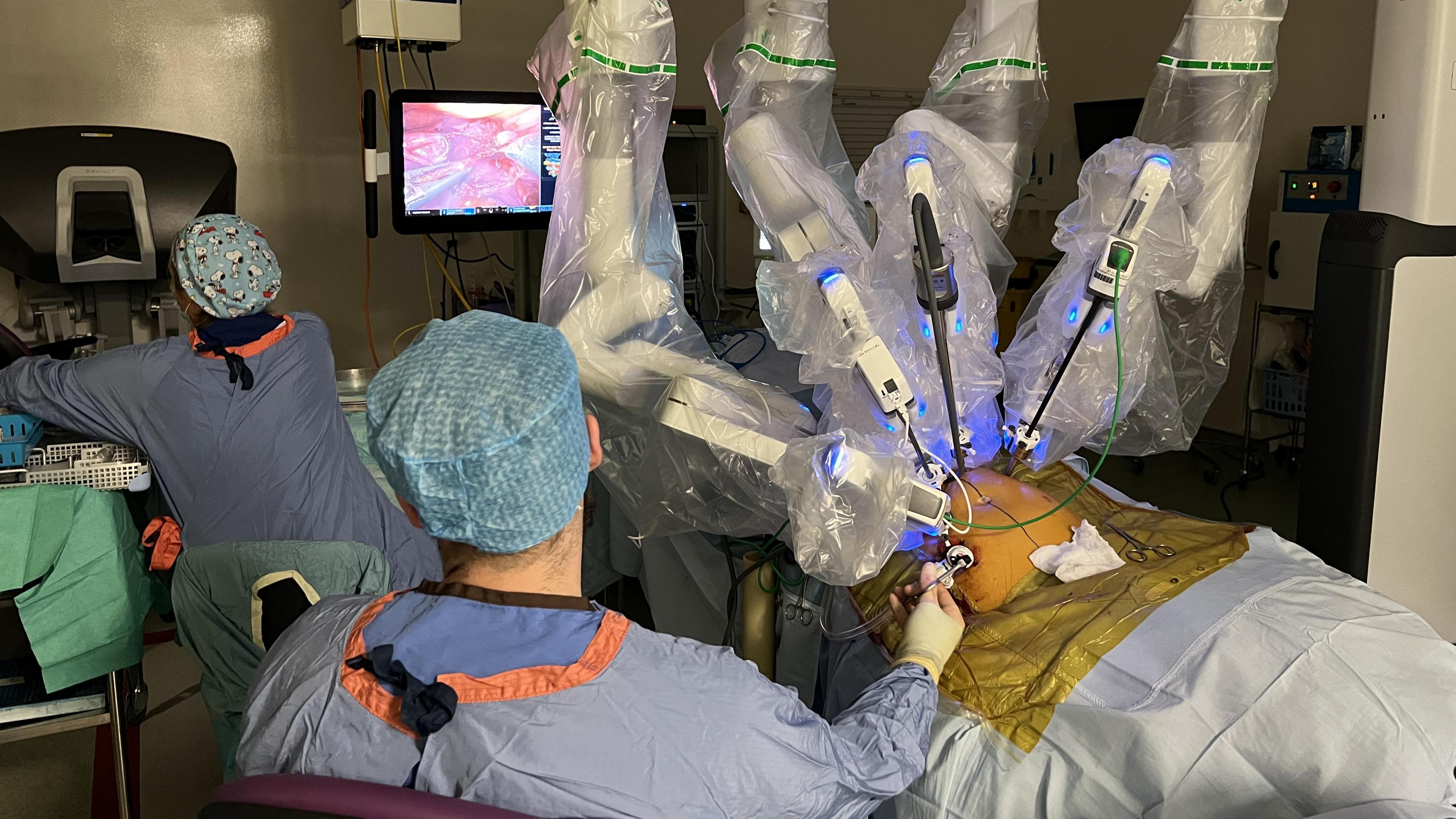
To understand why a grape is used for educational purposes, one must first examine the technological capabilities of advanced surgical systems, such as the da Vinci Surgical System, which is frequently used in these demonstrations. These platforms are not autonomous robots that operate independently; rather, they are sophisticated telepresence systems.
Teleoperation means the surgeon sits at an ergonomic console, viewing a high-definition, three-dimensional stereoscopic visualization of the surgical field. When the surgeon moves their hands within the master controllers, those movements are translated into micro-movements at the patient-side cart.
- Surgeon Console (Hand & Finger Inputs)
- Control & Scaling (Filter & Translation)
- Patient-Side Robotic Arms (Micro-Instruments)
Educational programs utilize the grape because its physical properties mimic biological challenges in miniature:
- Delicate Membranes: The skin of a grape is fragile, requiring precise force feedback and tension control to remove without tearing the underlying flesh.
- Curved Geometry: Operating on a spherical surface demands constant spatial awareness and multi-axis instrument articulation.
- Limited Workspace: The scale of a grape forces students and trainees to operate within a constrained field of view, emphasizing the necessity of absolute precision.
Educational Applications in Engineering and Medicine
The integration of surgical robotics into curricula spans multiple academic levels, transforming how complex technical skills are taught.
Biomedical Engineering and Mechatronics
Engineering students study surgical robots to understand kinematics, sensor integration, and control theory. By analyzing how a robotic arm scales a 10-centimeter hand movement down to a 1-millimeter instrument tip motion, students learn about mechanical advantage and gear ratios. The grape test provides a standard benchmark for testing student-built prototypes or calibrating commercial systems. It demonstrates the real-world impact of lag reduction, spatial resolution, and actuator precision.
Medical School and Residency Training
For surgical residents, mastering console ergonomics and stereoscopic depth perception is a steep learning curve. Traditional open surgery relies on direct tactile feedback, whereas robotic surgery interposes a digital interface between the clinician and the patient. Using a robotic system on a grape—or synthetic task trainers designed to mimic similar properties—allows residents to develop "robotic literacy." They learn to adapt to the absence of direct haptic feedback, relying instead on visual cues such as tissue deformation to gauge applied force.
K-12 STEM Outreach
In secondary education, the grape demonstration serves as a high-impact hook to attract students to STEM (Science, Technology, Engineering, and Mathematics) careers. Showing a machine performing delicate tasks on fruit communicates complex concepts of automation and computational control in an accessible, memorable way.
Technical Principles Demonstrated by the Grape Exercise
Educators rely on specific mechanical and computational concepts when using the grape exercise to explain surgical systems.
| Technical Concept | Description | Educational Relevance in Grape Exercise |
|---|---|---|
| Motion Scaling | Translating large hand motions into microscopic instrument movements. | Shows students how accuracy increases when the system scales down operator input. |
| Tremor Filtration | Algorithmic removal of natural human hand tremors. | Demonstrates how software stabilizes unsteady inputs to protect delicate tissues. |
| Degrees of Freedom | The number of independent ways an instrument can move in space. | Highlights the advantage of wristed instruments over rigid traditional laparoscopic tools. |
| Stereoscopic Vision | Providing independent images to each eye to recreate depth perception. | Teaches the importance of 3D visualization in spatial navigation and tissue manipulation. |
Limitations and Common Misconceptions
While the grape demonstration is an effective educational tool, instructors must contextualize its use to avoid common misunderstandings.
The most prevalent misconception is that the robot is operating autonomously. Viewers often assume artificial intelligence drives the instrument, but the system is entirely controlled by a human operator. Educational modules emphasize that surgical robots are tools that extend human capability, not autonomous agents that make clinical decisions.
Another limitation is the lack of true haptic feedback in many standard educational platforms. While advanced systems are evolving to transmit tactile sensations back to the surgeon's fingertips, most rely strictly on visual indicators of force. The grape exercise forces learners to interpret visual tissue blanching and stretching as a proxy for touch, highlighting a critical limitation in current technology that engineers are actively working to solve.
Comparing Traditional Laparoscopy and Robotic Surgery
To understand the context of robotic training, educators often contrast traditional minimally invasive techniques with computer-assisted systems.
- Traditional Laparoscopy: Requires long, rigid instruments inserted through small ports. The fulcrum effect reverses hand movements (moving the handle left moves the tip right), and visualization is typically provided by a flat 2D monitor held by an assistant.
- Robotic-Assisted Surgery: Utilizes wristed instruments that mimic human wrist articulation, eliminates the fulcrum reversal effect through computer processing, and delivers an immersive 3D HD view directly to the console operator.
The grape exercise encapsulates this transition. Performing the same task with manual laparoscopic tools versus robotic instruments dramatically illustrates the ergonomic and mechanical advantages of computer assistance.
Frequently Asked Questions
Is the robot performing surgery on the grape autonomously?
No. The robotic system is entirely teleoperated by a human operator sitting at a console. Every movement of the instrument is a direct translation of the surgeon's hand movements, filtered and scaled by the computer system.
Why use a grape instead of an actual biological model for initial training?
A grape provides a readily available, inexpensive, and structurally consistent medium with a delicate skin and soft interior. It mimics the challenges of working with fragile anatomical membranes without the logistical and ethical complexities of using animal or human tissue during introductory phases.
Do medical students actually practice on grapes during training?
While official medical curricula utilize sophisticated synthetic task simulators, animal models, and formal dry-labs, the grape demonstration is frequently replicated in university engineering labs, science museums, and introductory workshop settings to teach basic teleoperation principles.
What is the primary technical limitation highlighted by this exercise?
The exercise highlights the challenge of absent or limited haptic feedback. Because operators cannot physically feel the resistance of the grape skin, they must rely entirely on visual cues to gauge the force they are applying.
How does motion scaling improve precision during these demonstrations?
Motion scaling allows the system software to translate a large movement of the surgeon's hand—such as a 3-centimeter shift—into a tiny 3-millimeter movement at the instrument tip, effectively dampening errors and enabling sub-millimeter surgical accuracy.
Next Actions for Students and Educators
For educators looking to incorporate robotic surgical principles into their curricula, begin by reviewing open-source robotics modules focusing on kinematics and teleoperation. Students interested in the field should explore foundational coursework in linear algebra, control systems, and biomedical instrumentation. By understanding the underlying engineering principles rather than just the visual spectacle, learners can better appreciate the future trajectory of computer-assisted medicine.
Image Gallery