NBA Scoring Records: All-Time Leaders, Single-Game Highs, and Playoff Benchmarks
LeBron James holds the NBA record for most career regular-season points, having surpassed Kareem Abdul-Jabbar’s long-standing mark of 38,387 points. Wilt Chamberlain maintains the single-game scoring record with his historic 100-point...
LeBron James holds the NBA record for most career regular-season points, having surpassed Kareem Abdul-Jabbar’s long-standing mark of 38,387 points. Wilt Chamberlain maintains the single-game scoring record with his historic 100-point performance in 1962, while Michael Jordan holds the record for the highest career scoring average at 30.12 points per game.
Contents
The evolution of NBA scoring reflects changing rules, pacing, offensive strategies, and athletic conditioning across distinct eras. From the interior dominance of the 1960s to the perimeter-oriented "pace and space" offensive revolution of the modern era, individual scoring achievements highlight the peak of basketball offensive execution. Evaluating these milestones requires looking at total cumulative points, single-game explosions, playoff resilience, and per-game scoring efficiency.
The All-Time Regular Season Scoring Hierarchy
Cumulative regular-season scoring is the ultimate test of offensive elite skill paired with extraordinary career longevity. Sustaining high-level scoring output across 15 to 20 seasons requires health management, physical durability, tactical adaptation, and consistent execution against evolving defensive schemes.
The NBA all-time scoring list is an elite tier of player durability. Reaching the top requires averaging over 20 points per game across more than 1,200 career games, a feat accomplished by only a select group of players in basketball history.
1. LeBron James: The Peak of Longevity and Adaptability
Passing Kareem Abdul-Jabbar in February 2023, LeBron James established a new ceiling for career scoring. Built on over two decades of elite performance, James combined interior power, elite transition execution, and a continually improving perimeter shot. His ability to adjust his offensive repertoire—transitioning from an athletic rim-attacker in the mid-2000s to a high-volume three-point shooter and floor general in his later career—allowed him to maintain a scoring average above 25 points per game well into his late 30s and 40s.
2. Kareem Abdul-Jabbar: The Skyhook and Unmatched Consistency
Kareem Abdul-Jabbar held the scoring crown for nearly 39 years, accumulating 38,387 regular-season points across 20 seasons with the Milwaukee Bucks and Los Angeles Lakers. His primary weapon, the unblockable "Skyhook," served as the most reliable half-court scoring instrument in basketball history. Supported by an rigorous conditioning routine and elite positional durability, Abdul-Jabbar scored in double digits in 787 consecutive games.
3. Karl Malone: The Durable Pick-and-Roll Powerhouse
Karl Malone ranks third all-time with 36,928 points. Operating alongside point guard John Stockton in Utah’s pick-and-roll offense, Malone utilized mid-range jump shooting, physical rim running, and transition scoring to dominate the power forward position. Malone missed only 10 games total over his first 18 NBA seasons, demonstrating the importance of availability in setting cumulative statistical records.
4. Kobe Bryant: Elite Shot-Making and Volume Scoring
Kobe Bryant finished his career with 33,643 points, driven by unmatched footwork, mid-range mastery, and an relentless offensive mentality. Modeled after Michael Jordan’s technical foundation, Bryant’s scoring portfolio included complex post-ups, difficult contested jumpers, and aggressive drive mechanics. His career featured historic scoring spurts, including a month in March 2007 where he logged four consecutive 50-plus point games.
5. Michael Jordan: Unparalleled Volume and Peak Scoring
Michael Jordan finished fifth in total points with 32,292 despite missing significant time due to two retirements (1993–1995 and 1998–2001) and an injury early in his career. Jordan earned 10 NBA scoring titles—the most in league history—including seven consecutive titles from 1987 to 1993. His scoring relied on elite athleticism, first-step explosion, and an unguardable mid-range fadeaway jumper.
Single-Game Masterpieces: Single-Night Scoring Explosions
While career scoring totals measure long-term durability, single-game scoring records showcase peak athletic performance. Scoring 70 or more points in a single game requires a combination of high usage rates, remarkable shooting accuracy, team pacing, and game situations that demand sustained individual scoring output.
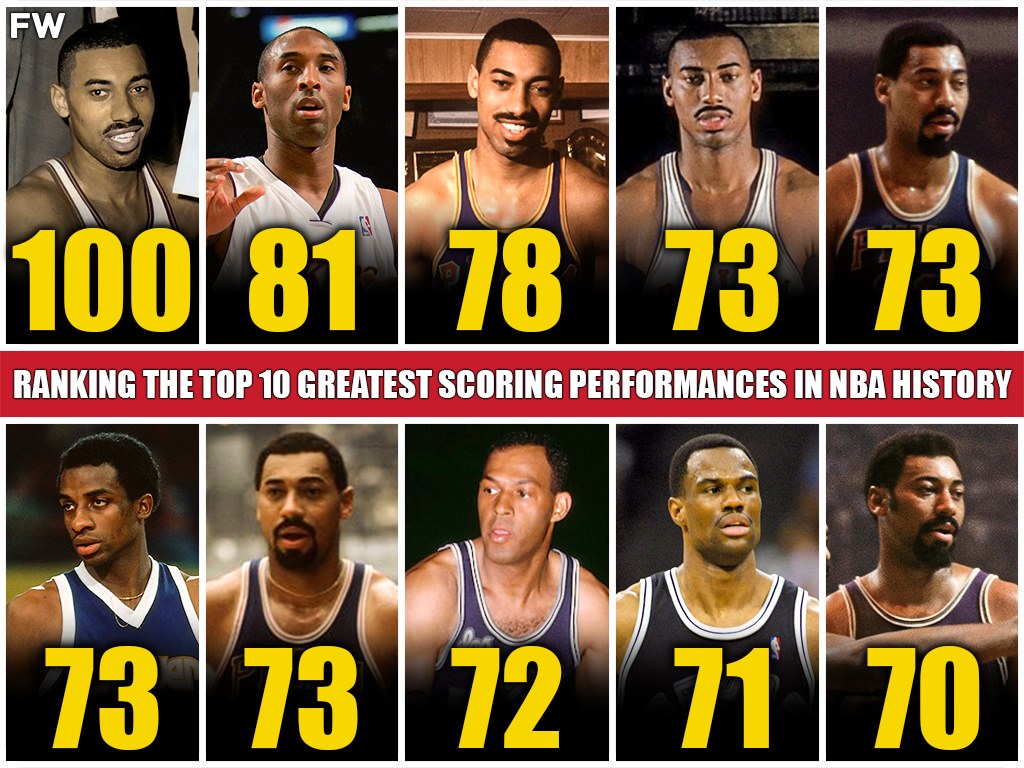
Top Single-Game Scoring Performances in NBA History: 1. Wilt Chamberlain - 100 Points (March 2, 1962) 2. Kobe Bryant - 81 Points (January 22, 2006) 3. Wilt Chamberlain - 78 Points (December 8, 1961) 4. David Thompson - 73 Points (April 9, 1978) Luka Dončić - 73 Points (January 26, 2024) Wilt Chamberlain - 73 Points (Two Times, 1962)
Wilt Chamberlain’s 100-Point Game
On March 2, 1962, playing for the Philadelphia Warriors against the New York Knicks in Hershey, Pennsylvania, Wilt Chamberlain scored 100 points in a 169–147 victory. Chamberlain made 36 of 63 field goal attempts and an unprecedented 28 of 32 free throws—a notable statistical outlier given his career 51.1% free-throw average. Played at an ultra-fast pace without a three-point line, Chamberlain’s 100-point performance remains one of the most iconic single-game records in professional sports.
Kobe Bryant’s 81-Point Showcase
On January 22, 2006, Kobe Bryant scored 81 points against the Toronto Raptors in a 122–104 Lakers victory. Unlike Chamberlain’s game, which was intentionally fast-paced to feed the center, Bryant’s performance brought his team back from a 18-point second-half deficit. Bryant shot 28-of-46 from the field, 7-of-13 from three-point range, and 18-of-20 from the free-throw line, scoring 55 points in the second half alone.
Modern High-Scoring Resurgence
In recent years, modern offensive spacing, rule changes limiting physical perimeter defense, and increased reliance on three-point volume have driven a resurgence in 70-point individual games:
- Luka Dončić (73 Points): On January 26, 2024, Dončić recorded 73 points against the Atlanta Hawks, making 25 of 33 shot attempts (75.8% FG), achieving the most efficient 70-plus point performance in NBA history.
- Damian Lillard (71 Points): On February 26, 2023, Lillard connected on 13 three-pointers en route to 71 points against the Houston Rockets.
- Donovan Mitchell (71 Points): On January 2, 2023, Mitchell scored 71 points alongside 11 assists against the Chicago Bulls, creating the highest total point contribution (points scored + points assisted) in modern history.
- Joel Embiid (70 Points): On January 22, 2024, Embiid recorded 70 points and 18 rebounds in 36 minutes against the San Antonio Spurs, showing interior dominance alongside modern mid-range scoring.
Comprehensive NBA Scoring Records Leaderboard
The following table summarizes the historic benchmarks across key regular season, playoff, and single-game scoring categories:
| Record Category | Record Holder | Statistical Benchmark | Date / Era | Key Strategic Context |
|---|---|---|---|---|
| All-Time Regular Season Points | LeBron James | 40,000+ Points | 2003–Present | Achieved via 20+ years of high-volume scoring and modern perimeter evolution. |
| Highest Single-Game Points | Wilt Chamberlain | 100 Points | March 2, 1962 | 36/63 FG, 28/32 FT; pre-three-point shot era with fast possession pace. |
| Highest Career PPG Average | Michael Jordan | 30.12 PPG | 1984–2003 | Accomplished over 1,072 games with 10 individual scoring titles. |
| All-Time Playoff Points | LeBron James | 8,000+ Points | 2006–Present | Built over more than 280 postseason games across multiple championship runs. |
| Highest Playoff Game Points | Michael Jordan | 63 Points | April 20, 1986 | Set in a double-overtime game against the 1985–86 Boston Celtics defense. |
| Highest Finals Game Points | Elgin Baylor | 61 Points | April 14, 1962 | Scored in Game 5 of the NBA Finals for the Lakers against Boston. |
| Most Points in a Single Quarter | Klay Thompson | 37 Points | January 23, 2015 | Scored in the 3rd quarter vs. Kings; 13/13 FG, 9/9 3PM without missing a shot. |
| Most Scoring Titles | Michael Jordan | 10 Titles | 1987–1998 | Won 7 consecutive titles (1987–1993) and 3 straight (1996–1998). |
Playoff Scoring Supremacy: High-Stakes Performance
Regular season success measures broad performance, but playoff scoring requires executing against concentrated game plans, defensive adjustments, and elite opponent scouting across seven-game series.
Playoff Career Points: Total Accumulation
LeBron James sits atop the playoff scoring rankings with over 8,000 points, far surpassing second-place Michael Jordan (5,987 points) and third-place Kareem Abdul-Jabbar (5,762 points). Because playoff games do not count toward official all-time regular season scoring records, James’ combined career regular season and postseason total stands unmatched in basketball history.
Playoff scoring requires exceptional efficiency under tight defensive pressure. Top postseason scorers must adjust to altered defensive schemes, increased physical play, and targeted defensive coverage over seven-game series.
Single-Game Playoff Highs
- Michael Jordan (63 Points): On April 20, 1986, a 23-year-old Michael Jordan scored 63 points against the Boston Celtics at the Boston Garden in Game 2 of the Eastern Conference First Round. Facing a Celtics team widely considered one of the greatest defensive rosters ever assembled, Jordan shot 22-of-41 from the field and 19-of-21 from the free-throw line in a double-overtime thriller.
- Elgin Baylor (61 Points): On April 14, 1962, Elgin Baylor scored 61 points for the Los Angeles Lakers in Game 5 of the NBA Finals against the Boston Celtics. Baylor’s single-game Finals record has stood for over six decades, highlighting his mid-air adjustment capabilities and perimeter-to-rim scoring skills.
- Donovan Mitchell (57 Points): On August 17, 2020, Donovan Mitchell scored 57 points for the Utah Jazz against the Denver Nuggets, recording the third-highest single-game playoff total in league history.
Per-Game Efficiency: PPG Leaders vs. Cumulative Volume
While total points showcase durability, points per game (PPG) averages highlight a player's game-to-game scoring impact during their career. Balancing volume with efficiency is the primary challenge for dominant primary scorers.
Highest Career Points Per Game (PPG) Averages in NBA History: 1. Michael Jordan - 30.12 PPG (1,072 Games) 2. Wilt Chamberlain - 30.07 PPG (1,045 Games) 3. Luka Dončić - ~28.5+ PPG (Active Career Average) 4. Elgin Baylor - 27.36 PPG (846 Games) 5. Kevin Durant - 27.30 PPG (Active Career Average) 6. Jerry West - 27.03 PPG (932 Games) 7. LeBron James - 27.00 PPG (Active Career Average)
Michael Jordan vs. Wilt Chamberlain
The battle for highest career PPG is a close contest between Michael Jordan (30.12 PPG) and Wilt Chamberlain (30.07 PPG):
- Wilt Chamberlain’s Early Dominance: Chamberlain averaged an astonishing 50.4 points per game during the 1961–62 season and 44.8 PPG in 1962–63. However, later in his career with the 76ers and Lakers, he shifted his focus toward playmaking and rebounding, which lowered his career per-game scoring average.
- Michael Jordan’s Sustained Output: Jordan maintained high scoring averages throughout his entire career. He averaged over 30 points per game in eight separate seasons, including a peak of 37.1 PPG in 1986–87. Jordan’s career average dropped slightly during his final two comeback seasons with the Washington Wizards (where he still averaged 21.2 PPG at ages 38–40), but he retained the top historic spot.
The Impact of True Shooting Percentage (TS%)
Modern analytics evaluate scoring efficiency through True Shooting Percentage (TS%), a metric that accounts for two-point field goals, three-point field goals, and free throws using the formula:
$$\text{TS%} = \frac{\text{Total Points}}{2 \times (\text{FGA} + (0.44 \times \text{FTA}))}$$
High-volume scorers who maintain high efficiency (such as Kevin Durant, who boasts a career TS% over 61%) generate higher offensive value per possession than past scorers who relied purely on field goal volume with lower relative efficiency.
Era Shifts: Rules, Pace, and Three-Point Spatial Dynamics
Comparing scoring records across eras requires context regarding how basketball rules, tactical philosophies, and physical play have evolved over time.
1. The 1960s Pace Explosion
The early 1960s featured the fastest pace of play in NBA history. Teams averaged between 115 and 125 possessions per game, compared to 95 to 100 possessions per game in the modern era. This rapid pace created far more shot attempts per game, inflating single-game scoring and rebounding totals for players like Wilt Chamberlain, Elgin Baylor, and Oscar Robertson.
2. The Isolation and Defensive Grind (1990s–2000s)
Following the addition of the three-point line in 1979, defenses adapted by enforcing physical perimeter coverage and clogged paint lanes under illegal defense rules. The mid-to-late 1990s and early 2000s marked the slowest pace and lowest scoring environment in modern league history. Teams regularly held opponents under 90 points per game, making the scoring output of stars like Michael Jordan, Kobe Bryant, and Allen Iverson all the more impressive.
3. The Modern Pace-and-Space Era (2010s–Present)
The modern NBA scoring landscape was transformed by three key tactical and regulatory shifts:
- Removal of Illegal Defense / Introduction of Defensive Three Seconds (2001): Encouraged zone defenses, forcing teams to prioritize floor spacing and perimeter shooting.
- Freedom of Movement Guidelines: Tightened hand-checking rules to penalize physical perimeter touch-fouls, aiding quick guards and ball-handlers.
- Analytical Spatial Efficiency: Led by teams shifting away from mid-range attempts toward high-value corner three-pointers, shots at the rim, and trip-generating drives. This spatial revolution has enabled higher offensive efficiency, resulting in a surge of 50-, 60-, and 70-point individual games.
Frequently Asked Questions
Who holds the record for the most points scored in a single NBA game?
Wilt Chamberlain holds the NBA record for most points in a single game, scoring 100 points for the Philadelphia Warriors against the New York Knicks on March 2, 1962. Kobe Bryant holds the second-highest record with 81 points, set on January 22, 2006.
Who is the all-time leading scorer in NBA history?
LeBron James is the all-time leading scorer in NBA regular-season history. He passed Kareem Abdul-Jabbar's previous record of 38,387 points in February 2023 and expanded his record total past the 40,000-point threshold.
What is the record for the most points scored in a single quarter?
Klay Thompson holds the NBA record for the most points scored in a single quarter, recording 37 points in the third quarter for the Golden State Warriors against the Sacramento Kings on January 23, 2015. Thompson went a perfect 13-for-13 from the field and 9-for-9 from three-point range during those 12 minutes.
Who has the highest career points-per-game (PPG) average in NBA history?
Michael Jordan holds the record for the highest career scoring average in NBA history at 30.12 points per game across 1,072 regular-season games. Wilt Chamberlain ranks second with a career average of 30.07 points per game.
Who holds the record for the most points in an NBA playoff game?
Michael Jordan holds the single-game playoff scoring record with 63 points, set against the Boston Celtics on April 20, 1986. Elgin Baylor holds the record for the most points scored in an NBA Finals game with 61 points, recorded on April 14, 1962.
Analyzing Historical Context in Scoring Records
Evaluating scoring records across different eras of basketball requires balancing raw cumulative totals with per-possession efficiency, pace context, and rule developments. While Wilt Chamberlain’s single-game records showcase unmatched physical dominance during the league’s early years, modern stars like LeBron James and Kevin Durant demonstrate how sports science, shooting range, and career longevity enable unprecedented scoring records in the contemporary game. As shot selection, three-point volume, and offensive spacing continue to evolve, individual scoring records remain the ultimate standard for basketball excellence.
Image Gallery