German Phrase for "I Hate You": Translations, Grammar, and Nuances
The primary German phrase for "I hate you" is "Ich hasse dich" (pronounced [ɪç ˈhasə dɪç]). It combines the first-person pronoun Ich (I), the conjugated verb hasse (hate), and the accusative informal pronoun dich (you). Depending on th...
The primary German phrase for "I hate you" is "Ich hasse dich" (pronounced [ɪç ˈhasə dɪç]). It combines the first-person pronoun Ich (I), the conjugated verb hasse (hate), and the accusative informal pronoun dich (you). Depending on the target audience and context, variations include Ich hasse euch for groups and Ich hasse Sie for formal address.
Contents
Translating emotional statements between English and German requires an understanding of both grammar and social register. The word Hass (hatred) carries significant emotional weight in German-speaking cultures, making the exact phrase Ich hasse dich far more intense than its casual English counterpart.
Deconstructing "Ich hasse dich": Word-by-Word Breakdown
To understand how the phrase is constructed, it helps to examine each component through the lens of German grammar:
[Ich] [hasse] [dich] Subject Verb Direct Object (1st Sing.) (Present Tense) (Accusative Sing.)
- Ich (Subject / Nominative Case): The first-person singular personal pronoun meaning "I".
- hasse (Verb): The first-person singular present tense form of the verb hassen (to hate). German verbs conjugate based on the subject; the stem hass- takes the ending -e for ich.
- dich (Direct Object / Accusative Case): The accusative singular form of the informal second-person pronoun du (you). Because hassen is a transitive verb, its direct object must take the accusative case.
Why Case Matters: Nominative vs. Accusative
In English, the word "you" remains identical whether it acts as a subject ("you left") or an object ("I saw you"). German distinguishes these roles strictly through grammatical case.
- Nominative (Subject): du (you)
- Accusative (Direct Object): dich (you)
- Dative (Indirect Object): dir (to/for you)
Using the incorrect case—such as saying "Ich hasse dir"—is grammatically invalid in standard German because the verb hassen requires an accusative object.
Pronunciation Guide and Phonetic Details
Achieving accurate pronunciation is essential for clarity and to avoid sounding like a non-native speaker substituting English phonemes.
Phrase: Ich hasse dich IPA: /ɪç/ /ˈhasə/ /dɪç/ Phonetic: [ikh] [HAH-seh] [dikh]
1. The German "ich" Sound (/ç/)
The ending sound in Ich and dich is the Ich-Laut (voiceless palatal fricative, represented in IPA as /ç/).
- How to form it: Lightly press the middle of your tongue against the roof of your mouth (the hard palate), right where you pronounce the initial sound of the English word "huge" or "humor." Exhale gently without engaging your vocal cords.
- Common mistake: Do not pronounce dich as "dikk" (hard /k/) or "dish" (English /ʃ/).
2. The Short Vowel and Double Consonant in "hasse" (/ˈhasə/)
- Vowel sound: The a in hasse is a short, open vowel /a/, similar to the "a" in the English word "father," but held for a shorter duration.
- Consonant sound: The double ss indicates that the preceding vowel is short and that the consonant itself is a unvoiced alveolar sibilant /s/ (like the "ss" in "hiss").
- Ending schwa: The final -e is an unstressed schwa /ə/, sounding like the "a" in "sofa."
Formality and Plural Variations
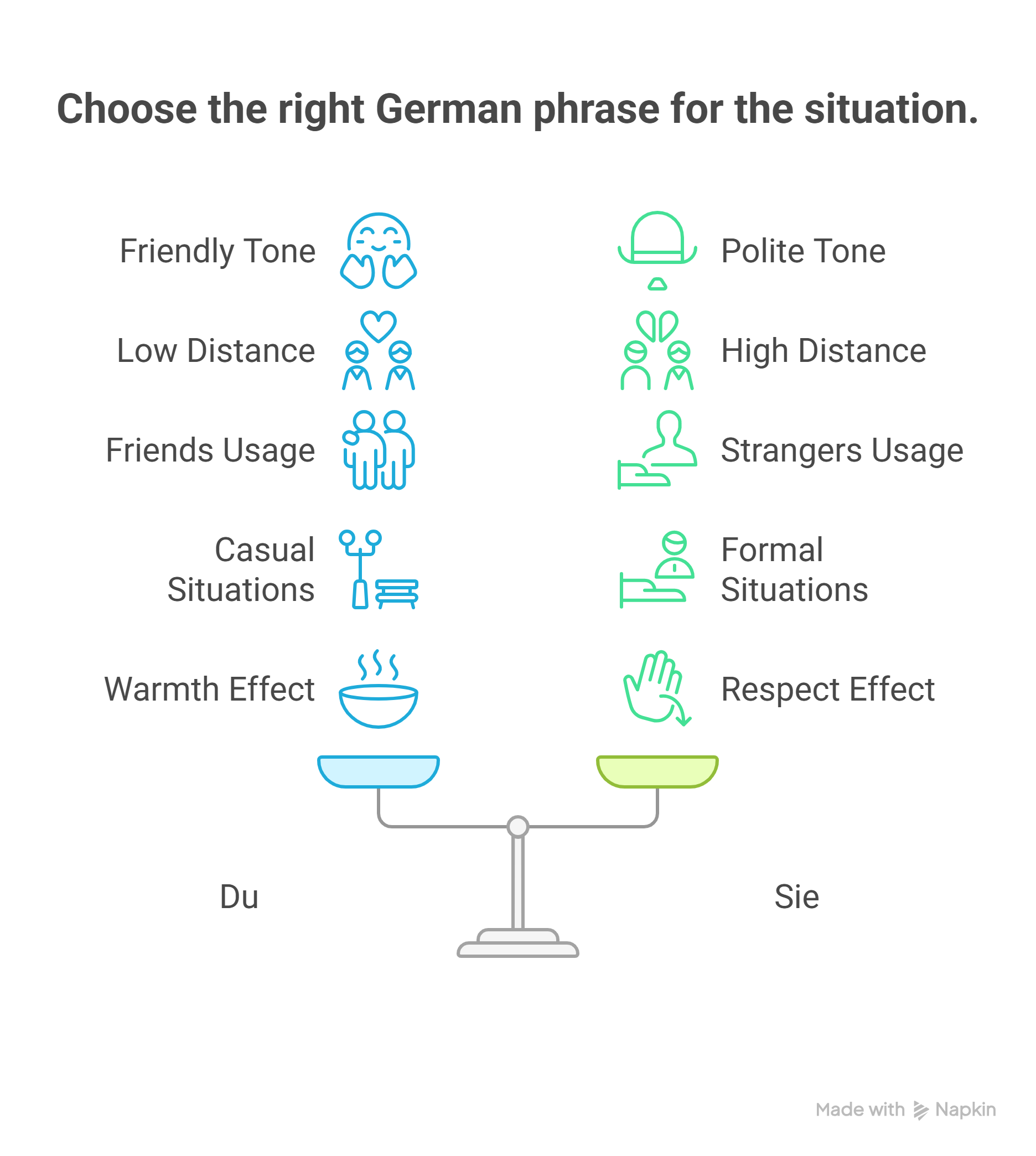
German maintains distinct pronouns based on social distance (informal vs. formal) and number (singular vs. plural). Choosing the correct phrase depends entirely on whom you are addressing.
Addressing One Person Addressing Multiple People Informal Address: Ich hasse dich. Ich hasse euch. Formal Address: Ich hasse Sie. Ich hasse Sie.
1. Informal Singular: Ich hasse dich
Used when speaking to one person with whom you have an informal relationship, such as a friend, romantic partner, peer, child, or family member.
2. Informal Plural: Ich hasse euch
Used when speaking to two or more people whom you would individually address as du.
- Grammar: Euch is the accusative plural form of ihr (you all).
- Example: Ich hasse euch alle! (I hate you all!)
3. Formal Singular and Plural: Ich hasse Sie
Used in professional environments, when addressing strangers, elders, or in formal written communications.
- Grammar: Sie serves as both the singular and plural formal pronoun. It is always capitalized in written German to distinguish it from sie (she) and sie (they).
- Usage Context: Hating someone formally is rare in everyday speech, but the phrase appears in literature, legal dramas, theatrical dialogue, or intense professional disputes.
Verb Conjugation: Hassen across Tenses
To express hatred across different temporal contexts or sentence structures, you must conjugate hassen correctly. It is a regular (weak) verb, meaning its stem does not change during conjugation.
Present Tense (Präsens)
| Pronoun | German Conjugation | English Translation |
|---|---|---|
| ich | ich hasse | I hate |
| du | du hasst | you (informal sing.) hate |
| er / sie / es | er / sie / es hasst | he / she / it hates |
| wir | wir hassen | we hate |
| ihr | ihr hasst | you (informal pl.) hate |
| sie / Sie | sie / Sie hassen | they / You (formal) hate |
Past Tenses: Perfekt vs. Präteritum
In spoken German, past events are usually expressed using the conversational past (Perfekt). In formal writing, literature, or news reports, the simple past (Präteritum) is preferred.
- Conversational Past (Perfekt):
- Ich habe dich gehasst. (I hated you / I have hated you.)
- Structure: Auxiliary verb haben + past participle gehasst.
- Simple Past (Präteritum):
- Ich hasste dich. (I hated you.)
- Structure: Verb stem hass- + past tense suffix -te + personal ending.
Alternative German Expressions for Dislike and Hostility
In English, people often say "I hate you" lightheartedly (e.g., when a friend spoils a movie twist). In German, using hassen in casual settings can sound overly aggressive or alienating. German offers a spectrum of phrases to express varying degrees of annoyance, dislike, and contempt.
Mild Dislike -------------> Moderate Dislike -------------> Intense Hostility Ich mag dich nicht. Ich kann dich nicht leiden. Ich hasse dich.
Mild to Moderate Dislike
1. Ich mag dich nicht.
- Literal Translation: I do not like you.
- Nuance: The standard, direct way to state a lack of affection without declaring open war.
- Grammar: Uses the modal-like verb mögen (to like) negated by nicht.
2. Ich kann dich nicht leiden.
- Literal Translation: I cannot suffer/endure you.
- English Equivalent: I can't stand you.
- Nuance: Indicates strong personal aversion or incompatibility. Very common in everyday spoken German.
Moderate to Strong Hostility
3. Ich kann dich nicht ausstehen.
- Literal Translation: I cannot endure/bear you.
- English Equivalent: I can't bear you / I loathe being around you.
- Nuance: Expresses deep irritation with someone's presence, personality, or behavior.
4. Du bist mir zuwider.
- Literal Translation: You are contrary/repulsive to me.
- English Equivalent: You disgust me / I find you repulsive.
- Grammar: Requires a dative personal pronoun (mir).
5. Ich habe einen Hass auf dich.
- Literal Translation: I have a hatred toward you.
- English Equivalent: I hold a grudge/hatred against you.
- Grammar: Uses the noun der Hass paired with the preposition auf (+ accusative).
Expressions of Annoyance and Irritation
When the feeling is temporary annoyance rather than deep-seated hatred, native speakers use idiomatic expressions involving personal boundary metaphors:
- "Du gehst mir auf die Nerven." (You're getting on my nerves.)
- "Du gehst mir auf den Senkel." (Idiomatic: You're driving me crazy / annoying me.)
- "Du nervst mich." (You're annoying/bugging me.)
Comparative Breakdown of German Hostility Expressions
The table below compares phrases by intensity, literal meaning, register, and grammatical construction.
| German Phrase | English Equivalent | Intensity Level | Grammatical Notes |
|---|---|---|---|
| Ich mag dich nicht. | I don't like you. | Low | Negated present tense of mögen + accusative dich. |
| Du nervst mich. | You're annoying me. | Low–Moderate | Transitive verb nerven + accusative mich. |
| Du gehst mir auf die Nerven. | You're getting on my nerves. | Moderate | Idiomatic phrase using dative pronoun mir. |
| Ich kann dich nicht leiden. | I can't stand you. | Moderate–High | Verbal construction with modal verb können + leiden. |
| Ich kann dich nicht ausstehen. | I loathe/can't tolerate you. | High | Separable prefix construction with ausstehen. |
| Ich hasse dich. | I hate you. | Very High | Direct present tense of hassen + accusative dich. |
| Du bist mir zuwider. | You disgust me. | Extreme | Predicative adjective requiring dative object mir. |
Cultural Context: Emotional Weight in German-Speaking Regions
German communication styles in Germany, Austria, and German-speaking Switzerland tend to be direct, precise, and literal. This cultural norm directly influences how emotional language is interpreted.
The Weight of Hass
In English-speaking countries, hyperbole is common. Statements such as "I hate Mondays," "I hate this weather," or a playful "I hate you!" to a friend are frequent and rarely taken literally.
In contrast, the German verb hassen carries serious emotional weight. Declaring Ich hasse dich to another person implies profound animosity, total broken trust, or deep hostility.
- In Friendships: Saying Ich hasse dich to a friend in response to a harmless joke can sound jarring or overly aggressive. Native speakers are more likely to say Du bist fies! (You're mean!) or Du nervst! (You're annoying!).
- In Romantic Relationships: Using Ich hasse dich during an argument signals severe emotional distress or breakup-level conflict.
- Regarding Objects or Concepts: While hassen is increasingly used for inanimate objects (Ich hasse Regen – I hate rain), many speakers still prefer Ich mag keinen Regen (I don't like rain) or Ich komme mit dem Wetter nicht klar (I can't deal with this weather).
The authoritative German language resource Duden defines hassen as feeling deep, passionate animosity or hostility toward someone or something, emphasizing its emotional intensity.
Common Grammatical and Linguistic Errors to Avoid
Non-native speakers frequently make structural or phonetic errors when attempting to use this phrase.
1. Case Confusion: Ich hasse dir
- Incorrect: Ich hasse dir.
- Correct: Ich hasse dich.
- Explanation: Certain German verbs require dative objects (such as gehören, helfen, or danken). However, hassen is strictly transitive and must govern an accusative direct object (dich).
2. Mispronunciation of the ch Sound
- Incorrect: Pronouncing dich as "dikk" or "dish".
- Correct: Producing the palatal fricative /ç/.
- Tip: If you struggle with the sound, practice pronouncing the word "hue" in English without voicing the vowel at the start.
3. Word Order Errors in Subordinate Clauses
In standard main clauses, the conjugated verb sits in the second position (Ich hasse dich). However, when placed inside a subordinate clause (introduced by conjunctions like weil [because] or dass [that]), the conjugated verb moves to the very end of the clause.
- Main Clause: Ich hasse dich. (I hate you.)
- Subordinate Clause: ...weil ich dich hasse. (...because I hate you.)
- Incorrect Subordinate Order: *...weil ich hasse dich.
Frequently Asked Questions
How do you pronounce "Ich hasse dich"?
It is pronounced [ɪç ˈhasə dɪç] (roughly ikh HAH-seh dikh). The ch in Ich and dich is a soft palatal fricative made by exhaling lightly while holding your tongue against the roof of your mouth.
Is "Ich hasse dich" stronger than "I hate you" in English?
Yes. In German-speaking cultures, emotional vocabulary is taken more literally. While English speakers often use "I hate you" hyperbolically in casual banter, Ich hasse dich conveys deep, genuine animosity and is rarely used lightheartedly.
What is the formal way to say "I hate you" in German?
The formal equivalent is "Ich hasse Sie." The formal pronoun Sie must always be capitalized in written German. This phrase is used when addressing strangers, superiors, or in formal written correspondence.
How do you say "I hate you all" in German?
To address a group of people informally, say "Ich hasse euch alle" or "Ich hasse euch." Euch is the accusative plural pronoun corresponding to ihr (you all).
What is the difference between "Ich hasse dich" and "Ich kann dich nicht leiden"?
Ich hasse dich means "I hate you" and represents an intense, active hatred. Ich kann dich nicht leiden literally translates to "I cannot endure you" and is equivalent to "I can't stand you"—expressing strong personal dislike without the extreme intensity of hatred.
Next Steps for German Language Learners
Mastering expressions of emotion in German requires balancing grammatical precision with an understanding of social registers. To expand your command of German interaction:
- Practice Accusative Pronouns: Review the full spectrum of personal pronouns in the accusative case (mich, dich, ihn, sie, es, uns, euch, sie, Sie) to ensure you can build direct-object sentences effortlessly.
- Explore Verbs of Emotion: Study related verbs such as lieben (to love), mögen (to like), verabscheuen (to despise), and bewundern (to admire) alongside their respective case requirements.
- Observe Native Usage: Pay attention to how native speakers express frustration in movies, podcasts, or literature. Notice how idioms like Du gehst mir auf die Nerven are preferred over direct declarations of hatred in daily life.
EDITORIAL CATEGORY METADATA:
Image Gallery