Why the Blue Jay Matters for Backyard Birdwatchers
Blue Jays are essential to backyard ecosystems because they serve as primary sentinels, alerting other species to predators, and act as key drivers of forest regeneration through acorn dispersal. Their high intelligence, complex social...
Blue Jays are essential to backyard ecosystems because they serve as primary sentinels, alerting other species to predators, and act as key drivers of forest regeneration through acorn dispersal. Their high intelligence, complex social hierarchies, and striking structural coloration provide birdwatchers with deep insights into avian cognition and ecological interdependence.
Contents
The Sentinel of the Garden: Understanding Alert Behaviors
For many backyard birdwatchers, the first sign of a Blue Jay (Cyanocitta cristata) is not a flash of blue, but a piercing, melodic, or harsh vocalization. This species is often referred to as the "alarm system" of the North American woods. Their role as sentinels is not merely a byproduct of their loud nature; it is a sophisticated survival mechanism that benefits a wide array of species.
When a Blue Jay spots a predator, such as a Cooper’s Hawk or a domestic cat, it emits a specific "jay-jay" call that signals danger. This behavior, known as mobbing, often draws in other Blue Jays and even different species of songbirds to harass the predator until it leaves the area. By paying attention to these calls, birdwatchers can often locate raptors that would otherwise remain hidden.
Furthermore, Blue Jays are master mimics. They are particularly adept at imitating the calls of Red-shouldered Hawks. Research suggests this mimicry serves two potential purposes: to warn other jays that a hawk is nearby, or to deceive other birds into believing a predator is present, thereby clearing a bird feeder for the jay’s exclusive use. Observing these nuances in vocalization allows birdwatchers to witness active tactical deception—a trait usually reserved for higher-order mammals.
Ecological Engineers: Blue Jays and the Growth of Oak Forests
The impact of the Blue Jay extends far beyond the boundaries of a backyard fence. They are arguably the most important agents for the spread of oak trees across North America. This relationship is a classic example of mutualism. While many birds eat acorns, Blue Jays are "scatter-hoarders."
During the autumn months, a single Blue Jay can cache between 3,000 and 5,000 acorns. They are highly selective, choosing only the healthiest, most viable nuts. Using a specialized sublingual pouch—an expandable throat pocket—they can carry up to five acorns at a time: three in the pouch, one in the mouth, and one at the tip of the bill.
Because they often fly several miles away from the parent tree to bury these nuts in soft soil or under leaf litter, they effectively "plant" the next generation of forests. While the jays retrieve many of these caches during the winter, thousands are forgotten or left behind, where they eventually germinate. This behavior was instrumental in the rapid post-glacial migration of oak trees across the continent, a pace that would have been impossible through wind dispersal or the slower movements of squirrels. For the backyard enthusiast, seeing a Blue Jay at a feeder is a reminder of this bird's massive footprint on the continental landscape.
Complex Intelligence and Social Structures
Blue Jays belong to the family Corvidae, which includes crows, ravens, and magpies. This family is widely considered the most intelligent group of birds on the planet. For the birdwatcher in 2026, observing Blue Jays offers a front-row seat to avian problem-solving.
In laboratory settings, Blue Jays have demonstrated the ability to use tools—such as using strips of newspaper to reach food pellets outside their cages. In a backyard setting, this intelligence manifests as memory and social complexity. They can remember the locations of thousands of food caches and have been observed monitoring the behavior of their peers to ensure their hoards aren't being watched.
Their social lives are equally intricate. Blue Jays typically form monogamous pair bonds that often last for life. They are highly social within their family units, and their communication involves more than just loud screams; they use a variety of "whisper songs," clicks, and "rusty pump" sounds that are only audible at close range. These quieter vocalizations are used during courtship and within family groups, revealing a tender side of a bird often unfairly labeled as a neighborhood bully.
Structural Coloration: The Physics of Blue
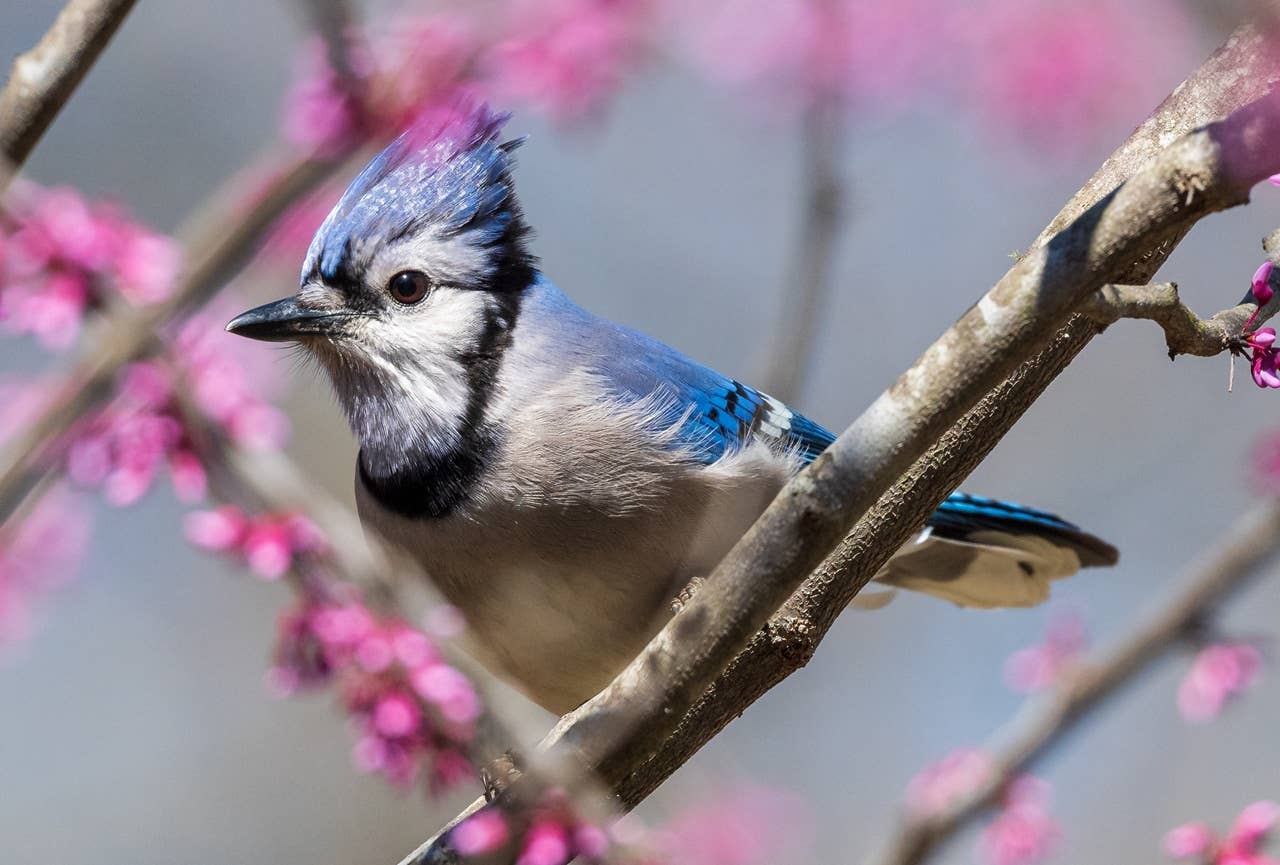
One of the most fascinating technical aspects of the Blue Jay is that it is not actually blue. Unlike birds with red or yellow feathers, which derive their color from pigments (carotenoids) in the food they eat, Blue Jays use structural coloration.
The blue appearance is a result of light interference. The barbs of the feathers contain a layer of translucent cells that contain keratin and tiny air pockets. When light hits these feathers, all wavelengths except blue are absorbed or canceled out, while the blue light is scattered and reflected back to the eye. This is known as the Tyndall effect.
If you were to find a Blue Jay feather on the ground and crush it, the "blue" would disappear, leaving only a dull brown or gray dust. This is because the physical structure that scatters the light has been destroyed. For birdwatchers, this explains why a Blue Jay may look vibrant cerulean in direct sunlight but appear dull or even gray in the deep shade or on a heavily overcast day.
Attracting and Managing Blue Jays at Feeders
To truly appreciate the value of Blue Jays, one must manage the backyard environment to accommodate their specific needs. Because of their size and intelligence, they have different requirements than smaller finches or sparrows.
Preferred Foods and Feeder Types
Blue Jays are omnivores with a strong preference for large seeds and nuts. In 2026, the most effective way to attract them remains the use of whole peanuts (in the shell).
- Peanuts: These are high in fat and protein, making them ideal for caching.
- Black Oil Sunflower Seeds: A staple for many birds, but jays prefer them in large quantities.
- Striped Sunflower Seeds: The thicker hull is no match for a jay's powerful beak.
- Suet: High-energy fat cakes are popular during winter months.
Standard tube feeders are often difficult for Blue Jays to use because they lack a large enough perching surface. Platform feeders or large hopper feeders are much more effective. Many birdwatchers also use specialized "peanut wreaths" which allow jays to pull whole peanuts through a wire mesh, providing both food and mental stimulation.
Managing Feeder Dynamics
Blue Jays are often accused of "bullying" smaller birds. While they are dominant due to their size, their presence at a feeder is usually brief. They tend to land, grab several items quickly to cache elsewhere, and depart. To maintain a peaceful backyard, birdwatchers often set up a "decoy" station. By placing a platform feeder with peanuts further away from the main songbird feeders, you can draw the jays to their own designated area, allowing smaller birds like chickadees and nuthatches to feed undisturbed.
Distinguishing Blue Jays from Similar Species
While the Blue Jay is distinct in the eastern and central United States, many birdwatchers encounter similar species depending on their geography or the bird's life stage.
| Feature | Blue Jay (C. cristata) | Steller's Jay (C. stelleri) | Florida Scrub-Jay (A. coerulescens) | Eastern Bluebird (S. sialis) |
|---|---|---|---|---|
| Primary Region | East of Rockies | Western North America | Central Florida Only | Eastern North America |
| Crest | Prominent Blue Crest | Prominent Black/Deep Blue Crest | No Crest | No Crest |
| Vocalizations | Loud "jay-jay", mimicry | Harsh "shack-shack" | Scolding chirps | Musical warbles |
| Chest Color | White/Off-white | Dark Charcoal/Blue | Gray/Light Blue | Rusty Red/Orange |
| Dietary Habit | Caches acorns/nuts | Caches nuts/seeds | Caches acorns (endangered habitat) | Primarily Insects/Berries |
Seasonal Presence and Migration in 2026
The migratory patterns of Blue Jays remain one of the great mysteries of North American ornithology. Unlike many species that follow a strict migratory schedule, Blue Jay migration is facultative and unpredictable.
Current data from the Cornell Lab of Ornithology and Audubon Society indicates that while some Blue Jays stay in the same territory year-round, others migrate in large flocks along the Great Lakes and Atlantic coast. Surprisingly, an individual jay may migrate one year and remain in the north the following year.
Younger birds are more likely to migrate than adults, but there is no clear consensus on what triggers these movements. It does not appear to be purely food-based, as many birds migrate even when nut crops are abundant. For the backyard observer, this means the Blue Jay population in your yard may completely turn over between October and April, with "your" summer birds being replaced by visitors from further north.
Common Challenges: Managing Aggression and Resource Guarding
While Blue Jays are beneficial, their intelligence can lead to behaviors that some homeowners find frustrating. One such behavior is resource guarding. A Blue Jay may sit near a feeder and dive-bomb any other bird that attempts to land, even if the jay is not currently eating.
This is usually a temporary behavior linked to the nesting season or a particularly scarce food supply. To mitigate this:
- Multiple Feeding Stations: Spread feeders out so no single bird can "guard" all the resources at once.
- Diverse Food Options: Blue Jays rarely bother with tiny seeds like nyjer (thistle). Keeping a separate nyjer feeder will ensure finches always have a place to eat.
- Water Sources: Blue Jays are enthusiastic bathers. Providing a large, sturdy birdbath can often distract them from the feeders and provide a different type of entertainment for the observer.
Frequently Asked Questions
Do Blue Jays eat other birds' eggs?
While Blue Jays are known to occasionally raid nests for eggs or nestlings, extensive stomach-content studies show that this makes up only about 1% of their diet. The vast majority of their food consists of nuts, seeds, fruits, and insects. Their reputation as "nest robbers" is largely exaggerated compared to their actual impact on songbird populations.
How long do Blue Jays live?
The average lifespan of a Blue Jay that survives to adulthood is approximately 7 years. However, the oldest recorded wild Blue Jay was at least 26 years and 11 months old, according to bird banding records. This longevity allows them to build long-term social relationships and gain significant "knowledge" of their local environment.
Why are there fewer Blue Jays in my yard in the summer?
During the nesting season (typically late spring and early summer), Blue Jays become remarkably quiet and secretive to avoid leading predators to their nests. You may think they have left, but they are likely still there, just behaving much more inconspicuously than they do during the loud, social months of autumn and winter.
Can Blue Jays recognize individual humans?
Given their high intelligence and belonging to the corvid family, it is highly likely. Many birdwatchers report jays landing on porches or calling out specifically when a certain person arrives to fill the feeders. While scientific evidence specifically for Blue Jays is less documented than for crows, their cognitive abilities suggest they can distinguish between "friendly" humans and potential threats.
Are Blue Jay populations declining in 2026?
According to long-term data from the North American Breeding Bird Survey, Blue Jay populations have seen a slight decline of about 25% since the 1960s, primarily due to habitat loss and West Nile Virus. However, they remain a "Species of Least Concern" and are quite resilient in suburban environments where mature trees and bird feeders are present.
Practical Recommendation for 2026 Birdwatchers
If you want to maximize the benefit of Blue Jays in your backyard, prioritize planting native mast-producing trees, specifically White Oak (Quercus alba) or American Beech (Fagus grandifolia). While feeders are helpful, the natural cycle of caching and forest regeneration is where the Blue Jay truly shines. By providing a natural source of nuts, you support their complex social behaviors and ensure that your local ecosystem remains vibrant for decades to come.
Image Gallery