Complete Guide to NYC D Train Stops: Full Station List, Express Routes, and Transfers
The New York City Transit D train operates between Norwood–205 St in the Bronx and Coney Island–Stillwell Av in Brooklyn. Serving 41 regular stations across the Bronx, Manhattan, and Brooklyn, the D train acts as a Sixth Avenue Express...
The New York City Transit D train operates between Norwood–205 St in the Bronx and Coney Island–Stillwell Av in Brooklyn. Serving 41 regular stations across the Bronx, Manhattan, and Brooklyn, the D train acts as a Sixth Avenue Express in Manhattan, a 4th Avenue Express in Brooklyn, and a Concourse Line service in the Bronx.
Contents
Understanding the D Train Service: Express Patterns, Hours, and Operational Design
The D Sixth Avenue Express is a backbone of the New York City Subway network, operated by the Metropolitan Transportation Authority (MTA). Recognized by its bright orange line bullet, the D route spans approximately 26 miles, connecting northern residential neighborhoods in the Bronx to lower Brooklyn's coastal destinations through the heart of Midtown Manhattan.
(No code blocks - strictly checking text only)
To navigate the system efficiently, passengers must understand how the service operates across different times of day and major geographic corridors:
- Full-Time Route Span: Runs 24 hours a day, 7 days a week, traveling through three New York City boroughs (The Bronx, Manhattan, and Brooklyn).
- Manhattan Core (Sixth Avenue Line): Operates as an express service along 6th Avenue between 59th Street–Columbus Circle and Grand Street during daytime hours.
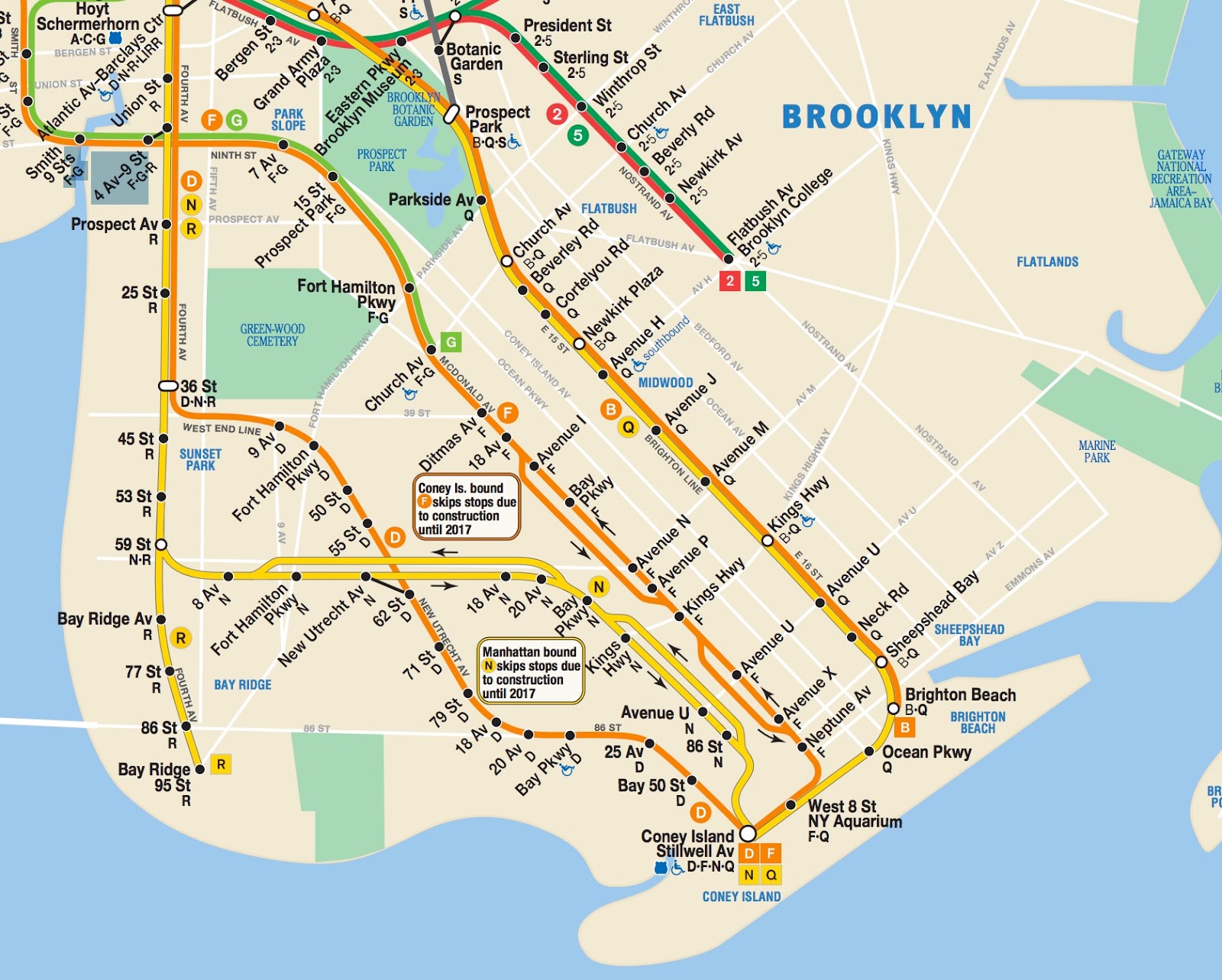
- Brooklyn Mainline (4th Avenue and West End Lines): Operates express along the 4th Avenue Line from Atlantic Avenue–Barclays Center to 36th Street, then transitions to a local service along the elevated West End Line down to Coney Island.
- Bronx Corridor (Concourse Line): Runs local along Grand Concourse at most hours, with peak-direction express service operating during weekday morning and evening rush periods.
- Late-Night Operational Adjustments: During overnight service (roughly 11:30 PM to 5:30 AM), the D train operates local across its entire route in Manhattan and Brooklyn to replace local services like the N or R lines.
All D train stations feature complete OMNY contactless fare integration, enabling seamless tap-to-enter access via smart cards, mobile wallets, or standard contactless debit and credit cards. Real-time arrival updates for all stops are published continuously on the official MTA Service Portal.
Complete Stop-by-Stop Breakdown of the NYC D Train
The table below outlines every standard stop along the D train route, organized from the northern terminal in the Bronx to the southern terminal in Brooklyn. Service designations indicate standard weekday daytime operations.
| Station Name | Borough | Station Type | Service Pattern (Daytime) | Key Transit Transfers | Accessibility (ADA) |
|---|---|---|---|---|---|
| Norwood–205 St | The Bronx | Underground | Terminal / All Times | None (Bx10, Bx16, Bx28, Bx34 buses) | No |
| Bedford Park Blvd | The Bronx | Underground | Local (Express Start/End) | B Train (Peak) | Yes |
| Kingsbridge Rd | The Bronx | Underground | Local / Peak Express | B Train | Yes |
| Fordham Rd | The Bronx | Underground | Local / Peak Express | B Train, Select Bus Service (Bx12 SBS) | Yes |
| 182nd–183rd Sts | The Bronx | Underground | Local Only | B Train | No |
| Tremont Av | The Bronx | Underground | Local / Peak Express | B Train | No |
| 174th–175th Sts | The Bronx | Underground | Local Only | B Train | No |
| 170th St | The Bronx | Underground | Local Only | B Train | No |
| 167th St | The Bronx | Underground | Local Only | B Train | No |
| 161st St–Yankee Stadium | The Bronx | Underground | Local Only | 4 Train, Metro-North (at E 153 St) | Yes |
| 155th St | Manhattan | Underground | Local Only | B Train | No |
| 145th St | Manhattan | Underground | Express / Transfer Hub | A, B, C Trains | Upper Level Only |
| 125th St | Manhattan | Underground | Express | A, B, C Trains, M60-SBS to LGA | Yes |
| 59th St–Columbus Circle | Manhattan | Underground | Express Hub | 1, A, B, C Trains | Yes |
| 7th Av (53rd St) | Manhattan | Underground | Express Track | E, B Trains | No |
| 47th–50th Sts–Rockefeller Ctr | Manhattan | Underground | Express Core | B, F, M Trains | Yes |
| 42nd St–Bryant Park | Manhattan | Underground | Express Core | 7, B, F, M Trains, (1, 2, 3, N, Q, R, W, S via tunnel) | Yes |
| 34th St–Herald Square | Manhattan | Underground | Major Express Hub | B, F, M, N, Q, R, W, PATH Train | Yes |
| Broadway–Lafayette St | Manhattan | Underground | Express Hub | 6, B, F, M, (FX, W via Downtown transfer) | Yes |
| Grand St | Manhattan | Underground | Express Track | B Train | No |
| Atlantic Av–Barclays Ctr | Brooklyn | Underground | Major Transit Hub | 2, 3, 4, 5, B, N, Q, R Trains, LIRR | Yes |
| 36th St | Brooklyn | Underground | Express Transfer | N, R Trains | No |
| 9th Av | Brooklyn | Open-Cut | Local Start (West End) | None | No |
| Fort Hamilton Pkwy | Brooklyn | Open-Cut | Local | None | No |
| 50th St | Brooklyn | Open-Cut | Local | None | No |
| 55th St | Brooklyn | Open-Cut | Local | None | No |
| 62nd St | Brooklyn | Elevated | Local | N Train (at New Utrecht Av) | Yes |
| 71st St | Brooklyn | Elevated | Local | None | No |
| 79th St | Brooklyn | Elevated | Local | None | No |
| 18th Av | Brooklyn | Elevated | Local | None | No |
| 20th Av | Brooklyn | Elevated | Local | None | No |
| Bay Pkwy | Brooklyn | Elevated | Local | None | Yes |
| 25th Av | Brooklyn | Elevated | Local | None | No |
| Bay 50th St | Brooklyn | Elevated | Local | None | No |
| Coney Island–Stillwell Av | Brooklyn | Elevated Terminal | Terminal | F, N, Q Trains | Yes |
Borough-by-Borough Route Breakdown and Technical Details
1. The Bronx Corridor: IND Concourse Line
The northern section of the D line runs underneath Grand Concourse in the Bronx. This three-track corridor accommodates both local and peak-express routing:
Peak Direction Express Rules During morning rush hours (southbound toward Manhattan), D trains utilize the center track between Bedford Park Blvd and 145th St in Manhattan, stopping only at Kingsbridge Rd, Fordham Rd, and Tremont Av. During afternoon rush hours (northbound toward the Bronx), this express service pattern operates in reverse.
- Norwood–205th St: The northern terminus located near Montefiore Medical Center. Unlike many line terminals, this is a two-track, single-island platform station with no direct cross-platform transfer to other subway lines.
- Fordham Road & Kingsbridge Road: Key commercial transport destinations serving Fordham University and Lehman College. Fordham Road offers direct connections to the Bx12 Select Bus Service across 207th Street into Manhattan.
- 161st St–Yankee Stadium: Provides high-capacity access to Yankee Stadium and the Bronx County Courthouse complex. Offers a direct transfer to the IRT Jerome Avenue Line (4 Train) and is a short walk from the Metro-North Railroad E. 153rd St Station.
2. Manhattan Core: IND Eighth Avenue & Sixth Avenue Lines
Upon entering Manhattan via the Concourse Tunnel beneath the Harlem River, the D train merges into the IND Eighth Avenue Line system at 145th Street before transferring to the IND Sixth Avenue Line at 59th Street–Columbus Circle.
- 145th Street & 125th Street: Major transfer hubs in Harlem. Passengers can switch between local B/C services and express A/D services. The 125th Street station provides direct connection to the M60-SBS bus heading to LaGuardia Airport.
- 59th Street–Columbus Circle: A critical Midtown transfer junction linking the IND lines with the IRT Broadway–Seventh Avenue Line (1 train). It serves Central Park West, Lincoln Center, and the Upper West Side.
- Midtown Express Axis (47th–50th Sts to 34th St–Herald Square): The highest-density segment of the D route. Stations along this corridor serve major international landmarks including Rockefeller Center, Radio City Music Hall, Bryant Park, the New York Public Library Main Branch, and the Empire State Building.
- Grand Street: The final station in Manhattan. Located in Chinatown, this high-volume station features two tracks and two side platforms, taking trains directly onto the north tracks of the Manhattan Bridge toward Brooklyn.
3. Brooklyn Transit Sector: 4th Avenue & West End Lines
Crossing the Manhattan Bridge, the D train provides views of lower Manhattan and the East River before entering Brooklyn near Downtown.
Manhattan Bridge Routing Mechanics The D train runs on the north side of the Manhattan Bridge, which leads directly onto the IND/BMT lines in Brooklyn without slowing down local corridor traffic along Broadway or Nassau Street.
- Atlantic Avenue–Barclays Center: The principal transit interchange in Brooklyn. Riders can access nine subway lines (2, 3, 4, 5, B, D, N, Q, R) and regional rail via the Long Island Rail Road (LIRR) at Atlantic Terminal.
- 36th Street Junction: The D train operates express along 4th Avenue alongside the N train, bypassing local stops at Union St, 9th St, 15th St–Prospect Park, and 25th St. At 36th Street, the line branches east onto the IND/BMT West End Line.
- West End Elevated Line (9th Av to Bay 50th St): Traveling through Sunset Park, Borough Park, Bensonhurst, and Bath Beach, this section operates primarily as an elevated structural line above New Utrecht Avenue and 86th Street.
- Coney Island–Stillwell Avenue: The southern terminal for the D train. This station features eight tracks and four island platforms under a solar panel roof structure, offering transfers to the F, N, and Q trains near the Coney Island boardwalk and amusement district.
Express vs. Local Service Variations Across Schedules
Operating patterns for the D line change throughout the day to optimize system capacity across Midtown Manhattan and outer-borough connectors.
(No flowcharts or ASCII diagrams - narrative text below)
Daytime & Weekday Hours (6:00 AM – 11:00 PM)
- Bronx: Local service (except peak-direction express bypasses on weekdays).
- Manhattan: Express service on 8th Ave (145th to 59th) and 6th Ave (59th to Grand St).
- Brooklyn: Express service along 4th Avenue (Atlantic Av to 36th St); local service along West End Line (36th St to Coney Island).
Late-Night Hours (11:30 PM – 5:30 AM)
- Bronx: Local service at all stations.
- Manhattan: Operates local along 6th Avenue to maintain service frequency at local stops (such as 14th St and 23rd St) when B and M trains are not running.
- Brooklyn: Operates local along 4th Avenue, making all stops between Atlantic Av and 36th St (replacing late-night R local trips or supplementing N local service).
Commuter & Transfer Strategy Guide
Critical Airport Connections
While the D train does not run directly to any New York regional airport, it provides strategic connections to airport transit corridors:
- To John F. Kennedy International Airport (JFK): Take the D train to 34th St–Herald Square or Atlantic Av–Barclays Center, transfer to the Long Island Rail Road (LIRR) to Jamaica Station, and connect to the JFK AirTrain.
- To LaGuardia Airport (LGA): Take the D train to 125th St in Manhattan and transfer directly to the M60-SBS bus line, which runs directly to Terminals A, B, and C.
- To Newark Liberty International Airport (EWR): Take the D train to 34th St–Herald Square, walk one block west to New York Penn Station, and board NJ Transit rail service to Newark Airport Station.
Essential System Transfer Hubs
(Formatting standard text/list format)
- 34th St–Herald Square: Cross-platform transfer to B, F, and M trains; mezzanine connection to N, Q, R, and W services; direct connection to the PATH network for interstate travel to New Jersey.
- Broadway–Lafayette St / Bleecker St: Transfers between 6th Avenue (B, D, F, M) and IRT Lexington Avenue Line (6 train), allowing connections to Midtown East and the Financial District.
- Atlantic Av–Barclays Center: Connects Brooklyn commuters to express IRT services (2, 3, 4, 5) heading to East New York, Crown Heights, or Manhattan's West Side.
Accessibility and ADA Upgrades
Under the MTA's Capital Program guidelines, several historical stations along the D line have received accessibility modifications, including modern elevator installations, tactile platform edge striping, enhanced audio-visual communication systems, and accessible boarding areas.
Accessible D Train Stations
- Bronx: Bedford Park Blvd, Kingsbridge Rd, Fordham Rd, 161st St–Yankee Stadium.
- Manhattan: 125th St, 59th St–Columbus Circle, 47th–50th Sts–Rockefeller Ctr, 42nd St–Bryant Park, 34th St–Herald Sq, Broadway–Lafayette St.
- Brooklyn: Atlantic Av–Barclays Ctr, 62nd St (New Utrecht Av complex), Bay Pkwy, Coney Island–Stillwell Av.
Riders requiring elevator access should verify real-time equipment status using the official elevator and escalator tracking tool on the MTA Equipment Status Page prior to traveling.
Frequently Asked Questions
What are the main terminal stops for the NYC D train?
The northern terminal for the D train is Norwood–205 St in the Bronx, and the southern terminal is Coney Island–Stillwell Av in Brooklyn.
These terminals operate 24 hours a day, connecting northern Bronx residential zones through Manhattan directly to Brooklyn's southern coast.
Does the D train run express in Manhattan?
Yes, the D train runs as an express service in Manhattan during daytime hours.
It bypasses local stops between 145th St and 59th St–Columbus Circle, and along 6th Avenue between 59th St–Columbus Circle and Grand St. During late-night hours, it converts to local service to maintain station coverage across the corridor.
Does the D train cross the Manhattan Bridge?
Yes, the D train crosses the East River via the north tracks of the Manhattan Bridge.
This bridge passage connects the Grand St station in lower Manhattan directly to the Atlantic Av–Barclays Ctr station in Brooklyn, bypassing lower Manhattan local tunnels.
How long does the entire D train trip take from end to end?
A full end-to-end trip from Norwood–205 St in the Bronx to Coney Island–Stillwell Av in Brooklyn takes approximately 75 to 90 minutes.
Travel times vary based on time of day, peak express patterns in the Bronx, and late-night local route adjustments.
What train line replaces the D train's express service late at night?
No express train replaces the D train late at night; instead, the D train itself switches to local service in Manhattan and Brooklyn.
Because local services like the B line do not run during late-night hours, the D train absorbs these stops to maintain overnight subway access.
Image Gallery