Donna Douglas Swimsuit Photos: The Legacy of a Mid-Century Hollywood Icon
Donna Douglas’s iconic swimsuit photos capture a defining moment in mid-century American pop culture, tracing her transition from 1950s Southern beauty queen to major Hollywood television star. Best known as Elly May Clampett on The Be...
Donna Douglas’s iconic swimsuit photos capture a defining moment in mid-century American pop culture, tracing her transition from 1950s Southern beauty queen to major Hollywood television star. Best known as Elly May Clampett on The Beverly Hillbillies, Douglas’s publicity swimwear photography showcased 1960s resort fashion and highlighted the striking contrast between her glamorous real-life image and her famous on-screen tomboy character.
Contents
From Louisiana Beauty Queen to New York Model
Before becoming one of the most recognizable faces on 1960s American television, Donna Douglas (born Doris Ione Smith on September 26, 1932, near Pride, Louisiana) established her public presence through beauty pageants and swimsuit modeling. Raised in East Baton Rouge Parish, Douglas grew up active in outdoor sports, playing softball and basketball in high school—skills that later contributed to her athletic posture and natural poise in front of the camera.
In the mid-1950s, Douglas entered local and regional beauty contests, earning the titles of Miss Baton Rouge and Miss New Orleans in 1957. During this era, beauty competitions relied heavily on standardized swimsuit modeling segments to evaluate posture, physical fitness, and poise under stage lighting. The garments worn in these pageants were typical of late-1950s resort wear, characterized by structured interiors, modest leg cuts, and heavy elasticized textiles.
Winning regional titles prompted Douglas to move to New York City to pursue a professional career in modeling and acting. In New York, she quickly secured commercial assignments, appearing in print advertisements for national consumer brands and work as a featured billboard model. Her national television breakthrough occurred when she was cast as the "Letters Girl" on The Perry Como Show and made frequent appearances on The Steve Allen Show. These early television gigs frequently showcased her modeling background, setting the foundation for her transition to Hollywood studio contract work.
- 1957: Wins Miss Baton Rouge and Miss New Orleans pageants.
- 1958: Relocates to New York City; begins commercial print and swimsuit modeling.
- 1959: Appears on national variety broadcasts (The Perry Como Show, The Steve Allen Show).
- 1959: Film debut in Career (uncredited) and contract acting roles in Los Angeles.
- 1962: Cast as Elly May Clampett on CBS's The Beverly Hillbillies.
The Elly May Contrast: Studio Marketing vs. Character Arc
When producer Paul Henning created The Beverly Hillbillies in 1962, he searched extensively for an actress who could embody both striking physical beauty and believable rural innocence. Out of more than 500 actresses auditioned, Douglas secured the role of Elly May Clampett.
On screen, Elly May was famous for her rustic wardrobe: dark blue denim jeans held up by a simple piece of rope, a checkered flannel shirt, and blonde pigtails. Her character spent more time wrestling chimpanzees, feeding dogs, and climbing trees than displaying conventional Hollywood glamour.
However, the CBS publicity department and production company Filmways utilized a completely different marketing strategy behind the scenes. To promote the series to national magazines, newspapers, and television guides, studio photographers regularly photographed Douglas in high-fashion swimwear, posing alongside the swimming pool at the Clampett family mansion (famously referred to on the show as the "cement pond").
| ON-SCREEN CHARACTER (Elly May Clampett) | OFF-SCREEN PUBLICITY IMAGE |
|---|---|
| • Blue denim jeans with rope belt | • Tailored studio swimsuits |
| • Flannel shirts and high collars | • High-fashion beachwear |
| • Tomboy traits & animal handler storylines | • Glamour pin-up aesthetics |
| • Minimal makeup, rustic pigtails | • Styled blonde bouffant |
This juxtaposition was central to the show's promotional campaign. While viewers tuned in weekly to watch Elly May out-run suitors and tend to her farm animals, print publications feature articles consistently showcased Douglas as a polished Hollywood starlet. Occasional episodes of The Beverly Hillbillies incorporated the estate's pool into the plot, giving the writers a natural context to feature Douglas in swimwear without breaking the show's comedic premise.
Mid-Century Swimwear Fashion: Design and Technical Features
The swimsuit photos of Donna Douglas from the late 1950s and mid-1960s serve as an architectural catalog of mid-century American resort fashion. Swimwear design during this period underwent significant transformation, shifting from rigid, foundation-garment construction toward more flexible synthetic textiles.
Textile Composition and Engineering
During the late 1950s and early 1960s, swimsuits were engineered to hold a pre-shaped silhouette regardless of the wearer's body shape. Key materials included:
- Lastex: A revolutionary yarn composed of a rubber core wrapped in cotton, rayon, or silk thread. Lastex allowed fabrics to stretch and retract, providing firm shaping across the midsection.
- Cotton Satin and Brocade: Woven non-stretch face fabrics lined with elasticized panels, often featuring decorative surface patterns, floral motifs, or metallic threading.
- Early Nylon Blends: Introduced to reduce drying time, though initial iterations lacked the multi-directional stretch of modern elastane fabrics.
Garment Silhouette and Interior Construction
Swimsuits from Douglas's publicity shoots featured precise internal engineering designed for vintage photography lighting. Internal support systems utilized sewn-in wire boning, spiral steel stays along the side seams, and molded foam cups. These features allowed strapless sweetheart necklines to maintain structural integrity without slipping during movement.
Bottom cuts during this era were conservative by modern standards. Swimsuits featured low-cut leg openings—often referred to as boy-leg or sheath cuts—that extended horizontally across the upper thigh to provide full coverage. High-waisted two-piece sets covered the navel, emphasizing an hourglass ratio while remaining compliant with network standards and general audience print media guidelines.
| Design Feature | 1950s–1960s Original Swimsuits (Donna Douglas Era) | Modern Retro Reproduction Swimwear | Architectural Function |
|---|---|---|---|
| Primary Fabric | Lastex, cotton-satins, heavy woven rayon-nylon blends | Spandex (Elastane), polyester, lightweight quick-dry synthetics | Vintage textiles held shape rigidly; modern fabrics rely on dynamic multi-way stretch. |
| Internal Support | Built-in steel boning, rigid molded foam cups, inner girdle panels | Soft removable pads, flexible underwire, light mesh lining | Vintage suits functioned as exterior shapewear; modern suits prioritize comfort and mobility. |
| Leg Line Cut | Low-cut horizontal leg lines, boy-leg sheaths, skirted fronts | Variable cuts, high-cut leg openings, cheeky or mid-coverage rears | Mid-century cuts minimized hip exposure, focusing attention on the natural waistline. |
| Closures | Heavy-duty metal back zippers, metal hook-and-eye closures | Pull-on construction, plastic sliders, lightweight synthetic zips | Heavy hardware was required to secure stiff, non-stretch woven panels against tension. |
| Necklines | Sweetheart, halter straps, wide-set shoulder bands | Wide variety including plunge, asymmetrical, scoop, and triangle | Structured boning supported dramatic strapless and sweetheart cuts for photo shoots. |
Key Photo Shoots, Film Roles, and Media Coverage
Throughout her career under contract with CBS and independent studios, Donna Douglas participated in hundreds of controlled publicity shoots. These sessions took place across Los Angeles studio backlots, private estates in Bel Air, and coastal locations in Southern California.
Studio Publicity Stills (1962–1971)
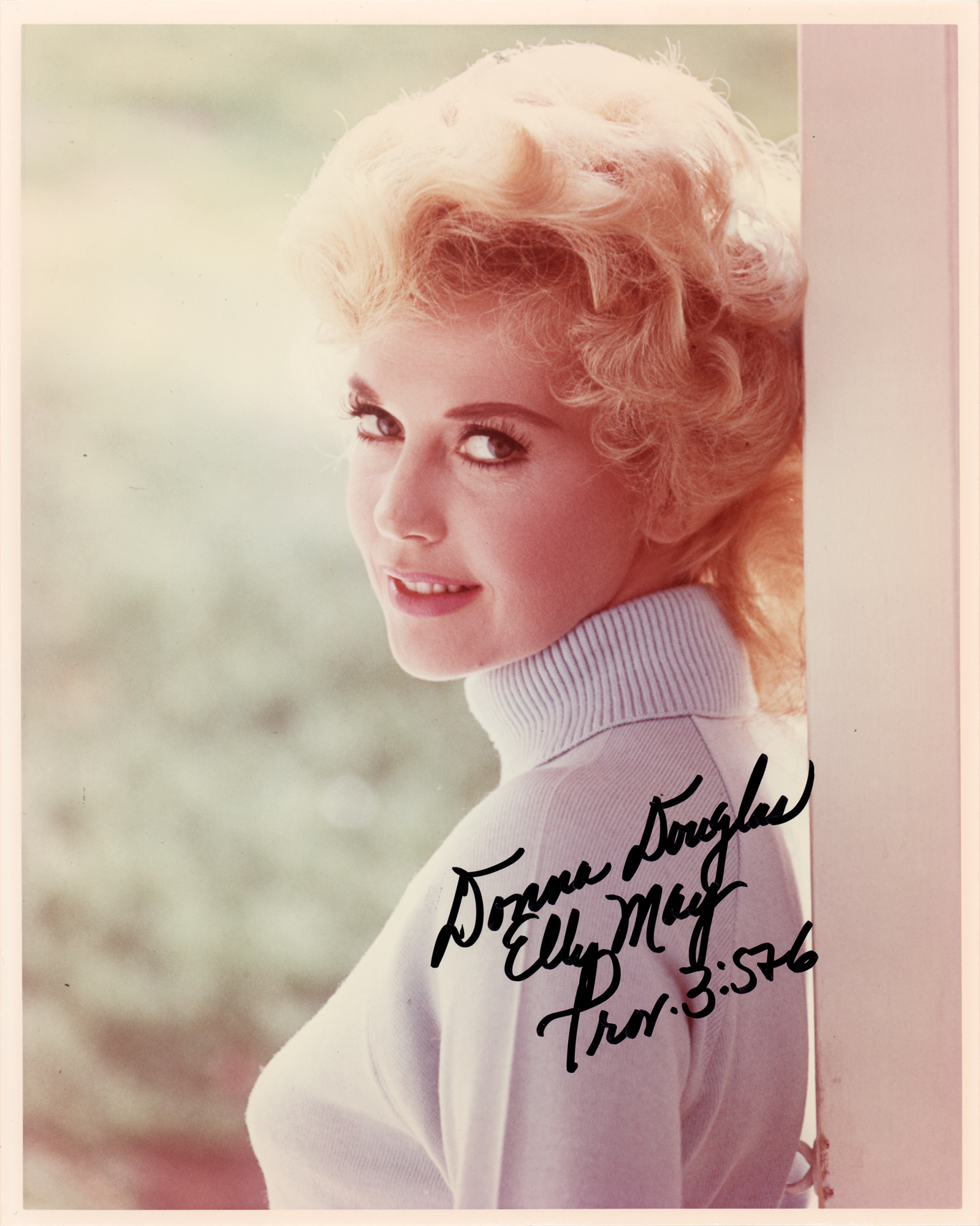
The majority of iconic Donna Douglas swimsuit images were produced by CBS staff photographers for press distribution kits. These images were mailed directly to newspaper entertainment editors, magazine publishers, and television listing syndicates.
Photographers typically favored natural sunlight paired with fill reflectors around pool decks to highlight Douglas's signature blonde hair and bright blue eyes. Favorite wardrobe selections included white one-piece sheath suits, classic polka-dot patterns, and gingham-printed halter swimsuits that bridged the gap between rustic charm and Hollywood glamour.
Frankie and Johnny (1966)
In 1966, Douglas starred opposite Elvis Presley in the United Artists musical film Frankie and Johnny. Set along the Mississippi River in the 1890s, the film required period-accurate wardrobe for its narrative scenes.
However, during the international promotional tour for the movie, United Artists released updated glamour portraits and resort wear promotional stills of Douglas to market the picture to younger audiences. These images further cemented her status alongside contemporaries like Elizabeth Montgomery (Bewitched), Barbara Eden (I Dream of Jeannie), and Yvonne De Carlo (The Munsters) as leading icons of 1960s pop culture.
- Key Media Outlets Featuring Donna Douglas Stills:
- TV Guide (Multiple cover stories and internal photo spreads)
- Life Magazine (Feature layouts covering cast popularity)
- Look Magazine (Focus on Hollywood fashion trends)
- Motion Picture Magazine & Photoplay (Glamour and pin-up spreads)
Collecting Original Donna Douglas Swimsuit Photographs
For photographic archivists, entertainment memorabilia collectors, and vintage fashion historians, original publicity photographs of Donna Douglas are highly prized items. Navigating the collector market requires an understanding of mid-century print photography techniques and studio distribution practices.
Identifying Authentic Vintage Press Prints
Not all physical photographs available on secondary markets are original period items. Collectors evaluate several physical characteristics to confirm authenticity:
- Paper Stock and Finish: Original studio press photos from the 1950s and 1960s were typically printed on fiber-based paper rather than modern resin-coated (RC) paper. Fiber-based prints have a distinct weight, texture, and natural curl along the edges.
- Backstamps and Press Captions: Authentic wire photos and press stills feature physical stamps on the reverse side. Look for inked studio logos (e.g., "CBS Television Network Press Department"), photographer credit lines, or pasted paper caption slips ("sluglines") explaining the context of the image.
- Chemical Toning and Aging: Black-and-white silver gelatin prints from the era show subtle tonal shifts over time, particularly along the margins, while vintage color prints (often produced on Ektacolor paper) exhibit specific color fading profiles distinct from digital reproductions.
- VERIFICATION CHECKLIST FOR COLLECTORS
- Check paper type (Fiber-based paper indicating pre-1970s chemical production)
- Inspect reverse side for studio stamp, date imprint, or paper caption slug
- Examine edge wear and corner sharpness (Authentic age vs. artificial aging)
- Verify image clarity (Direct print from original negative vs. second-gen copy)
- Ensure absence of digital halftone dot patterns under magnification
Preservation and Archival Care
To maintain the physical condition of vintage photographic prints featuring Donna Douglas, collectors follow established archival guidelines:
- Sleeving Materials: Photos should be housed in inert plastic sleeves made from polypropylene, polyester (Mylar), or polyethylene. Avoid vinyl or polyvinyl chloride (PVC) sleeves, which release harmful plasticizers that degrade photographic emulsions.
- Environmental Control: Store prints in a climate-controlled room with relative humidity levels between 30% and 50% and temperatures below 70°F (21°C). Fluctuations in humidity cause paper warping and emulsion cracking.
- Light Exposure: Keep vintage photographs out of direct sunlight and fluorescent light, both of which emit high levels of ultraviolet (UV) radiation that fade silver gelatin and color dyes. Use UV-filtering acrylic glass when framing original prints for display.
Frequently Asked Questions
Did Donna Douglas win any major beauty pageants before acting?
Yes. Before moving to New York City to pursue modeling and acting, Donna Douglas won local and regional beauty titles in Louisiana, including Miss Baton Rouge and Miss New Orleans in 1957. These pageant victories involved standardized swimsuit modeling segments that launched her early commercial print career.
What swimsuit style was Donna Douglas most famous for wearing?
In her studio publicity stills, Douglas was frequently photographed in 1960s classic one-piece sheath swimsuits featuring sweetheart necklines, internal boning, and low-cut leg openings. She was also widely photographed in high-waisted two-piece suits featuring polka dot, gingham, and solid white fabrics.
Did Elly May Clampett wear a swimsuit on The Beverly Hillbillies?
Yes, though infrequently compared to her standard denim wardrobe. Because the Clampett mansion featured an outdoor swimming pool (referred to by the family as the "cement pond"), specific storylines occasionally called for Elly May to wear modest, period-appropriate swimsuits during backyard scenes.
How can collectors spot a modern reproduction photo versus an original studio press print?
Original press prints from the 1950s and 1960s were produced on fiber-based photo paper and usually feature studio ink stamps, dates, or pasted paper caption slugs on the back. Modern reproductions are typically printed on resin-coated paper or display digital halftone dot patterns when viewed under magnification.
Where can authentic photos of Donna Douglas be viewed today?
Authentic archival prints and original studio negatives are preserved in major media archives, including the CBS Photo Archive, the Getty Images Editorial Collection, and the Library of Congress entertainment collections. High-resolution scans are frequently made available through digital historic archives for research and educational purposes.
Practical Recommendations for Historians and Collectors
Whether researching 1960s television history or building a personal collection of mid-century Hollywood memorabilia, clear procedures help ensure historical accuracy and asset preservation.
- Cross-Reference Press Slugs with Episode Air Dates: When cataloging publicity prints, match the CBS press slug date on the reverse of the photo with the broadcast history of The Beverly Hillbillies. Studio photo shoots were often timed to release two to three weeks prior to specific high-rating television episodes.
- Source from Accredited Vintage Photo Dealers: Acquire original press stills through established auction houses or specialized photographic dealers who provide clear provenance details and authenticity guarantees regarding vintage print age.
- Study Period Textile Construction: For fashion historians recreating vintage garments, examine the internal structural elements of mid-century suits—such as Lastex weaving and spiral boning—rather than relying solely on surface appearances, as internal foundation construction defines the signature silhouette seen in Douglas's photos.
Image Gallery