NYPD Police Salary in 2026: Comprehensive Pay Scale and Benefits Guide
As of 2026, the starting base salary for a New York City Police Department (NYPD) officer is approximately $58,580, which scales through a series of contractual steps to a top base pay of $109,192 after five and a half years of service...
As of 2026, the starting base salary for a New York City Police Department (NYPD) officer is approximately $58,580, which scales through a series of contractual steps to a top base pay of $109,192 after five and a half years of service. When including longevity pay, night shift differentials, and overtime, total compensation for experienced officers often exceeds $155,000 annually.
Contents
The 2026 NYPD Pay Scale: A Step-by-Step Progression
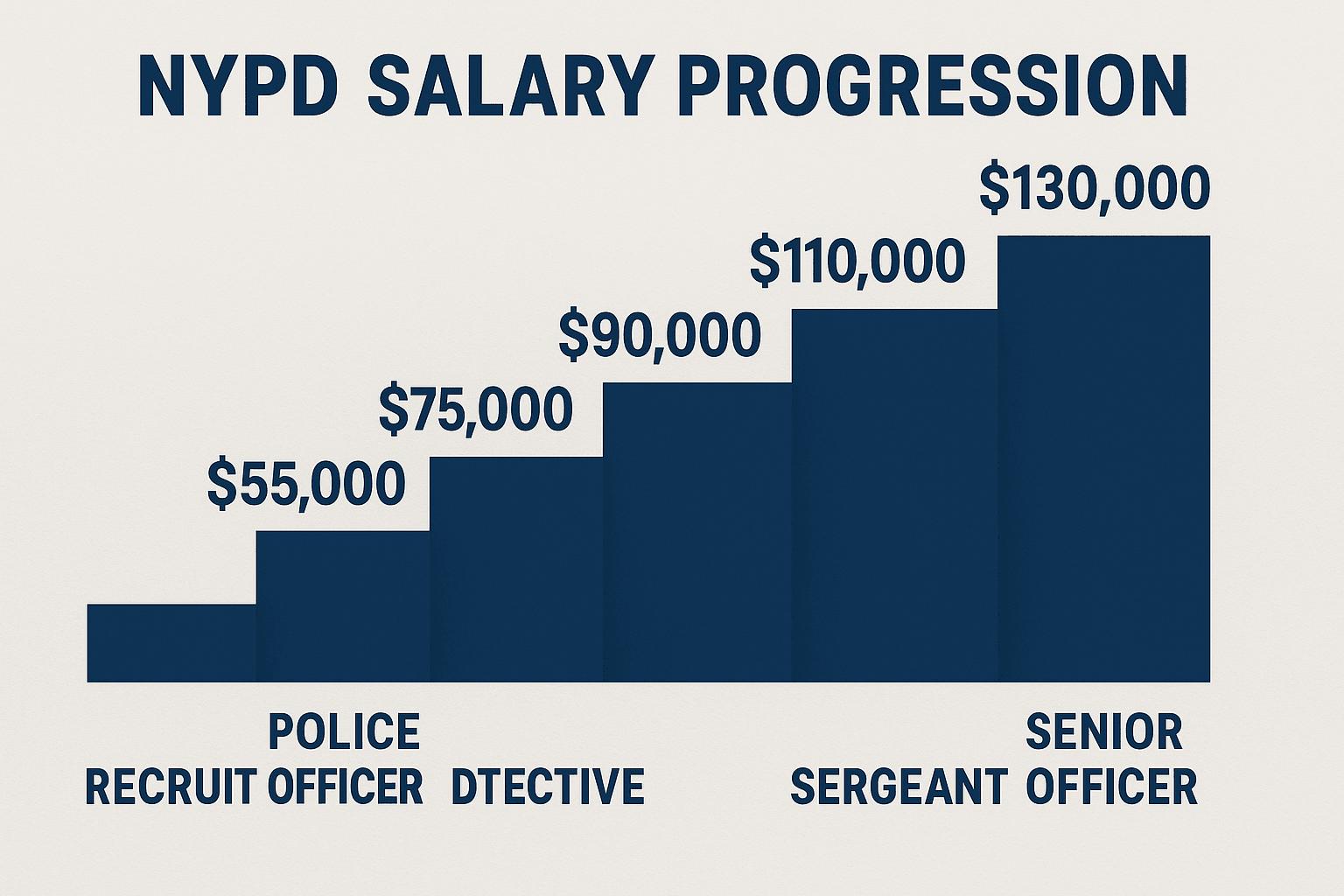
The compensation structure for the NYPD is defined by a rigorous "step" system established through collective bargaining agreements between the City of New York and the Police Benevolent Association (PBA). For those entering the academy in 2026, the financial trajectory is predictable and legally protected, providing a clear path from entry-level recruit to a six-figure base salary.
Unlike many private-sector roles where raises are merit-based or discretionary, NYPD salary increases are automatic based on time in grade. This ensures that every officer reaching the 5.5-year milestone attains the same "top pay" status, regardless of their specific precinct or assignment.
2026 Estimated Base Salary Table
The following table outlines the base salary progression for an officer hired in the 2026 fiscal cycle. These figures represent base pay only and do not include mandatory overtime, holiday pay, or shift differentials.
| Years of Service | Estimated Base Salary (2026) | Approximate Total with Standard Additives |
|---|---|---|
| Academy / First Year | $58,580 | $62,000 - $65,000 |
| After 1.5 Years | $62,450 | $68,000 - $72,000 |
| After 2.5 Years | $68,320 | $75,000 - $80,000 |
| After 3.5 Years | $75,890 | $85,000 - $92,000 |
| After 4.5 Years | $88,440 | $105,000 - $115,000 |
| After 5.5 Years (Top Pay) | $109,192 | $150,000 - $165,000+ |
Total Compensation: Beyond the Base Salary
In 2026, focusing solely on the base salary misses nearly 30% to 40% of an officer's actual take-home pay. The NYPD compensation model relies heavily on "additives"—extra payments triggered by specific working conditions or tenure milestones.
Overtime and Holiday Pay
New York City's high-demand policing environment necessitates significant overtime. While the city has implemented various budget management strategies, the operational reality of 24/7 policing ensures that overtime remains a staple of the NYPD paycheck. Officers are paid at a rate of time-and-a-half for hours worked beyond their scheduled tours. Additionally, officers receive extra compensation for working on designated legal holidays.
Night Shift Differential
Policing is a 24-hour operation. Officers assigned to "late" or "overnight" tours receive a night shift differential, typically calculated as a percentage of their hourly rate (usually 10%). This differential is a critical component for junior officers who are frequently assigned to evening or midnight shifts.
Longevity Increments
As an officer stays with the department, they become eligible for longevity pay. These are fixed annual sums added to the base salary starting at the 5-year mark, with subsequent increases at 10, 15, and 20 years of service. In 2026, these increments serve as a retention tool to keep experienced officers within the department.
Uniform Allowance
Every NYPD officer receives an annual uniform allowance, currently valued at approximately $1,100. This is intended to cover the costs of maintaining, cleaning, and replacing duty gear and official uniforms.
Health and Insurance Benefits in 2026
The City of New York provides a robust benefits package that often surpasses what is available in the private sector. For 2026 hires, these benefits provide long-term financial security for both the officer and their family.
Health Insurance Coverage
NYPD officers can choose from several health insurance plans, with the most common being the GHI-CBP (Comprehensive Benefits Plan) and HIP (Health Insurance Plan of Greater New York). As of 2026, basic coverage for the officer and their immediate family is generally provided at no premium cost to the employee, though co-pays for specific services apply.
Prescription and Dental Benefits
These benefits are typically administered through the PBA Health and Welfare Fund rather than directly by the City. The fund provides comprehensive prescription drug coverage, dental insurance, and vision care. In 2026, the fund continues to offer high-tier coverage for specialized dental procedures and orthodontic care, which are often expensive out-of-pocket costs in other industries.
Retirement and Pension Structure
One of the primary reasons individuals join the NYPD is the retirement package. While the pension tiers have evolved over the decades, the 2026 retirement system remains one of the most stable public safety pensions in the United States.
The Tier 3 Modified / Tier 6 Pension
Most officers hired in 2026 fall under the Tier 3 Modified or Tier 6 pension structures. Key features of this retirement plan include:
- Service Requirement: Officers are eligible for a service retirement pension after 22 years of creditable service.
- Pension Amount: Upon reaching 22 years, officers typically receive 50% of their Final Average Salary (FAS). The FAS is calculated based on the highest consecutive three years of earnings.
- Variable Supplement Fund (VSF): Often referred to as the "Holiday Bonus," eligible retirees receive an annual payment of $12,000 from the VSF. This payment is fixed and does not increase with inflation, but it provides a significant supplement to the standard pension check.
Deferred Compensation Plans
In addition to the defined benefit pension, NYPD officers in 2026 have access to 401(k) and 457(b) Deferred Compensation Plans. These allow officers to invest a portion of their pre-tax income into various mutual funds and target-date funds, creating a supplemental "third leg" of retirement income alongside the pension and Social Security.
Eligibility and Requirements for 2026 Candidates
The path to receiving an NYPD salary begins with the Civil Service Exam. To be eligible for hire in 2026, candidates must meet stringent physical, mental, and legal requirements.
- Educational Requirements: Candidates must have earned 60 college credits with a minimum 2.0 GPA from an accredited institution or have two years of active military service.
- Age Limits: You must be at least 21 years of age to be appointed, but you can take the entrance exam at 17.5 years old. Candidates must not have reached their 35th birthday by the time they take the exam (though certain military exceptions apply).
- Residency: Officers must reside within one of the five boroughs of NYC or in the surrounding counties of Nassau, Suffolk, Westchester, Rockland, Orange, or Putnam.
- Character and Background: A thorough background check, including criminal history, driving record, and financial stability, is mandatory. Any felony conviction is an automatic disqualification.
NYPD vs. Surrounding Agencies: A Comparative Analysis
When researching the "nypd police salary," it is vital to compare it against neighboring jurisdictions. While the NYPD offers the most diverse career opportunities and specialized units, surrounding agencies in the New York metropolitan area often offer higher base salaries.
| Agency | 2026 Est. Starting Pay | 2026 Est. Top Pay | Years to Top Pay |
|---|---|---|---|
| NYPD | $58,580 | $109,192 | 5.5 Years |
| Nassau County PD | $42,000 (Academy) | $135,000+ | 9 Years |
| Suffolk County PD | $46,000 | $145,000+ | 12 Years |
| Port Authority PD | $65,000 | $120,000+ | 6 Years |
While Nassau and Suffolk County departments eventually reach higher top pay figures, the NYPD has a significantly faster "ladder" to $100k+ base pay (5.5 years compared to 9 or 12 years). Furthermore, the sheer size of the NYPD (over 30,000 officers) means there are more opportunities for promotion to Sergeant, Lieutenant, and Captain, or for assignment to elite units like ESU (Emergency Service Unit), K-9, or the Intelligence Bureau.
Career Advancement and Promotional Salary Increases
Promotion is the fastest way to increase your salary within the NYPD. Each rank carries its own distinct pay scale that sits above the standard Police Officer steps.
Sergeant (Sgt)
Promotion to Sergeant is competitive and requires passing a civil service exam. In 2026, the base salary for a Sergeant starts at approximately $120,000 and rises to over $138,000. Sergeants also receive higher longevity increments and shift differentials.
Lieutenant (Lt)
Lieutenants serve as mid-level managers. Their 2026 base salary typically starts around $145,000 and can exceed $165,000 with additives. Lieutenants are exempt from some overtime rules but often receive "comp time" or specialized managerial pay.
Detective (Det)
The rank of Detective is a discretionary promotion based on investigative performance rather than a civil service exam. There are three grades of Detective (3rd, 2nd, and 1st).
- 3rd Grade: Pay is roughly equivalent to a Police Officer at top pay.
- 2nd Grade: Pay is roughly equivalent to a Sergeant.
- 1st Grade: Pay is roughly equivalent to a Lieutenant.
Challenges and Considerations: The Real Cost of Living
While a $100,000+ salary is substantial, it must be viewed within the context of the New York City metropolitan area's cost of living. In 2026, housing costs, taxes, and general inflation remain high in the "NYPD-allowed" counties.
- Taxes: Officers living within NYC are subject to the New York City resident income tax, which can take an additional 3-4% of gross pay.
- Commuting: For officers living in Orange or Putnam counties, the cost of tolls and fuel for the daily commute to a precinct in Brooklyn or Queens can be several thousand dollars per year.
- Work-Life Balance: The higher "total compensation" figures are often the result of mandatory overtime (forced 12-hour shifts or canceled days off), which can impact family life and mental health.
Frequently Asked Questions
How long does it take to reach the $100,000 base salary mark in the NYPD?
In 2026, an officer reaches the "Top Pay" bracket after completing five and a half years of service. At this milestone, the base salary jumps to $109,192, though total compensation usually hits the $100k mark much earlier (around year 4) when overtime and differentials are included.
Do NYPD recruits get paid while in the Police Academy?
Yes, recruits are paid the full starting base salary (approx. $58,580 in 2026) beginning on their first day of training at the NYPD Police Academy in College Point, Queens. They also receive full health benefits during the six-month training period.
Is there a residency requirement for the NYPD in 2026?
Yes. You must be a resident of one of the five NYC boroughs or the surrounding New York State counties of Nassau, Suffolk, Westchester, Rockland, Orange, or Putnam. Living in New Jersey, Connecticut, or Pennsylvania is generally not permitted for NYPD officers.
What is the "Variable Supplement Fund" in the NYPD pension?
The Variable Supplement Fund (VSF) is a specialized benefit that pays retired NYPD officers a flat $12,000 per year in addition to their standard pension. It is often referred to as the "Police Officer's Holiday Bonus" and is paid annually in December.
Can an NYPD officer earn more than a Sergeant through overtime?
It is common for "Top Pay" Police Officers to out-earn Sergeants or even Lieutenants by working excessive overtime. While a Sergeant has a higher base pay, a Police Officer working a high-activity precinct or specialized detail with high OT demand can see total compensation exceed $170,000.
Summary of the 2026 NYPD Financial Outlook
Choosing a career with the NYPD in 2026 offers a blend of high-intensity public service and long-term financial stability. While the starting salary requires a period of financial discipline, the rapid ascent to a six-figure base salary in under six years is a timeline rarely matched in other government sectors. Prospective candidates should weigh the high cost of living in the NYC area against the lifetime value of the Tier 6 pension and the comprehensive health benefits that protect them and their families.
For those ready to begin the process, the first step is monitoring the DCAS (Department of Citywide Administrative Services) website for upcoming exam dates and ensuring all educational prerequisites are met before the filing period ends.
Image Gallery