VTI vs. VXUS: The Essential Guide to Balancing Domestic and International ETFs in 2026
VTI (Vanguard Total Stock Market ETF) provides exposure to the entire investable United States equity market, while VXUS (Vanguard Total International Stock ETF) covers nearly all non-U.S. markets, including developed and emerging econ...
VTI (Vanguard Total Stock Market ETF) provides exposure to the entire investable United States equity market, while VXUS (Vanguard Total International Stock ETF) covers nearly all non-U.S. markets, including developed and emerging economies. Choosing between them involves balancing the high-growth potential of U.S. technology with the valuation benefits and diversification of global markets in a 2026 portfolio.
Contents
Vanguard remains a titan in the low-cost indexing space, and these two ETFs represent the bedrock of the "Boglehead" investment philosophy. While the 2020s have seen significant volatility and shifts in interest rate environments, the core mechanics of these funds have remained remarkably consistent. Understanding their structural differences, tax implications, and performance drivers is critical for any investor looking to build a resilient portfolio.
Understanding the Core: VTI Technical Overview
The Vanguard Total Stock Market ETF (VTI) is designed to track the CRSP US Total Market Index. This index represents 100% of the investable U.S. stock market, including mega-, large-, mid-, small-, and micro-cap stocks. As we move through 2026, VTI remains the gold standard for U.S. equity exposure due to its extreme efficiency and broad reach.
The fund utilizes a representative sampling strategy, meaning it holds a vast majority of the stocks in the index to mirror its performance without the administrative cost of buying every single micro-cap security. In 2026, VTI continues to offer an industry-leading expense ratio of 0.03%, making it one of the cheapest ways to own the entire U.S. economy.
Key Characteristics of VTI
- Total Holdings: Typically exceeds 3,700 stocks.
- Market Cap Weighting: Large-cap stocks like Apple, Microsoft, and NVIDIA dominate the top holdings, while thousands of smaller companies provide the "long tail" of the U.S. economy.
- Sector Concentration: Historically heavy in Technology, Financials, and Healthcare.
- Dividend Yield: Generally fluctuates between 1.3% and 1.6% based on market valuations.
Expanding Horizons: VXUS Technical Overview
The Vanguard Total International Stock ETF (VXUS) seeks to track the FTSE Global All Cap ex US Index. This index provides exposure to both developed and emerging markets outside the United States. For investors in 2026, VXUS serves as the primary tool to hedge against domestic economic downturns and to capture growth in rapidly industrializing nations.
VXUS covers approximately 98% of the world’s non-U.S. market capitalization. Unlike VTI, which is purely domestic, VXUS spans across Europe, the Pacific, and Emerging Markets (such as China, India, and Brazil). Its expense ratio stands at 0.08%, which is slightly higher than VTI’s due to the increased complexity of trading in dozens of international jurisdictions, yet it remains significantly lower than the category average.
Key Characteristics of VXUS
- Total Holdings: Approximately 8,000 stocks, offering even broader diversification by name count than VTI.
- Geographic Split: Usually divided between 40% Developed Europe, 25% Pacific, and 25% Emerging Markets, with the remainder in Canada and the Middle East.
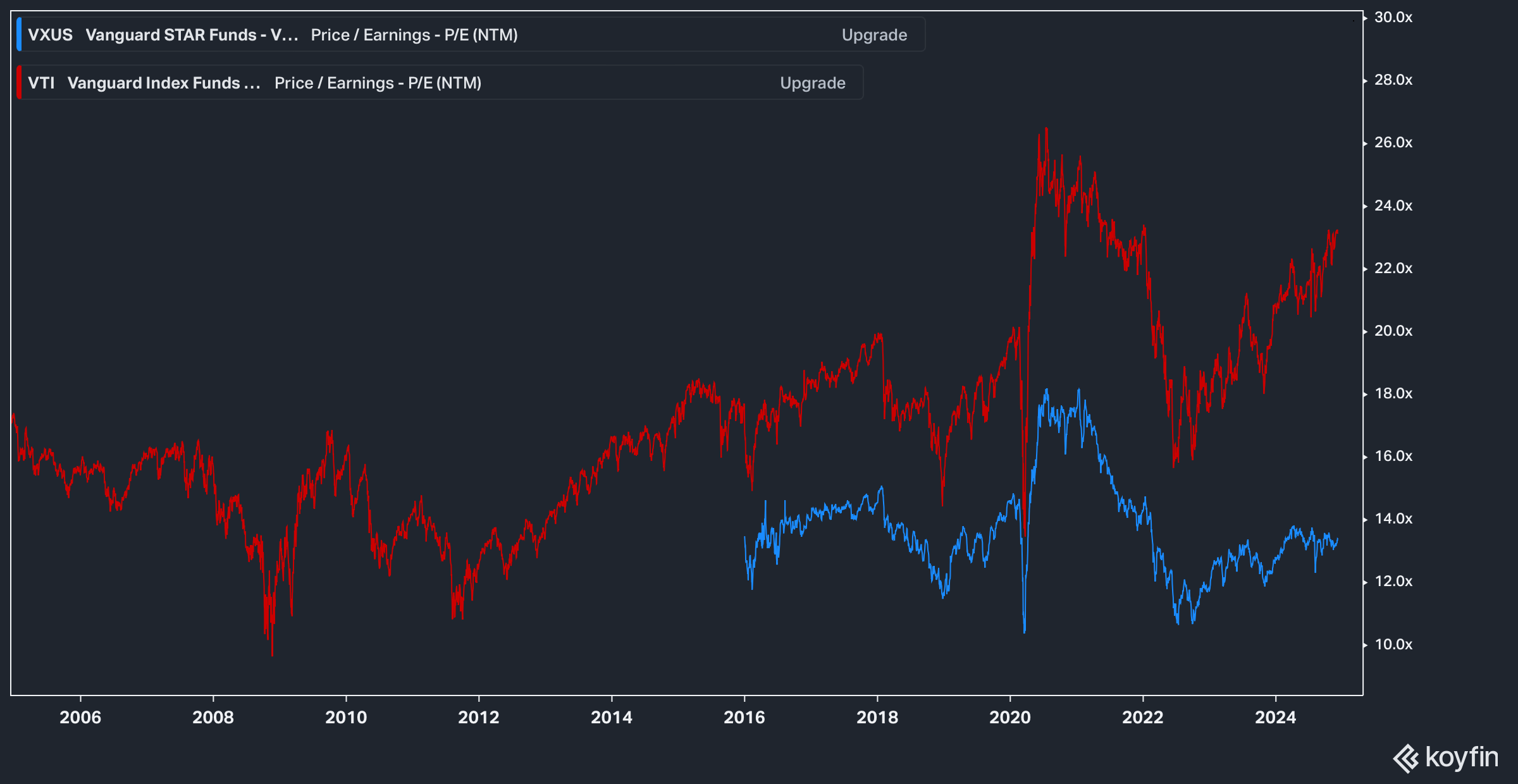
- Valuation Profile: Often trades at lower Price-to-Earnings (P/E) ratios compared to VTI, appealing to value-oriented investors.
- Dividend Yield: Generally higher than VTI, often ranging from 2.8% to 3.5%, reflecting the dividend-paying cultures of European and Asian markets.
Comprehensive Comparison: VTI vs. VXUS in 2026
| Feature | Vanguard Total Stock Market (VTI) | Vanguard Total International Stock (VXUS) |
|---|---|---|
| Asset Class | Domestic (U.S.) Equity | International (Ex-U.S.) Equity |
| Underlying Index | CRSP US Total Market Index | FTSE Global All Cap ex US Index |
| Expense Ratio (2026) | 0.03% | 0.08% |
| Number of Holdings | ~3,700 | ~8,000 |
| Top Sector | Information Technology | Financials |
| Emerging Markets | 0% | ~25% |
| Dividend Yield | Lower (Growth Focused) | Higher (Income/Value Focused) |
| Tax Efficiency | Excellent (Qualified Dividends) | High (Foreign Tax Credit Eligible) |
| Inception Date | 2001 | 2011 |
Performance Dynamics: The "U.S. vs. The World" Cycle
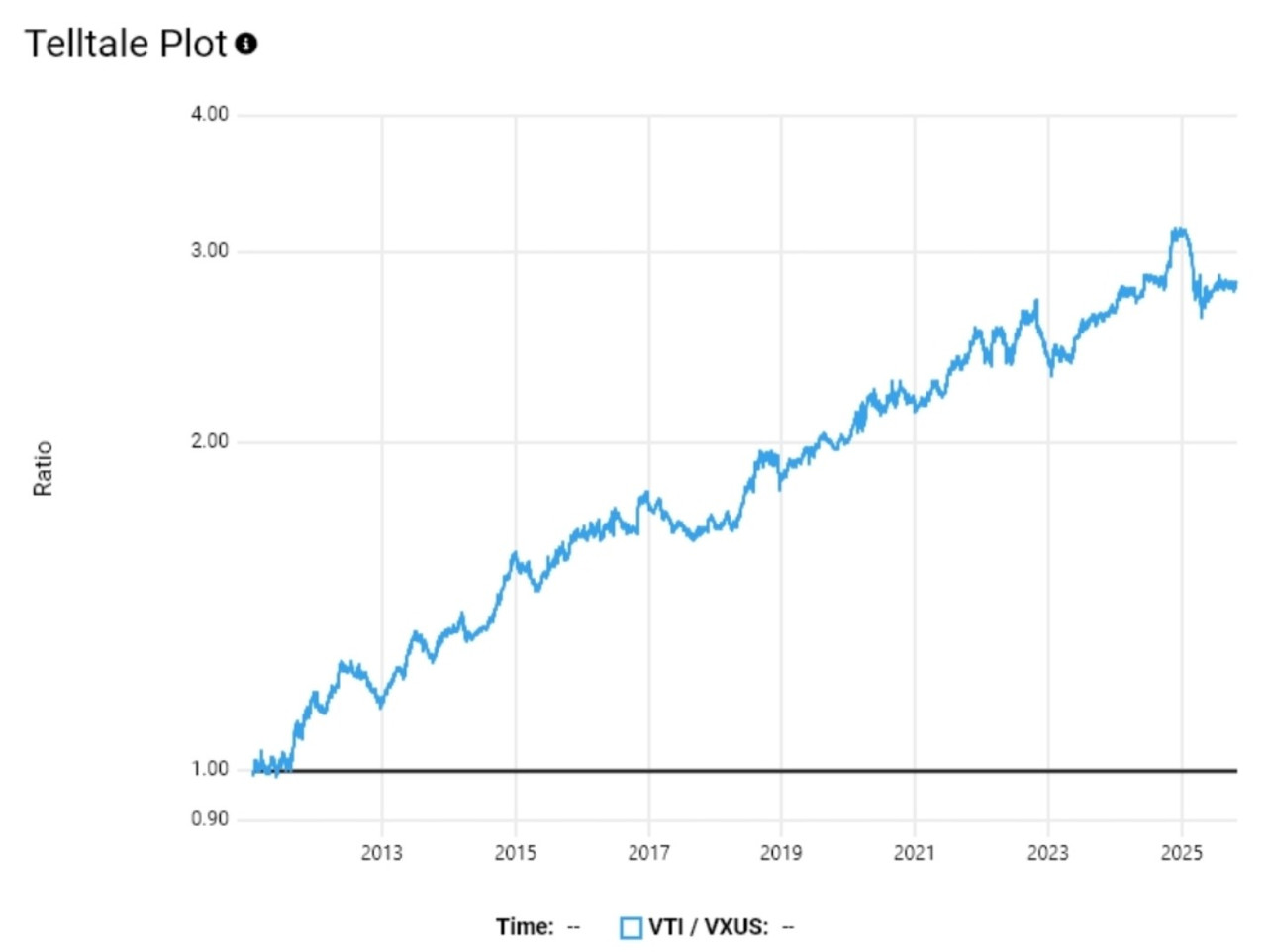
A common mistake for investors in 2026 is "recency bias"—the tendency to believe that because U.S. tech has performed exceptionally well over the last decade, it will always do so. Historical data shows that U.S. and International equities trade leadership in long-term cycles.
- The Case for VTI: The U.S. market has historically benefited from a robust legal system, deep capital markets, and a culture of innovation. In 2026, the dominance of U.S. "Magnificent Seven" style companies continues to drive VTI's performance, especially as Artificial Intelligence and biotechnology reach new levels of commercialization.
- The Case for VXUS: International markets often outperform when the U.S. dollar weakens. Furthermore, because VXUS is more heavily weighted toward Financials, Industrials, and Materials, it often outperforms during inflationary periods or when value-oriented sectors lead the market. In 2026, many analysts point to the lower P/E ratios of international stocks as a sign of higher expected future returns compared to the relatively "expensive" U.S. market.
Strategic Asset Allocation in a 2026 Portfolio
Deciding how much of each fund to hold depends on your risk tolerance and your view of global economics. Modern Portfolio Theory suggests that a globally diversified portfolio provides the best risk-adjusted returns.
The 60/40 Domestic-to-International Split
Many financial advisors recommend a 60% VTI and 40% VXUS split. This closely mirrors the "Global Market Cap Weight," which is how the world's wealth is actually distributed across stock markets. By following this weight, you aren't betting on one country over another; you are simply owning the global economy as it exists.
The Home Bias Strategy (70/30 or 80/20)
Many U.S. investors prefer a "Home Bias," allocating 70% or 80% to VTI and only 20% to 30% to VXUS. The rationale is that U.S. companies are already global; many S&P 500 companies derive more than 40% of their revenue from overseas. This strategy reduces currency risk but may leave the investor over-exposed if the U.S. economy faces a stagnant decade.
The Three-Fund Portfolio Integration
In the context of 2026, both VTI and VXUS are essential components of the "Three-Fund Portfolio," which typically includes:
- VTI (Total U.S. Stock Market)
- VXUS (Total International Stock Market)
- BND (Total Bond Market ETF)
Tax Implications and Account Placement
Where you hold VTI and VXUS can significantly impact your "net-of-tax" returns. In 2026, the tax code continues to provide specific advantages for international holdings in taxable brokerage accounts.
The Foreign Tax Credit Advantage
When you own VXUS in a taxable brokerage account, you pay taxes to foreign governments on the dividends those international companies pay out. However, the U.S. government allows you to claim a "Foreign Tax Credit" on your Form 1040 to offset this double taxation. If you hold VXUS in a tax-advantaged account like a 401(k) or IRA, you cannot claim this credit, and that tax money is effectively lost.
Qualified Dividends in VTI
VTI is incredibly tax-efficient. The vast majority of the dividends paid by VTI are "Qualified Dividends," which are taxed at the lower long-term capital gains rate (0%, 15%, or 20%) rather than your higher ordinary income tax rate. This makes VTI a "buy and hold" staple for both taxable and tax-deferred accounts.
Common Mistakes and Troubleshooting
Even with simple ETFs like VTI and VXUS, investors in 2026 can run into pitfalls. Below are the most common errors observed by senior strategists:
- Chasing Performance: Selling VXUS to buy more VTI because the U.S. had a better year. This is the definition of "buying high and selling low." Stick to a predetermined allocation and rebalance annually.
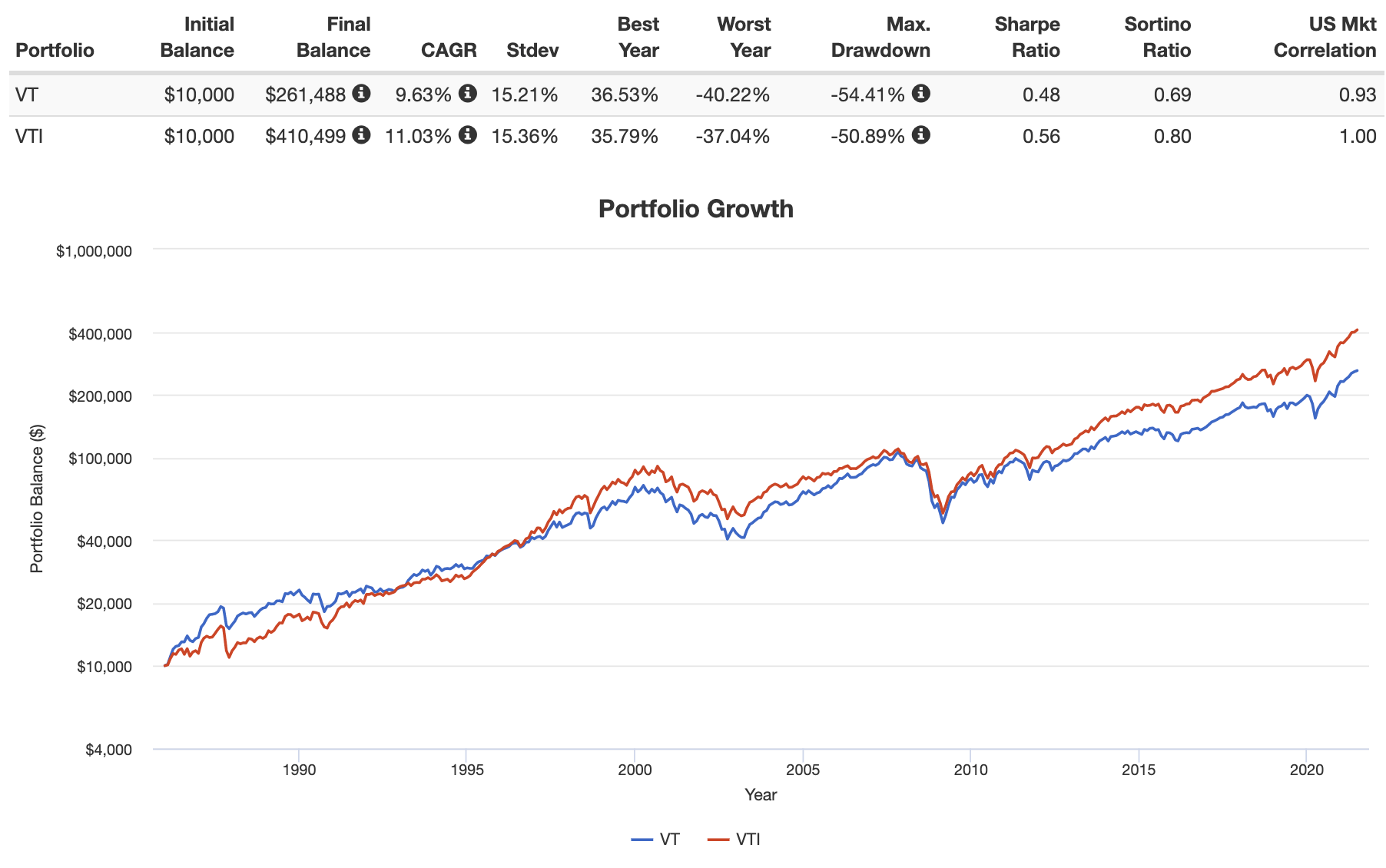
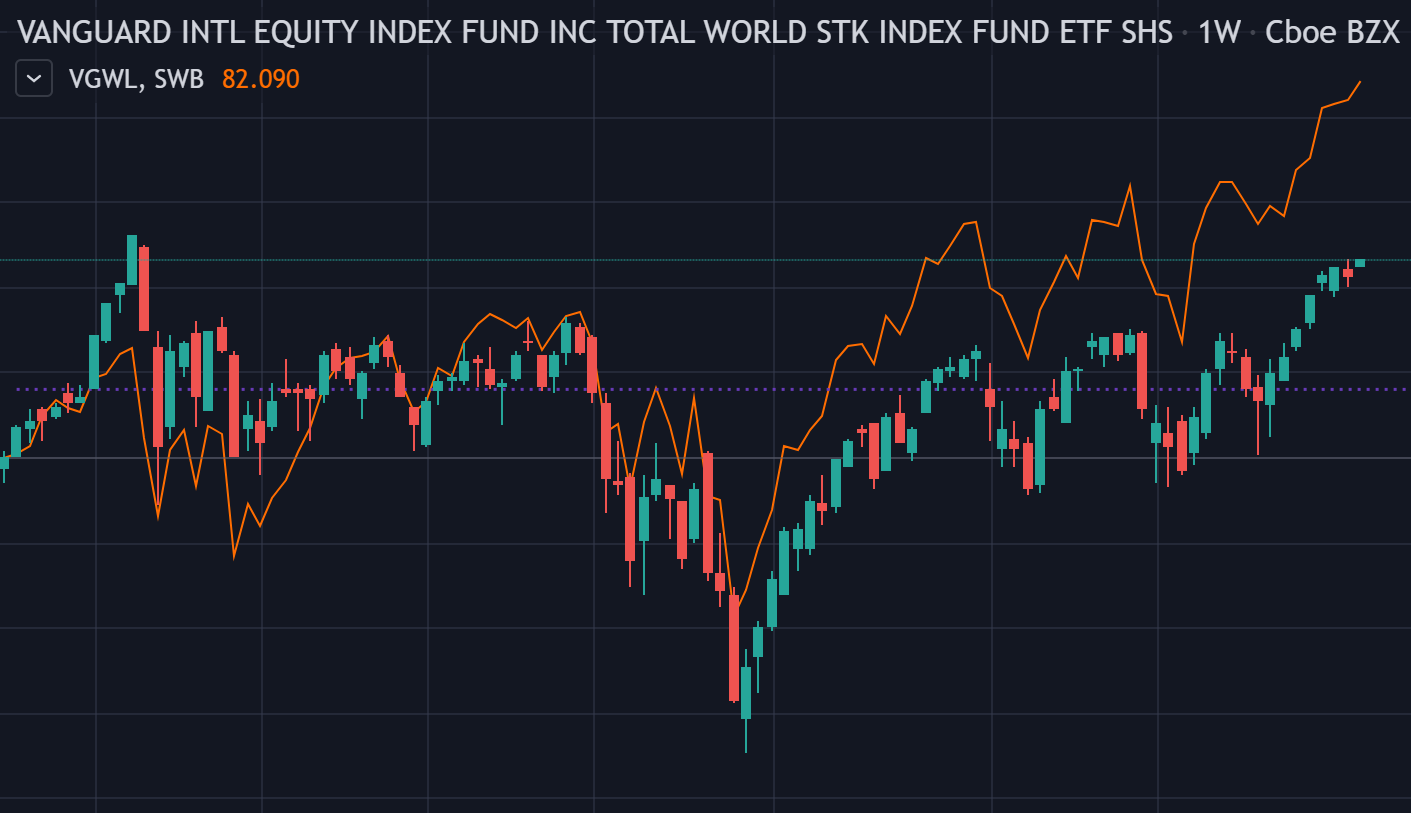
- Overlapping with VT: Some investors buy VT (Vanguard Total World Stock ETF) alongside VTI and VXUS. VT is essentially VTI and VXUS combined into one fund. Holding all three creates unnecessary complexity and can lead to unintended over-weighting in certain regions.
- Ignoring Currency Risk: When you buy VXUS, you are buying stocks in Euros, Yen, Pounds, and Yuan. If the U.S. Dollar becomes extremely strong, your international returns will look lower when converted back to dollars, even if the companies are doing well. Conversely, a weak dollar boosts VXUS returns.
- Neglecting Rebalancing: In a year where VTI grows by 20% and VXUS grows by 5%, your 60/40 split will shift to roughly 65/35. You must sell a small portion of the winner (VTI) and buy the loser (VXUS) to maintain your risk profile.
How to Transition Your Portfolio in 2026
If you are currently over-concentrated in one area, use the following steps to rebalance into a VTI/VXUS split:
- Assess Your Current Weights: Calculate the total dollar value of your U.S. holdings versus international holdings across all accounts (401k, IRA, Brokerage).
- Identify Tax Impact: Before selling, check for "unrealized gains." In 2026, selling VTI in a taxable account may trigger a significant capital gains tax if you've held it for years.
- Use New Contributions: The most tax-efficient way to rebalance is to stop buying the over-weighted fund and direct all new investment capital into the under-weighted fund until your targets are met.
- Set a Rebalancing Band: Many professionals use a 5% "tolerance band." If your target for VXUS is 30%, only rebalance if it falls below 25% or rises above 35%.
Frequently Asked Questions
Does VTI already include international exposure because U.S. companies sell products globally?
While many U.S. companies in VTI (like Apple or Coca-Cola) earn significant revenue abroad, VTI does not provide exposure to foreign currency fluctuations, foreign regulatory environments, or companies headquartered in other nations (like Nestle, Samsung, or Toyota). Relying solely on VTI misses out on thousands of companies that drive global innovation and provide a hedge against U.S.-specific economic risks.
Why is the expense ratio for VXUS higher than VTI?
The expense ratio for VXUS is 0.08% compared to VTI’s 0.03% because it is more expensive for Vanguard to operate. International investing requires paying foreign exchange fees, dealing with multiple international stock exchanges, and navigating various local tax laws and regulations. Despite this, 0.08% remains extremely low compared to the average international fund fee of 0.80% or higher.
Should I hold VTI and VXUS in my Roth IRA?
Yes, both are excellent for a Roth IRA, but for different reasons. VTI is great because it has high growth potential, and all that growth will be tax-free upon withdrawal. VXUS is also good, though you do lose the ability to claim the Foreign Tax Credit in a Roth IRA. Most investors prioritize putting their highest-growth expected assets (usually VTI or high-growth tech) into the Roth IRA first.
Is VXUS better than VT?
Neither is "better," but they serve different purposes. VT is a "set it and forget it" fund that handles the ratio of U.S. to International stocks for you. Using VTI and VXUS separately allows you to control the exact percentage of international exposure you want and enables you to claim the Foreign Tax Credit in taxable accounts, which VT does not allow as effectively.
What is the ideal percentage of VXUS for a retiree in 2026?
For retirees, sequence of returns risk is a major concern. Having a portion of the portfolio in VXUS (typically 20-30%) can help because international markets may be in a bull cycle when U.S. markets are in a bear cycle, allowing the retiree to sell the better-performing assets for income while leaving the depressed assets to recover.
Can I just hold the S&P 500 (VOO) instead of VTI?
You can, but VTI is more comprehensive. VOO (Vanguard S&P 500 ETF) only includes the 500 largest U.S. companies. VTI includes those 500 companies plus over 3,000 small- and mid-cap companies. Historically, VTI and VOO track very closely, but VTI offers better diversification by including the small-cap segment of the market.
The Path Forward for Investors
As we navigate the economic landscape of 2026, the debate between VTI and VXUS remains a cornerstone of prudent financial planning. VTI offers the stability and growth of the world's largest economy, while VXUS provides the necessary diversification and valuation benefits of the global marketplace.
For most long-term investors, the answer is not "either/or" but "both." By combining these two funds, you create a total-world equity strategy that minimizes the risk of being in the wrong country at the wrong time. Monitor your allocations, stay mindful of tax placement, and maintain a long-term perspective to let the power of global compounding work for your portfolio.
Image Gallery