Understanding the Haru Urara Race Record: Statistics, Cultural Impact, and Racing History
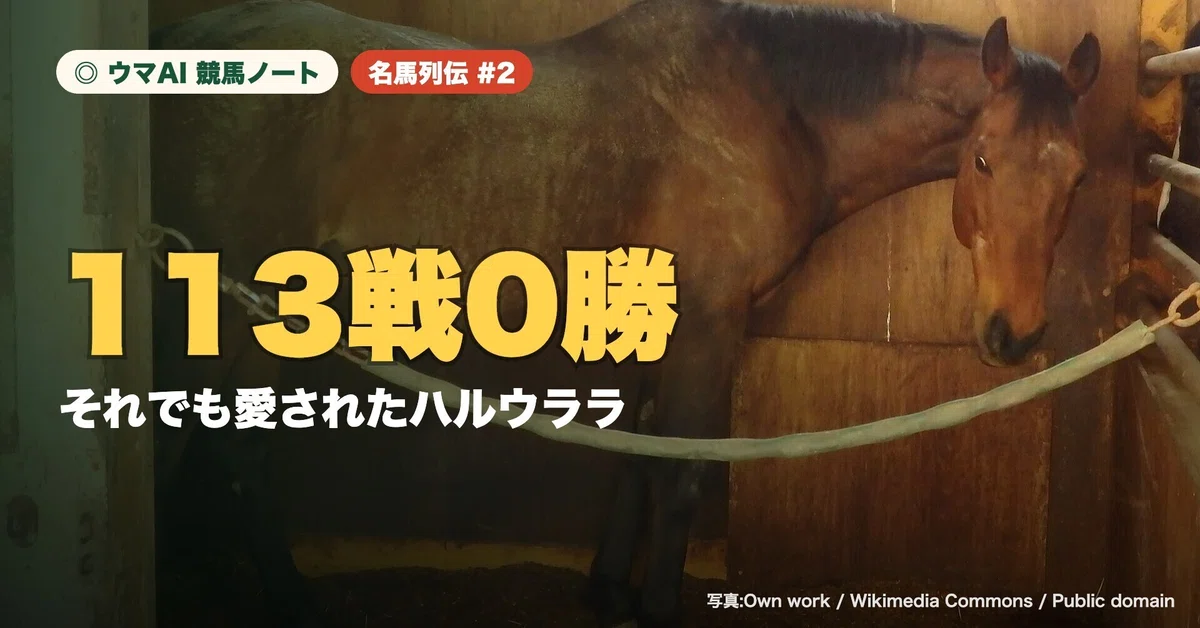
Haru Urara’s official race record stands at 113 starts, 0 wins, 5 second-place finishes, and 7 third-place finishes across a six-year career at Kochi Racetrack. Despite never securing a single victory, she became a landmark cultural ph...
Haru Urara’s official race record stands at 113 starts, 0 wins, 5 second-place finishes, and 7 third-place finishes across a six-year career at Kochi Racetrack. Despite never securing a single victory, she became a landmark cultural phenomenon in Japan, transforming an unprecedented winless streak into a celebrated symbol of perseverance and economic revival.
Contents
The Origin and Profile of Haru Urara
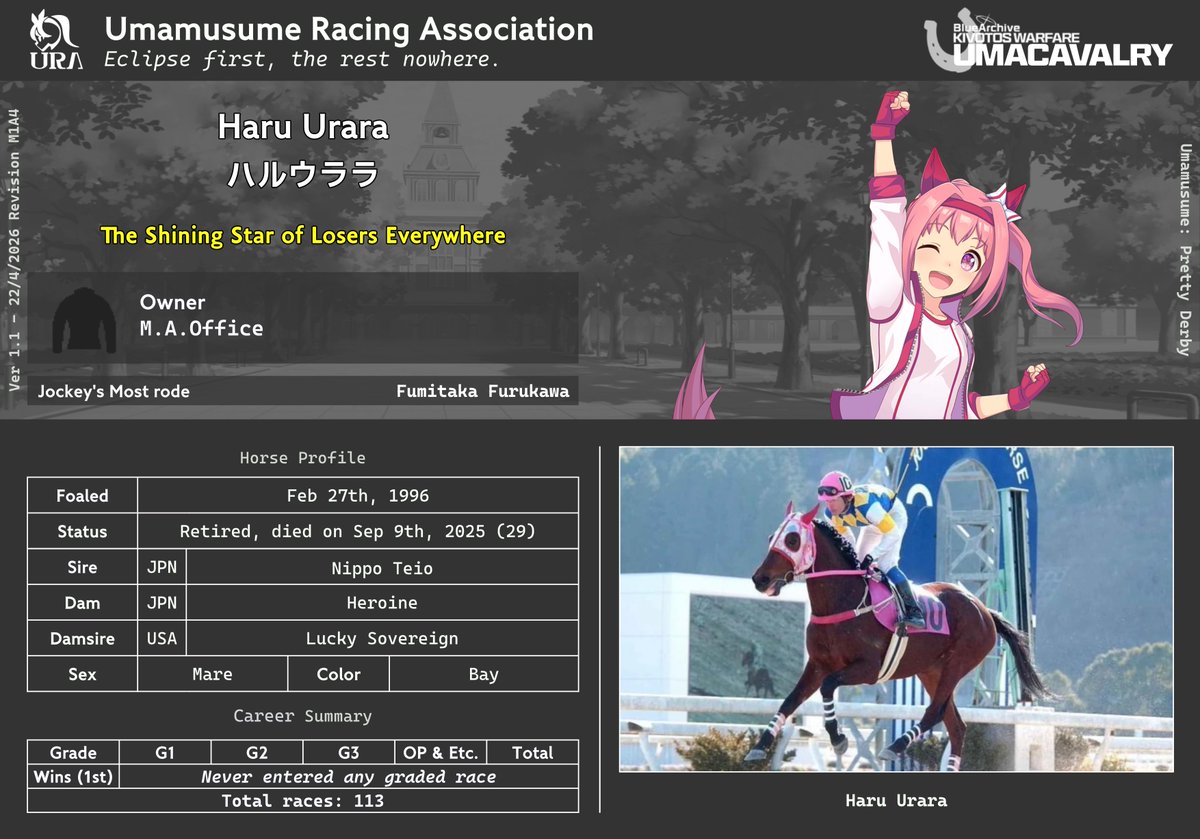
Foaled on March 27, 1996, at Noboribetsu Sanhei Farm in Hokkaido, Japan, Haru Urara was a Thoroughbred mare bred for racing. Her lineage included notable bloodlines; her sire was Nippo Teio, a dominant turf sprinter and miler who won prestigious Grade 1 titles including the Mile Championship, the Yasuda Kinen, and the Tenno Sho (Autumn). Her dam was Heroine, a mare descended from imported English stock.
Despite her sire's high-speed pedigree, Haru Urara did not inherit the physical dimensions or explosive acceleration typical of top-tier stakes horses. Weighing between 390 and 410 kilograms during her racing career, she was notably smaller than average Thoroughbred racehorses, which typically weigh between 450 and 500 kilograms. This smaller frame made it difficult for her to generate power on deep dirt track surfaces.
Haru Urara was placed under the care of trainer Dai Muneishi at Kochi Racetrack, a regional racing venue operated under the jurisdiction of Japan's National Association of Racing (NAR). She made her professional racing debut on November 17, 1998, in a maiden race at Kochi, finishing fifth out of five runners. That debut established a pattern that would define her entire competitive career.
Breakdown of the 113-Race Winless Streak
To understand Haru Urara’s 0-for-113 record, one must examine the operational structure of regional Thoroughbred racing in Japan. Unlike the central circuit managed by the Japan Racing Association (JRA), regional circuits like the NAR cater to local government-operated tracks where horses race frequently to sustain stable finances, earn participation fees, and maintain race card volume.
Haru Urara competed primarily in low-tier C3-class races at Kochi Racetrack. Because her owner and trainer relied on appearance allowances—guaranteed funds paid to horse owners for entering a race—Haru Urara was entered into races far more frequently than typical elite racehorses. While elite JRA racehorses might start 4 to 8 times per year, Haru Urara regularly ran 15 to 25 times annually, sometimes competing twice within a single month.
Total Starts: 113
- Wins (1st Place): 0 (0.0%)
- Places (2nd Place): 5 (4.4%)
- Shows (3rd Place): 7 (6.2%)
- Board Finishes (4th–5th Place): 24 (21.2%)
- Unplaced (6th or lower): 77 (68.1%)
Her failure to win was not caused by a lack of health or structural defects. Trainer Dai Muneishi frequently noted her remarkable physical durability and calm temperament. She rarely suffered from the tendon injuries, joint issues, or respiratory conditions that plague high-intensity racehorses. Her record reflects a consistent level of athletic effort that was simply a step slower than her local competition. She frequently finished near the back of the pack, but her sound health allowed her to return to the track repeatedly over six years.
Comprehensive Lifetime Race Record Summary
The following table summarizes the complete career metrics for Haru Urara across her active racing span from 1998 through 2004.
| Career Metric | Statistic / Detail |
|---|---|
| Official Name | Haru Urara (ハルウララ) |
| Foal Date | March 27, 1996 |
| Sex / Coat | Mare / Bay |
| Sire | Nippo Teio |
| Dam | Heroine |
| Primary Circuit | Kochi Racetrack (NAR Dirt Track) |
| Trainer | Dai Muneishi |
| Active Years | 1998 – 2004 |
| Total Career Starts | 113 |
| 1st Place Finishes (Wins) | 0 |
| 2nd Place Finishes | 5 |
| 3rd Place Finishes | 7 |
| Top-3 Finish Rate | 10.6% |
| Top-5 Finish Rate | 31.8% |
| Career Earnings | Approx. ¥1.1 million (excluding appearance fees) |
| Notable Jockeys | Ryuji Miyagawa, Yutaka Take |
The 2003–2004 Economic and Media Phenomenon
In late 2003, Haru Urara’s winless streak began attracting local news coverage in Kochi Prefecture. At the time, Japan was enduring prolonged economic stagnation following the collapse of its asset price bubble, a period often called the "Lost Decades." Businesses across the country faced bankruptcy, and restructuring was common.
When public broadcaster NHK aired national news segments highlighting a small mare at a struggling regional track who lost every race yet kept running without injury or complaint, the public identified with her story. The Japanese media dubbed her "The Shining Star of Losers Everywhere" (Makegumi no Hoshi).
- National Economic Stagnation
- Media Highlights Winless Streak
- Symbolic Resonate with Public
- Surge in Track Attendance & Ticket Sales
The Ataranai Good Luck Charm
A unique linguistic phenomenon fueled the commercial surge surrounding Haru Urara. In Japanese horse racing, a losing betting ticket is said to ataranai (当たらない), meaning "does not hit" or "does not win." However, the word ataranai is homophonous with the phrase meaning "will not collide" or "will not hit an object."
Commuters, taxi drivers, and motorists began purchasing Haru Urara win tickets not to make money, but to use them as protective amulets against traffic accidents. Because a win ticket on Haru Urara was virtually guaranteed to not hit a win, buyers reasoned it was a natural charm to guarantee they would not hit another vehicle. Kochi Racetrack began selling special betting tickets encased in protective holders, creating a revenue stream out of paper tickets that held no redemption value.
Rescuing Kochi Racetrack
Prior to 2003, Kochi Racetrack faced severe financial deficits exceeding tens of millions of yen and was on the verge of permanent closure. The influx of fans traveling to see Haru Urara reversed the track's financial trajectory:
- Attendance: Daily attendance at Kochi Racetrack multiplied several times over, routinely drawing thousands of visitors from across Japan.
- Wagering Volume: Off-track and on-track betting totals soared as fans bought win tickets on Haru Urara as souvenirs.
- Merchandising: The track authorized official merchandise, including plush toys, t-shirts, caps, sticker sets, and local agricultural products branded with her name.
The Historic March 22, 2004 Race with Yutaka Take
The peak of the Haru Urara phenomenon occurred on March 22, 2004, when Yutaka Take—Japan’s premier jockey with hundreds of Grade 1 victories—agreed to travel to Kochi to ride her in a single race.
- Race Date: March 22, 2004
- Location: Kochi Racetrack (Race 10, C3 Class, 1,300 meters)
- Jockey: Yutaka Take
- Attendance: 13,000+ spectators (Track Record)
- Total Betting Handle on Race: ¥867,000,000+
- Haru Urara Result: 10th Place (out of 11 runners)
The event drew a record crowd of more than 13,000 spectators to Kochi Racetrack. Television networks broadcast the race live across the nation. Over ¥867 million was wagered on that single 1,300-meter race, with more than ¥121 million bet on Haru Urara to win.
Riding under 54 kilograms, Haru Urara broke cleanly from the gate and tracked the field, but lacked the closing drive on the stretch. She finished 10th out of 11 horses. Post-race, Yutaka Take praised her durability, professional manner in the saddling enclosure, and ability to bring public attention to regional Japanese racing.
Retirement and Modern Legacy
Haru Urara ran her final official race on August 3, 2004, finishing deep in the field once again. Plans were made for a final farewell race in early 2005, but persistent rest requirements and eventual changes in ownership led to her quiet retirement from the track.
Following her retirement, public donations and dedicated horse welfare organizations stepped in to secure her long-term care. She was relocated to a retirement facility in Chiba Prefecture, later living at Grace Riding Club in Onjuku. Funded by a dedicated fan support group (The Haru Urara Stables Association), she transitioned into a peaceful post-racing life as a mascot and riding horse.
The Uma Musume Revival
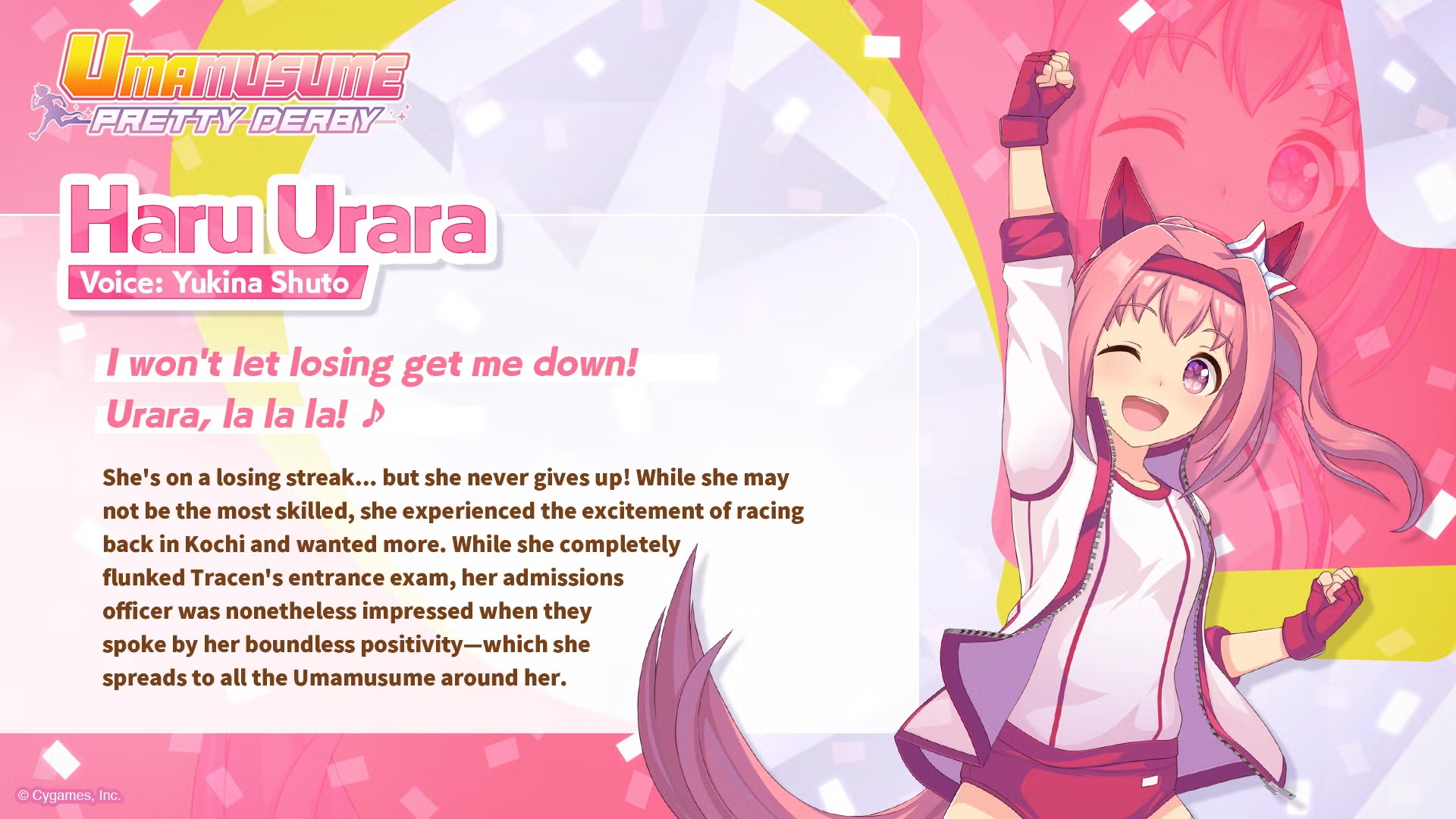
Haru Urara's legacy experienced a major global resurgence following the release of Cygames’ multimedia franchise Uma Musume Pretty Derby. The franchise reimagines famous Japanese racehorses as anime characters competing in races while reflecting their real-world racing histories.
In the game, Haru Urara is portrayed as an optimistic character whose base stats reflect her real-life career struggles. Players are challenged to guide her to her first official career win—a goal that eluded her in real life. This digital representation introduced her historical 113-race record to a new generation of racing fans worldwide.
Frequently Asked Questions
Did Haru Urara ever win a single official race?
No. Across 113 official starts under the National Association of Racing (NAR) between November 1998 and August 2004, Haru Urara never finished first. Her best career results were 5 second-place finishes and 7 third-place finishes.
Why did people buy Haru Urara betting tickets if she never won?
In Japanese, the phrase ataranai means both "does not hit a win" and "does not hit an object/collide." Drivers purchased her win tickets as protective safety amulets against car accidents, knowing the ticket was guaranteed ataranai (never hitting a win).
How did Haru Urara save Kochi Racetrack from closure?
In 2003, Kochi Racetrack was suffering severe financial losses and faced imminent closure. Haru Urara’s national fame brought tens of thousands of visitors, massive betting handle, national media rights, and official merchandise sales, generating enough revenue to clear debts and stabilize the track's operations.
What was Haru Urara's racing style and physique?
Haru Urara was a small mare, weighing roughly 390–410 kg, which is small for a dirt sprinter. She raced as a back-runner (sashiuma) who stayed near the rear of the pack before attempting a late stretch run. Her small stature made it difficult to make up ground on deep dirt tracks.
Is Haru Urara still alive, and where is she kept?
Haru Urara lives at a retirement facility in Onjuku, Chiba Prefecture, Japan. Supported by private donations and a dedicated fan club, she remains healthy in her late 20s as a retired mascot.
Key Takeaways from the Haru Urara Record
Understanding Haru Urara's race record requires looking beyond basic win-loss percentages. While a 0-for-113 record represents a lack of competitive success on the track, her career highlights several important aspects of horse racing history:
- Physical Resilience: Competing in 113 races over six years without major structural injuries demonstrates remarkable durability and physical condition.
- Economic Role of Regional Racing: Her career illustrates how regional racing circuits in Japan function, where appearance allowances enable steady racing schedules for lower-tier horses.
- Cultural Impact: Haru Urara demonstrated that sports fandom can extend beyond winning streaks, transforming a winless record into a national symbol of perseverance and community support.
Image Gallery