Cheap Auto Insurance in Corpus Christi: Finding Affordable Coverage in Coastal Texas
Finding cheap auto insurance in Corpus Christi requires balancing state minimum legal mandates with local environmental and traffic risks. Drivers can secure affordable premiums by comparing localized quotes, capitalizing on Texas-spec...
Finding cheap auto insurance in Corpus Christi requires balancing state minimum legal mandates with local environmental and traffic risks. Drivers can secure affordable premiums by comparing localized quotes, capitalizing on Texas-specific discounts, raising deductibles, and selecting policy limits that accurately reflect vehicle values while maintaining financial protection against coastal weather hazards.
Contents
Texas Auto Insurance Minimum Requirements vs. Recommended Coverage
Under the Texas Department of Insurance regulations, all drivers operating motor vehicles on public roads must establish financial responsibility. Texas uses a mandatory minimum liability framework known as 30/60/25 coverage, which sets the legal baseline for bodily injury and property damage liabilities.
TEXAS MINIMUM LIABILITY MANDATES (30/60/25)
| Coverage Category | Statutory Minimum Amount |
|---|---|
| Bodily Injury (Per Person) | $30,000 |
| Bodily Injury (Per Accident) | $60,000 total across all injured |
| Property Damage (Per Accident) | $25,000 |
While carrying 30/60/25 minimum liability satisfies state law, relying solely on minimum coverage leaves policyholders exposed to significant financial liabilities:
- Property Damage Deficits: Modern vehicle replacement and repair costs frequently exceed $25,000. If an at-fault driver collides with a newer truck, SUV, or multi-vehicle pileup on the SPID (South Padre Island Drive), liability claims can quickly surpass statutory caps, leaving the driver personally liable for the remaining balance.
- Bodily Injury Exhaustion: Severe injuries requiring emergency hospital transport, surgery, or prolonged care routinely exceed $30,000 per person.
Essential Optional Coverages for Corpus Christi Drivers
To guard against unexpected out-of-pocket expenses, insurance specialists recommend expanding policy protections beyond state minimums:
- Comprehensive Coverage: Protects against non-collision losses, including storm damage, flood damage from tidal surges, hail, falling debris, vandalism, and animal strikes.
- Collision Coverage: Pays for damage to your own vehicle resulting from an impact with another vehicle or stationary object, regardless of fault.
- Uninsured/Underinsured Motorist (UM/UIM): Pays for medical care and property damage if you are struck by a driver who lacks auto insurance or carries inadequate limits. Under Texas law, insurers must offer UM/UIM coverage in writing, though policyholders may reject it in writing if preferred.
- Personal Injury Protection (PIP) or Medical Payments (MedPay): Covers immediate medical expenses and lost wages for you and your passengers after an accident. PIP includes 80% wage loss reimbursement and caregiver costs, whereas MedPay covers strict medical fees.
Disclaimer: Auto insurance requirements and liability rules vary by jurisdiction. This article provides general educational information for Texas policyholders and does not constitute formal legal or financial advice. Consult a licensed insurance professional for specific coverage planning.
Factors Influencing Auto Insurance Rates in Corpus Christi
Car insurance premiums in Corpus Christi reflect both statewide risk models and hyper-local geographical circumstances. Understanding these variables helps policyholders control costs effectively.
- Corpus Christi Premium Risk Factors
- Coastal Weather
- Tropical storms
- Tidal flooding
- Salt corrosion
- Local Traffic Density
- SPID (SH 358) bottleneck
- Crosstown Expressway
- Port / Industrial traffic
- Driver Profile & Credit
- Texas Credit Score Rules
- Driving History
- ZIP Code Variations
- Coastal Weather
1. Coastal Geography and Weather Hazards
Corpus Christi's position along Corpus Christi Bay and the Gulf of Mexico introduces severe environmental risks. Tropical storms, heavy hail storms, flash flooding, and hurricane activity increase comprehensive claims across Nueces County. Additionally, ambient coastal humidity and atmospheric salt accelerate vehicle body corrosion and electrical deterioration, indirectly impacting long-term claim costs.
2. Traffic Bottlenecks and High-Accident Corridors
Urban commuter routes experience localized collision surges. High-density corridors such as South Padre Island Drive (SH 358), the Crosstown Expressway (SH 286), Interstate 37, and the Harbor Bridge replacement zone report elevated accident frequencies. Higher traffic volumes along commercial corridors translate to increased claim statistics, raising baseline rates across surrounding residential ZIP codes.
3. Regional ZIP Code Variations
Insurance companies calculate baseline risk by geographic boundaries. Residential ZIP codes on the South Side (e.g., 78413, 78414) often yield different base premiums than industrial or coastal neighborhoods such as North Beach (78402), Flour Bluff (78418), or Calallen (78410). Factors such as neighborhood vehicle theft rates, street parking prevalence, and historical flood maps influence these micro-regional rates.
4. Credit-Based Insurance Scores
Under the Texas Insurance Code, insurers are permitted to evaluate a policyholder's credit history to assign a credit-based insurance score. Insurers use statistical correlations between credit management and claim frequency to price policy tiers. Maintaining strong credit history typically secures lower monthly premiums.
Average Cost of Car Insurance in Corpus Christi
Auto insurance costs shift continuously based on market conditions, carrier underwriting algorithms, and economic inflation. A driver maintaining a clean record will pay significantly less than someone seeking coverage with prior moving violations or at-fault accidents.
The following comparative table illustrates estimated annual and monthly rate ranges across major insurance providers operating in Corpus Christi for standard driver profiles.
| Insurance Carrier | Minimum Liability (Est. Monthly) | Minimum Liability (Est. Annual) | Full Coverage (Est. Monthly) | Full Coverage (Est. Annual) | Key Local Discounts Offered |
|---|---|---|---|---|---|
| State Farm | $45 – $65 | $540 – $780 | $125 – $165 | $1,500 – $1,980 | Drive Safe & Save, Multi-Policy, Good Student |
| GEICO | $42 – $60 | $504 – $720 | $120 – $155 | $1,440 – $1,860 | Federal/Military, Anti-Theft, Multi-Vehicle |
| Texas Farm Bureau | $40 – $58 | $480 – $696 | $115 – $150 | $1,380 – $1,800 | Farm Bureau Member, Safe Driver, Bundling |
| Progressive | $50 – $72 | $600 – $864 | $135 – $180 | $1,620 – $2,160 | Snapshot Telematics, Name Your Price Tool |
| Allstate | $55 – $80 | $660 – $960 | $145 – $195 | $1,740 – $2,340 | Drivewise, Paperless, Defensive Driver |
| USAA (Active/Veteran Military) | $35 – $50 | $420 – $600 | $95 – $135 | $1,140 – $1,620 | Military Deployment, Safe Driver, Multi-Vehicle |
Note: Rate ranges serve as broad estimates based on regional averages for drivers with clean driving records. Actual premiums depend on individualized underwriting factors including vehicle make/model, exact age, deductible selection, and driving history.
Step-by-Step Guide to Securing the Lowest Rates in Corpus Christi
Achieving minimum cost without sacrificing vital coverage requires systematic comparison and deliberate policy structuring.
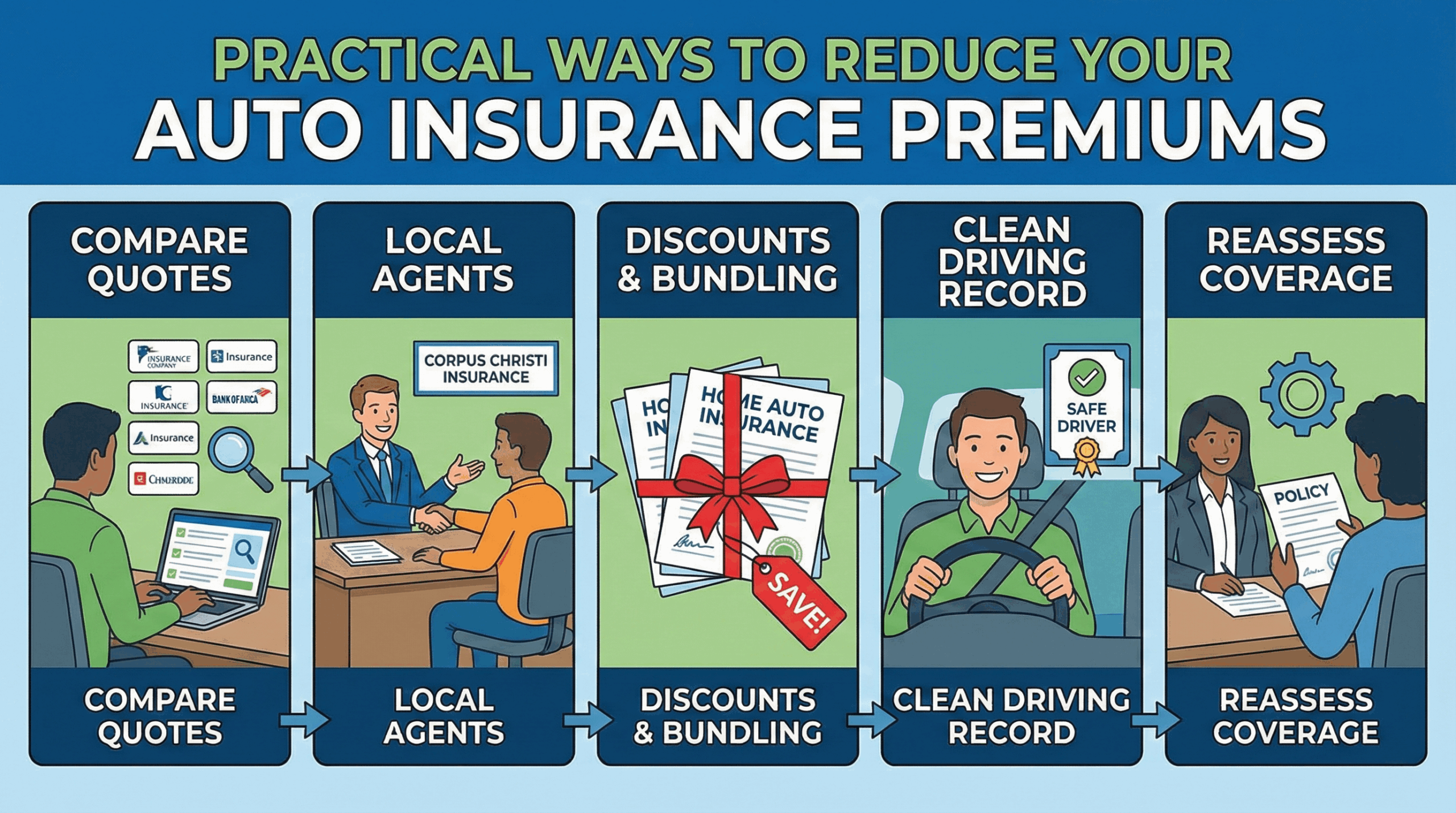
- Step 1: Standardize Quote Parameters
- Step 2: Compare Quotes via State & Independent Tools
- Step 3: Stack Eligible Discounts (Telematics, Bundling)
- Step 4: Optimize Comprehensive & Deductible Limits
- Step 5: Review & Re-quote Annually
Step 1: Standardize Quote Parameters
When requesting quotes from competing carriers, ensure you enter identical coverage parameters across every platform:
- Set identical liability limits (e.g., compare 50/100/50 across all carriers rather than mixing 30/60/25 with higher tiers).
- Match collision and comprehensive deductibles precisely (e.g., $500 vs. $1,000).
- Include identical secondary coverages (such as towing, rental reimbursement, and roadside assistance).
Step 2: Utilize Official State Comparison Resources
Texas drivers can cross-examine price tiers using HelpInsure.com, a free tool operated by the Texas Department of Insurance and the Office of Public Insurance Counsel. HelpInsure displays sample rates across major carriers licensed in Texas, allowing consumers to identify price-competitive providers in Nueces County before submitting detailed applications.
Step 3: Stack Telematics and Safe Driving Discounts
Enrolling in usage-based insurance (UBI) programs—such as Progressive Snapshot, State Farm Drive Safe & Save, or Allstate Drivewise—can unlock substantial initial discounts. Mobile apps monitor real-time driving habits, including hard braking, cornering speed, late-night driving, and total mileage. Drivers with low annual mileage in Corpus Christi can gain significant savings through telematics platforms.
Furthermore, drivers who complete a state-approved defensive driving course licensed by the Texas Department of Licensing and Regulation (TDLR) may qualify for voluntary premium discounts valid for up to three years with participating insurers.
Step 4: Restructure Deductibles Strategically
Raising collision and comprehensive deductibles from $250 or $500 to $1,000 immediately lowers overall premium costs. However, drivers must maintain an emergency fund equal to the chosen deductible amount to cover out-of-pocket expenses during a claim.
Step 5: Bundle Auto and Homeowners/Renters Policies
Combining vehicle policies with property, renters, or condo insurance through the same carrier remains one of the most consistent ways to reduce multi-line costs, frequently driving total policy savings down by 10% to 25%.
High-Risk Auto Insurance and SR-22 Filings in Texas
Drivers with past traffic violations, driving under the influence (DUI/DWI) convictions, or previous lapses in coverage are often classified as high-risk motorists by commercial underwriters.
TEXAS SR-22 FILING PROCESS
- Driver incurs suspension or mandate via TxDPS / Court Order
- Driver purchases Non-Standard Policy with mandatory SR-22 Rider
- Insurer files SR-22 Certificate electronically with TxDPS
- Driver maintains continuous active policy for required term
Understanding the SR-22 Requirement
An SR-22 is not an insurance policy; it is an official certificate of financial responsibility submitted directly to the Texas Department of Public Safety (DPS) by an authorized insurance carrier. The certificate proves that a driver carries at least Texas statutory minimum liability limits.
Common triggers for an SR-22 mandate in Texas include:
- DWI or DUI convictions.
- Driving without valid liability insurance (repeat offenses).
- Driving with a suspended or revoked driver’s license.
- Accumulating excess points or crash liabilities under state administrative rules.
Managing Costs on High-Risk Policies
- SR-22 Filing Fees: Insurers typically charge a small one-time administrative filing fee (usually $15 to $25) to transmit the SR-22 to the state. However, the underlying high-risk status causes primary auto premiums to rise substantially.
- Non-Owner Auto Policies: Drivers who must maintain an SR-22 to restore their driver's license but do not own a vehicle can purchase a non-owner auto insurance policy. Non-owner policies provide minimum liability coverage when operating rented or borrowed vehicles and represent a cost-effective method to fulfill state SR-22 requirements.
- Avoiding Policy Lapses: If an SR-22 policy cancels or lapses for non-payment, the insurer is legally mandated to file a Form SR-26 with the Texas DPS. This action triggers an immediate re-suspension of the policyholder's driver’s license and resets administrative compliance timelines.
Frequently Asked Questions About Corpus Christi Auto Insurance
What is the absolute cheapest auto insurance company in Corpus Christi?
There is no single insurer that offers the lowest rate for every driver. For active-duty military members, veterans, and military families stationed near Naval Air Station Corpus Christi, USAA consistently offers some of the lowest average rates. For non-military residents, carriers like Texas Farm Bureau, State Farm, and GEICO frequently provide competitive baseline quotes. Obtaining quotes tailored to your exact driving record and ZIP code is necessary to identify the lowest rate.
Does standard Texas auto insurance cover flood damage from tropical storms?
Standard auto liability insurance does not cover flood or water damage to your own vehicle. To protect your vehicle against storm surges, heavy rainfall, or coastal tidal flooding in Corpus Christi, you must purchase Comprehensive Coverage. Comprehensive pays for flood-related damages minus your elected deductible.
How does my Corpus Christi ZIP code affect my car insurance rates?
Insurance companies adjust baseline premiums by ZIP code using historic claim frequencies, localized auto theft rates, street-parking risk factors, traffic density, and flood zone mappings. For instance, inland residential neighborhoods typically experience slightly lower comprehensive rates than flood-prone coastal zones.
Can Texas auto insurance companies use my credit score to adjust rates?
Yes. Texas law allows insurance providers to use credit-based insurance scores to price policies. A higher credit score generally correlates with lower monthly premiums. However, Texas law prevents insurers from using credit history as the sole reason to deny, cancel, or refuse to renew an existing policy.
What are the legal penalties for driving without insurance in Corpus Christi?
Under the Texas Transportation Code, driving without proof of financial responsibility results in a misdemeanor offense. First-offense fines range between $175 and $350. Subsequent offenses can result in fines up to $1,000, impoundment of the uninsured vehicle, driver's license suspension, and mandatory SR-22 filing requirements for up to three years.
How long do moving violations remain on my Texas driving record for insurance pricing?
In Texas, standard moving violations (such as speeding tickets or failure to yield) generally impact your auto insurance underwriting rates for 36 months (3 years) from the date of conviction. Major violations, such as a DWI or driving without insurance, can impact rates and eligibility for up to 5 years or longer.
Strategic Recommendations for Long-Term Savings
To maintain low insurance costs while protecting your personal assets in Corpus Christi:
- Re-Quote Coverage Annually: Set a calendar reminder to shop your coverage across at least three competing carriers every 12 months using standardized coverage parameters.
- Match Coverage to Vehicle Depreciation: As an older vehicle's market value declines, evaluate whether carrying comprehensive and collision coverage remains cost-effective relative to your emergency savings balance.
- Maintain Continuous Policy History: Avoid gaps or lapses in coverage, even during brief transitions between vehicles. Insurance companies penalize coverage lapses with elevated baseline premiums.
- Protect Against Coastal Weather: Ensure your policy includes comprehensive coverage if your vehicle is parked in low-lying zones exposed to tropical storm surges or urban flash flooding.
Image Gallery