The Oldest Egyptian Horoscopes Revealed: Ancient Celestial Maps and Astrology
The oldest Egyptian horoscopes date to the late Ptolemaic and Roman periods (1st century BCE to 2nd century CE), blending native Egyptian star systems with Hellenistic and Babylonian zodiacs. Recent conservation work at the Temple of E...
The oldest Egyptian horoscopes date to the late Ptolemaic and Roman periods (1st century BCE to 2nd century CE), blending native Egyptian star systems with Hellenistic and Babylonian zodiacs. Recent conservation work at the Temple of Esna has uncovered exceptionally preserved, fully painted celestial ceilings depicting complete zodiac cycles, planetary positions, and previously unknown indigenous constellations.
Contents
The Evolution of Astronomical Thought in Ancient Egypt
To understand the oldest Egyptian horoscopes, one must distinguish between traditional Egyptian stellar religion and true horoscopic astrology. For over two millennia, native Egyptian astronomy focused primarily on practical timekeeping, religious ritual scheduling, and architectural orientation.
The System of the 36 Decans
Long before the introduction of the twelve-sign zodiac, ancient Egyptian astronomers developed a system based on decans—36 groups of stars (constellations) whose heliacal risings occurred sequentially every ten days throughout the 365-day solar calendar. First documented on coffin lids from the Ninth and Tenth Dynasties (c. 2100 BCE) as diagonal star clocks, decans were used to track the hours of the night and ensure that funerary offerings and rituals were conducted at precise cosmic intervals.
Each decan was governed by a protective deity. When a person was born or passed away under a specific decan, that deity was believed to exert influence over the individual's spiritual transit. However, decanal star clocks were not horoscopes in the modern sense; they did not map individual birth charts or predict personal character traits based on planetary positions.
The Hellenistic Synthesis
Horoscopic astrology—the practice of calculating a person's character, life trajectory, or destiny based on the exact positions of the Sun, Moon, and planets relative to the zodiac at the moment of birth—arrived in Egypt following the conquest of Alexander the Great in 332 BCE. During the Ptolemaic Dynasty (305–30 BCE), Greek scholars working in cosmopolitan centers like Alexandria combined native Egyptian decanal systems with Mesopotamian mathematical astrology and Greek philosophical models.
This synthesis created a distinct Greco-Egyptian astrological tradition. The classical twelve signs of the zodiac (Aries through Pisces) were integrated with the 36 native Egyptian decans, resulting in a complex system where each zodiac sign was subdivided into three decans of ten degrees each.
Major Archaeological Revelations: Esna and Dendera
While written horoscopes exist on papyri and pottery fragments, the most spectacular visual manifestations of ancient Egyptian horoscopes are carved and painted on the ceilings of Ptolemaic and Roman temples.
- EVOLUTION OF EGYPTIAN ASTROLOGY
- Old & Middle Kingdoms (c. 2100 BCE)
- 36 Decans used as nocturnal star clocks
- Focus on funerary rites and state calendar
- Ptolemaic Period (305-30 BCE)
- Synthesis of Egyptian decans, Greek philosophy, & Babylonian zodiacal signs
- Creation of temple ceilings like the Dendera Zodiac
- Roman Period (30 BCE - 4th Century CE)
- Proliferation of individual natal horoscopes (papyri/ostraca)
- Complete polychrome painted zodiacs, such as the Esna Temple
- Old & Middle Kingdoms (c. 2100 BCE)
The Esna Temple Restoration: Rediscovering Lost Colors
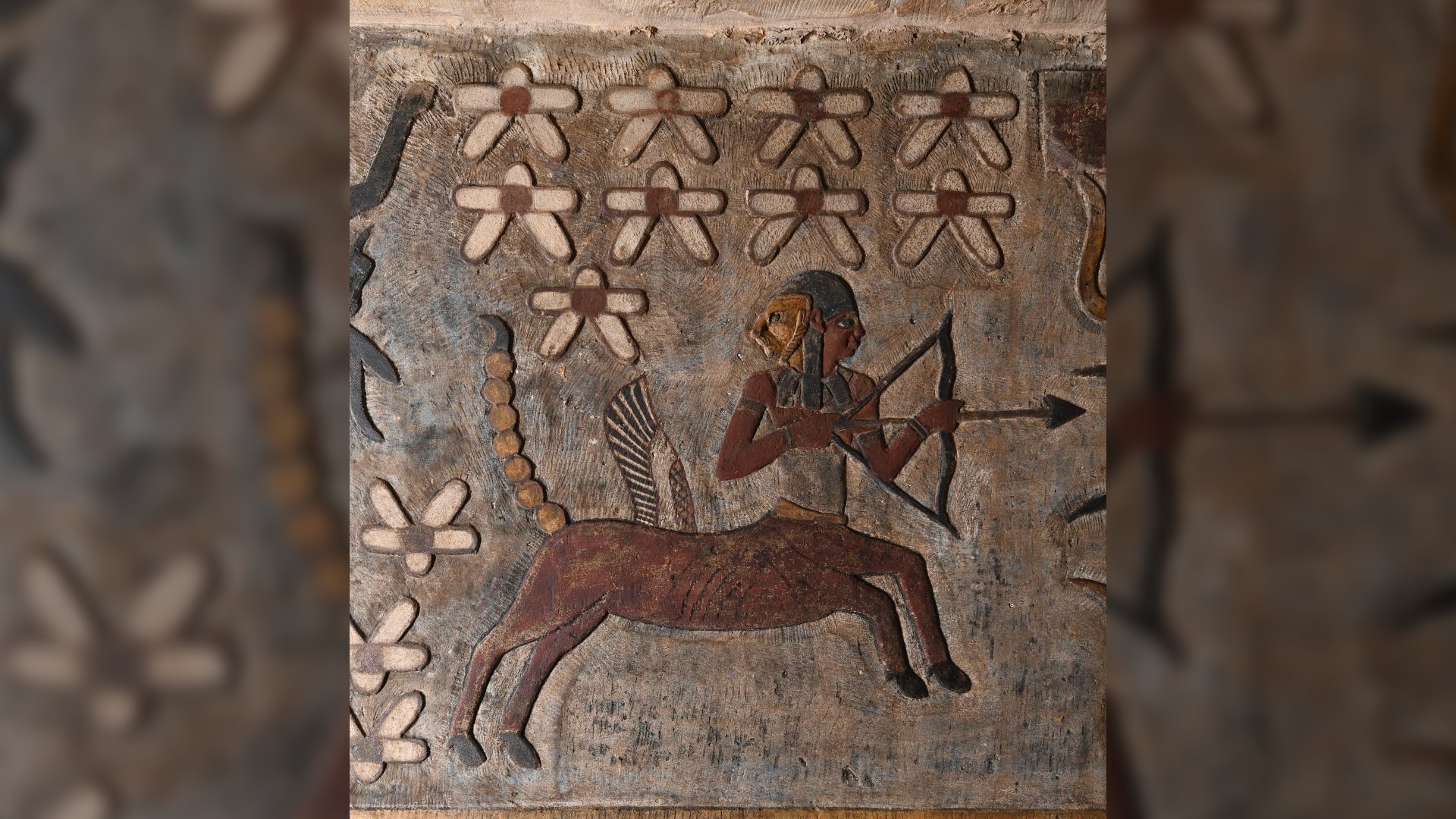
The most significant recent breakthrough in Egyptian astronomical research stems from the multi-year restoration project at the Temple of Esna (located approximately 60 kilometers south of Luxor). Conducted by a joint team from the Egyptian Ministry of Tourism and Antiquities and the Institute for Ancient Near Eastern Studies (IANES) at the University of Tübingen, led by Professor Christian Leitz, the project systematically removed centuries of soot, dirt, and bird lime from the hypostyle hall ceiling.
The restoration revealed vivid, fully painted relief depictions of the zodiac dating to the Roman Period (completed around the reign of Emperor Domitian, 81–96 CE, with additions continuing into the reign of Trajan). Highlights of the Esna ceiling disclosures include:
- Complete Zodiacal Cycles: Full depictions of all twelve signs of the zodiac, painted in brilliant polychrome pigments using malachite greens, Egyptian blues, ochres, and cinnabar.
- Planetary Deities: Clear representations of the known planets visualized as divine entities riding celestial barks. Mars is depicted as a falcon-headed deity (Horus the Red), Saturn as a bull-headed god (Horus the Bull), and Jupiter as a royal figure (Horus Who Bounds the Two Lands).
- Unidentified Indigenous Constellations: Beside standard zodiacal figures, researchers uncovered representations of ancient Egyptian constellations never before seen in full color, such as Apes m-khent-f ("He who measures his length") depicted as a snake-headed creature, and the Constellation of the Goose, symbolizing the creator god Amun.
The Dendera Circular Zodiac
Before the Esna revelations, the most famous Egyptian astronomical relief was the Dendera Zodiac, discovered in the Hathor Temple at Dendera. Carved during the late Ptolemaic period (around 50 BCE), this circular bas-relief—which was removed from Egypt in 1821 and is currently displayed at the Musée du Louvre in Paris—presents a comprehensive map of the night sky.
The Dendera relief displays the twelve zodiacal constellations placed along an off-center ecliptic circle, surrounded by the 36 decans. The constellation figures show a fascinating blend of cultures: Aries, Taurus, and Gemini appear in standard Greco-Babylonian forms, whereas the constellation Ursa Major (the Big Dipper) is rendered in traditional Egyptian iconographic form as the foreleg of an ox (Meskhetiu).
Written Personal Horoscopes: Papyri, Ostraca, and Coffins
Beyond monumental temple ceilings meant for public and religious spaces, ancient archaeologists have recovered numerous private, individual horoscopes that document how ordinary people engaged with celestial fate.
- ANCIENT EGYPTIAN HOROSCOPE MEDIA
- SACRED & PUBLIC MONUMENTS
- Esna Ceiling
- Dendera Relief
- Temple Walls
- PRIVATE & INDIVID APPLICATION
- Demotic Papyri
- Ostraca Sherds
- Coffin Interiors
- SACRED & PUBLIC MONUMENTS
Demotic and Greek Astrological Papyri
During the 1st century BCE through the 3rd century CE, private citizens commissioned personal natal horoscopes written on papyrus scrolls or inked onto ostraca (flaked limestone or broken pottery sherds). The vast majority of these documents are written in Demotic (the late cursive Egyptian script) or Koine Greek.
A standard personal Egyptian horoscope contained specific astronomical coordinates:
- The Date of Birth: Recorded according to the Egyptian civil calendar and the regnal year of the ruling Roman emperor.
- The Positions of the Planets: The precise zodiac sign occupied by the Sun, Moon, Saturn, Jupiter, Mars, Venus, and Mercury at the moment of birth.
- The Ascendant (Horoskopos): The exact zodiac sign rising on the eastern horizon at birth, considered the most crucial calculation for determining personal destiny.
The Coffin Horoscopes of Petosiris
A unique bridge between funerary customs and horoscopic astrology is found in the Roman-era tombs of Atfih and El-Salamuni. The wooden coffin lids belonging to individuals such as Petosiris (dated to the 1st or 2nd century CE) feature detailed celestial maps painted directly on their interior surfaces.
Placing a personal birth chart inside a sarcophagus served a protective purpose: it aligned the deceased’s individual earthly identity with the cosmic order, ensuring that the planetary gods recognized the deceased as they journeyed through the underworld toward eternal rebirth.
Comparing Key Ancient Egyptian Astrological Sites and Artifacts
The table below contrasts the primary physical discoveries that inform our modern understanding of ancient Egyptian horoscopes:
| Artifact / Monument Site | Primary Date Range | Medium / Material | Dominant Script / Style | Key Astronomical Features | Current Physical Location |
|---|---|---|---|---|---|
| Temple of Esna Ceiling | 1st Century CE (Roman) | Painted sandstone relief | Polychrome relief with hieroglyphic labels | 12 complete zodiac signs, 36 decans, indigenous constellations, planetary barks | Hypostyle Hall, Esna, Egypt |
| Dendera Circular Zodiac | c. 50 BCE (Late Ptolemaic) | Carved sandstone ceiling slab | Greco-Egyptian relief with hieroglyphic markings | Circular ecliptic map combining decans, constellations, solar and lunar eclipses | Musée du Louvre, Paris, France |
| Athribis Ostraca Archive | 1st Century BCE – 2nd Century CE | Inked ceramic sherds | Demotic, Greek, Hieratic, and Coptic scripts | Hundreds of short astrological notes, birth charts, and planetary calculation tables | Athribis Excavation Site / University of Tübingen |
| Petosiris Sarcophagi | 1st – 2nd Century CE | Painted wood coffins | Greco-Roman style with Egyptian iconography | Personal birth charts painted on the interior lid directly above the mummy | Egyptian Museum, Cairo, Egypt |
| Oxyrhynchus Astrological Papyri | 1st – 4th Century CE | Inked papyrus sheets | Koine Greek and Demotic | Individual birth predictions, aspect tables, planetary transit logs | Various institutional library collections globally |
Decoding Ancient Egyptian Horoscopic Symbols and Meanings
Understanding an ancient Egyptian horoscope requires navigating a layered system of symbolism where astronomical observation met religious mythology.
- ANCIENT EGYPTIAN HOROSCOPE
- [ ZODIAC SIGNS ] Transferred via Hellenistic influence
- [ 36 DECANS ] Traditional Egyptian 10-day star groups
- [ 5 PLANETS ] Deities navigating celestial barks
The Celestial Bodies as Gods
In native Egyptian tradition, celestial bodies were not inanimate rock or gas; they were living manifestations of the gods (netjeru):
- The Sun (Re / Khepri / Atum): Represented the life force, royal authority, and the primary cycle of birth, death, and resurrection.
- The Moon (Thoth / Khonsu): Associated with wisdom, measurement, time, and hidden knowledge.
- Saturn (Horus the Bull of Heaven): Seen as a stern, stabilizing force linked to cosmic order (Ma'at).
- Jupiter (Horus Who Guides the Mystery): Viewed as a highly auspicious planet representing growth, kingship, and divine favor.
- Mars (Horus the Red): Associated with aggression, warfare, and protective energy against chaotic forces.
- Venus (The Star That Crosses / Morning Star): Tied to rebirth, renewal, and divine beauty.
- Mercury (Sebeku / Associated with Seth or Thoth): Linked to swiftness, communication, and transitions between realms.
The Role of the Ascendant
In Demotic astrological texts, the Ascendant was referred to as the Horoskopos (a Greek loanword meaning "hour-watcher"). Ancient Egyptian astrologers believed that the exact sign rising on the horizon at the moment of a child's first breath dictated their Shai (fate or destiny) and Renenutet (nurturing spirit). A person born when Aries was ascending might be predicted to have a bold, pioneering spirit protected by Amun, whereas someone born under a Virgo ascendant was seen as destined for scribal work or temple service under the protection of Isis.
How Archaeoastronomers Date and Decode Ancient Charts
Modern Egyptologists and astronomical historians use advanced computational tools to analyze the dates inscribed on ancient Egyptian horoscopes. Because planetary motion follows precise, predictable mathematical orbits, a chart showing the relative positions of Saturn, Jupiter, Mars, Venus, and the Sun often creates a unique celestial signature that occurs only once every few centuries.
Retrocalculate Planetary Alignments
Using modern celestial software, researchers retrocalculate planetary coordinates backward thousands of years. For example, when analyzing the Dendera Circular Zodiac:
- Observing Planetary Positions: Researchers noted that the planets depicted in relief are located in specific zodiacal signs (e.g., Venus in Pisces, Mars in Capricorn).
- Solar and Lunar Eclipses: The relief depicts a lunar eclipse in the sign of Pisces and a solar eclipse in the sign of Virgo.
- Pinpointing the Date: By cross-referencing these positions, astronomical historians calculated that the configuration shown on the Dendera ceiling reflects the exact night sky visible in Egypt between June 15 and August 15, 50 BCE.
Deciphering Demotic Scripts
Reading personal papyrus horoscopes requires specialized linguistic knowledge. Demotic script uses shorthand notations for signs, planets, and degrees. Translators must reconcile the Egyptian civil calendar (comprising three seasons: Akhet [Inundation], Peret [Emergence], and Shemu [Harvest]) with the Julian and Alexandrian calendars used by Roman administrators to establish precise birth dates down to the hour.
Frequently Asked Questions
What is the absolute oldest personal Egyptian horoscope ever found?
The oldest surviving written personal horoscope from Egypt dates to 38 BCE (the late Ptolemaic period). It is recorded in Demotic script on papyrus and details the birth chart of an individual born in the regnal year of Cleopatra VII. Monumental celestial ceilings like those at Dendera date to roughly the same century.
Did ancient Egyptians invent the zodiac?
No. The twelve-sign zodiac originated in ancient Mesopotamia (Babylonia) around the 5th century BCE. It was later refined by Greek astronomers and introduced into Egypt during the Ptolemaic period (after 332 BCE), where native Egyptians combined it with their existing 36 decanal star system.
How were horoscopes used in daily Egyptian life?
For most of Egyptian history, astrology was a state-level concern used to align royal rituals, temple foundations, and agricultural cycles with the cosmos. During the Roman period, personal natal astrology expanded to wealthy individuals who used written horoscopes to assess health prospects, career suitability, marriage timing, and ideal funerary arrangements.
What makes the Esna Temple horoscope discoveries unique?
The Esna discoveries are unique because modern restoration techniques removed centuries of black soot, revealing the original, vibrant colors of the ceiling reliefs for the first time in nearly two thousand years. This work uncovered previously undocumented Egyptian constellation names, complete color schemes, and detailed divine representations of the planets.
Can tourists view these ancient Egyptian horoscopes today?
Yes. Visitors to Egypt can view the in-situ ceiling reliefs at the Temple of Esna near Luxor and the Temple of Hathor at Dendera. The famous original circular Dendera Zodiac ceiling slab is housed in the Musée du Louvre in Paris, France, while a plaster replica remains in the original temple ceiling in Egypt.
Recommended Next Steps for Researchers and Enthusiasts
To further explore ancient Egyptian astrology, consider the following academic avenues:
- Examine Digital Archives: Review publication catalogs from the University of Tübingen’s Esna Project to access high-resolution digital imagery of restored celestial ceilings and translated Demotic texts.
- Study Primary Collections: Visit major Egyptology departments and museum collections, such as the Musée du Louvre (Paris), the British Museum (London), or the Egyptian Museum (Cairo), which house original papyri, ostraca, and sarcophagi containing ancient astrological charts.
- Explore Archaeoastronomy Literature: Consult academic works on Greco-Egyptian astrology by scholars such as Christian Leitz, Alexandra von Lieven, and Roger Bagnall for detailed translations of Demotic astrological handbooks.
Image Gallery