Is Interest on a Life Insurance Loan for a Home Purchase Tax-Deductible?
Interest paid on a life insurance policy loan used to purchase a personal home is generally not tax-deductible under Internal Revenue Code guidelines. Because the policy loan is collateralized by the contract’s cash value rather than s...
Interest paid on a life insurance policy loan used to purchase a personal home is generally not tax-deductible under Internal Revenue Code guidelines. Because the policy loan is collateralized by the contract’s cash value rather than secured by the real property itself, it fails to meet the legal requirements for qualified residence interest.
Contents
The Legal Framework: IRC Section 163 and Personal Interest
To understand why interest on a life insurance loan used for a home purchase is non-deductible, one must examine Internal Revenue Code (IRC) Section 163. Under IRC § 163(h), personal interest paid or accrued by a non-corporate taxpayer is explicitly disallowed as a tax deduction.
- IRC Section 163(h): Disallowance of Personal Interest
- Personal Expenditure (Unsecured or Policy Loan)
- NON-DEDUCTIBLE INTEREST (IRC § 163(h) General Rule)
- Qualified Residence (Secured Real Property)
- DEDUCTIBLE INTEREST (IRC § 163(h)(3) Exception)
- Personal Expenditure (Unsecured or Policy Loan)
The tax code provides specific exceptions to this disallowance rule, most notably for qualified residence interest under IRC § 163(h)(3). For interest on home-related debt to qualify for an itemized deduction on Schedule A (Form 1040), the debt must meet two primary criteria:
- Acquisition Indebtedness or Home Equity Indebtedness: The funds must be incurred in acquiring, constructing, or substantially improving a qualified residence of the taxpayer.
- Secured Debt Requirement: The debt must be secured by the qualified residence itself.
The Secured Debt Requirement Explained
The IRS defines a secured debt in Treasury Regulation § 1.163-10T and IRS Publication 936 (Home Mortgage Interest Deduction). A debt is considered secured only if the borrower grants the lender a security interest in the real property via an instrument such as a mortgage, deed of trust, or land contract under applicable state law. The instrument must be properly recorded or perfected in the public records of the jurisdiction where the property is located.
When a policyholder borrows against the cash value of a permanent life insurance policy (such as a whole life or universal life policy), the loan is extended by the insurance carrier. The collateral for this transaction is the policy’s cash surrender value—not the underlying real estate. Even if 100% of the loan proceeds are directly transferred to an escrow account to complete a home purchase, the obligation remains legally secured by the insurance policy contract. Because the debt is not perfected against the property title, it fails the definition of qualified residence interest, rendering the interest non-deductible personal interest.
Treasury Regulations and Interest Tracing Rules
Taxpayers often wonder whether the intended use of the funds overrides the type of loan collateral. The Internal Revenue Service addresses this issue through Treasury Regulation § 1.163-8T, known as the interest tracing rules.
Under interest tracing rules, interest expense is generally allocated according to the specific allocation and expenditure of the loan proceeds, rather than the collateral securing the loan. However, there is a key interaction between interest tracing and the statutory definitions under IRC § 163:
- Personal Home Purchase: If proceeds from a life insurance policy loan are traced to the purchase of a personal primary residence or secondary home, the interest is classified as a personal expenditure. Personal interest is strictly non-deductible under IRC § 163(h)(1). The tracing rule does not transform personal debt into qualified residence interest unless the underlying debt is legally secured by the home.
- Investment Real Estate Purchase: If a policyholder uses a life insurance policy loan to acquire income-producing rental real estate or commercial property, interest tracing rules treat the borrowing as an investment or business expenditure rather than a personal one.
Tracing Policy Loans for Investment Properties
When policy loan proceeds are traced directly to an investment property (such as a residential rental property held for passive income), the interest paid on the life insurance loan may be deductible as investment interest expense under IRC § 163(d) or as a business expense under IRC § 162.
- Investment Interest Expenses (IRC § 163(d)): If the property is held for investment purposes (such as raw land intended for appreciation), interest is deductible up to the taxpayer's net investment income for the year. Any excess non-deductible investment interest can be carried forward to subsequent tax years.
- Passive Activity / Rental Real Estate (IRC § 469): If the funds are used to buy rental housing that constitutes a passive trade or business, the interest expense is allocated to the rental activity. It is deducted against gross rental income on Schedule E (Form 1040), subject to passive activity loss rules under IRC § 469.
To maintain deductibility for investment real estate, the taxpayer must strictly trace the funds from the life insurance company loan directly into an isolated bank account and directly out to the property settlement agent. Mixed or commingled funds can invalidate the tax tracing audit trail.
How Life Insurance Policy Loans Function
To evaluate the broader financial trade-offs of using cash value life insurance to fund property acquisitions, it is essential to understand the mechanics of policy loans.
Cash Value Accumulation and Borrowing
Permanent life insurance contracts—including whole life, variable universal life, and indexed universal life—contain a cash value component that grows over time on a tax-deferred basis under IRC § 7702. When a policyowner requests a policy loan, the insurance carrier pays out funds directly to the policyowner using the insurer's general account or non-guaranteed account assets, placing an equal amount of the policy’s cash value as collateral.
Unlike traditional bank loans, life insurance loans do not require:
- Mandatory credit checks or underwriting.
- Income verification or debt-to-income (DTI) ratio calculations.
- A fixed repayment schedule or mandatory monthly principal payments.
Direct vs. Non-Direct Recognition
Insurance carriers account for policy loans using two distinct methods, which affect net asset growth and overall cost:
Direct Recognition: The insurer reduces the dividend or interest crediting rate on the specific portion of the cash value held as loan collateral. The unencumbered cash value continues to receive the standard dividend rate, while the borrowed cash value receives an adjusted (often lower) rate.
Non-Direct Recognition: The insurer pays the same dividend or crediting rate on the entire cash value, regardless of whether a policy loan is outstanding. However, the interest rate charged on the policy loan is typically adjusted periodically to reflect market rates.
Policy Loan Mechanics:
- Cash Surrender Value
- Pledged as Collateral
- Insurer Issues Policy Loan
- No mandatory monthly repayment schedule
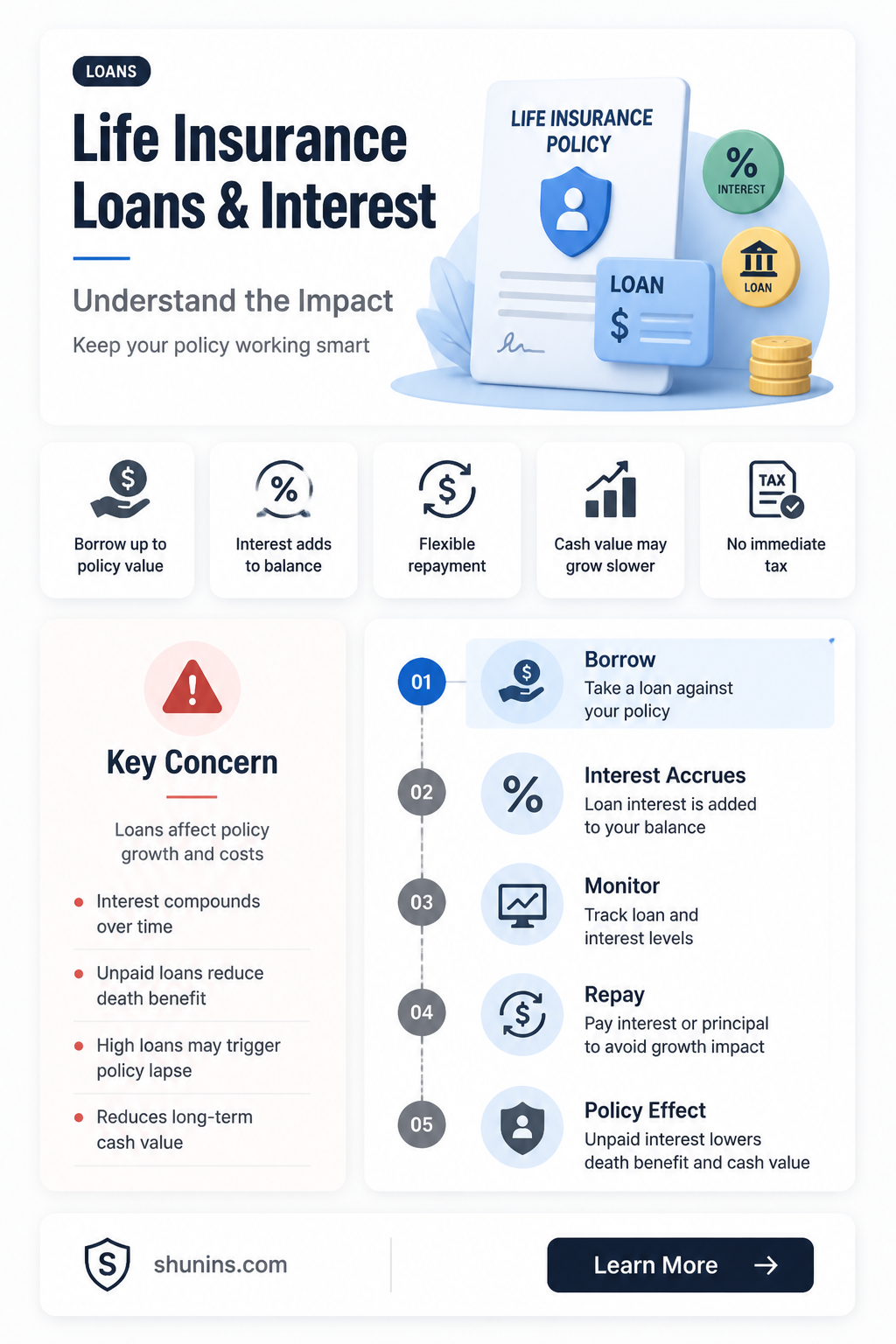
- Unpaid interest compounds annually against cash value
- Outstanding loan balance reduces death benefit payable to beneficiaries
Compounding Interest Risks and Tax Pitfalls
Interest on a life insurance loan accrues daily and is billed annually. If the policyholder chooses not to pay the accrued interest out of pocket, the insurer automatically adds the unpaid interest to the total outstanding loan balance. This process causes interest to compound against the remaining cash value.
If the outstanding loan balance plus accrued interest grows to exceed the policy's total cash value, the policy will lapse. A policy lapse while an unpaid loan exceeds the cost basis triggers a severe tax event:
- Phantom Tax Liability: Under IRC § 72, any cash value gain (total cash value minus cumulative premiums paid) that was previously tax-deferred becomes immediately taxable as ordinary income in the year of the lapse.
- Loss of Capital: The policy owner loses the insurance coverage, receives no additional cash, and owes ordinary income tax on the unrecognized gain that was consumed by the compounding loan interest.
Comparison: Life Insurance Loans vs. Traditional Mortgages
When financing a personal residence, policyholders often compare life insurance policy loans against standard home loans and Home Equity Lines of Credit (HELOCs).
| Feature / Metric | Traditional First Mortgage | Home Equity Line of Credit (HELOC) | Life Insurance Policy Loan |
|---|---|---|---|
| Primary Collateral | Real Property (Deed of Trust) | Real Property (Subordinate Lien) | Policy Cash Value |
| Tax Deductibility (Personal Home) | Deductible (up to IRC caps, itemized) | Deductible (if used to buy/improve home) | Non-Deductible |
| Underwriting Requirements | Full income, credit, asset verification | Income, credit, property appraisal | None (automated approval) |
| Impact on Personal Credit Report | Reported to credit bureaus | Reported to credit bureaus | Not reported (private contract) |
| Repayment Structure | Mandatory monthly amortized payments | Variable draw & repayment terms | Flexible; no mandatory monthly schedule |
| Max Loan Limit | Based on LTV and underwriting limits | Based on home equity (typically 80-85% LTV) | Typically 90-95% of accumulated cash value |
| Lapse / Foreclosure Risk | Property foreclosure on default | Property foreclosure on default | Policy lapse & ordinary income tax on default |
Structuring Alternatives: Third-Party Collateral Assignments
Because direct policy loans from an insurance company are non-deductible when used to buy a personal primary home, some high-net-worth taxpayers explore an alternative arrangement known as a bank line of credit secured by collateral assignment (often termed a cash-value line of credit or CSVLI line).
- Cash Value Life Insurance Policy
- Assignment of Policy Collateral
- Commercial Bank (Third Party)
- Issues Mortgage / Secured Real Estate Debt
- Personal Home (Recorded Lien)
How a Collateral Assignment Line of Credit Works
- The policyholder applies for a credit facility with a commercial bank or private wealth lender.
- Rather than borrowing directly from the insurance carrier, the borrower executes a collateral assignment of the life insurance policy to the bank as secondary collateral.
- The bank issues a loan or line of credit to the borrower.
- To qualify for the home mortgage interest deduction under IRC § 163(h)(3), the bank must also record a valid mortgage or deed of trust against the acquired real property in local land records.
Tax Consequences of Collateral Assignment Loans
If the bank loan is dual-collateralized (secured by a recorded first mortgage on the home and supported by the pledged insurance policy), the interest paid to the bank may meet the IRS definition of qualified residence interest.
However, if the bank relies solely on the pledged life insurance contract without recording a legal lien against the home title, the interest remains non-deductible personal interest. Perfecting the real estate lien under local property law is the mandatory prerequisite for tax deductibility.
Common Misconceptions Regarding Insurance Loan Deductibility
Several persistent myths surrounding life insurance loans can lead to tax penalties and unexpected liabilities during an IRS audit.
Misconception 1: "The 'Use of Funds' Test Overrides the Collateral Requirement"
Many taxpayers assume that because the borrowed proceeds were transferred to an escrow agent to buy a home, the interest automatically transforms into mortgage interest. As established under Treasury Regulations, while interest tracing rules categorize how funds are expendited, personal expenditures (including personal housing) remain strictly non-deductible unless the debt is formally secured by the property.
Misconception 2: "Interest Paid to My Own Policy is Tax-Free and Deductible"
Borrowers often believe they are "paying interest back to themselves." In reality, policy loan interest is paid directly to the insurance carrier's general pool to offset lost earnings on the general portfolio assets backing the contract. The interest paid is not credited dollar-for-dollar into the borrower's individual cash value account, nor can it be claimed on Schedule A.
Misconception 3: "Down Payment Funding via Policy Loan Makes the Whole Loan Deductible"
Using a policy loan to fund a down payment while obtaining a traditional primary mortgage from a commercial bank split-funds the transaction. Interest paid on the primary commercial mortgage (which is secured by the home) is deductible subject to standard IRS limits. However, the interest paid on the secondary policy loan used for the down payment remains non-deductible personal interest.
Frequently Asked Questions
Can I deduct interest on a life insurance loan if the proceeds buy a rental property?
Yes, if the borrowed funds are used exclusively to purchase or improve income-producing rental real estate. Under Treasury Regulation § 1.163-8T, interest tracing rules classify the expense as a rental real estate expenditure. You can deduct the interest on Schedule E (Form 1040) against gross rental income, subject to passive loss limits under IRC § 469.
What happens if I do not pay the interest on my life insurance policy loan?
If you do not pay the annual interest out of pocket, the insurance company automatically adds the unpaid interest amount to your total outstanding policy loan balance. The accumulated loan balance compounds over time. If the total balance exceeds the cash surrender value, the policy will lapse, creating an immediate taxable event for any policy gains above your basis.
Is taking a cash withdrawal from a policy different from taking a loan to buy a home?
Yes. A policy withdrawal permanently surrenders a portion of the policy's cash value, reducing the cash value and original death benefit. Withdrawals are generally tax-free up to your investment in the contract (cost basis) under IRC § 72(e), but no interest is charged because there is no loan to repay. A policy loan, by contrast, keeps the underlying cash value intact as collateral while charging ongoing loan interest.
Can I retroactively secure a policy loan with my home to make the interest deductible?
No. Insurance carriers operate under strict insurance regulatory framework mandates and do not record mortgages or deeds of trust against real property. A standard policy loan contract cannot be retroactively converted into a home-secured mortgage instrument.
How did the Tax Cuts and Jobs Act affect mortgage interest rules?
The Tax Cuts and Jobs Act (TCJA) suspended the deduction for home equity debt (borrowing not used to buy, build, or substantially improve a home) and adjusted acquisition indebtedness limits. However, it did not alter the fundamental rule that personal interest—including interest on policy loans unsecured by real property—is strictly non-deductible.
Action Steps and Financial Planning Recommendations
If you are considering using a cash value life insurance policy loan to acquire residential real estate, follow these steps to safeguard your financial and tax position:
- Review Policy Loan Terms: Obtain an illustration from your life insurance provider detailing current loan interest rates, whether the policy uses direct or non-direct recognition, and how loan interest compounding will affect long-term policy performance.
- Establish Strict Account Tracing: If the real estate acquisition is for investment or commercial rental purposes, open a dedicated bank account for loan proceeds. Wire funds directly from the insurer into this dedicated account, and pay the settlement agent directly from the same account to substantiate the audit trail under Treasury Regulation § 1.163-8T.
- Evaluate Third-Party Bank Credit Lines: If you require deductible interest for a primary residence purchase and have substantial cash value, consult a private bank regarding a securities-backed or cash-value-backed line of credit that includes a recorded first mortgage on the target real estate.
- Consult Qualified Professionals: Work with a Certified Public Accountant (CPA) or credentialed tax attorney to verify how state laws and federal tax codes apply to your specific real estate transaction prior to executing loan documentation.
Disclaimer: This article is provided for educational and informational purposes only and does not constitute formal tax, legal, or financial advice. Tax laws, IRS regulations, and estate rules are subject to change. Consult a qualified CPA or legal advisor for guidance tailored to your individual tax situation.
Image Gallery