How New Jersey Property Tax Exemptions Work: Eligibility, Programs, and Application Guide
New Jersey property tax exemptions reduce or eliminate local real estate taxes for qualified homeowners, non-profit organizations, and disabled veterans. Municipal tax assessors grant these tax breaks based on statutory requirements se...
New Jersey property tax exemptions reduce or eliminate local real estate taxes for qualified homeowners, non-profit organizations, and disabled veterans. Municipal tax assessors grant these tax breaks based on statutory requirements set by state law. Property owners qualify by meeting specific ownership, residency, income, or service-connected disability criteria and submitting formal applications to their municipal assessor.
Contents
Understanding New Jersey Property Tax Exemptions, Deductions, and Relief
New Jersey maintains some of the highest property tax rates in the United States. To ease this financial burden, state statutes mandate several forms of property tax assistance. While residents often use the term "tax exemption" broadly, New Jersey law distinguishes between three distinct mechanisms: full exemptions, annual deductions, and state-funded relief rebates.
NJ Property Tax Relief Options:
Full Exemptions (100% Tax-Free)
- 100% Disabled Veterans
- Non-Profits & Churches
Annual Tax Deductions
- $250 Veteran Deduction
- $250 Senior / Disabled
State Relief Programs
- ANCHOR Rebates
- Senior Freeze (PTR)
Property Tax Exemptions: Completely eliminate property taxes on a qualified parcel. Under New Jersey law, full exemptions apply to specific categories, including 100% permanently and totally disabled veterans and qualified religious, educational, or charitable non-profit entities.
Property Tax Deductions: Provide a direct, fixed subtraction from a property owner's annual tax bill. The two primary statutory deductions are the $250 Veteran Deduction and the $250 Senior Citizen / Disabled Person Deduction.
State Property Tax Relief Programs: Administered through the New Jersey Division of Taxation rather than individual municipal assessors. Programs such as the ANCHOR benefit and the Senior Freeze (Property Tax Reimbursement) issue direct rebate payments or offset property tax rate increases over time.
Local property taxes in New Jersey are assessed annually as of October 1 for the following tax year. Applying for an exemption or deduction requires strict adherence to statutory deadlines and documented proof of eligibility.
Municipal Property Tax Exemptions in New Jersey
Full property tax exemptions relieve property owners of 100% of their local property tax obligation. Because property taxes fund municipal operations, school districts, and county services, statutory standards for full exemptions are narrowly construed by New Jersey tax courts.
100% Permanently and Totally Disabled Veteran Exemption
Under N.J.S.A. 54:4-3.30, honorably discharged veterans who sustain a 100% permanent and total service-connected disability are entitled to a full exemption from local property taxes on their primary dwelling house and the underlying land.
- Eligibility Requirements:
- Full ownership of the dwelling house (or legal title held jointly with a spouse).
- Proof of legal residence in New Jersey.
- Active service in the United States Armed Forces with an honorable discharge.
- Official documentation from the U.S. Department of Veterans Affairs (VA) certifying a 100% permanent and total service-connected disability (or a 100% unemployability rating treated as total disability).
- Surviving Spouse Benefit: The surviving spouse of a qualified disabled veteran retains the full exemption after the veteran's death, provided the spouse does not remarry and continues to reside in the home as a primary residence.
Non-Profit, Religious, Educational, and Charitable Exemptions
Under N.J.S.A. 54:4-3.6, real property owned by qualified non-profit organizations is exempt from local property taxation if the property meets three fundamental tests:
- Ownership Test: The property must be legally owned by an entity organized exclusively for moral, religious, educational, hospital, or charitable purposes.
- Use Test: The property must be actively used exclusively for the tax-exempt purpose specified in the statute. Vacant land or leased space used for commercial operations invalidates the exemption.
- Non-Profit Test: The operating entity must not operate for private gain or profit.
Municipal Property Tax Deductions
Property tax deductions directly reduce an eligible taxpayer's total annual property tax bill by $250. Qualified applicants can receive multiple deductions if eligible under separate statutory provisions (for example, a qualified senior citizen who is also an honorably discharged veteran may receive a total annual deduction of $500).
Annual Municipal Property Tax Deductions:
- $250 Veteran Deduction
- Honorable Discharge
- Active Service
- NJ Primary Residence
- $250 Senior / Disabled Deduction
- Age 65+ or Disabled
- Income ≤ $10,000* (Excludes Social Security & government pensions)
- NJ Primary Residence
1. The $250 Veteran Deduction
Established under N.J.S.A. 54:4-8.10, this deduction provides an annual $250 credit against property taxes for qualified military service members.
- Eligibility: Applicants must be honorably discharged veterans of the U.S. Armed Forces who served on active duty and maintain legal residence in New Jersey as of October 1 of the pre-tax year.
- Surviving Spouses: The un-remarried surviving spouse of an eligible veteran or a service member killed on active duty is eligible to claim the $250 deduction annually.
2. The $250 Senior Citizen, Disabled Person, or Surviving Spouse Deduction
Under N.J.S.A. 54:4-8.40, eligible senior citizens and permanently disabled residents receive a $250 property tax deduction.
- Eligibility Criteria:
- Age/Disability: Must be age 65 or older by December 31 of the pre-tax year, OR under age 65 and permanently and totally disabled, OR an un-remarried surviving spouse age 55 or older.
- Residency: Must be a legal resident of New Jersey for at least 12 consecutive months immediately preceding October 1 of the pre-tax year and own/occupy the property as a primary residence.
- Income Limit: The applicant's annual income must not exceed $10,000, excluding Social Security benefits, federal/state government pensions, and railroad retirement benefits.
- Annual Verification: Beneficiaries must file an annual Post-Budget Income Statement (Form PD56) by March 1 following the tax year to confirm their income did not exceed the legal threshold. Failure to file results in disallowance and retroactive billing of the $250 deduction.
State-Level Property Tax Relief Programs
In addition to municipal exemptions and deductions, the New Jersey Division of Taxation operates state funded property tax relief programs that pay rebates directly to property owners or cap tax liabilities.
Senior Freeze (Property Tax Reimbursement)
The Senior Freeze program reimburses eligible senior citizens and disabled residents for property tax increases on their principal residence. The program freezes the base year property tax amount; the State of New Jersey pays the difference between the base year tax rate and subsequent annual increases.
- Key Eligibility Factors:
- Age 65+ or receiving federal Social Security disability benefits.
- Continuous homeownership and residence in New Jersey for required baseline periods.
- Compliance with state-mandated annual household income limits, which are adjusted annually by statute.
ANCHOR Program (Affordable New Jersey Communities for Homeowners and Renters)
The ANCHOR program replaced the former Homestead Benefit. It provides direct financial relief payouts to qualified New Jersey homeowners and renters who meet state income thresholds.
- Homeowner Benefits: Payout levels are determined by household income, with higher relief amounts designated for seniors aged 65 and older.
- Renter Benefits: Qualified tenants also receive direct cash payments based on income limits.
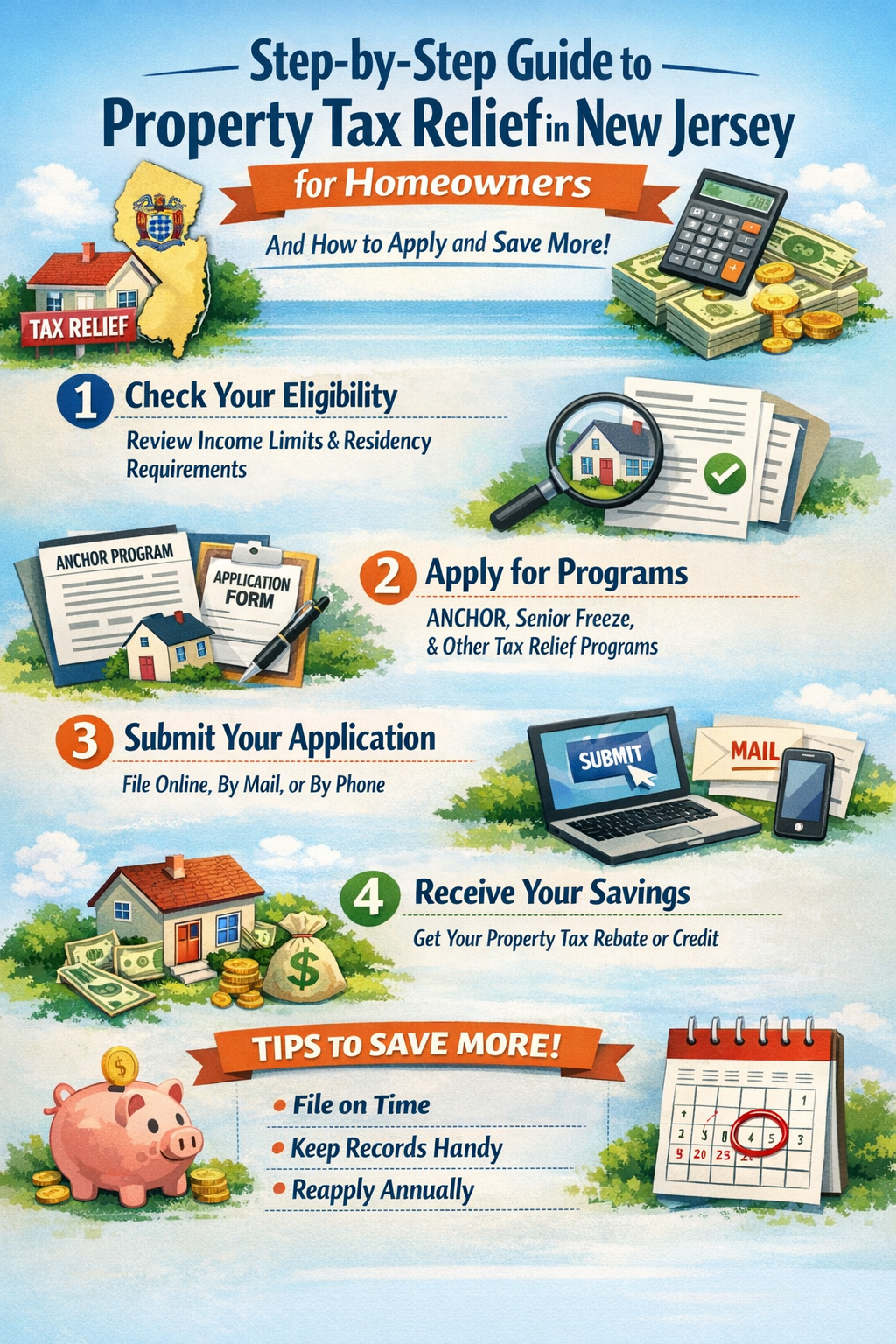
Step-by-Step Application Process
Securing a property tax exemption or deduction requires submitting specific legal forms and documentation to the local municipal tax assessor where the property is located.
Exemption Application Process:
- Step 1: Identify Proper Claim Form (Form D.V.S.S.E., Form V.D., Form P.T.D., or Form I.S.)
- Step 2: Assemble Required Verification Records (DD-214, VA Rating Letter, Proof of Residency, Income)
- Step 3: File Application with Local Tax Assessor (Submit by statutory deadline; retain delivery receipt)
- Step 4: Comply with Renewal & Audit Filings (Submit Form PD56 or Form F.S. as required)
Step 1: Obtain the Correct Application Form
Official application forms are provided by the New Jersey Division of Taxation and are available at local municipal tax offices:
- Form D.V.S.S.E.: Claim for Real Property Tax Exemption on Dwelling House of Disabled Veteran or Surviving Spouse.
- Form V.D.: Claim for Property Tax Deduction by Veteran or Surviving Spouse.
- Form P.T.D.: Claim for Annual Property Tax Deduction for Senior Citizen, Disabled Person, or Surviving Spouse.
- Form Initial Statement (Form I.S.): Property Tax Exemption Claim for Non-Profit Organizations.
Step 2: Gather Supporting Records
Assessors require concrete evidence to grant property tax adjustments. Required documentation includes:
- Military Records: Certificate of Release or Discharge from Active Duty (DD Form 214) showing branch of service, entry and discharge dates, and honorable discharge status.
- Disability Documentation: Official VA Award Letter certifying a 100% permanent and total service-connected disability rating.
- Proof of Ownership and Residency: Recorded deed, New Jersey driver's license, voter registration, and utility statements verifying primary residence.
- Income Statements (For Senior/Disabled Deductions): Federal and State income tax returns, W-2s, 1099s, and completed Form PD56.
Step 3: Submit the Claim to the Municipal Tax Assessor
File the completed application and attachments directly with the municipal tax assessor in the municipality where the property is situated.
Applications for the $250 Veteran or Senior deductions can be filed throughout the tax year. Once granted, deductions apply to the current tax year and continue in subsequent years, provided the owner remains qualified. The 100% Disabled Veteran exemption takes effect on the date the assessor receives the fully completed application alongside complete VA proof.
Step 4: Maintain Annual Compliance
Taxpayers must satisfy ongoing verification requirements:
- Senior/Disabled Deduction Holders: Must file Form PD56 (Post-Budget Income Statement) with the municipal tax collector by March 1 every year.
- Non-Profit Entities: Must file a Triennial Further Statement (Form F.S.) every three years with the municipal tax assessor to confirm continued non-profit ownership and exclusive tax-exempt usage.
Comparison of New Jersey Property Tax Benefit Programs
| Program / Benefit Name | Benefit Amount | Statutory Authority | Primary Eligibility Criteria | Annual Income Ceiling | Required Application Form |
|---|---|---|---|---|---|
| 100% Disabled Veteran Exemption | 100% Exemption of Property Taxes | N.J.S.A. 54:4-3.30 | 100% P&T VA Disability rating; honorable discharge; owner-occupied primary home | None | Form D.V.S.S.E. |
| Veteran Tax Deduction | $250 annual tax credit | N.J.S.A. 54:4-8.10 | Active military service during war/conflict; honorable discharge; owner-occupied home | None | Form V.D. |
| Senior / Disabled Person Deduction | $250 annual tax credit | N.J.S.A. 54:4-8.40 | Age 65+ or permanently disabled; NJ resident 1+ years; primary residence | $10,000 (Excludes Social Security/Pensions) | Form P.T.D. & Annual Form PD56 |
| Non-Profit / Religious Exemption | 100% Exemption of Property Taxes | N.J.S.A. 54:4-3.6 | Organized exclusively for charitable/religious/educational use; non-profit operation | None | Initial Statement (Form I.S.) |
| Senior Freeze (PTR) | Reimbursement of annual tax rate increases | N.J.S.A. 54:4-8.67 | Age 65+ or disabled; 10-year NJ residency; 3-year home ownership | Set annually by State (e.g., ~$150,000–$163,000) | Form PTR-1 / PTR-2 |
| ANCHOR Program | Direct payment rebate ($400–$1,750 typical range) | Annual NJ State Budget | Homeowners and renters meeting state income limits on principal residence | Up to $250,000 (Homeowners); Up to $150,000 (Renters) | Online via NJ Division of Taxation |
Common Pitfalls, Assessor Audits, and Appeal Rights
Even qualified property owners may face denial or revocation of property tax benefits due to procedural oversights or statutory misinterpretations.
Frequent Application Errors
- Primary Residence Discrepancies: New Jersey law limits exemptions and deductions strictly to a taxpayer's principal residence. Owning multiple homes, holding out-of-state driver's licenses, or renting out portions of the property can trigger disallowance.
- Misunderstanding Income Exclusions: Claimants for the $250 Senior Deduction frequently fail to realize that while Social Security income is excluded from the $10,000 limit, interest, dividends, capital gains, and IRA distributions count toward the ceiling.
- Delay in VA Paperwork Submission: The 100% Disabled Veteran exemption cannot be retroactively applied to prior tax years before the complete application and formal VA rating letter are delivered to the assessor.
Appealing Exemption and Deduction Denials
If a municipal tax assessor denies a claim for a property tax exemption or deduction, the assessor issues a formal notice of disallowance.
- Filing an Appeal: The property owner can appeal the denial to the County Board of Taxation in the county where the property is located.
- Statutory Filing Deadline: Appeals must be filed on or before April 1 of the tax year (or May 1 for municipalities undergoing a municipal-wide reassessment or revaluation).
- Tax Court Appeals: If the County Board of Taxation upholds the assessor's denial, the property owner may file a further appeal with the Tax Court of New Jersey within 45 days of the County Board's judgment.
Frequently Asked Questions
Can a surviving spouse keep a 100% Disabled Veteran property tax exemption?
Yes. The un-remarried surviving spouse of a qualified 100% permanently and totally disabled veteran retains the full property tax exemption, provided the spouse continues to own and occupy the home as their primary New Jersey residence. If the surviving spouse moves to a new primary residence in New Jersey, the exemption can be transferred to the new home upon submitting a new application to the local assessor.
Does the $250 Senior Citizen Deduction apply automatically once I turn 65?
No. The deduction is not automatic. Homeowners must submit Form P.T.D. along with proof of age, ownership, residency, and income to their municipal tax assessor. Additionally, recipients must complete Form PD56 every year by March 1 to confirm their income remains below the $10,000 limit (excluding Social Security and qualifying pensions).
What happens to a property tax exemption if I place my home into a revocable living trust?
Placing a residence into a revocable living trust can imperil an exemption or deduction if the trust structure separates legal title from beneficial ownership. Under New Jersey law, the applicant must maintain clear legal title or a qualifying life estate in the property. Property owners planning to transfer real estate into a trust should ensure the trust instrument includes specific life-estate or primary-beneficiary provisions compliant with N.J.S.A. 54:4 requirements.
Are non-profit organizations automatically exempt from New Jersey property taxes upon incorporation?
No. Incorporating as a 501(c)(3) non-profit entity with the IRS or New Jersey Department of the Treasury does not grant automatic local property tax exemption. The organization must own the real estate and submit Form Initial Statement (Form I.S.) to the municipal tax assessor, proving the property is actively and exclusively used for statutory tax-exempt purposes.
Can I claim both the $250 Veteran Deduction and the $250 Senior Citizen Deduction?
Yes. If a taxpayer meets all individual statutory qualifications for both programs—such as being an honorably discharged veteran and an income-qualified senior citizen aged 65 or older—the municipality will grant both benefits, resulting in a combined annual property tax deduction of $500.
Practical Actions and Professional Guidance
Homeowners and non-profit administrators seeking property tax relief in New Jersey should take the following immediate steps:
- Verify Qualifications: Review official statutory criteria on the New Jersey Division of Taxation Property Tax Page.
- Schedule a Meeting with the Municipal Tax Assessor: Request localized application forms and verify exact filing requirements before submittal.
- Maintain Detailed Records: Keep copies of all filed application forms, certified mail receipts, and annual income verification notices (Form PD56).
Disclaimer: New Jersey property tax regulations and statutory income thresholds are enforced strictly by local municipal assessors and county tax boards. For complex property title issues, trust arrangements, or contested tax assessment appeals, property owners should consult a qualified New Jersey real estate attorney or certified tax professional.
Image Gallery