Understanding the Bromine Noble Gas Configuration
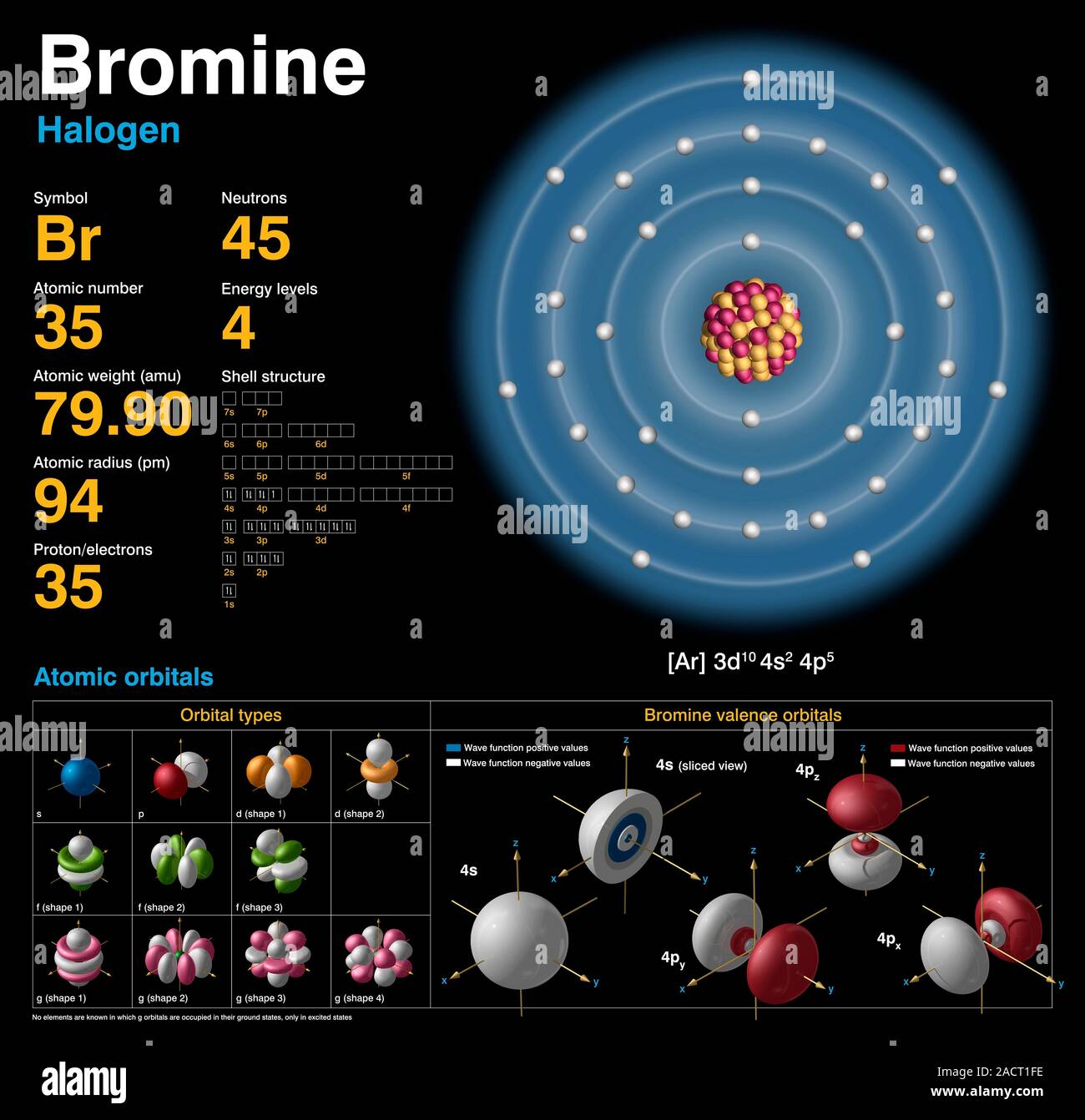
The noble gas configuration for bromine (atomic number 35) is [Ar] 3d¹⁰ 4s² 4p⁵. This shorthand notation identifies argon as the preceding noble gas, representing the first 18 electrons, while explicitly detailing the arrangement of th...
The noble gas configuration for bromine (atomic number 35) is [Ar] 3d¹⁰ 4s² 4p⁵. This shorthand notation identifies argon as the preceding noble gas, representing the first 18 electrons, while explicitly detailing the arrangement of the remaining 17 electrons in the third and fourth energy levels.
Contents
The Fundamentals of Electron Configuration
Electron configuration is the distribution of electrons of an atom or molecule in atomic or molecular orbitals. In the year 2026, the study of electronic structures remains the cornerstone of predictive chemistry, allowing scientists to anticipate how elements will react, bond, and conduct energy. For an element like bromine, understanding its configuration is not merely an academic exercise; it is essential for mastering halogen chemistry, which governs everything from flame retardants to pharmaceutical synthesis.
The distribution of electrons follows specific quantum mechanical rules:
- The Aufbau Principle: Electrons fill subshells of the lowest available energy levels before occupying higher levels (e.g., 1s before 2s).
- The Pauli Exclusion Principle: An orbital can hold a maximum of two electrons, and they must have opposite spins.
- Hund’s Rule: Every orbital in a subshell is singly occupied with one electron before any one orbital is doubly occupied.
When writing the configuration for heavier elements like bromine, the full notation becomes cumbersome. This is where the noble gas shorthand provides clarity and efficiency.
Bromine on the Periodic Table: A Period 4 Halogen
Bromine is a chemical element with the symbol Br and atomic number 35. Situated in Group 17 (the halogens) and Period 4, it is the only nonmetallic element that is liquid at standard room temperature. Its position on the periodic table provides the immediate roadmap for its electron configuration.
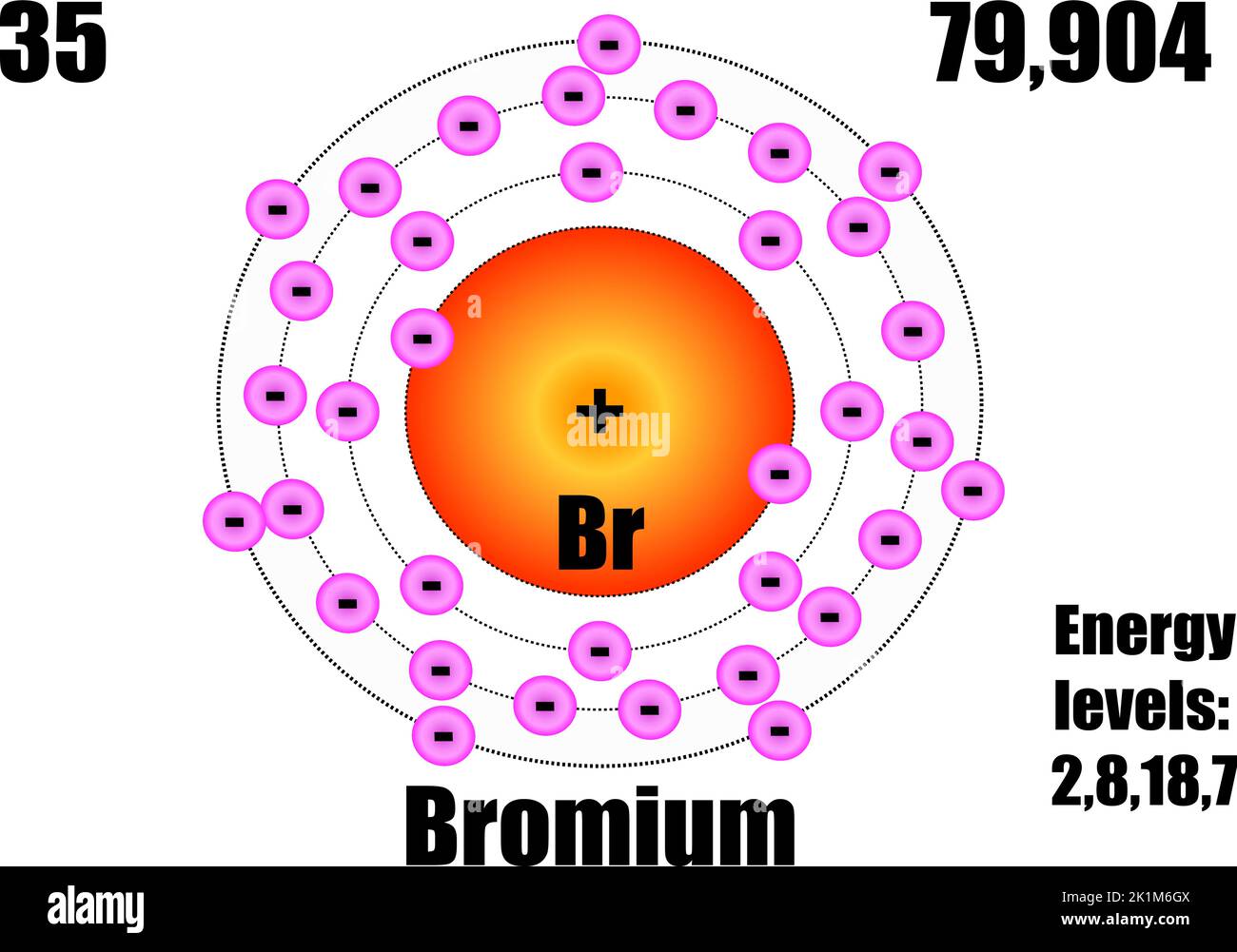
As a member of Period 4, bromine has electrons occupying the first, second, third, and fourth principal energy levels. As a Group 17 element, we can immediately deduce that it possesses seven valence electrons, which are the electrons in the outermost shell that participate in chemical bonding.
The Full Electron Configuration of Bromine
To arrive at the noble gas configuration, one must first understand the complete path of electron filling for all 35 electrons:
- 1s²: The first shell (n=1) is filled with 2 electrons.
- 2s² 2p⁶: The second shell (n=2) is filled with 8 electrons.
- 3s² 3p⁶: The third shell starts filling with 8 electrons.
- 4s²: According to the Aufbau principle, the 4s subshell fills before the 3d subshell because it is at a slightly lower energy level in a neutral atom.
- 3d¹⁰: The transition metal block is traversed, filling the 3d subshell with 10 electrons.
- 4p⁵: Finally, five electrons enter the 4p subshell.
Summing these up ($2+2+6+2+6+2+10+5$), we reach the total of 35.
Deriving the Bromine Noble Gas Configuration
The "noble gas configuration" or "shorthand notation" uses the symbol of the noble gas from the period immediately preceding the element in question. For bromine, which is in Period 4, the preceding noble gas is Argon (Ar), located at the end of Period 3.
Step 1: Identify the Core Electrons
Argon has an atomic number of 18. Its configuration is $1s^2 2s^2 2p^6 3s^2 3p^6$. These 18 electrons are considered "core electrons" for bromine. They are tightly bound to the nucleus and do not typically participate in chemical reactions.
Step 2: Replace Core Electrons with the Noble Gas Symbol
We replace the first 18 electrons of bromine's full configuration with the symbol [Ar].
- Full: $1s^2 2s^2 2p^6 3s^2 3p^6 4s^2 3d^{10} 4p^5$
- Shorthand: [Ar] 4s² 3d¹⁰ 4p⁵
Step 3: Standardizing the Order
In many academic contexts, the configuration is written in order of increasing energy (4s before 3d). However, it is also common to see it written by principal quantum number ($[Ar] 3d^{10} 4s^2 4p^5$). Both are technically correct, but the latter clearly separates the "inner" filled 3d shell from the "outer" valence 4s and 4p shells.
The Significance of the 3d¹⁰ Subshell
A common point of confusion for students is the presence of the 3d¹⁰ subshell. While bromine is not a transition metal, it follows the first row of transition metals (Scandium through Zinc). By the time we reach bromine, the 3d subshell is completely filled.
Because the 3d subshell is full and belongs to the n=3 energy level, these 10 electrons are generally not considered valence electrons. However, their presence provides "shielding" for the outer electrons and influences the effective nuclear charge felt by the 4s and 4p electrons. This shielding explains why bromine is smaller and more electronegative than one might expect if the d-block did not exist.
Chemical Properties and the Valence Shell
The most critical part of the bromine noble gas configuration is the 4s² 4p⁵ segment. These seven electrons constitute the valence shell.
Electronegativity and Reactivity
With seven electrons in its outer shell, bromine is only one electron short of achieving a stable "octet" (the configuration of the noble gas Krypton). This gives bromine a high electronegativity. It is highly reactive, specifically acting as a strong oxidizing agent. It seeks to gain one electron to form the bromide ion ($Br^-$).
The Bromide Ion Configuration
When bromine reacts and gains an electron, its configuration changes. The extra electron enters the 4p subshell:
- Bromine atom (Br): $[Ar] 3d^{10} 4s^2 4p^5$
- Bromide ion ($Br^-$): $[Ar] 3d^{10} 4s^2 4p^6$
This resulting configuration is isoelectronic with Krypton ([Kr]), explaining why the bromide ion is so chemically stable compared to the neutral bromine atom.
Comparative Electron Configurations of Halogens
To understand the patterns in the periodic table, it is helpful to compare bromine with its "family members" in Group 17.
| Element | Atomic Number | Noble Gas Configuration | Valence Electrons |
|---|---|---|---|
| Fluorine (F) | 9 | [He] 2s² 2p⁵ | 7 |
| Chlorine (Cl) | 17 | [Ne] 3s² 3p⁵ | 7 |
| Bromine (Br) | 35 | [Ar] 3d¹⁰ 4s² 4p⁵ | 7 |
| Iodine (I) | 53 | [Kr] 4d¹⁰ 5s² 5p⁵ | 7 |
| Astatine (At) | 85 | [Xe] 4f¹⁴ 5d¹⁰ 6s² 6p⁵ | 7 |
As we move down the group, the valence shell configuration remains $ns^2 np^5$, but the principal quantum number ($n$) increases. This consistency is why all halogens share similar chemical properties, such as forming salts with alkali metals.
Common Pitfalls and Troubleshooting
When writing the configuration for bromine, learners frequently encounter a few specific hurdles:
- Omitting the 3d orbital: Because bromine is a p-block element, some mistakenly jump from 4s to 4p. Always remember that the 3d subshell must be filled for any element with an atomic number greater than 30.
- Incorrect Electron Count: It is easy to miscount the 4p electrons. Since bromine is the fifth element in the 4p block, it must end in $p^5$.
- Confusing Chlorine and Bromine: Chlorine ends in $3s^2 3p^5$, while Bromine ends in $4s^2 4p^5$ with the additional $3d^{10}$ buffer.
- Order of 3d and 4s: In the year 2026, most standardized testing and scientific journals accept $[Ar] 3d^{10} 4s^2 4p^5$ as the preferred way to show the physical shell structure, but $[Ar] 4s^2 3d^{10} 4p^5$ is still used in textbooks to emphasize the order of filling.
Technical Applications of Bromine’s Electronic Structure
The specific electronic arrangement of bromine allows it to participate in orbital hybridization. In complex molecules, such as Bromine Pentafluoride ($BrF_5$), the bromine atom undergoes $sp^3d^2$ hybridization. This is only possible because the empty 4d orbitals are energetically accessible, allowing bromine to expand its octet—a phenomenon not seen in fluorine but common in heavier halogens.
Furthermore, the 4p electrons are responsible for bromine's unique spectral lines. In analytical chemistry, atomic absorption spectroscopy (AAS) targets the transitions of these specific valence electrons to identify and quantify bromine in environmental samples.
Frequently Asked Questions
Why is Argon used for the shorthand instead of Krypton?
Argon is used because it is the noble gas that comes before bromine. Noble gas notation is designed to show the "extra" electrons an element has beyond the previous stable shell. Krypton comes after bromine; therefore, bromine has not yet attained the Krypton configuration.
Is the 3d¹⁰ subshell considered part of the valence shell?
No. For bromine, the valence shell consists only of the electrons in the highest principal quantum number, which is $n=4$. Thus, only the $4s^2$ and $4p^5$ electrons (7 total) are valence electrons. The $3d^{10}$ electrons are considered part of the "core" or "inner" electrons in this context, although they are technically outside the Argon core.
How does the configuration explain bromine being a liquid?
The electron configuration determines the polarizability of the atom. Bromine has a relatively large electron cloud ($[Ar] 3d^{10} 4s^2 4p^5$). This allows for stronger London dispersion forces compared to fluorine or chlorine, but weaker than the solid iodine. This "middle ground" of intermolecular attraction results in a liquid state at room temperature.
What is the noble gas configuration for the excited state of bromine?
In an excited state, one of the 4p electrons could jump to a higher energy level, such as the 5s or 4d orbital. An example of an excited state configuration would be $[Ar] 3d^{10} 4s^2 4p^4 5s^1$. Note that the total electron count (35) remains the same, but the distribution changes.
Why do some sources write 4s before 3d?
This follows the Aufbau filling order. Since the 4s orbital is lower in energy than the 3d orbital in neutral atoms before they are filled, the 4s is written first to show the sequence in which electrons were added. However, once filled, the 3d electrons are actually closer to the nucleus than the 4s electrons.
Practical Recommendation for Students
To master the bromine noble gas configuration and similar elements, it is recommended to use the diagonal rule (also known as the Madelung rule) for the filling order. Always verify your total electron count against the atomic number on the periodic table. For those pursuing organic chemistry or materials science, focus specifically on the seven valence electrons ($4s^2 4p^5$), as these dictate the "leaving group" ability of bromine in substitution reactions and its role in forming covalent bonds in flame retardants.
Image Gallery