Sun Life Insurance for Individuals with HIV: An Overview
Securing life insurance while living with HIV has become significantly more accessible over the last decade due to advancements in medical treatment and a more sophisticated underwriting approach by major carriers. Sun Life, as a promi...
Securing life insurance while living with HIV has become significantly more accessible over the last decade due to advancements in medical treatment and a more sophisticated underwriting approach by major carriers. Sun Life, as a prominent player in the insurance market, evaluates applicants based on current health status, viral load, and adherence to antiretroviral therapy (ART) rather than historical stigma, allowing many individuals to qualify for coverage that fits their financial planning needs.
Contents
Understanding the Shift in Underwriting Standards
Historically, life insurance underwriting for individuals diagnosed with HIV was often straightforward: applications were frequently met with automatic declinations. However, the insurance industry has evolved alongside medical progress. Today, underwriters at companies like Sun Life look at the “big picture” of an applicant’s health.
When you apply for a policy in 2026, the focus is placed on the stability of your condition. Modern underwriting recognizes that with consistent medical management, HIV is increasingly viewed as a chronic, manageable condition rather than an uninsurable risk. Underwriters assess your eligibility by reviewing your medical history, specifically looking for sustained viral suppression, a stable CD4 count, and evidence of a consistent, compliant relationship with a healthcare provider. The goal of the insurer is to determine your long-term mortality risk, and data consistently shows that individuals on effective ART who maintain healthy lifestyle markers have life expectancies that often approach those of the general population.
Prerequisites for Consideration
If you are considering applying for a life insurance policy with Sun Life, you must be prepared to provide a detailed medical profile. This process is not markedly different from the standard underwriting process for other chronic conditions, such as diabetes or hypertension. To maximize your chances of approval, ensure you have the following information readily available:
- Diagnosis and Treatment History: Be prepared to provide the date of your initial diagnosis and a clear timeline of your treatment history.
- Viral Load Reports: Insurers will require evidence of your current and historical viral load. Documenting an "undetectable" status for an extended period is a significant positive factor in the underwriting assessment.
- CD4 Count Trends: Similar to viral load, your CD4 count provides a snapshot of your immune system's health. Stable or high counts are indicators of effective management.
- Medication Adherence: You must be able to demonstrate that you are currently taking prescribed antiretroviral therapy. Consistent adherence is the most important metric for an insurer to evaluate your risk level.
- Co-morbidities: Be honest about any other health issues. Insurance carriers look for the presence of other conditions—such as hepatitis, cardiovascular disease, or kidney issues—which may complicate the risk assessment.
The Application Process: Steps to Success
Navigating the application process requires transparency and organization. Because insurance underwriting is a data-driven process, the quality of the information you provide dictates the accuracy of the quote and the speed of the approval process.
- Consult a Licensed Advisor: Working with a professional who has experience in "impaired risk" underwriting is essential. They can help you identify which products are most appropriate for your specific health profile and guide you on how to present your medical records effectively.
- Request an Attending Physician Statement (APS): Your insurance company will likely request an APS from your primary care physician or specialist. Ensure your doctor is prepared to provide a comprehensive and accurate report of your health status.
- Prepare for a Paramedical Exam: Even if you have recent medical records, many policies require a routine paramedical exam. This involves a physical check-up, blood draw, and urine analysis. Being well-rested and prepared for this exam is a standard step in the application.
- Reviewing the Offer: Once the underwriting team has reviewed your file, they will either approve the policy, request an exclusion, or—in some cases—decline the application. If an offer is made, carefully review the "rating," which is the additional cost added to the premium based on your risk profile.
Comparison of Coverage Options
The following table outlines how different types of life insurance products generally interact with an HIV-positive applicant's risk profile.
| Product Type | Accessibility for HIV-Positive Applicants | Primary Benefit |
|---|---|---|
| Group Life Insurance | High (Often Guaranteed Issue) | No medical underwriting required in many cases. |
| Term Life Insurance | Moderate (Requires Underwriting) | Affordable, fixed-period coverage for financial protection. |
| Permanent Life Insurance | Moderate to Low | Provides long-term cash value and lifetime coverage. |
| Simplified Issue | Moderate | Faster approval but often with lower coverage caps. |
Addressing Common Challenges and Misconceptions
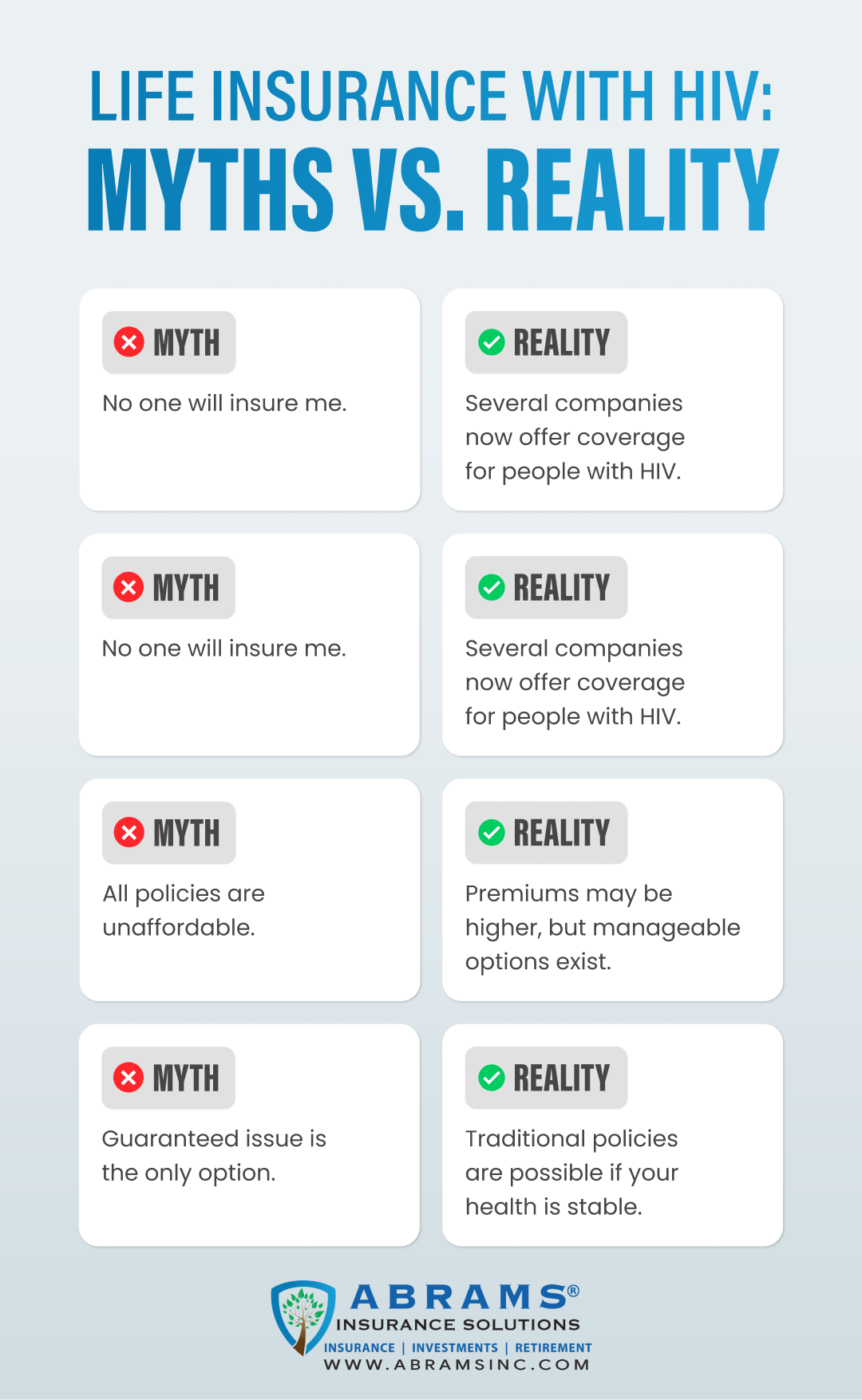
One of the most persistent hurdles for individuals with HIV seeking insurance is the fear of automatic rejection. While it is true that you may be charged a "substandard" or "rated" premium—meaning you pay more than an individual without the condition—this does not mean you cannot secure meaningful coverage.
A common mistake is failing to disclose the diagnosis during the application. Any material misrepresentation in your application can lead to a policy being voided during the claims process, leaving your beneficiaries without the protection you intended to provide. Always be truthful. If you find that a traditional individual policy is too expensive or inaccessible due to your specific health profile, consider group insurance options provided through your employer. These plans often provide a foundational level of coverage that does not require the same depth of individual medical underwriting as a private policy.
Ongoing Requirements and Maintenance
Maintaining your insurance coverage is just as important as obtaining it. If you have a permanent life insurance policy, ensure that you keep up with your premium payments. If you are participating in a group plan, be aware of what happens to your coverage if you change jobs or leave your current employer. Many employer-sponsored policies are "portable," meaning you can take them with you, but you must actively apply for this conversion within a specific window of time.
Additionally, stay in contact with your medical providers. Consistent medical care is not only vital for your health but also serves as your strongest evidence if you ever need to apply for a policy upgrade or if you are reviewing your coverage needs later in life.
Frequently Asked Questions
Can I be declined for life insurance solely because of my HIV status? While insurance companies have the right to assess risk, current underwriting practices are based on medical data. Most major insurers, including Sun Life, evaluate individuals on a case-by-case basis. Being HIV-positive does not automatically result in a decline, provided the applicant meets specific health and treatment criteria.
Will I have to pay higher premiums for my life insurance? It is likely that you will be offered a "rated" policy, which involves a higher premium than a standard policy. This is a common practice for individuals with any chronic health condition. The rating is calculated based on the insurer's assessment of your specific risk profile.
What is the role of an Attending Physician Statement (APS)? The APS is a document provided by your doctor to the insurance company. It details your diagnosis, current treatment regimen, laboratory results, and overall clinical prognosis. It is the most important document in the underwriting process.
Is group life insurance better than an individual policy? Group insurance is often the easiest to secure because it frequently requires little to no medical underwriting. However, individual policies offer more control, higher coverage limits, and portability regardless of your employment status.
How often should I review my life insurance coverage? You should review your insurance needs whenever you experience a major life event, such as marriage, the birth of a child, or a significant change in your financial obligations. Furthermore, as medical treatments continue to advance, your eligibility for more favorable ratings may improve over time.
Recommendation for Next Steps
If you are ready to pursue life insurance, your first action should be to organize your medical records. Request copies of your latest lab results and a summary of your treatment plan from your infectious disease specialist. Once you have this documentation, reach out to an independent insurance broker or a specialized financial advisor who has experience with non-standard underwriting. This professional will act as your advocate, ensuring that your application is presented in the most favorable light to the insurance carrier's underwriting department. Do not wait for a major life event to begin this process; the best time to apply is when your health is stable and your medical records are up to date.
Image Gallery