How to Calculate Workers Compensation in NSW: A Complete Guide for 2026
To calculate workers compensation in New South Wales (NSW), you must first determine your Pre-Injury Average Weekly Earnings (PIAWE). For the first 13 weeks of a claim, you generally receive 95% of your PIAWE. Between weeks 14 and 130,...
To calculate workers compensation in New South Wales (NSW), you must first determine your Pre-Injury Average Weekly Earnings (PIAWE). For the first 13 weeks of a claim, you generally receive 95% of your PIAWE. Between weeks 14 and 130, this usually drops to 80% unless you have returned to work for at least 15 hours per week.
Contents
Calculating your entitlements or premiums within the NSW workers compensation system requires navigating a complex framework governed by the State Insurance Regulatory Authority (SIRA). Whether you are an injured worker seeking to understand your weekly payments or an employer attempting to project annual premium costs, the formulas involve specific statutory variables, indexation, and historical earning data. As of 2026, these calculations remain centered on the reforms designed to simplify the "Average Weekly Earnings" model, though specific caps and thresholds are updated bi-annually.
Understanding Pre-Injury Average Weekly Earnings (PIAWE)
The cornerstone of any workers compensation benefit calculation in NSW is the Pre-Injury Average Weekly Earnings (PIAWE). This figure represents the average gross amount you earned per week before your injury occurred. It is not merely a reflection of your base salary; it is a holistic view of your financial remuneration over a specific "relevant period."
The Relevant Period
For most workers, the relevant period used to calculate PIAWE is the 52 weeks immediately preceding the injury. If you have been employed for less than 52 weeks with your current employer, the calculation is based on the period you were actually employed. If your employment was so short that an average cannot be fairly calculated (e.g., you were injured on your second day), the insurer may look at the earnings of a comparable worker in the same role.
What is Included in the Calculation?
Under the current 2026 guidelines, PIAWE includes:
- Base Salary or Wages: Your standard hourly or weekly rate.
- Overtime: Included if it was regular and would likely have continued if not for the injury.
- Shift Allowances: Regular payments for working specific hours or conditions.
- Non-Monetary Benefits: In some cases, the value of a car, health insurance, or subsidized housing may be included if these benefits ceased because of the injury.
It is important to note that certain one-off bonuses or expense reimbursements (like a travel allowance that covers actual costs incurred) are generally excluded from the PIAWE calculation.
Calculating Weekly Payment Tiers
Once the PIAWE is established, the actual amount paid to a worker depends on how long they have been receiving benefits and their current "capacity" to work. The NSW system uses a tiered structure to encourage a gradual return to the workforce.
The First Period: Weeks 1 to 13
During the initial 13 weeks of incapacity, the system provides the highest level of support.
- If you have no capacity for work: You receive 95% of your PIAWE.
- If you have partial capacity: You receive the difference between 95% of your PIAWE and your current actual earnings.
The Second Period: Weeks 14 to 130
After the 13-week mark, the calculation shifts based on your engagement with the workforce.
- If you are not working: Your entitlement drops to 80% of your PIAWE.
- If you are working (at least 15 hours per week): You may remain eligible for 95% of your PIAWE (minus your current earnings). This is a significant incentive designed to support those who make a genuine effort to return to modified duties.
- If you are working (less than 15 hours per week): You will typically receive 80% of your PIAWE (minus your current earnings).
The Third Period: Post 130 Weeks
Entitlements after 130 weeks (approximately 2.5 years) are subject to more stringent "Work Capacity Assessments." To continue receiving weekly payments, you must demonstrate that you are likely to be "totally and permanently incapacitated" for work, or that you are working at least 15 hours per week and earning at least a specific statutory amount. For many, payments cease at the five-year mark (260 weeks) unless their Whole Person Impairment (WPI) is assessed as being greater than 20%.
Statutory Maximum Caps for 2026
Calculations are always subject to a "maximum weekly compensation amount." Even if 95% of your PIAWE exceeds this cap, you will only be paid the maximum allowed by law. SIRA indexes these amounts on April 1 and October 1 every year.
| Entitlement Factor | 2026 Estimated Limit (Subject to Indexation) |
|---|---|
| Maximum Weekly Payment Cap | Approximately $2,650.00 - $2,780.00 |
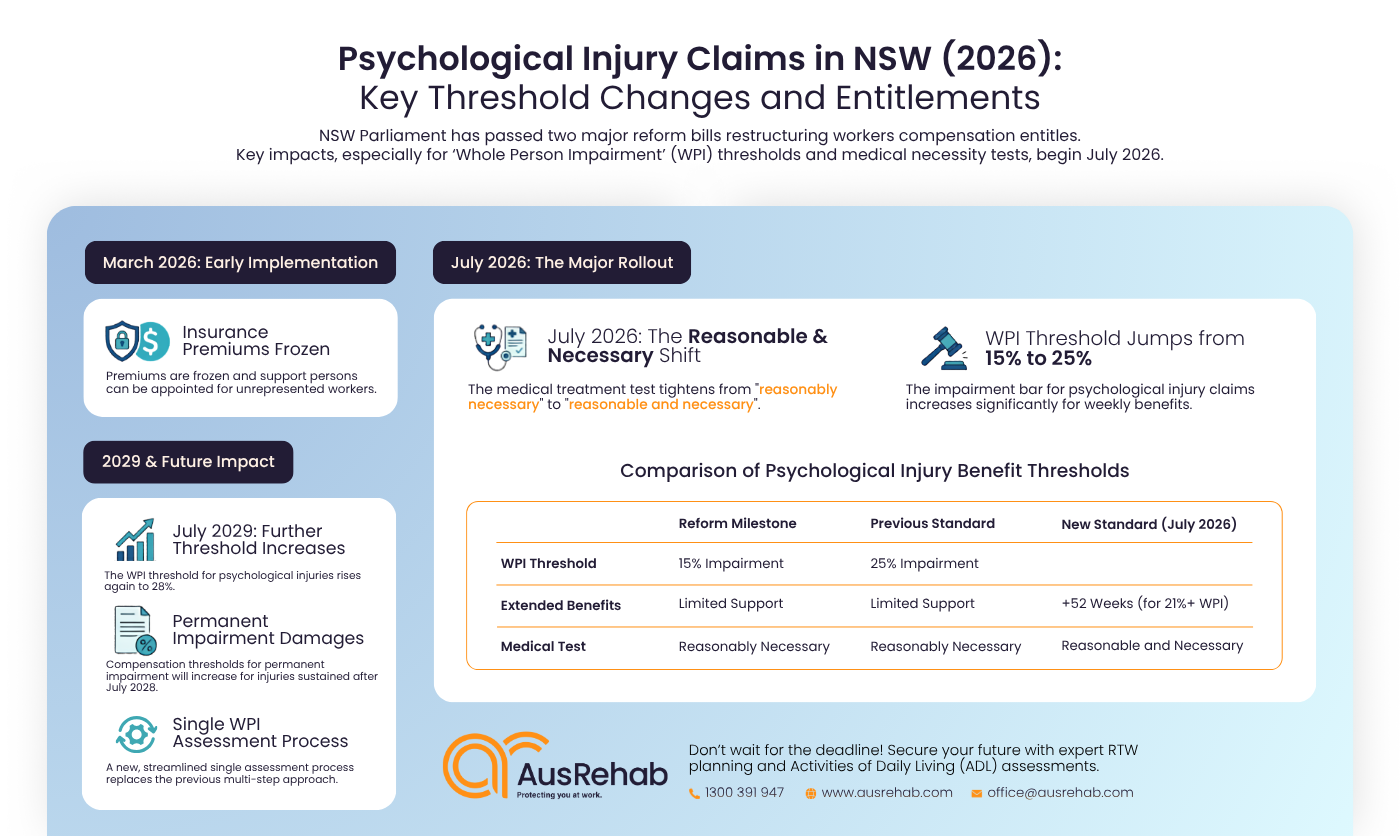
| WPI Threshold for Lump Sum | 11% for physical injuries; 15% for psychological |
| Medical Expenses Cap | 2 years post-weekly payments (for <10% WPI) |
| Funeral Expenses | Up to approximately $10,500.00 |
Note: These figures are based on 2024-2025 trends projected into 2026. Always check the latest SIRA Workers Compensation Benefits Guide for the exact dollar amount applicable to your date of injury.
Calculating Permanent Impairment (Lump Sums)
In addition to weekly payments, you may be entitled to a lump sum payment if your injury results in a permanent impairment. This is calculated using the Whole Person Impairment (WPI) scale.
To qualify for a lump sum for a physical injury, you must generally have a WPI of at least 11%. For primary psychological injuries, the threshold is 15%. A medical specialist trained in the SIRA Guidelines for the Evaluation of Permanent Impairment will conduct an assessment.
The calculation is not a percentage of your salary, but a fixed statutory amount assigned to the WPI percentage. For example, a 15% WPI attracts a significantly higher lump sum than an 11% WPI, with the amounts increasing exponentially as the impairment percentage rises. These figures are updated annually and can be found in the "Lump Sum Compensation" tables published by SIRA.
How Employers Calculate Workers Compensation Premiums
For business owners, "calculating workers compensation" refers to the annual premium paid to an insurer (typically iCare in NSW). This is not a flat fee but a calculation based on risk, wages, and industry.
The Basic Formula
The calculation for an average employer (not a "Small Employer") generally follows this logic: Premium = (Wages × Industry Rate) ± (Experience Adjustment) + Levies
- Wages: The total gross salaries, wages, superannuation, and bonuses paid to all workers.
- Workplace Industry Classification (WIC): Every industry is assigned a WIC code with a corresponding percentage rate. A construction company will have a higher WIC rate than an accounting firm due to the inherent risks.
- Experience Rating: For medium to large employers, your claims history impacts your premium. If you have a high number of claims or expensive long-term claims, your "Experience Adjustment" will increase your premium. Conversely, a safe workplace with fewer claims can receive a discount.
Small Employer vs. Experience-Rated Employer
In 2026, the distinction remains:
- Small Employers: Generally defined by their basic tariff premium. Their premiums are calculated primarily on wages and industry rate, with less emphasis on individual claim costs.
- Experience-Rated Employers: Larger businesses whose premiums are heavily influenced by their safety performance. For these entities, "calculating" the premium requires looking at the last three years of claims data.
Common Calculation Errors to Avoid
Whether you are a worker or an employer, errors in the initial calculation can lead to significant financial discrepancies.
- Excluding Superannuation (for Premiums): Employers often forget that mandatory superannuation contributions must be included in the total wage declaration for premium calculations.
- Ignoring the 52-Week Average (for Workers): Insurers sometimes calculate PIAWE based on only the last few months of earnings. If you had high overtime in the months prior to that, you might be underpaid. Always insist on a full 52-week review.
- Misclassifying the WIC Code: Using the wrong industry code can lead to overpaying premiums for years or facing penalties from iCare for under-declaration of risk.
- Failing to Update Work Capacity: Workers who return to work for more than 15 hours often forget to submit their pay slips to ensure their entitlement stays at the 95% rate rather than dropping to 80%.
Frequently Asked Questions
Does workers compensation include superannuation payments?
For the worker, weekly compensation payments usually do not include superannuation contributions for the first 52 weeks of incapacity, unless your specific employment contract or award states otherwise. After 52 weeks, some provisions may apply, but generally, the insurer is not required to pay super on top of weekly benefits.
How do I calculate payments if I have two jobs?
If you are an "incapable worker" who held multiple jobs at the time of injury, your PIAWE should be calculated based on the combined earnings from all your employers, provided you can prove those earnings via pay slips or tax returns.
Can the insurer change my PIAWE calculation after it has been set?
Yes. An insurer can conduct a Work Capacity Decision or a "PIAWE review" if new information comes to light, such as a calculation error or a change in the interpretation of your historical earnings. You have the right to dispute these decisions through the Personal Injury Commission.
Are bonuses and commissions included in workers compensation?
Yes, provided they were earned during the relevant 52-week period. Because commissions can fluctuate, they are averaged out over the year to provide a stable weekly figure.
What happens to my calculation if I am a "High Income Earner"?
If 95% of your PIAWE is $4,000 but the statutory cap for 2026 is $2,700, you will only receive $2,700. The law limits the liability of the insurer to the maximum indexed amount regardless of your previous high salary.
Next Steps for Accuracy
To ensure your calculation is correct, you should:
- Request a PIAWE Form: Ask your insurer for the specific breakdown of how they reached your average weekly earnings figure.
- Verify the Relevant Period: Check that they used the full 52 weeks (or the duration of your employment) and didn't exclude regular overtime.
- Consult a Professional: If your claim involves permanent impairment or complex earnings (like contractors or piece-workers), seeking advice from a lawyer specializing in NSW workers compensation is highly recommended.
- Use Official Calculators: For employers, iCare NSW provides online tools to estimate premiums based on current industry rates and wage projections.
Disclaimer: This guide provides general information regarding workers compensation in New South Wales and is current for the 2026 timeframe. It does not constitute legal or financial advice. Jurisdictional rules and statutory amounts are subject to change by SIRA and the NSW Government. Always consult with a qualified legal professional for specific advice regarding your claim or policy.
Image Gallery