Understanding Economic Sectors: A Comprehensive Guide to Industrial Classification and Global Trends in 2026
Economic sectors are the primary classifications used to categorize types of economic activity based on the nature of the work performed and the goods or services produced. By the 2026 fiscal year, these classifications—Primary, Second...
Economic sectors are the primary classifications used to categorize types of economic activity based on the nature of the work performed and the goods or services produced. By the 2026 fiscal year, these classifications—Primary, Secondary, Tertiary, Quaternary, and Quinary—serve as the foundational framework for analyzing GDP, labor market shifts, and the integration of advanced technologies like generative AI and autonomous systems. This classification system allows economists and policymakers to measure the health of an economy and direct capital toward high-growth areas.
Contents
The Evolution and Importance of Sectoral Analysis
The study of economic sectors is rooted in the Clark-Fisher model, which suggests that as an economy develops, its focus shifts from the extraction of raw materials to manufacturing, and finally to services and knowledge-based activities. In 2026, this transition is more rapid than ever due to the "Green Transition" and the democratization of high-level computing.
Analyzing economic sectors is not merely an academic exercise; it is a critical tool for:
- GDP Contribution Mapping: Identifying which parts of the economy are driving national wealth.
- Labor Allocation: Understanding where jobs are being created and where automation is displacing workers.
- Investment Strategy: Helping venture capitalists and institutional investors identify sectors with the highest "Alpha" potential.
- Policy Development: Allowing governments to provide subsidies or tax incentives to sectors deemed vital for national security or environmental goals.
The following sections provide a deep dive into each of the five recognized sectors, reflecting the current state of industry, technology, and labor as of 2026.
The Primary Sector: Raw Materials and Resource Extraction
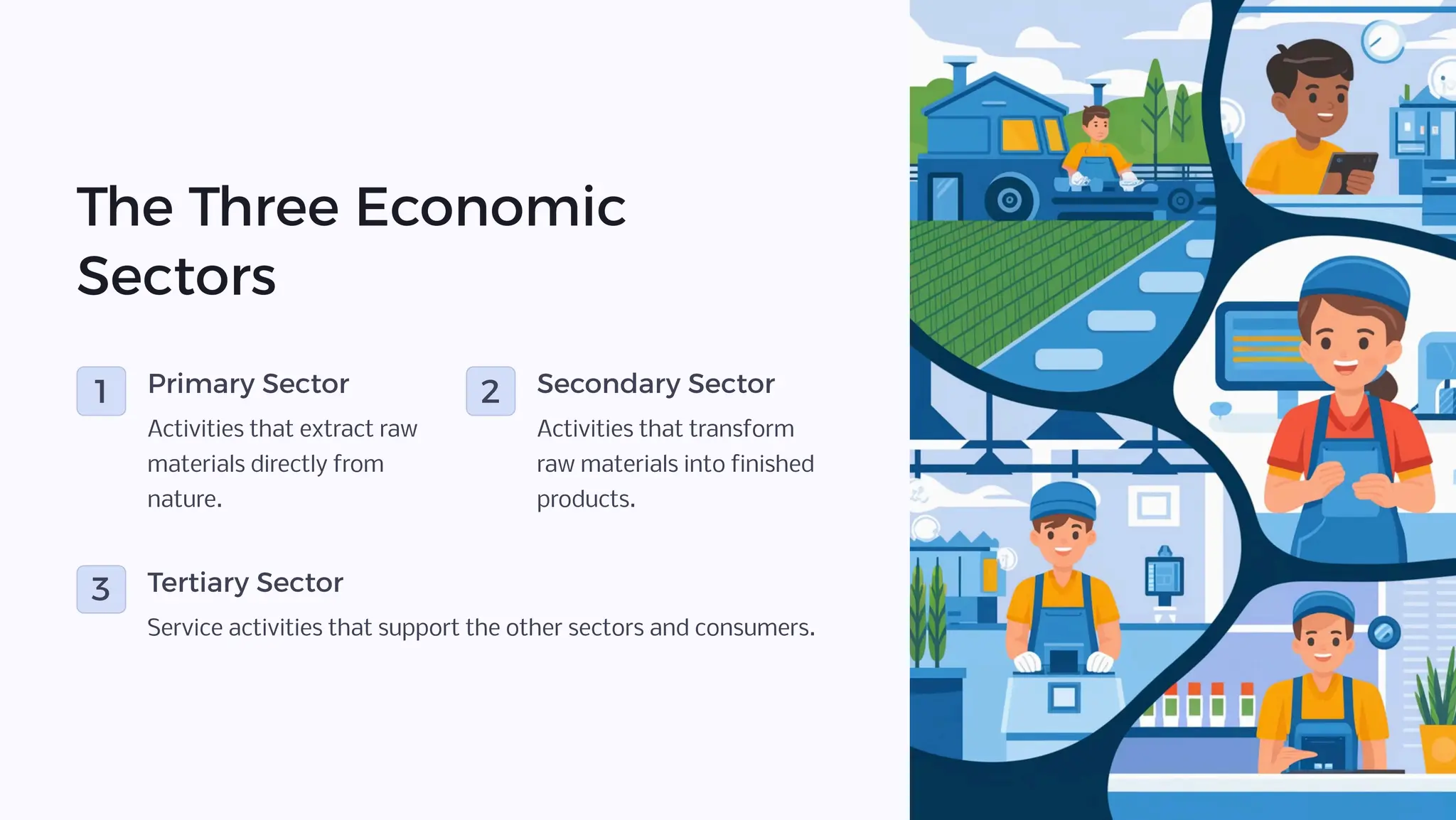
The primary sector involves the direct extraction or harvesting of natural resources from the earth. This includes agriculture, forestry, fishing, and mining. While many developed nations see a lower percentage of their GDP coming from this sector, it remains the vital foundation for all other economic activities.
Precision Agriculture and Sustainable Farming
As of 2026, the primary sector is undergoing a massive transformation. Agriculture has shifted toward "Precision Ag," where IoT sensors, satellite imagery, and AI-driven irrigation systems optimize crop yields while minimizing water usage. Carbon sequestration credits have also become a secondary revenue stream for farmers, integrating the primary sector with environmental service markets.
Mining and Rare Earth Elements
The global push for electrification has placed a premium on the mining sub-sector. In 2026, the extraction of lithium, cobalt, and rare earth elements is a matter of geopolitical priority. Modern mining operations now utilize autonomous haulage systems and deep-sea mineral exploration technologies to meet the demand for battery production and semiconductor manufacturing.
The Secondary Sector: Manufacturing and Construction
The secondary sector processes the raw materials provided by the primary sector into finished goods. This includes manufacturing, construction, and utilities (such as power and water). It is often referred to as the "industrial sector."
Industry 5.0 and Human-Robot Collaboration
The year 2026 marks the widespread adoption of Industry 5.0. Unlike Industry 4.0, which focused on pure automation, Industry 5.0 emphasizes the collaboration between humans and "cobots" (collaborative robots). This shift aims to combine the precision of machines with human creativity and critical thinking.
Green Manufacturing and Circular Economies
Sustainable manufacturing is no longer an outlier but a regulatory requirement in most major economies. Companies are now measured by their "Circular Economy" index—how much of their waste is recycled back into the production loop. The construction sub-sector has also evolved, with 3D-printed modular housing and carbon-negative concrete becoming standard in urban development projects.
The Tertiary Sector: Services and the Consumer Economy
The tertiary sector is the largest component of most modern economies. It does not produce tangible goods but provides services to consumers and businesses. This includes retail, transportation, healthcare, education, and entertainment.
The Domination of the Service Economy
In 2026, the tertiary sector accounts for over 75% of GDP in the United States and many European nations. The focus has shifted from "selling products" to "providing experiences" and "subscription-based access."
Healthcare as a Service (HaaS)
The healthcare sub-sector has transitioned into a predictive model. By using wearable bio-trackers and real-time data analysis, providers focus on preventative care rather than reactive treatment. This has stabilized healthcare costs while increasing the technical demand for specialized medical technicians and data analysts.
Logistics and the "Last Mile" Revolution
E-commerce has forced a complete overhaul of the transportation and logistics sub-sector. In 2026, urban centers utilize drone delivery networks and autonomous electric vans to solve the "last mile" delivery problem, reducing traffic congestion and lowering the carbon footprint of retail.
The Quaternary Sector: The Knowledge Economy
The quaternary sector is an extension of the tertiary sector but is distinct enough to warrant its own category. It focuses on intellectual activities such as research and development (R&D), information technology, and high-level consulting.
AI Integration and Data Science
In 2026, the quaternary sector is the primary engine of productivity growth. Generative AI is no longer a novelty; it is the fundamental tool used by software engineers, architects, and researchers to accelerate the pace of discovery. Data is frequently referred to as the "new oil," and those who can refine it into actionable intelligence hold the most economic power.
Intellectual Property and Innovation
This sector thrives on the protection and monetization of intellectual property (IP). Universities and private research labs are more integrated than ever, creating "Innovation Hubs" that drive local economies. The value of this sector is often intangible, measured in patents and proprietary algorithms rather than physical units.
The Quinary Sector: High-Level Decision Making
The quinary sector includes the highest levels of decision-making in a society or economy. This includes government officials, top corporate executives (CEOs), non-profit leaders, and cultural influencers.
Global Governance and Ethical Oversight
In 2026, the quinary sector's role has expanded to include the ethical oversight of emerging technologies. Leaders in this sector are tasked with navigating the complexities of AI ethics, climate policy, and international trade agreements in a multipolar world.
Social Impact and Philanthropy
The quinary sector also encompasses major non-governmental organizations (NGOs) and philanthropic foundations that wield significant economic influence. These entities often step in where governments cannot, funding massive public health or education initiatives that have long-term economic consequences.
Comparative Analysis of Economic Sectors in 2026
The following table compares the five sectors across key economic metrics relevant to the 2026 fiscal year.
| Sector | Primary Activity | Tech Intensity | Labor Intensity | 2026 Growth Outlook |
|---|---|---|---|---|
| Primary | Extraction/Harvesting | Medium (Autonomous) | Low (Decreasing) | Stable / Commodity Dependent |
| Secondary | Manufacturing | High (Industry 5.0) | Medium | High (Re-shoring Trends) |
| Tertiary | Service Delivery | High (Digital First) | Very High | Constant Expansion |
| Quaternary | Knowledge & R&D | Highest (AI/Data) | Medium (Highly Skilled) | Explosive Growth |
| Quinary | Executive Control | High (Decision Support) | Very Low | Strategic Influence |
Sectoral Interdependence: The Economic Feedback Loop
No sector operates in a vacuum. The efficiency of the primary sector determines the input costs for the secondary sector. Likewise, the quaternary sector provides the technological innovations that make the primary and secondary sectors more efficient.
- Input Linkage: A mining company (Primary) provides lithium to a battery manufacturer (Secondary).
- Service Linkage: The manufacturer uses a logistics firm (Tertiary) to ship batteries to an EV company.
- Innovation Linkage: An AI research firm (Quaternary) develops an algorithm that allows the EV company to increase battery efficiency by 20%.
- Policy Linkage: The government (Quinary) provides a tax credit for consumers who buy these high-efficiency EVs, stimulating the entire chain.
Challenges and Risks in Modern Sectoral Shifts
Despite the technological advancements of 2026, several risks persist across all economic sectors:
- Labor Displacement: As the primary and secondary sectors become more automated, there is a risk of structural unemployment for workers without quaternary-level skills.
- Supply Chain Fragility: Over-reliance on specific geographic regions for raw materials (Primary) or manufacturing (Secondary) can lead to economic shocks during geopolitical instability.
- Data Privacy and Security: The quaternary sector's reliance on data makes the entire economy vulnerable to cyber threats and data breaches.
- Environmental Limits: The primary sector must balance the need for resources with the planetary boundaries of carbon emissions and biodiversity loss.
Strategic Recommendations for 2026
For businesses and investors looking to navigate these sectors in 2026, the following strategies are recommended:
- Diversification Across Linkages: Do not invest solely in one sector. Look for companies that bridge the gap between sectors, such as "Ag-Tech" (Primary/Quaternary) or "Fin-Tech" (Tertiary/Quaternary).
- Focus on Sustainability: Regulatory environments in 2026 heavily favor companies with low ESG (Environmental, Social, and Governance) risk profiles.
- Invest in Human Capital: As machines take over routine tasks, the economic value of soft skills—leadership, ethics, and creative problem solving—in the quinary and tertiary sectors will increase.
Frequently Asked Questions
Which economic sector is the most important for GDP growth?
The importance of a sector depends on the country's stage of development. In most developed nations, the Tertiary and Quaternary sectors drive the majority of GDP growth. However, the Primary and Secondary sectors remain the fundamental "real" economy that provides the physical goods necessary for the service and knowledge economies to function.
How has AI changed the definition of the Quaternary sector?
In 2026, AI has transitioned the Quaternary sector from a human-exclusive knowledge base to a collaborative human-machine intelligence base. It has shifted the focus from "data collection" to "automated synthesis and execution," making the sector more productive and reducing the time required for R&D cycles.
Can a country skip the Secondary sector and move straight to the Tertiary sector?
This is known as "leapfrogging." While some developing nations have attempted to move directly from an agrarian (Primary) to a service (Tertiary) economy via call centers and digital services, most economists agree that a robust Secondary (Manufacturing) sector is necessary to build the infrastructure and middle-class wealth required for long-term stability.
What is the difference between the Quaternary and Quinary sectors?
The Quaternary sector focuses on the creation and processing of knowledge (engineers, scientists, analysts), while the Quinary sector focuses on high-level decision-making and leadership (CEOs, government ministers). One provides the information; the other decides how to use it for the benefit (or detriment) of society.
Why is the Primary sector still relevant in a high-tech 2026?
Technological societies are more dependent on raw materials than ever before. Without the Primary sector providing minerals for semiconductors, silicon for solar panels, and food for the workforce, the "high-tech" Quaternary and Quinary sectors would cease to function.
The classification of economic sectors provides the essential roadmap for understanding the complex global economy of 2026. By recognizing the shifts in labor, technology, and output across these five categories, stakeholders can make more informed decisions that foster sustainable and inclusive growth.
Image Gallery