Lady Gaga in Her Prime: Defining an Era Through Chart and Award Milestones
Lady Gaga’s prime, broadly spanning the period from her 2008 breakout with The Fame through the cultural saturation of Born This Way and the critical pivot of the Cheek to Cheek era, serves as a masterclass in pop-culture dominance. He...
Lady Gaga’s prime, broadly spanning the period from her 2008 breakout with The Fame through the cultural saturation of Born This Way and the critical pivot of the Cheek to Cheek era, serves as a masterclass in pop-culture dominance. Her trajectory was defined not merely by visibility, but by a rigorous alignment of high-concept performance art, consistent chart-topping success, and an unprecedented accumulation of industry accolades that validated her status as a generational artist.
Contents
The Foundation of Dominance: The Fame and The Fame Monster
The emergence of Stefani Germanotta as Lady Gaga signaled a shift in the music industry’s approach to the "pop star" archetype. Between 2008 and 2010, the strategy was defined by high-frequency output and uncompromising visual branding.
The Fame (2008) introduced a soundscape that bridged the gap between underground electronic music and radio-friendly pop. The commercial reality of this period is best measured by the longevity of its singles. "Just Dance" and "Poker Face" were not merely hits; they were persistent fixtures on the Billboard Hot 100, marking the beginning of a streak of consecutive top-ten entries that solidified her market penetration.
The subsequent release, The Fame Monster (2009), acted as a strategic expansion. By releasing it as a deluxe addition rather than a standard sophomore album, Gaga maintained her momentum while evolving her sound. This period resulted in her first major recognition from the Recording Academy. At the 52nd Annual Grammy Awards, Gaga won Best Dance Recording for "Poker Face" and Best Electronic/Dance Album for The Fame, cementing her crossover success.
Statistical Benchmarks of Commercial Success
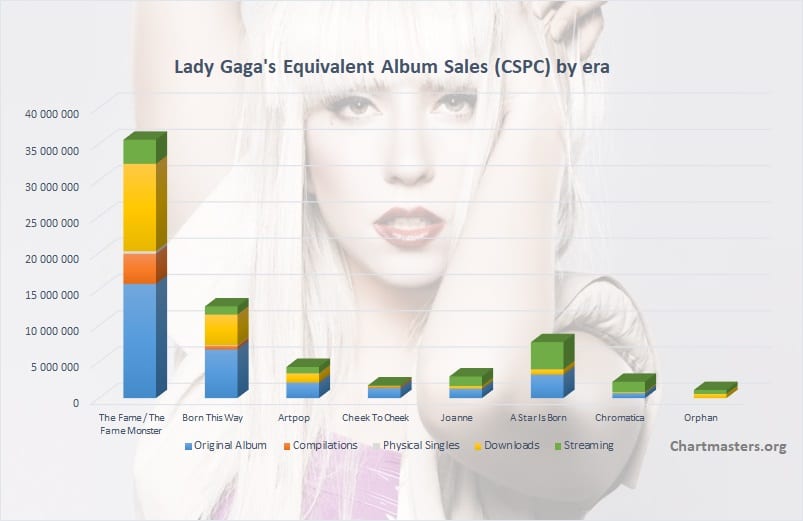
To analyze Lady Gaga’s prime, one must look at the intersection of streaming-era precursors and physical sales. In the late 2000s and early 2010s, "prime" was defined by a specific set of metrics: physical CD sales, digital download volume (the peak of the iTunes era), and heavy radio rotation.
| Milestone Metric | Significance in the 2008–2014 Era |
|---|---|
| Billboard Hot 100 | Sustained top-ten placement for lead singles. |
| Grammy Awards | Recognition across both dance and pop categories. |
| Touring Revenue | Conversion of chart hits into high-capacity stadium draws. |
| Digital Downloads | Dominance in the iTunes Store era (pre-streaming dominance). |
| Cultural Impact | The conversion of visual branding into viral marketing. |
These metrics confirm that Gaga’s prime was not a singular moment of luck but a sustained campaign of commercial consistency. The "Born This Way" (2011) release cycle pushed this even further, with the title track becoming one of the fastest-selling songs in history at that time, debuting at number one on the Billboard Hot 100.
Award Milestones as Industry Validation
An artist’s prime is often ratified by the formal approval of their peers and industry bodies. Gaga’s career is punctuated by a rapid transition from "novelty act" to "legitimate vocal powerhouse" in the eyes of award committees.
Her early Grammy wins established her electronic credibility, but the shift toward traditional acclaim occurred as she began to collaborate with established legends. The 2014 release of Cheek to Cheek with Tony Bennett was a calculated pivot. It earned the Grammy Award for Best Traditional Pop Vocal Album, effectively insulating her against the transience of pop stardom. By demonstrating vocal versatility, she ensured that her "prime" was not limited to dance-pop but extended to a broader musical canon.
The Role of Performance Art in Chart Retention
Unlike many contemporaries, Gaga’s chart milestones were inextricably linked to her performance art. The "meat dress" at the 2010 MTV Video Music Awards and the egg-like vessel during her 2011 Grammy entrance were not distractions; they were intentional marketing mechanisms designed to maintain public focus on her brand.
By controlling the visual narrative, Gaga ensured that her chart performance remained resilient. When a song began to decline on the Billboard charts, a controversial performance or an elaborate music video release would act as a secondary ignition point. This loop of music, visual art, and award-season campaigning created a cycle of engagement that sustained her peak for roughly six years.
Strategic Transitions: From Pop Icon to Cinematic Success
The conclusion of Gaga's traditional "prime" is often debated, but it is best categorized by her transition into film and prestige musical projects. The 2016 release of Joanne and the subsequent 2018 success of A Star Is Born signaled that she had reached a maturity level where chart placement became secondary to long-term artistic legacy.
Winning the Academy Award for Best Original Song for "Shallow" in 2019 functioned as the final validation of her transition. It marked the end of the "chart-milestone" era and the beginning of a "legacy-driven" era. At this point, the metrics shifted from "number of consecutive hits" to "longevity of influence" and "critical versatility."
Common Misconceptions Regarding the "Prime" Era
A frequent point of confusion is the assumption that an artist’s prime is only defined by their highest-grossing moment. For Lady Gaga, the most commercially lucrative phase (the Chromatica or A Star Is Born eras) differs from the phase of most rapid growth and industry disruption (2008–2011).
- Misconception 1: The Prime is static. It is more accurate to view it as a series of phases. The chart-dominance phase (2008–2012) is distinct from the critical-acclaim phase (2014–2019).
- Misconception 2: Awards are solely popularity contests. While audience engagement fuels some awards, Grammy and Oscar recognition for Gaga required a demonstration of traditional musical proficiency, which she used to cement her transition from pop star to vocalist.
- Misconception 3: Commercial peaks are synonymous with creative peaks. Gaga's creative peak involved deep experimentation with genre, whereas her commercial peak was tightly controlled by radio-ready, high-tempo production.
Frequently Asked Questions
What defines the start of Lady Gaga’s prime? Her prime is widely considered to have begun with the release of The Fame in 2008. The rapid succession of number-one singles like "Just Dance" and "Poker Face" immediately established her as a dominant force in the global music industry.
Did her awards influence her chart success? Yes, indirectly. Grammy recognition served as a catalyst for mainstream media coverage and radio support. The "prestige" of being a multi-Grammy-winning artist allowed her to maintain higher rotation on adult contemporary stations, which extended the lifespan of her radio hits.
How did the transition to streaming affect her chart milestones? Gaga’s primary prime occurred during the digital download era (iTunes). As the industry shifted to streaming models (post-2015), her chart metrics changed from unit sales to stream counts. This makes direct comparisons between her early work and modern milestones difficult, as the Billboard formulas for success evolved significantly.
Is Lady Gaga still in her prime in 2026? By 2026, Lady Gaga operates in a phase of established legacy. While she continues to see commercial success, her current status is characterized by selective projects and artistic evolution rather than the aggressive, non-stop chart-chasing that defined her 2008–2014 era.
Which award milestone was most significant for her transition? Winning the Academy Award for Best Original Song in 2019 for "Shallow" is widely viewed as her most significant professional milestone. It solidified her crossover from a pop-music icon to a respected member of the elite Hollywood and musical establishment.
Recommendation for Further Analysis
Readers interested in understanding the mechanics of stardom should focus on the promotional calendars of the 2008–2011 period. By mapping individual single releases against the Billboard Hot 100 data and correlating those dates with major award ceremony dates, one can clearly see the "forced" nature of her ascent—a strategic, highly disciplined approach to global fame that remains a blueprint for pop artists today.
Image Gallery