Choosing the Right Business Card Thickness: The Complete Professional Guide for 2026
Choosing the right business card thickness involves balancing brand perception, tactile quality, and practical durability. While 14pt remains the standard for high-volume distribution, 16pt offers a premium feel for most professionals,...
Choosing the right business card thickness involves balancing brand perception, tactile quality, and practical durability. While 14pt remains the standard for high-volume distribution, 16pt offers a premium feel for most professionals, and 32pt serves luxury brands. The ideal choice ensures your card survives handling while effectively communicating your market position.
Contents
In 2026, the physical business card remains a vital "handshake" in professional networking. Even as digital alternatives proliferate, the tactile experience of a physical card provides a cognitive anchor for new connections. However, selecting the wrong paper stock can undermine your message. A card that is too thin feels cheap and disposable, while one that is excessively thick may not fit into a standard wallet, leading to it being discarded. Understanding the technical specifications of paper weight and thickness—measured in points (pt) and grams per square meter (gsm)—is the first step toward creating a lasting impression.
Understanding the Measurement Systems: PT vs. GSM
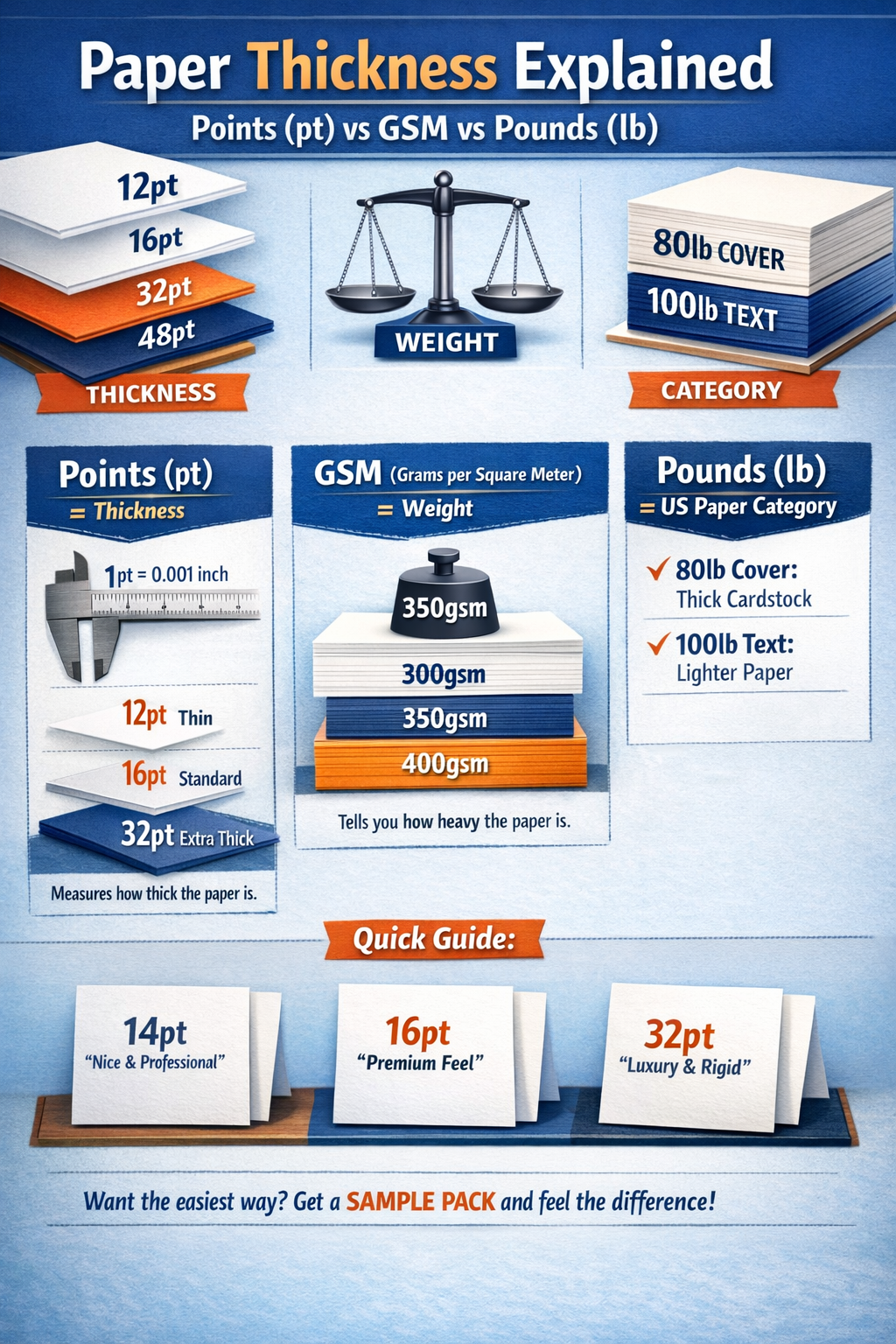
When evaluating business card thickness, you will encounter two primary units of measurement: points (pt) and grams per square meter (gsm). These measurements are related but represent different physical properties of the paper.
The Point System (Caliper)
In the United States, thickness is most commonly measured in "points." One point is equivalent to 0.001 inches. Therefore, a 14pt card is 0.014 inches thick. The point system refers to the "caliper" of the paper, which is a direct measurement of its physical height or thickness. For professional branding, the difference between 14pt and 16pt may seem minuscule numerically, but it is immediately noticeable to the human hand.
The GSM System (Weight)
Internationally, and increasingly within high-end domestic print shops, the metric system of gsm (grams per square meter) is used. This measures the weight of the paper rather than its thickness. While weight and thickness often correlate, they are not the same. For example, a highly compressed, dense paper might be very heavy (high gsm) but relatively thin (lower pt). Conversely, a "bulky" paper stock may be thick but light. For most standard business card applications in 2026, a weight of 300gsm to 450gsm is considered the professional range.
The Hierarchy of Business Card Thickness
Choosing a thickness is essentially a decision about your brand’s "weight" in the market. Each tier of thickness serves a specific strategic purpose.
14pt: The Industry Standard
The 14pt stock is the baseline for professional business cards. It is sturdy enough to resist immediate folding and is the standard choice for large corporations that need to print thousands of cards for hundreds of employees.
- Pros: Highly cost-effective; fits easily into any wallet or cardholder; compatible with almost all printing finishes (UV gloss, matte, etc.).
- Cons: Can feel "entry-level" in high-stakes industries like private equity or luxury real estate.
16pt: The Premium Choice
By 2026, the 16pt card has become the preferred choice for small business owners, consultants, and independent professionals. It is roughly 15% thicker than the 14pt standard, providing a significant boost in rigidity.
- Pros: Feels substantial and high-quality; does not bend easily at the corners; works exceptionally well with "soft-touch" lamination or silk finishes.
- Cons: Slightly higher price point than 14pt; adds bulk if you carry many cards at once.
18pt to 24pt: The "Heavyweight" Contenders
These stocks are often used for cards that require extra durability or specific design techniques like embossing or debossing. An 18pt card is thick enough to allow for a slight "dent" in the paper without showing through on the reverse side.
- Best Use: High-end boutique brands, creative directors, and architects.
32pt and Beyond: Ultra-Thick Luxury
The 32pt card (sometimes called "double-thick" or "duplexed") is created by bonding two layers of paper together. These cards are roughly the thickness of a credit card.
- Pros: Impossible to ignore; allows for "painted edges" (where the side of the card is a different color); conveys extreme stability and luxury.
- Cons: Will not fit in many standard business card slots; significantly more expensive; can feel ostentatious if not paired with a minimalist design.
Technical Comparison of Business Card Stocks
The following table summarizes the most common specifications encountered in 2026 to help you align your choice with your professional needs.
| Thickness (pt) | Weight (gsm) | Relative Feel | Primary Use Case |
|---|---|---|---|
| 12pt | 250 - 280 | Thin / Flexible | Budget flyers or temporary event cards |
| 14pt | 300 - 310 | Standard | Large-scale corporate distribution |
| 16pt | 350 - 400 | Premium | Professional services, consultants, SMBs |
| 18pt | 400 - 450 | Heavy | Creative portfolios, boutique retail |
| 32pt | 600 - 700 | Rigid / Luxury | High-net-worth networking, executive roles |
The Psychology of Haptics in Branding
The science of haptic communication—how we perceive information through touch—suggests that the physical properties of an object can influence our judgment of its source. In a business context, a thicker card is often subconsciously associated with a more "solid" or "stable" company.
When a potential client holds a 16pt or 18pt card, the lack of "give" or flexibility in the paper communicates confidence. Thinner paper, which may flutter or crease, can unintentionally signal a lack of permanence or attention to detail. In competitive fields where many vendors offer similar services, these subtle physical cues can be the deciding factor in brand recall.
Furthermore, the "snap" of the card matters. A thicker card has a different acoustic profile when pulled from a holder or placed on a table. This multisensory experience (visual, tactile, and auditory) creates a more robust memory in the recipient’s mind.
Impact of Finishes and Coatings on Perceived Thickness
It is important to distinguish between the "base stock" thickness and the "finished" thickness. Many modern printing processes add layers to the paper that increase both its durability and its physical caliper.
- Lamination (Silk/Suede/Matte): Adding a plastic-based laminate film typically adds 1pt to 2pt of thickness. A 16pt card with a suede lamination will feel more like an 18pt card. It also adds significant "stiffness" because the laminate acts as a structural reinforcement.
- UV Coating: A liquid coating cured by ultraviolet light. While it adds minimal thickness (usually less than 0.5pt), it increases the card's resistance to moisture and tearing, making a thinner stock feel more durable.
- Spot UV and Raised Foil: These techniques add "build" to specific parts of the card. In 2026, digital spot UV can be layered to create a 3D texture that stands out significantly from the base paper.
Practical Constraints: Storage and Mailing
While the impulse may be to choose the thickest card possible to stand out, there are practical limitations to consider.
Wallet Compatibility
Standard wallet slots and business card holders are designed for 14pt and 16pt cards. If you opt for a 32pt "Mega Thick" card, your recipient may find they cannot tuck it into their wallet easily. If a card is difficult to store, the likelihood of it being left on a table or lost increases. If you choose an ultra-thick stock, ensure the design is compelling enough that the recipient will want to keep it on their desk rather than in a pocket.
Mailing and Weight Costs
If your business strategy involves mailing business cards as part of a marketing kit or a "thank you" note, the weight (gsm) becomes a factor. A stack of 500 cards at 32pt is twice as heavy and twice as tall as 500 cards at 14pt. This can significantly increase shipping costs for bulk orders and may push individual letters into higher postage brackets.
Sustainable Stocks and Thickness in 2026
Environmental considerations are a major factor in 2026 procurement. Historically, recycled paper was seen as thinner or "flimsier" than virgin fiber paper. However, modern manufacturing allows for high-caliper recycled stocks that are indistinguishable from standard premium options.
- Cotton Paper: Often available in 18pt to 22pt, cotton paper is made from linters (a byproduct of the textile industry). It is naturally thick and soft, making it the gold standard for letterpress printing.
- Bamboo and Hemp: These alternative fibers offer high rigidity at lower weights, allowing for a "thick-feeling" card that is lighter and more sustainable.
- Recycled Kraft: Usually available in 18pt, this stock provides a rustic, thick feel that communicates eco-consciousness without sacrificing durability.
Frequently Asked Questions
Is a 14pt business card too thin?
For most professional applications, 14pt is not "too thin," but it is the minimum recommended thickness. It is perfectly acceptable for high-volume networking where cost-per-card is a primary concern. However, if you are in a luxury or high-trust industry (like law or finance), upgrading to 16pt is generally recommended to avoid a "mass-produced" feel.
What is the difference between 16pt and 16pt with UV coating?
The 16pt base stock is the same, but the UV coating adds a protective liquid layer. While it doesn't significantly change the thickness, it adds a glossy sheen and prevents the ink from scuffing. If you want a thick card that feels more natural and "papery," choose a 16pt matte or uncoated stock instead.
Can I use 32pt cards for double-sided printing?
Yes, and in fact, 32pt cards are ideal for double-sided designs. Because the card is so thick, there is zero "show-through" (where the ink from one side is visible on the other). This thickness also allows for "triplexing," where a colored piece of paper is sandwiched between two white layers, creating a colored stripe along the edge of the card.
Why do some 16pt cards feel thicker than others?
This is due to the "bulk" of the paper. Different manufacturers use different fiber densities. A "high-bulk" paper is manufactured to have more air between the fibers, making it thicker (higher pt) without adding weight (gsm). Conversely, a very dense, calendared paper may feel thinner but be heavier.
Does thickness affect the price of business cards?
Yes. Generally, moving from 14pt to 16pt results in a 10% to 20% price increase. Moving to ultra-thick 32pt stocks can double or triple the price, as these often require manual "duplexing" or specialized cutting equipment to handle the density of the paper.
Strategic Recommendation
For the vast majority of professionals in 2026, the 16pt matte or soft-touch stock represents the best value. It provides a tactile "click" that signals quality without the excessive cost or storage bulk of ultra-thick luxury stocks. If you are representing a brand that commands a high price point—such as custom jewelry, executive coaching, or high-end consulting—investing in 24pt or 32pt cotton stocks with letterpress detailing will provide a sensory advantage that digital mediums cannot replicate.
Image Gallery