Optimizing the Patient Registration Process in Hospitals: A 2026 Comprehensive Guide
The modern hospital patient registration process is a specialized administrative workflow designed to capture accurate demographic, clinical, and financial data before medical services are rendered. In 2026, this process focuses on ens...
The modern hospital patient registration process is a specialized administrative workflow designed to capture accurate demographic, clinical, and financial data before medical services are rendered. In 2026, this process focuses on ensuring patient safety through precise identity verification, securing financial reimbursement via real-time insurance validation, and maintaining strict regulatory compliance with evolving healthcare data privacy standards.
Contents
The Evolution of Patient Intake and Registration Systems
The landscape of hospital administration has undergone a significant transformation leading into 2026. The traditional "clipboard and paper" model has been entirely superseded by integrated digital health ecosystems. Patient registration is no longer a static event occurring at a front desk; it is a dynamic, continuous data-gathering process that often begins days or weeks before a patient enters the facility.
Effective registration is the foundation of the entire revenue cycle and clinical care continuum. If data is entered incorrectly at the start—such as a misspelled name or an outdated insurance policy number—the downstream effects can be catastrophic, leading to denied claims, medication errors due to mismatched records, and significant patient dissatisfaction. In 2026, hospital systems prioritize "clean" registration through automated data scrubbing and interoperable Electronic Health Record (EHR) integrations.
Strategic Importance of Accuracy
High-performing hospital systems now treat the registration department as a critical clinical-financial gatekeeper. By utilizing advanced algorithms to cross-reference patient data against national databases, facilities can reduce claim rejection rates by up to 40 percent. This accuracy ensures that the clinical team has immediate access to correct historical data, which is vital for emergency interventions and chronic disease management.
Essential Prerequisites for Hospital Registration Compliance
Before a patient can be successfully registered, several prerequisites must be met to satisfy both clinical safety protocols and federal regulations, such as the updated HIPAA 2026 privacy guidelines and the "No Surprises Act" transparency requirements.
Identification and Biometric Authentication
In 2026, standard government-issued photo identification remains necessary, but many hospitals have moved toward biometric verification to combat medical identity theft.
- Government ID: A valid driver’s license, passport, or state ID is required to establish a legal record.
- Biometric Enrollment: Many facilities now use palm-vein scanning or iris recognition to link the physical person to their digital health record, preventing duplicate charts.
- Digital Health Keys: Patients may present a secure QR code from a verified state or federal health portal that contains encrypted identity metadata.
Insurance Verification and Payer Rules
Insurance landscape complexity requires rigorous verification during the registration phase. Hospitals must confirm not just the existence of coverage, but the specific network status and authorization requirements for 2026.
- HMO and PPO Clarity: For third-party HMO plans, the registration team must verify that the hospital is a contracted provider and that a designated Primary Care Physician (PCP) has issued any necessary referrals.
- Medicare vs. Medicare Advantage: It is critical to distinguish between Original Medicare and Medicare Advantage (MA) plans. Many medical groups and specialized hospital wings in 2026 may accept Traditional Medicare but remain out-of-network for specific private MA plans (e.g., specific regional HMO versions of Aetna or UnitedHealthcare).
- Real-Time Eligibility (RTE): Registration systems now use API-driven RTE tools to confirm co-pays, remaining deductibles, and "out-of-pocket" maximums in seconds, providing the patient with a Good Faith Estimate (GFE) as required by current law.
The 2026 Patient Registration Workflow: Step-by-Step
The following table outlines the standardized workflow used by leading healthcare institutions to ensure a balance between speed and data integrity.
| Stage | Primary Objective | Key Actions | Technical Requirement |
|---|---|---|---|
| 1. Pre-Registration | Data Gathering | Capturing demographics and insurance via mobile app or web portal prior to arrival. | Secure Patient Portal / HL7 FHIR API |
| 2. Financial Clearance | Coverage Verification | Confirming active insurance, securing prior authorizations, and estimating costs. | Real-time Eligibility (RTE) Engine |
| 3. Arrival & Check-In | Identity Confirmation | Biometric scan or ID verification; signing of digital consent forms. | Biometric Scanner / Tablet Interface |
| 4. Clinical Integration | Safety Preparation | Verifying allergies, current medications, and reason for visit (Chief Complaint). | EHR Integration (Epic, Cerner, etc.) |
| 5. Final Disposition | Bed/Room Assignment | Routing the patient to the correct department (ED, Surgery, Inpatient). | Bed Management Software |
Pre-Registration and Remote Intake
The goal of pre-registration is to move the administrative burden away from the hospital lobby. Patients receive automated prompts to upload photos of insurance cards and complete health history questionnaires. This stage allows the hospital’s financial counseling team to identify potential payment issues—such as the need for a prior authorization for a specialized MRI—before the patient arrives, preventing last-minute cancellations.
On-site Check-in and Consent Management
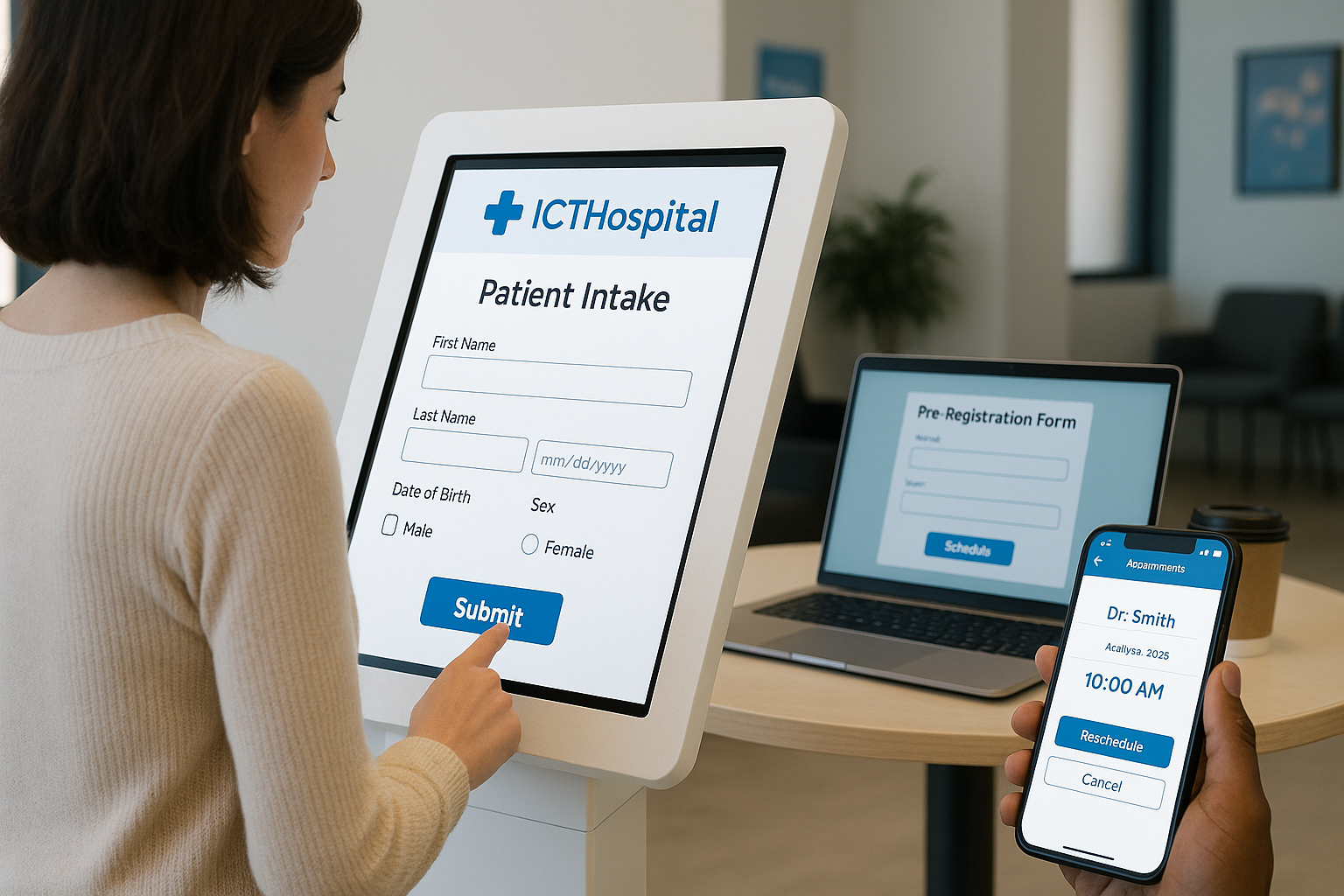
Upon arrival, the patient uses a "low-touch" or "no-touch" check-in kiosk or mobile geo-fencing. The physical registration clerk now acts more as a concierge, assisting with complex cases. During this phase, several legal documents must be executed:
- Conditions of Admission (COA): A general agreement to receive medical treatment.
- Privacy Notices: Acknowledgement of how their protected health information (PHI) will be used.
- Assignment of Benefits (AOB): Allowing the hospital to bill the insurance provider directly.
- Financial Responsibility Agreements: Clarifying that the patient is responsible for amounts not covered by insurance.
Advanced Technologies Driving Registration Efficiency in 2026
The integration of Artificial Intelligence (AI) has significantly reduced manual data entry errors. Optical Character Recognition (OCR) technology now reads insurance cards with 99.9% accuracy, automatically populating fields in the hospital information system.
AI-Driven Identity Resolution
One of the greatest challenges in hospital registration is the "duplicate record" problem. In 2026, AI algorithms analyze thousands of data points—past addresses, maiden names, and social security fragments—to ensure that a patient registered in the Emergency Department is the same person who had surgery five years prior. This ensures clinical continuity and prevents dangerous drug-to-drug interactions based on incomplete histories.
Automated Financial Counseling
Sophisticated software now analyzes a patient’s propensity to pay. If a patient is identified as underinsured or uninsured, the registration system automatically triggers a workflow for the hospital’s social work or financial assistance team. This allows the hospital to assist the patient with Medicaid applications or charity care enrollment immediately, rather than months later during the collections cycle.
Comparison of Registration Models
Hospitals in 2026 typically employ a hybrid model of registration, but the specific approach depends on the department and patient needs.
Evaluation of Registration Approaches
Centralized Registration This model uses a main lobby hub for all incoming patients. It is highly efficient for staff scheduling and training but can lead to "bottlenecks" during peak morning hours for elective surgeries. It offers the highest level of data consistency.
Decentralized Registration Registration occurs at the point of care (e.g., directly in the Radiology or Oncology department). This improves patient satisfaction by reducing wait times but requires a larger number of trained staff and can lead to decentralized data silos if not managed via a unified EHR.
Kiosk-Based / Mobile Self-Service This is the fastest method, preferred by 80% of tech-savvy patients in 2026. While it reduces overhead, it requires robust backup systems for patients who encounter technical errors or have complex secondary insurance coverage that the automated system cannot parse.
Troubleshooting Common Registration Bottlenecks
Even with advanced technology, certain hurdles can delay the registration process. Identifying these early is key to operational success.
- Incomplete Prior Authorizations: This is the leading cause of elective procedure delays. Hospitals now use automated "auth-check" bots that ping payer portals 48 hours before an appointment to ensure the authorization number is on file.
- Coordination of Benefits (COB) Conflicts: When a patient has two insurance plans (e.g., a primary employer plan and a secondary plan through a spouse), the registration system must correctly identify which is primary according to "birthday rules" or other legal hierarchies to avoid billing denials.
- Language and Accessibility Barriers: In 2026, hospitals utilize integrated video-remote interpreting (VRI) directly within the registration tablet to ensure non-English speaking patients can provide informed consent and accurate history without needing a physical translator present at the desk.
Critical Compliance and Regulatory Standards
Registration is not merely an administrative task; it is a legal requirement governed by several frameworks.
- EMTALA (Emergency Medical Treatment and Labor Act): In the Emergency Department, the "registration" process must never delay "Medical Screening Exams." Hospitals must perform a stabilization check before asking for insurance or payment information.
- CMS Star Ratings: Efficiency in the registration process directly impacts "Patient Experience" scores, which are a component of CMS Star Ratings. Long wait times or redundant questions can lower these scores, impacting federal reimbursement levels.
- The 21st Century Cures Act: This requires that data captured during registration be easily accessible to the patient. The registration process in 2026 must facilitate the "opening" of the patient’s digital record for their own use via third-party apps.
FAQ: Hospital Patient Registration
What documents do I need for hospital registration in 2026?
You must provide a valid government-issued photo ID, your current physical or digital insurance card, and any relevant physician referral forms. Many hospitals also require a biometric enrollment (such as a palm scan) to verify your identity and protect your medical records from fraud.
In addition to these basics, you should have a list of current medications and dosages ready. If you have an Advance Directive or Power of Attorney, providing a digital copy during the pre-registration phase ensures your medical wishes are documented in the system before treatment begins.
Can I register for my hospital visit online?
Yes, most hospitals in 2026 offer a comprehensive "e-registration" or "mobile check-in" process via a secure patient portal. Completing this process at least 24 to 72 hours before your appointment significantly reduces your wait time upon arrival at the facility.
Online registration typically involves verifying your contact information, uploading insurance images, and signing consent forms electronically. Once completed, you often receive a QR code on your smartphone that allows you to bypass the main registration desk and proceed directly to a "fast-track" check-in kiosk.
What happens if my insurance is not accepted during registration?
If a hospital is out-of-network for your specific plan, the registration team will provide you with a "Good Faith Estimate" of the costs you will be responsible for. They may also offer financial counseling to discuss payment plans or determine if you qualify for the hospital's financial assistance or charity care programs.
Under the 2026 updates to the No Surprises Act, hospitals are required to be transparent about your financial liability before non-emergency services are provided. If the facility does not accept your insurance, you have the right to reschedule with an in-network provider or proceed as a "self-pay" patient with a documented price agreement.
Why does the hospital ask for my social security number during registration?
While not always legally mandatory for medical care, your Social Security Number (SSN) is used as a unique identifier to ensure your records are accurately matched and to facilitate the processing of insurance claims. In 2026, many hospitals use encrypted "tokens" instead of storing the raw SSN to enhance data security.
Providing your SSN helps prevent the creation of duplicate medical charts, which can be dangerous for your health. However, if you are uncomfortable providing it, you can ask the registration clerk if an alternative identifier, such as a state-issued health ID or a biometric profile, can be used instead.
How long does the hospital registration process take?
With the 2026 digital enhancements, on-site registration typically takes between 5 to 10 minutes if you have pre-registered online. For patients who have not pre-registered or have complex insurance issues, the process can take 20 to 30 minutes.
The timeframe depends largely on the complexity of the visit. Emergency department registration is prioritized based on clinical need, while elective surgery registration is more thorough and may involve more extensive financial and clinical interviewing to ensure everything is ready for the operating room.
Strategic Recommendations for Healthcare Administrators
To maintain a competitive edge and high patient satisfaction scores in 2026, hospital administrators should focus on "Frictionless Intake." This involves investing in interoperable systems that can pull data from external pharmacies and clinics, reducing the number of questions a patient must answer.
Furthermore, training registration staff to act as "Financial Navigators" is essential. As healthcare costs and plan complexities rise, the ability of the registration team to clearly explain coverage and provide accurate cost estimates at the point of service is a major driver of patient loyalty and institutional financial health. Prioritize the use of automated eligibility tools and ensure your EHR is configured to flag "High-Risk" registration errors (such as mismatched birth dates) in real-time before the patient leaves the desk.
Image Gallery