Mobile Bay Ferry Schedule, Fares, and Boarding Guide (2026)
The Mobile Bay Ferry operates daily year-round between Fort Morgan and Dauphin Island, Alabama, departing every 45 to 90 minutes depending on whether one or two vessels are in service. Weather permitting, departures begin at 8:00 AM fr...
The Mobile Bay Ferry operates daily year-round between Fort Morgan and Dauphin Island, Alabama, departing every 45 to 90 minutes depending on whether one or two vessels are in service. Weather permitting, departures begin at 8:00 AM from Dauphin Island and 8:45 AM from Fort Morgan, running until sunset.
Contents
Connecting the eastern tip of Dauphin Island to Mobile Point at Fort Morgan, this passenger and vehicle transit link cuts roughly 80 to 100 miles of driving off a trip around Mobile Bay along Interstate 10. Whether traveling for leisure between Gulf Shores and the Dauphin Island Audubon Sanctuary or commuting across the bay, tracking departure timetables, seasonal operations, and tide conditions is essential for an efficient crossing.
Current 2026 Mobile Bay Ferry Operating Schedules
Operating status for the Mobile Bay Ferry varies primarily by season and the number of active vessels deployed on the route. The ferry system operates two auto/passenger vessels: the Fort Morgan and the Marissa Mae Nicole. Under standard single-boat operations (customary during late fall, winter, and scheduled dry-dock periods), crossings alternate between terminals every 90 minutes. During the peak summer travel window and high-volume holiday weekends, the service deploys both vessels, shortening departure windows to roughly every 45 minutes.
All departure times remain strictly subject to prevailing maritime conditions in the Mobile Bay channel, including low tide draft limits, severe fog, sustained gale winds, or tropical weather patterns.
Standard One-Boat Daily Schedule
When one vessel is active, the ship departs one dock, crosses the bay in approximately 40 to 45 minutes, unloads and reloads, and departs from the opposite shore.
| Departure from Dauphin Island | Departure from Fort Morgan | Operational Notes |
|---|---|---|
| 8:00 AM | 8:45 AM | First departure of the day; arrive 30 minutes early |
| 9:30 AM | 10:15 AM | High commercial vehicle and delivery traffic |
| 11:00 AM | 11:45 AM | Mid-day crossing |
| 12:30 PM | 1:15 PM | Peak midday passenger travel |
| 2:00 PM | 2:45 PM | Afternoon connection |
| 3:30 PM | 4:15 PM | Late afternoon crossing |
| 5:00 PM | 5:45 PM | Evening commuter and tourist return window |
| 6:30 PM | 7:15 PM | Final departure (adjusted seasonally based on twilight) |
Terminal Departure Verification
The 6:30 PM Dauphin Island and 7:15 PM Fort Morgan runs operate during daylight-extended seasonal periods (spring through early fall). In mid-winter months, the final ferry often departs earlier due to navigational visibility rules after dark. Always check real-time dock condition alerts on the day of your crossing.
Peak Season Two-Boat Schedule
During peak tourism months (typically Memorial Day through Labor Day, as well as spring break periods), a two-boat schedule is deployed whenever mechanical readiness and staffing allow. Under this rotation, departures leave each terminal approximately every 45 minutes starting around 8:00 AM, with the final departures clearing staging queues before dusk.
Boarding queues on two-boat holiday weekends back up rapidly. Lines at Fort Morgan State Historic Site along Alabama State Route 180 can stretch beyond the staging lanes by mid-morning, transforming a 40-minute scenic crossing into a multi-hour staging wait if travelers arrive without planning.
Departure Terminal Locations and Navigation Directions
Reaching either slip requires navigating to the southern coastal terminals of Baldwin and Mobile counties. Both terminals feature marked queuing lanes, ticket booths, and staging areas adjacent to major historical landmarks.
Dauphin Island Terminal
- Address: 111 Bienville Boulevard, Dauphin Island, AL 36528
- Geographic Landmark: Located at the easternmost point of Dauphin Island, directly adjacent to Historic Fort Gaines and the Dauphin Island Sea Lab (Estuarium).
- Approach Route: Cross the Dauphin Island Bridge via Alabama State Route 193 South. Turn left onto Bienville Boulevard and follow the roadway east to its terminus at the ferry landing loop.
Fort Morgan Terminal
- Address: 110 State Highway 180 West, Gulf Shores, AL 36542
- Geographic Landmark: Positioned at Mobile Point at the western end of the Fort Morgan Peninsula, right at the entrance gates of the Fort Morgan State Historic Site.
- Approach Route: From Gulf Shores, take Alabama State Route 180 West (Fort Morgan Road) westward for approximately 22 miles until the road terminates at the ferry staging plaza.
Vehicle Rates, Passenger Fares, and Payment Rules
Ferry passage is priced based on vehicle classification and the total number of occupants. Fares cover a one-way trip, though round-trip tickets are available at ticket booths on both sides of the bay.
All tickets are purchased on a first-come, first-served basis upon vehicle staging. Because reservations are not taken for standard vehicle travel, arriving early is critical during peak periods.
| Passage Classification | Length / Configuration Criteria | Standard One-Way Fare | Standard Round-Trip Fare |
|---|---|---|---|
| Standard Passenger Vehicle | Cars, SUVs, pickup trucks, minivans (includes driver) | $16.00 | $30.00 |
| Additional Passengers | Ages 12 and older | $6.00 | $10.00 |
| Child Passenger | Ages 5 to 11 | $3.00 | $5.00 |
| Young Child | Ages 4 and under | Free | Free |
| Motorcycle | Two-wheel motor vehicles (includes rider) | $10.00 | $18.00 |
| Bicycle & Cyclist | Standard bicycles and e-bikes | $6.00 | $10.00 |
| Walk-on Passenger | Pedestrian without vehicle | $6.00 | $10.00 |
| Motorhomes & RVs | Up to 30 feet in length (includes driver) | $32.00 | $60.00 |
| Extended / Commercial | Over 30 feet, dual axles, boat trailers, utility trailers | $40.00+ ($1.50/ft over 30') | Variable by length |
Payment Guidelines and Card Policies
- Cash and major credit cards (Visa, MasterCard, Discover, and American Express) are accepted at the staging booths at both terminals.
- Round-trip tickets are valid for return within 30 days of the purchase date, making them economical for vacationers planning day trips across the bay.
- Fares are non-refundable if a vessel’s operations are suspended mid-day for extreme weather; unredeemed round-trip tickets remain valid for future travel when service resumes.
Boarding Protocols: Step-by-Step Staging Procedure
Boarding an open-deck auto ferry alongside mixed tourist, pedestrian, and commercial traffic requires following strict Coast Guard regulations and dock staff directions.
Step 1: Arrive and Enter the Staging Queue
Arrive at the terminal at least 30 to 45 minutes prior to your targeted departure during the shoulder season, and 60 to 90 minutes prior on summer weekends. Enter the designated vehicle approach lanes. Do not attempt to bypass queuing cars to access the historic sites once lanes have merged.
Step 2: Payment and Vehicle Ticketing
Stop at the tollbooth window. Declare all passengers inside the vehicle, including children, and confirm whether you are towing a trailer, carrying rear-mounted hitch racks, or driving an over-length vehicle. Receive your boarding receipt and lane assignment.
Step 3: Lane Marshaling
Follow the marshaler’s hand signals into the staging lanes. Turn off high-beam headlights and keep your vehicle idling or ready to roll as the incoming boat docks and disembarks.
Step 4: Loading the Car Deck
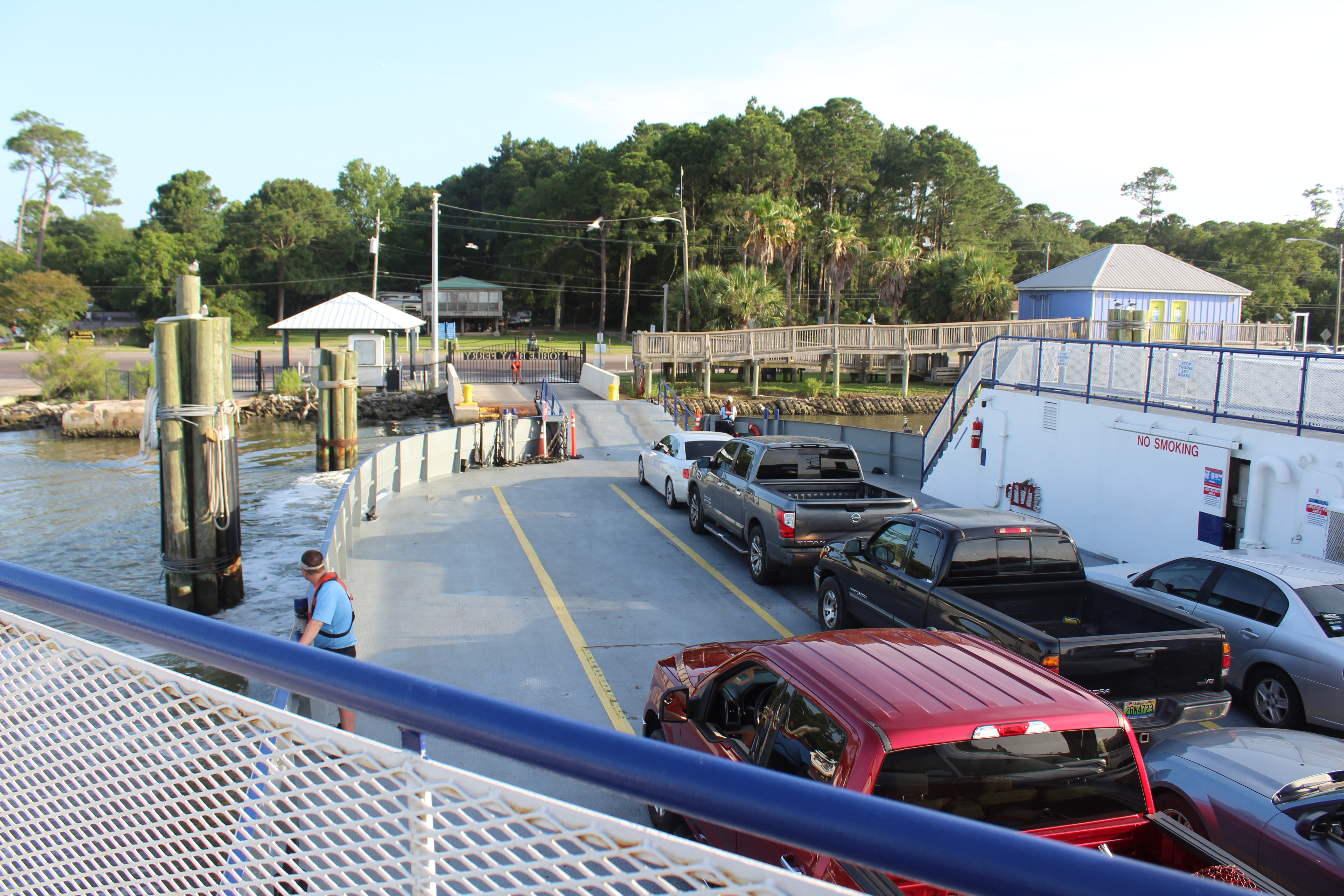
When directed, drive smoothly over the transfer bridge (ramp) onto the metal car deck at a speed of 5 mph. Deck marshals will instruct you where to stop, park, and set your emergency brake. Turn off your vehicle's engine and extinguish all smoking materials immediately upon parking.
Step 5: The Crossing
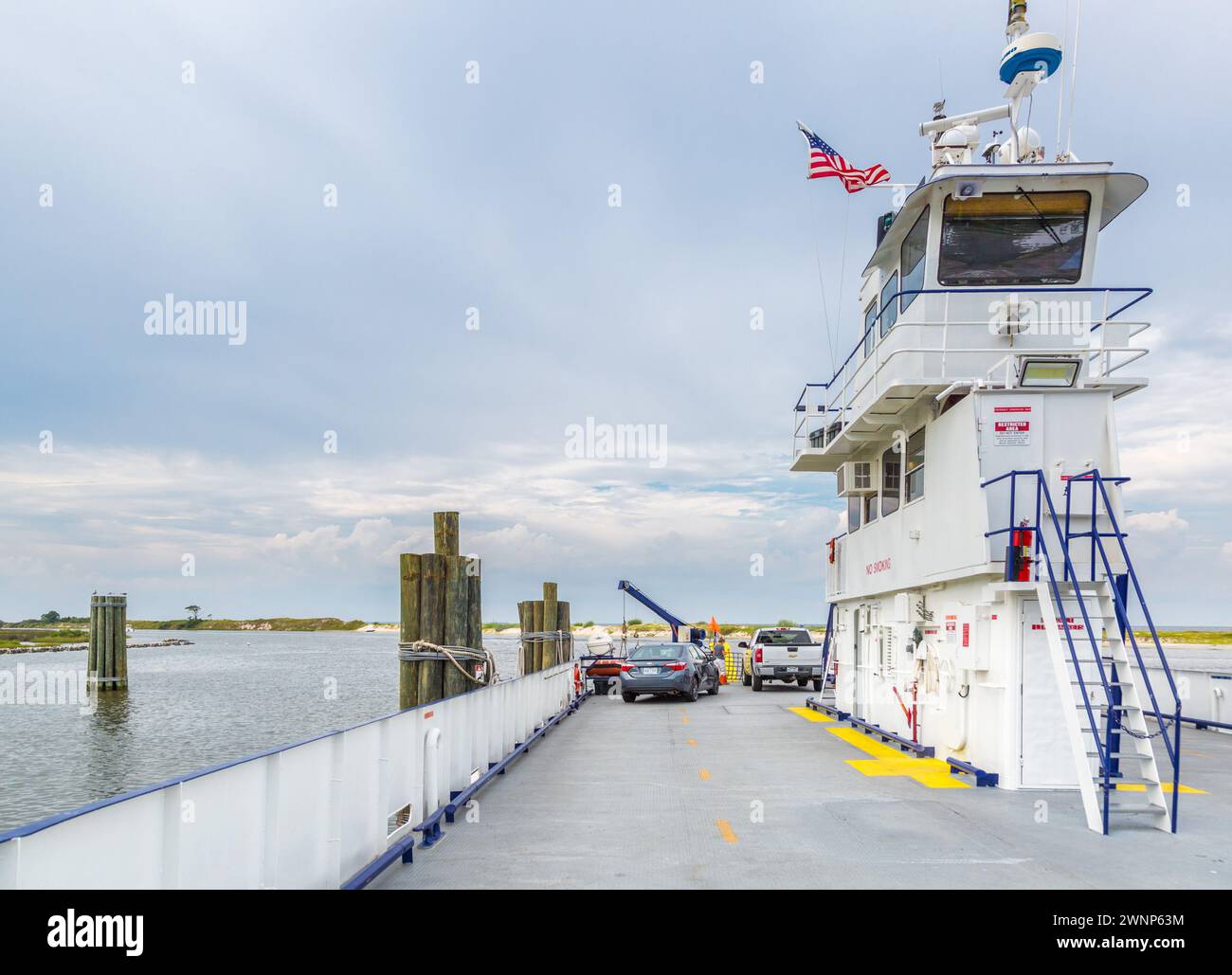
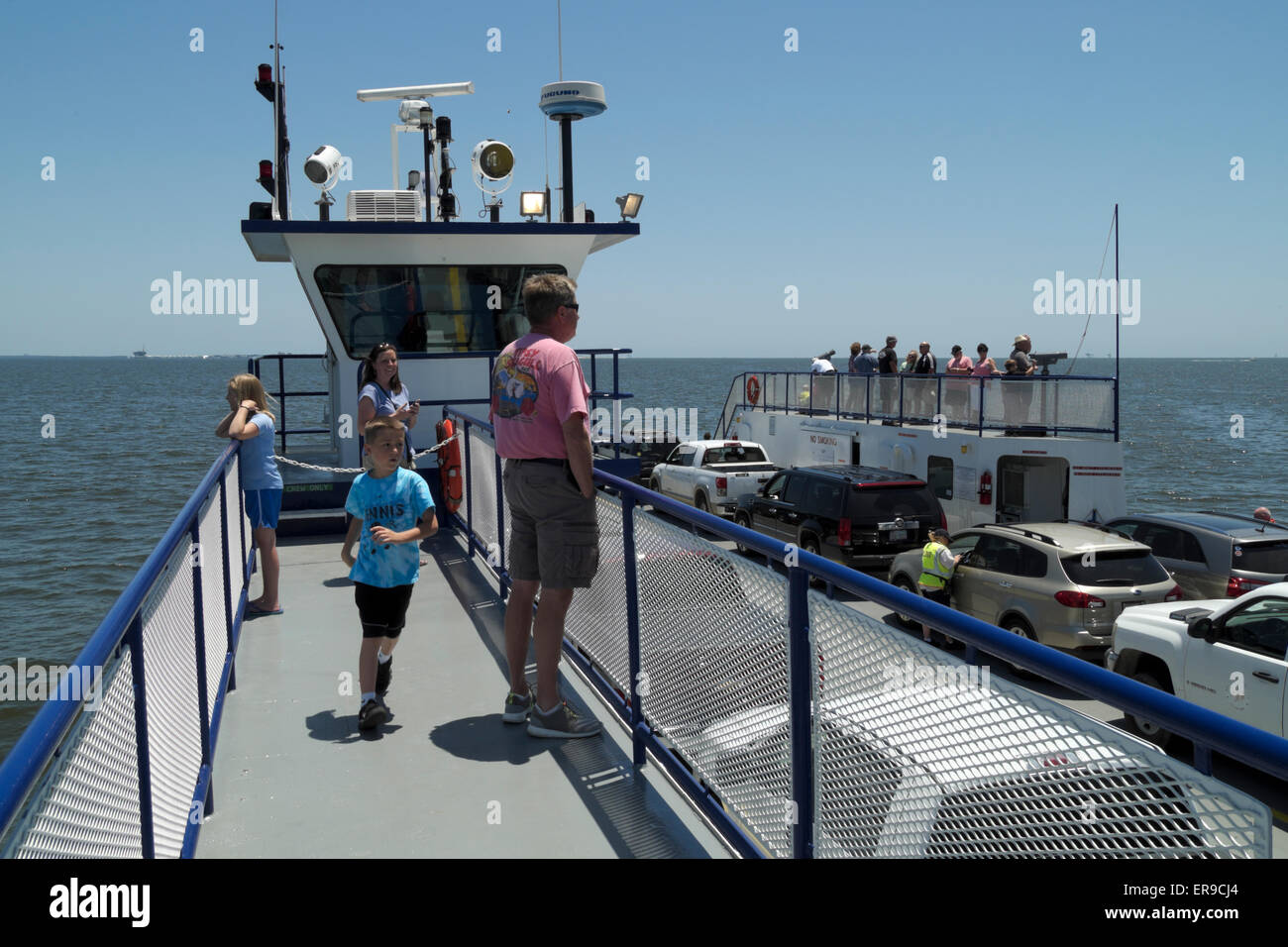
Once vehicles are secured and the vessel departs the slip, passengers are permitted to leave their cars. You may climb the external stairs to the covered passenger deck, utilize the air-conditioned cabin seating, use the onboard restrooms, or observe marine traffic and dolphin activity along the railing.
Step 6: Disembarkation Preparation
Listen for the marine crew's announcement indicating the ship is entering the slip. Return to your vehicle immediately, start your engine only when instructed, and drive off the boat in the orderly sequence directed by deck officers.
Technical Specifications, Sizing Limits, and Accessibility
The Mobile Bay Ferry system operates vessels designed specifically to handle shallow-water bay navigation while supporting heavy vehicular payloads.
Vessel Profiles
- The Fort Morgan: Built to handle up to 30 to 34 standard-sized automobiles or light trucks, alongside approximately 150 to 200 walk-on passengers.
- The Marissa Mae Nicole: Designed with an approximate capacity of 34 vehicles, operating with roll-on/roll-off vehicle ramps suited for standard and medium commercial transport.
Dimensional and Weight Restrictions
Travelers towing boats, utility trailers, or driving Class A or Class C recreational vehicles must observe the following constraints:
- Maximum Width: 10 feet. Loads exceeding standard road width must receive clearance from ferry operations prior to entering terminal approaches.
- Ground Clearance: Low-profile sports cars, lowered vehicles, or trailers with extreme overhangs may scrape deck aprons during extreme high or low water tides. Drivers must approach ramps slowly.
- Propane Restrictions: Recreational vehicles carrying liquefied petroleum gas (propane) tanks must ensure valves are closed securely before passing the staging gate.
Accessibility Standards
Both vessels provide ADA accessibility on the vehicle deck level. Restrooms on the main car deck are wheelchair accessible. Passenger lounges on the upper deck are reachable via external stairs; travelers with mobility challenges are welcome to remain comfortably inside their air-conditioned vehicles or enjoy the view directly from the open car deck viewing perimeter.
Marine Weather, Tides, and Operational Disruptions
Because Mobile Bay spans a massive expanse of shallow brackish water connected directly to the open Gulf of Mexico, environmental conditions play a decisive role in schedule integrity.
Operational Weather Thresholds
Navigation through the Dauphin Island and Mobile Point channels is suspended when winds exceed sustained speeds of 25 to 30 knots, or when tidal surges submerge the loading ramps. Fog conditions producing less than one-quarter mile of visibility will delay departures until maritime radar clearance can guarantee safe transit across the Mobile Bay Shipping Channel.
Impact of Winter "Northers" and Tide Swings
During winter months (December through March), strong cold fronts sweeping down from the north force water out of Mobile Bay into the Gulf. These severe low-water events, combined with normal low tides, can drain channels below the draft necessary for safe ferry passage. During these cycles, service may pause for several hours until the tide turns.
The Mobile Bay Shipping Channel Crossing
During the 40-minute journey, the ferry crosses the active Mobile Bay Ship Channel, an underwater highway supporting deep-draft container ships, bulk cargo carriers, and military vessels navigating to and from the Port of Mobile. Coast Guard navigational rules assign right-of-way to deep-draft ships trapped inside the narrow dredged channel. Consequently, the ferry captain may occasionally slow or hold position mid-bay to allow large container traffic to clear, adding 5 to 10 minutes to the crossing duration.
Ferry Crossing vs. Driving the I-10 Bayway: Strategic Comparison
Travelers deciding between crossing Mobile Bay on the ferry or driving the highway network around the bay balance scenery and direct geographic access against cost and schedule predictability.
Mobile Bay Transit Route Comparison
| Factor | Mobile Bay Ferry (Fort Morgan <-> Dauphin Island) | Driving Route (via AL-180, AL-59, I-10, AL-193) |
|---|---|---|
| Total Transit Distance | ~5 nautical miles (crossing only) | 85 to 100 driving miles |
| Total Travel Time | 40-45 minutes crossing (plus 30 min queue) | 1 hour 45 minutes to 2 hours 15 minutes |
| Financial Cost | $16.00 to $28.00+ (vehicle + occupants) | ~$12.00 to $18.00 in fuel costs |
| Scenery & Experience | Open water views, dolphins, lighthouses, forts | Concrete interstate, urban sprawl, bridge spans |
| Reliability Risk | Weather halts, mechanical delays, queue capacity | Heavy I-10 traffic, bridge bottlenecks, tunnel delays |
| Fuel & Wear Conservation | Preserves ~90 miles of vehicle engine wear | Standard highway driving wear and tear |
The ferry offers substantial advantages if your starting point is Fort Morgan and your destination is Dauphin Island (or western Mobile County). Conversely, if you are departing from downtown Gulf Shores or Orange Beach and traveling toward Mobile proper or points north, driving the Baldwin Beach Express to I-10 avoids the risk of full ferry staging lines.
Local Strategic Tips for a Seamless Crossing
Navigating the ferry without missing a targeted slot requires understanding local traffic patterns and coastal nuances.
- Leverage the Off-Peak Window: Queues are consistently lightest on departures prior to 9:30 AM and after 4:15 PM. Midday departures between 11:00 AM and 2:00 PM carry the heaviest vehicle volumes.
- Combine Your Trip with Historic Visits: If you arrive at Fort Morgan or Dauphin Island to find that the incoming boat is already at maximum capacity, park in the historic staging area. You can tour Fort Gaines on the west or Fort Morgan on the east rather than sitting idly in your vehicle while awaiting the next transit window.
- Secure Pets and Valuables: Pets are permitted on board, but Coast Guard safety regulations require all domestic animals to remain restrained on a leash or inside the vehicle. Keep dogs away from exterior car deck rails due to engine noise and sudden blast horns.
- Prepare for Sudden Sea Spray: Vehicles parked in the forward-most positions on the car deck will encounter sea salt spray if crossing during chop or breezy bay conditions. A quick vehicle rinse at a local car wash following your transit is highly recommended to protect auto finishes.
Frequently Asked Questions
Can I reserve a spot on the Mobile Bay Ferry in advance?
No, the Mobile Bay Ferry operates on a strict first-come, first-served basis. Reservations are not accepted for regular passenger vehicles, RVs, or walk-on passengers; staging lanes load in the exact sequence in which vehicles arrive at the tollbooth.
To guarantee passage on your preferred sailing, plan to reach the terminal staging area 30 to 45 minutes before departure during normal operations, or up to 90 minutes early on summer holiday weekends.
How long does the Mobile Bay Ferry ride take?
The actual transit across Mobile Bay between Fort Morgan and Dauphin Island takes roughly 40 to 45 minutes. Total transit time, including terminal arrival, staging, boarding, the bay crossing, and disembarkation, averages 1 hour and 15 minutes under normal traffic conditions.
Crossing times can lengthen slightly if the captain must yield right-of-way to deep-draft commercial container shipping inside the central Mobile Bay Shipping Channel.
Does the ferry run every day of the year?
The Mobile Bay Ferry operates 365 days a year, weather permitting, including all major holidays such as Thanksgiving, Christmas Day, and New Year's Day.
While the service operates every day, individual departures are subject to suspension if high sustained winds, severe low tides, heavy fog, or tropical storms make docking and navigation unsafe.
What happens if the weather cancels the ferry while I have a round-trip ticket?
Round-trip tickets remain active and valid for 30 days from the date of purchase. If adverse weather shuts down the ferry while you are on the opposite side of the bay, you must take the driving route around Mobile Bay via Interstate 10, saving your remaining ticket for a future trip within its validity window.
Ferry operators communicate severe weather suspensions on their official status boards and phone informational lines on the morning of severe weather events.
Are there restrooms and food options onboard the ferry?
Restrooms are located on the main deck level of the ferry, but there are no concession stands, food service, or vending machines aboard either vessel.
Both the Dauphin Island and Fort Morgan terminals feature public restrooms and small area shops nearby, but travelers should pack their own water and snacks if staging during heavy summer holiday queues.
Maximize Your Gulf Coast Travel
The Mobile Bay Ferry provides a relaxing, scenic shortcut that bypasses highway congestion between Baldwin County and Mobile County. By checking the morning tide forecasts, arriving at the terminal gates early, and timing your trip outside the busy midday rush, you can transform routine highway driving into an open-water coastal excursion. Check the morning operational status before hitting the road, stage your vehicle early, and enjoy the trip across Mobile Bay.
Image Gallery