Yellowstone Volcano Size Comparison: How the Supervolcano Measures Up
The Yellowstone supervolcano is significantly larger than typical stratovolcanoes like Mount St. Helens or Mount Rainier, both in physical caldera footprint and subterranean magma storage. Rather than a visible mountain peak, Yellowsto...
The Yellowstone supervolcano is significantly larger than typical stratovolcanoes like Mount St. Helens or Mount Rainier, both in physical caldera footprint and subterranean magma storage. Rather than a visible mountain peak, Yellowstone features a collapsed caldera measuring approximately 34 by 45 miles (55 by 72 kilometers), fed by a massive two-tiered underground magma reservoir system spanning thousands of cubic kilometers.
Contents
Understanding the Structure: Caldera vs. Traditional Volcanic Cone
To evaluate a yellowstone volcano size comparison, one must first understand that Yellowstone does not resemble iconic conical volcanoes such as Japan's Mount Fuji or Washington's Mount Rainier. Traditional volcanoes build tall, steep peaks over thousands of years as successive layers of lava, ash, and rock accumulate around a central vent. When these stratovolcanoes erupt, material flows out of or explodes from the summit crater.
In contrast, Yellowstone is a caldera-complex supervolcano. Supervolcano eruptions occur when immense volumes of continental crust melt, forming a massive subsurface reservoir of highly viscous, silica-rich rhyolitic magma. As this reservoir expands, enormous pressure builds beneath the Earth's crust. Rather than venting through a single pipe, the overlying crust fractures, releasing vast quantities of ash and pyroclastic material in catastrophic explosive events.
When the underlying magma chamber rapidly empties during a super eruption, the unsupported ground above collapses into the emptied space. This structural collapse creates a vast, bowl-shaped depression known as a caldera. Yellowstone’s present-day central caldera was formed during its last major explosive eruption 640,000 years ago. Consequently, comparing Yellowstone to a mountain peak is a structural misnomer; the entire park is essentially a living, breathing volcanic depression anchored by a continental hot spot.
Magma Reservoir Dimensions: What Lies Beneath Yellowstone
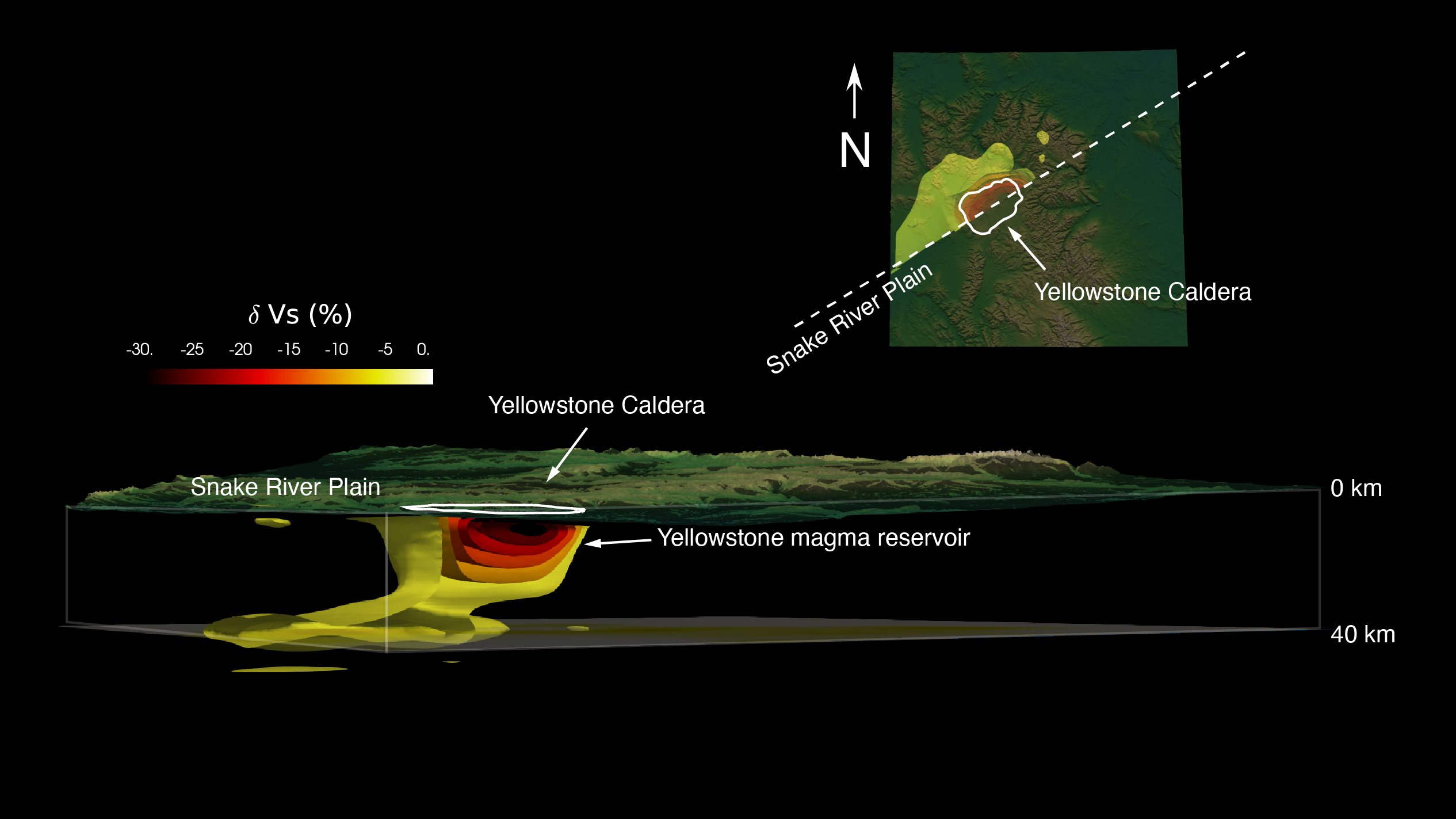
A accurate size comparison requires looking deep beneath the surface of Yellowstone National Park. Advanced seismic tomography conducted by geophysicists at the University of Utah and published by institutions such as the United States Geological Survey (USGS) has revealed that Yellowstone’s plumbing system consists of two interconnected magma reservoirs rather than a single underground cavern.
- EARTH'S SURFACE
- Yellowstone Caldera ~34 x 45 miles / 55 x 72 kilometers
- UPPER MAGMA RESERVOIR
- Depth: ~5 to 14 km (3 to 9 miles)
- Size: ~90 km long x 30 km wide
- Composition: Silicic / Rhyolitic
- Volume: ~10,000 km³ (Avg. Partial Melt: ~5% - 15%)
- LOWER MAGMA RESERVOIR
- Depth: ~20 to 50 km (12 to 31 miles)
- Size: ~4.5 times larger volume than upper reservoir
- Composition: Basaltic
- Function: Heats upper reservoir from mantle plume
The Upper Crustal Magma Chamber
Located roughly 3 to 9 miles (5 to 14 kilometers) beneath the national park, the shallow magma reservoir is predominantly rhyolitic. It measures approximately 55 miles (90 kilometers) long and 18 miles (30 kilometers) wide. The total volume of this upper chamber is estimated at roughly 10,000 cubic kilometers.
However, seismic studies confirm that this upper chamber is not a liquid lake of molten lava. Instead, it consists of a "magma sponge"—a solid crystalline rock matrix with liquid magma filling the pore spaces between grains. Current estimates show that the upper reservoir contains only about 5% to 15% liquid melt. Geologists generally agree that a volcanic reservoir requires at least 35% to 50% liquid melt fraction to mobilize and produce a major explosive eruption.
The Lower Crustal Magma Reservoir
In 2015, researchers mapped a second, deeper magma body located 12 to 31 miles (20 to 50 kilometers) down in the lower crust. This deep reservoir is basaltic in composition and is immense: it is roughly 4.5 times larger in volume than the upper chamber. Containing around 46,000 cubic kilometers of material, this lower reservoir acts as the primary transfer zone, conveying heat and magma upward from the mantle plume (hotspot) beneath the North American tectonic plate into the upper crustal chamber.
Eruption Volume Comparison: Ejected Material Across History
Volcanologists measure the magnitude of volcanic eruptions using the Volcanic Explosivity Index (VEI), established by Chris Newhall and Stephen Self in 1982. The scale ranges from VEI 0 (non-explosive Hawaiian eruptions) to VEI 8 (super-eruptions emitting more than 1,000 cubic kilometers of bulk deposit material). The scale is logarithmic; each step up represents a tenfold increase in ejected volume.
To grasp the scale of Yellowstone’s past eruptions, consider how its three major caldera-forming events compare to historical eruptions worldwide.
ERUPTION VOLUME COMPARISON (CUBIC KILOMETERS OF EJECTA)
- Yellowstone Huckleberry Ridge (VEI 8): 2,500 km³
- Lake Toba ~74,000 yrs ago (VEI 8): 2,800 km³
- Yellowstone Lava Creek (VEI 8): 1,000 km³
- Tambora 1815 (VEI 7): 150 km³
- Yellowstone Mesa Falls (VEI 7): 280 km³
- Krakatoa 1883 (VEI 6): 25 km³
- Mount Pinatubo 1991 (VEI 6): 10 km³
- Mount St. Helens 1980 (VEI 5): 1 km³
The Three Yellowstone Super-Eruptions
- Huckleberry Ridge Eruption (2.1 Million Years Ago): The largest of the three Yellowstone events produced the Huckleberry Ridge Tuff. It released an estimated 2,500 cubic kilometers (600 cubic miles) of volcanic material—a VEI 8 event. This single eruption was approximately 2,500 times larger than the 1980 eruption of Mount St. Helens.
- Mesa Falls Eruption (1.3 Million Years Ago): The smallest of the three major events ejected roughly 280 cubic kilometers (67 cubic miles) of material, creating the Henry's Fork Caldera west of the main park. Classified as a VEI 7 eruption, it was still nearly 300 times larger than Mount St. Helens.
- Lava Creek Eruption (640,000 Years Ago): The most recent caldera-forming event created the present 34 by 45 mile Yellowstone Caldera. It ejected approximately 1,000 cubic kilometers (240 cubic miles) of rock, ash, and pyroclastic surge deposits (VEI 8), covering vast portions of North America in volcanic ash.
Comparing Yellowstone to Known Historical Eruptions
The table below contrasts Yellowstone's past events with prominent historic and prehistoric eruptions around the world, using data compiled by the USGS Volcanic Explosivity Index framework.
| Volcanic Event | Approximate Date | VEI Rating | Estimated Bulk Volume (km³) | Explosive Comparison to Mt. St. Helens (1980) |
|---|---|---|---|---|
| Mount St. Helens (USA) | May 18, 1980 | VEI 5 | 1.0 km³ | Baseline (1x) |
| Mount Pinatubo (Philippines) | June 15, 1991 | VEI 6 | 10 km³ | ~10x larger |
| Krakatoa (Indonesia) | August 27, 1883 | VEI 6 | 25 km³ | ~25x larger |
| Novarupta / Katmai (USA) | June 6, 1912 | VEI 6 | 30 km³ | ~30x larger |
| Mount Tambora (Indonesia) | April 10, 1815 | VEI 7 | 100–150 km³ | ~100–150x larger |
| Mesa Falls / Yellowstone | 1.3 Ma | VEI 7 | 280 km³ | ~280x larger |
| Lava Creek / Yellowstone | 640,000 ya | VEI 8 | 1,000 km³ | ~1,000x larger |
| Huckleberry Ridge / Yellowstone | 2.1 Ma | VEI 8 | 2,500 km³ | ~2,500x larger |
| Lake Toba (Indonesia) | 74,000 ya | VEI 8 | 2,800 km³ | ~2,800x larger |
Physical Footprint: Comparing Yellowstone's Caldera to Cities and Regions
Visualizing the sheer area of the Yellowstone Caldera can be challenging because visitors stand inside it without seeing traditional crater walls. The main Yellowstone Caldera spans approximately 1,500 square miles (3,900 square kilometers).
To put this spatial scale into everyday perspective:
- Rhode Island: The state of Rhode Island covers 1,214 square miles. Yellowstone’s central caldera alone is roughly 25% larger than the entire state.
- New York City: The total land area of New York City’s five boroughs is roughly 300 square miles. The Yellowstone Caldera could fit five entire New York Cities within its perimeter.
- Greater London: Greater London covers roughly 607 square miles. The caldera could encompass Greater London two and a half times over.
- Mount St. Helens Crater: The blast crater formed at Mount St. Helens in 1980 is roughly 1.5 miles wide by 2 miles long. Yellowstone's primary caldera is more than 20 times wider and 20 times longer than that entire crater floor.
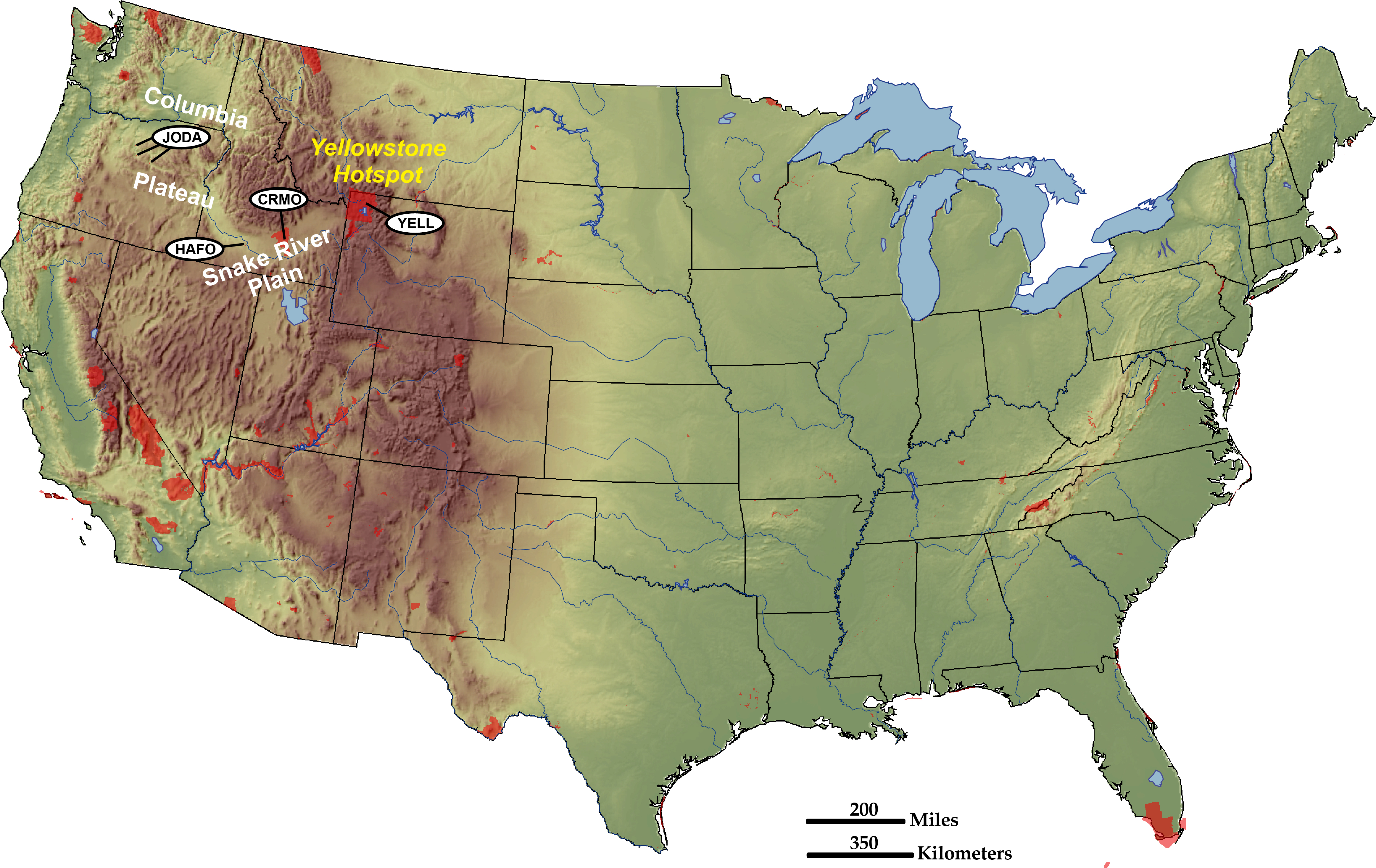
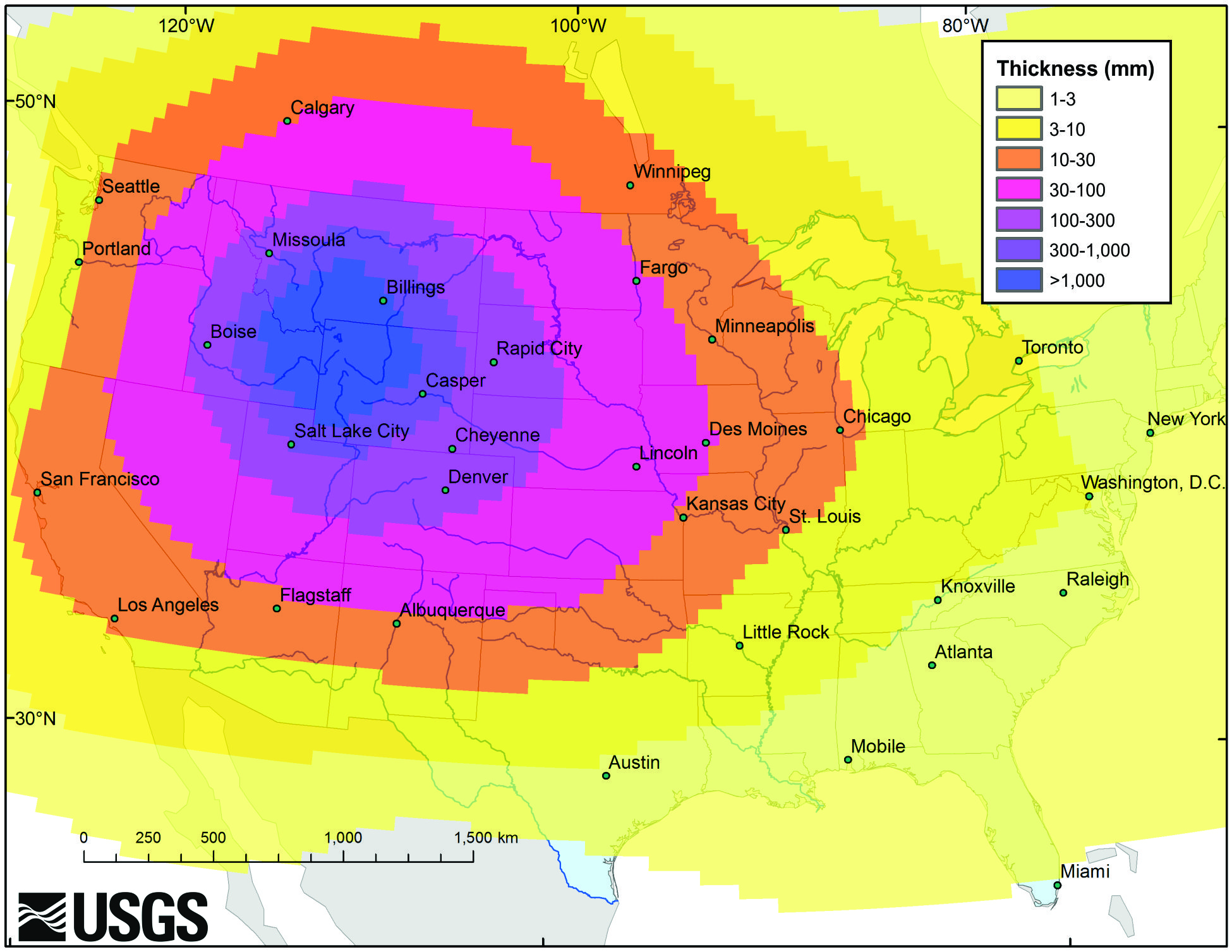
Beyond the caldera itself, the ash footprint of Yellowstone's super-eruptions is continent-spanning. The ash fall from the Lava Creek eruption covered more than half of the continental United States, stretching from the Pacific Coast to the Mississippi River, depositing blanket layers of ash several feet thick thousands of miles from the source.
Caldera Comparisons: Yellowstone vs. Other Supervolcanoes
Yellowstone is often called the world's most famous supervolcano, but it is not the only one on Earth. Comparing Yellowstone to other active or prehistoric caldera systems puts its scale in context.
Yellowstone vs. Long Valley Caldera (California, USA)
Located in eastern California, the Long Valley Caldera formed roughly 760,000 years ago during the Bishop Tuff eruption. Long Valley measures approximately 10 by 20 miles (16 by 32 kilometers) and ejected roughly 600 cubic kilometers of material (VEI 7). While Long Valley is an active volcanic system monitored closely by the USGS, Yellowstone’s caldera area is more than double the size of Long Valley, and its magma output during VEI 8 events is significantly greater.
Yellowstone vs. Taupo Volcanic Zone (New Zealand)
New Zealand’s Lake Taupo sits inside a caldera formed by the Oruanui eruption roughly 25,600 years ago. The Oruanui event released approximately 1,170 cubic kilometers of deposit (VEI 8), making it comparable in total ejected volume to Yellowstone's Lava Creek eruption. However, the physical surface caldera at Taupo is slightly smaller than Yellowstone's principal caldera ring.
Yellowstone vs. Lake Toba (Sumatra, Indonesia)
The Youngest Toba Tuff eruption occurred roughly 74,000 years ago and is recognized as the largest explosive volcanic eruption on Earth within the last 2 million years. Lake Toba's caldera measures 18 by 62 miles (30 by 100 kilometers). Ejecting roughly 2,800 cubic kilometers of material, the Toba event slightly surpassed Yellowstone's largest event (Huckleberry Ridge at 2,500 km³). Toba remains one of the few caldera structures on Earth larger than Yellowstone.
Current Status and Misconceptions About Eruption Risk
Because of the massive scale highlighted in size comparisons, sensationalist narratives often present Yellowstone as overdue for a catastrophic eruption. Geologists with the Yellowstone Volcano Observatory strongly refute this claim based on comprehensive real-time monitoring.
Seismic Monitoring and Melt Fraction
The USGS continuously monitors Yellowstone using GPS receivers, satellite radar (InSAR), borehole strainmeters, and a dense network of seismographs. Seismic waves travel slower through molten liquid rock than through solid rock. By recording thousands of small earthquake signals annually, geophysicists produce three-dimensional seismic tomographic maps of the subsurface.
As confirmed by continuous monitoring through 2026, the current state of Yellowstone's magma chamber displays two vital facts:
- Low Liquid Fraction: The shallow upper reservoir contains mostly solid rock intergrown with liquid melt (averaging only 5% to 15% melt). To trigger an eruption, this ratio would need to rise dramatically, requiring vast inputs of fresh basaltic magma from below.
- Lava Flows Are More Likely: If Yellowstone erupts again, history shows it is far more likely to produce localized rhyolitic or basaltic lava flows rather than a caldera-forming super-eruption. Over the past 640,000 years, Yellowstone has experienced approximately 80 non-explosive or weakly explosive lava flows. The most recent rhyolite lava flow occurred roughly 70,000 years ago at Pitchstone Plateau.
Frequently Asked Questions
Is Yellowstone the largest volcano in the world?
No. By physical footprint and height, Mauna Loa in Hawaii is the world's largest active single volcano by volume (containing approximately 75,000 cubic kilometers of rock). In terms of explosive caldera size and deposit volume, Lake Toba in Sumatra, Indonesia, produced a larger eruption within recent geological history (2,800 km³ compared to Yellowstone's 2,500 km³).
How does Yellowstone compare to Mount Vesuvius or Mount Etna?
Mount Vesuvius and Mount Etna are traditional stratovolcanoes with localized eruptive cones. Mount Vesuvius ejected roughly 3 cubic kilometers of material during its famous 79 AD eruption. Yellowstone’s largest eruption was more than 800 times larger than Vesuvius and covered thousands of times more geographic surface area.
Can you see the Yellowstone volcano crater when visiting the park?
Yes, but most visitors do not realize they are inside it because of its scale. Standing at viewpoints like Artist Point or driving through Hayden Valley, you are standing directly on the floor of the caldera. The surrounding mountain ranges (such as the Washburn Range) form parts of the ancient caldera rim.
What would happen if Yellowstone experienced a smaller lava flow eruption?
A non-explosive lava flow would alter local topography inside Yellowstone National Park, potentially closing roads, damaging park infrastructure, and disrupting regional visitor access. However, localized lava flows do not produce global ash clouds or global climate cooling and pose minimal risk to populations outside the immediate vicinity of the park.
Practical Takeaways and Next Steps
Understanding Yellowstone’s true size requires distinguishing between dramatic media depictions and verified scientific measurements:
- Size Metric: Yellowstone is defined by a massive 34x45-mile subsurface caldera and a dual-reservoir plumbing system, not a vertical volcanic cone.
- Eruption Scale: Its historical super-eruptions were between 280 and 2,500 times larger than Mount St. Helens (1980), placing them at VEI 7 and VEI 8.
- Current Physical Risk: With an upper magma reservoir consisting of only ~5%–15% melt fraction, the system lacks the fluid mobility necessary for an immediate major eruption.
- Monitoring Resources: For real-time updates on ground deformation, earthquake swarms, and thermal activity, consult official reports directly from the USGS Yellowstone Volcano Observatory.
Image Gallery