Open Source Business Process Management in the Wild
Open source business process management (BPM) in the wild refers to the real-world deployment of flexible, community-driven workflow engines to orchestrate complex enterprise operations. By leveraging frameworks like Camunda, Flowable,...
Open source business process management (BPM) in the wild refers to the real-world deployment of flexible, community-driven workflow engines to orchestrate complex enterprise operations. By leveraging frameworks like Camunda, Flowable, or Bonita, organizations transition from rigid, proprietary suites to agile, developer-centric architectures that balance cost-efficiency with high-scale automation and microservices integration.
Contents
The landscape of Business Process Management Systems (BPMS) has undergone a fundamental shift. As of 2026, the era of heavy, monolithic "low-code" platforms that lock data into proprietary silos is being challenged by "in the wild" open-source alternatives. These solutions are characterized by their ability to run in diverse environments—from on-premises legacy servers to cloud-native Kubernetes clusters—while providing developers with the transparency of source code access.
Navigating this ecosystem requires an understanding of how these tools function outside of controlled demo environments. Implementing open source BPM involves managing technical debt, ensuring security compliance, and fostering a culture where business logic is expressed through standardized models like BPMN 2.0.
The Evolution of Open Source BPM Architecture
The primary reason organizations seek open source BPM in the wild is the desire for architectural freedom. Unlike closed-source counterparts, open-source engines are often designed to be "headless." This means the workflow engine functions as a library or a remote service that applications call via API, rather than a standalone application that forces a specific user interface onto the staff.
From Monoliths to Microservices Orchestration
Historically, BPM was synonymous with a centralized server. In the wild today, the trend is toward microservices orchestration. Tools such as Camunda 8 and Flowable have optimized their engines to handle the high-throughput demands of distributed systems. In this context, the BPM engine acts as the "brain" that coordinates various microservices, ensuring that if one service fails, the state of the business process is preserved and can be recovered.
Cloud-Native and Serverless Integration
By 2026, "in the wild" deployments almost universally utilize containerization. Open source BPM projects have adapted by providing official Docker images and Helm charts for Kubernetes. This allows for horizontal scaling—adding more engine instances as process volume increases during peak hours. Furthermore, integration with serverless functions (like AWS Lambda or Google Cloud Functions) has become a standard requirement for modern workflow automation, allowing businesses to execute discrete process steps without maintaining permanent infrastructure.
Leading Open Source BPM Entities in 2026
When evaluating open source BPM "in the wild," three major players dominate the conversation. Each offers a different balance of community features versus enterprise-grade support.
| Feature | Camunda (8.x) | Flowable (7.x) | Bonita (2025+) |
|---|---|---|---|
| Core Engine | Zeebe (Cloud-native) | Flowable Engine (Java) | Bonita Engine (Java) |
| Primary License | BSL / Zeebe Community | Apache 2.0 | GPL v2 / Proprietary |
| Main Strength | High-scale orchestration | High-performance embeddability | End-to-end App Development |
| Best For | Complex Microservices | Financial/Transactional Apps | Process-centric User Portals |
| Standard Support | BPMN, DMN | BPMN, CMMN, DMN | BPMN |
Camunda: The Orchestration Powerhouse
Camunda has pivoted significantly toward cloud-native orchestration. While the older Camunda 7 (based on the original Activiti fork) remains in use for legacy Java environments, Camunda 8 utilizes the Zeebe engine. Zeebe is designed specifically for high-throughput and low-latency scenarios, making it the preferred choice for organizations running thousands of process instances per second.
Flowable: The Modular Alternative
Flowable, another descendant of the Activiti project, is frequently found in the wild within the financial services sector. Its primary advantage is its modularity and strict adherence to the Object Management Group (OMG) standards. Flowable excels at handling not just structured processes (BPMN) but also unstructured, case-managed workloads via CMMN (Case Management Model and Notation).
Bonita: The Low-Code Hybrid
Bonitasoft’s Bonita platform targets a slightly different niche. It provides a more comprehensive "application factory" approach. While the engine is open source, the platform emphasizes building the entire user interface and data model around the process. It is often the tool of choice for organizations that need to deploy functional business applications quickly without writing extensive frontend code.
Critical Standards: BPMN, DMN, and CMMN
A successful deployment in the wild relies on standardized languages. These allow business analysts and developers to speak the same language, reducing the "lost in translation" errors that plague digital transformation projects.
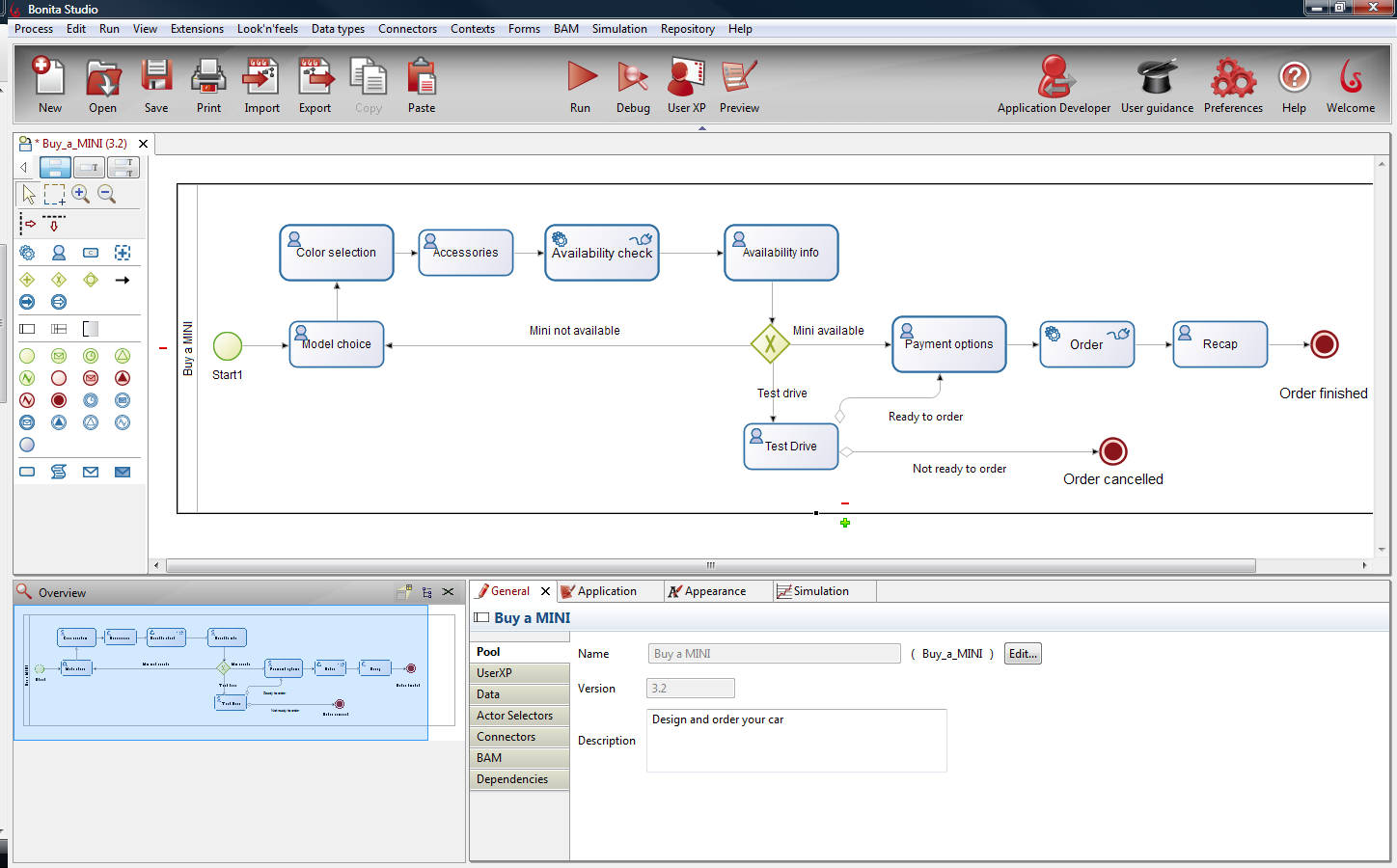
- BPMN 2.0 (Business Process Model and Notation): The global standard for process modeling. It uses standardized symbols (circles for events, rectangles for tasks, diamonds for gateways) to map out how work flows.
- DMN (Decision Model and Notation): Used for managing business rules. Instead of hard-coding "if-else" statements into an application, DMN allows business users to define logic in decision tables that the BPM engine can execute automatically.
- CMMN (Case Management Model and Notation): Essential for "in the wild" scenarios where the path isn't predictable. CMMN is used for investigations, healthcare, or legal cases where the next step depends on human judgment rather than a pre-defined flow.
Implementation Requirements and Prerequisites
Deploying open source BPM is not a "plug-and-play" endeavor. It requires a specific set of technical and organizational prerequisites to ensure the project doesn't stall in the development phase.
Technical Skill Sets
Your team must be proficient in the language of the chosen engine. Most major open-source BPM engines are built on Java, requiring expertise in the Spring Boot framework. However, with the rise of gRPC and REST-based engines like Zeebe, teams using Go, Python, or Node.js can now effectively manage workflows without deep Java knowledge.
Infrastructure and Persistence
"In the wild," the state of every process must be persisted. This requires robust database management. While most engines support relational databases like PostgreSQL or MySQL, high-scale deployments often move toward distributed stores or specialized exporters (like Elasticsearch) for process visibility and audit logging.
Security and Governance
Open source does not mean "less secure," but it does mean the responsibility for security patches lies with the implementer. Organizations must establish a pipeline for regularly updating the engine and its dependencies. Furthermore, Identity and Access Management (IAM) integration using protocols like OAuth2 or OIDC is mandatory for enterprise-grade deployments.
Challenges of Open Source BPM "In the Wild"
Despite the benefits, real-world implementations face several recurring hurdles. Addressing these early can prevent a "failed" project label.
- Version Drift and Forking: One of the greatest risks is customizing the open-source core so heavily that you can no longer upgrade to newer versions. The best practice is to extend functionality through external "service tasks" or listeners rather than modifying the engine code itself.
- The UI Gap: Many open-source engines provide a very basic "Tasklist" UI. Organizations often find they must build a custom frontend to meet user experience expectations, which can add significant time to the project timeline.
- Community vs. Enterprise Support: Relying solely on community forums is risky for mission-critical processes. Most organizations eventually opt for a "Dual-Licensing" model, where they use the open-source version for development and pay for enterprise support and advanced management tools (like specialized monitoring dashboards) in production.
Troubleshooting Common Deployment Issues
When a workflow stalls in production, the culprit is rarely the engine itself. Instead, it usually falls into one of three categories:
- Deadlocks and Race Conditions: This happens when multiple process instances try to update the same data record simultaneously. Proper transaction management and optimistic locking configurations in the BPM engine are the standard solutions.
- External Service Timeouts: A process is only as fast as the services it calls. If a third-party API is slow, the BPM engine can "hang." Implementing the Circuit Breaker pattern or using asynchronous "Send/Receive" tasks is the recommended way to handle these external dependencies.
- Version Mismatch: When a process definition is updated, existing "in-flight" instances are still running on the old version. Managing process migration—deciding whether to let old instances finish on the old logic or move them to the new version—is a complex but necessary task for any long-running process.
Frequently Asked Questions
Is open source BPM actually free to use in a commercial setting?
Yes, most core engines are licensed under Apache 2.0 or similar licenses that allow commercial use. However, advanced features (like enterprise-grade visualizers, administrative tools, or high-availability clusters) are often locked behind a commercial license or "Business Source License" (BSL). Always review the specific license for the version you are deploying.
Can open source BPM replace RPA (Robotic Process Automation)?
They are complementary. BPM is for orchestrating "clean" processes via APIs and human tasks, while RPA is for automating "dirty" processes involving legacy user interfaces. Many organizations use an open-source BPM engine as the "orchestrator" that tells various RPA bots when to execute their tasks.
How does AI integrate with open source BPM in 2026?
AI is primarily used for "Intelligent Document Processing" (IDP) and predictive analytics. For example, a BPM engine might send a PDF to an AI service, receive the extracted data, and then use a DMN table to decide whether to auto-approve the request or send it to a human. Some engines now also offer AI-assisted process modeling to help analysts draft BPMN diagrams from text descriptions.
What is the typical migration path from proprietary BPM suites?
The path usually starts with a "pilot" project—identifying a single, non-critical process to migrate. Organizations then map the existing logic to BPMN 2.0 and rebuild the integrations using modern APIs. The biggest hurdle is usually data migration—moving thousands of active instances from the old system to the new one.
Final Recommendation for 2026
For organizations looking to deploy open source BPM in the wild, the most sustainable path is a cloud-native, standards-based approach. Prioritize engines that strictly adhere to BPMN 2.0 to ensure your business logic remains portable. If your environment is microservices-heavy, Camunda 8 offers the most robust scalability. If you require deep embeddability within a Java application or need to handle complex case management, Flowable remains the industry gold standard. Regardless of the tool, invest heavily in developer training and standardized modeling to ensure that your "wild" deployment remains manageable as it scales.
Image Gallery