Understanding GCD and LCM: Calculation Methods, Mathematical Proofs, and Practical Applications
Understanding GCD (Greatest Common Divisor) and LCM (Least Common Multiple) requires examining how positive integers share factors and multiples. The GCD identifies the largest integer that divides two or more numbers without leaving a...
Understanding GCD (Greatest Common Divisor) and LCM (Least Common Multiple) requires examining how positive integers share factors and multiples. The GCD identifies the largest integer that divides two or more numbers without leaving a remainder, while the LCM represents the smallest positive integer divisible by all target numbers. Together, these two concepts serve as foundation stones in number theory, fraction simplification, modular arithmetic, and computer algorithm design.
Contents
Defining the Core Concepts: GCD and LCM
To work effectively with integer arithmetic, you must first establish a precise understanding of factors, divisors, and multiples.
What is the Greatest Common Divisor (GCD)?
The Greatest Common Divisor (GCD)—frequently termed the Highest Common Factor (HCF)—of two or more non-zero integers is the largest positive integer that divides each of the numbers without leaving a remainder.
For example, consider the numbers $24$ and $36$:
- Divisors of $24$: $1, 2, 3, 4, 6, 8, 12, 24$
- Divisors of $36$: $1, 2, 3, 4, 6, 9, 12, 18, 36$
- Shared Divisors: $1, 2, 3, 4, 6, 12$
The largest shared integer is $12$, meaning $\gcd(24, 36) = 12$. When the GCD of two numbers is $1$, those integers are classified as coprime or relatively prime (for example, $8$ and $15$).
What is the Least Common Multiple (LCM)?
The Least Common Multiple (LCM) of two or more non-zero integers is the smallest positive integer that is evenly divisible by each given number.
Using the same numbers, $24$ and $36$:
- Multiples of $24$: $24, 48, 72, 96, 120, 144, \dots$
- Multiples of $36$: $36, 72, 108, 144, 180, \dots$
- Shared Multiples: $72, 144, 216, \dots$
The smallest positive shared integer is $72$, establishing that $\text{lcm}(24, 36) = 72$.
Primary Methods for Calculating GCD and LCM
Several mathematical techniques exist for evaluating GCD and LCM. Selecting the appropriate method depends on the size of the input integers and whether the calculation is performed manually or via software.
- Input Numbers
- Is manual computation easy?
- YES: Prime Factorization (Small Integers)
- NO: Euclidean Algorithm (Large Integers / Software)
- Is manual computation easy?
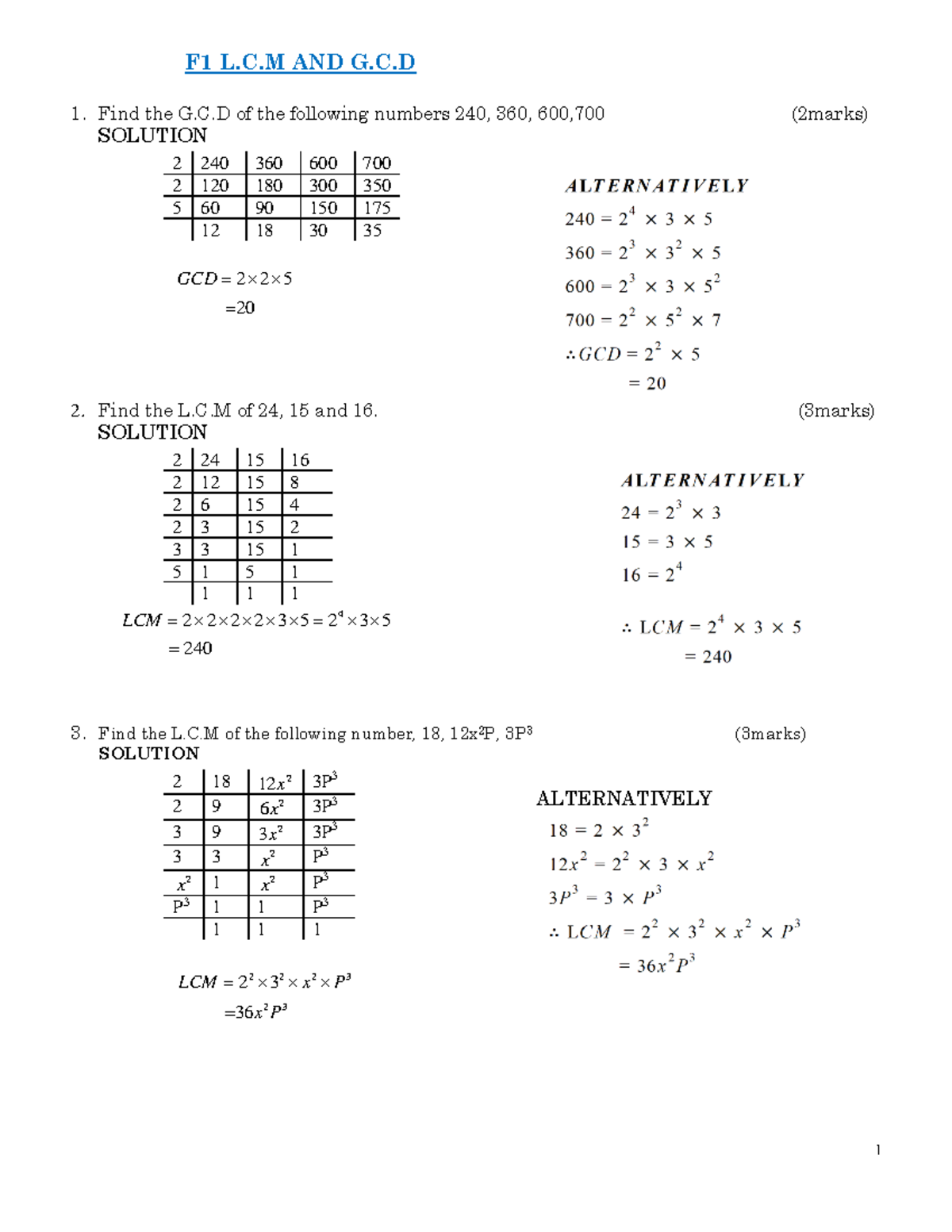
1. Prime Factorization Method
Prime factorization breaks down each integer into a product of prime numbers. According to the Fundamental Theorem of Arithmetic, every integer greater than $1$ has a unique prime factorization.
Step-by-Step Execution:
- Express each number as a product of prime powers.
- For GCD: Identify the prime factors common to all numbers. Take each common prime raised to its lowest exponent present in the factorizations, and multiply them.
- For LCM: Identify all prime factors present across any of the numbers. Take each prime raised to its highest exponent present, and multiply them.
Worked Example: Find GCD and LCM of $60$ and $168$
Prime factorization of $60$: $$60 = 2 \times 2 \times 3 \times 5 = 2^2 \times 3^1 \times 5^1$$
Prime factorization of $168$: $$168 = 2 \times 2 \times 2 \times 3 \times 7 = 2^3 \times 3^1 \times 7^1$$
Calculating $\gcd(60, 168)$:
- Common primes: $2$ and $3$.
- Lowest power of $2$: $2^2$
- Lowest power of $3$: $3^1$
- $\gcd(60, 168) = 2^2 \times 3^1 = 4 \times 3 = 12$
Calculating $\text{lcm}(60, 168)$:
- All prime factors present: $2, 3, 5, 7$.
- Highest power of $2$: $2^3$
- Highest power of $3$: $3^1$
- Highest power of $5$: $5^1$
- Highest power of $7$: $7^1$
- $\text{lcm}(60, 168) = 2^3 \times 3^1 \times 5^1 \times 7^1 = 8 \times 3 \times 5 \times 7 = 840$
2. The Euclidean Algorithm for GCD
While prime factorization is intuitive, factoring large integers becomes computationally expensive. The Euclidean Algorithm, documented by Euclid in Elements around 300 BCE, provides a highly efficient method based on the principle that the GCD of two numbers also divides their difference.
The modern division version of the algorithm uses the modulo operation: $$\gcd(a, b) = \gcd(b, a \bmod b)$$ This identity is repeatedly applied until the remainder $a \bmod b$ reaches zero. The final non-zero remainder (or divisor at that step) is the GCD.
Worked Example: Find $\gcd(252, 105)$
- Divide $252$ by $105$: $$252 = (105 \times 2) + 42 \implies 252 \bmod 105 = 42$$
- Replace $(a, b)$ with $(105, 42)$ and divide: $$105 = (42 \times 2) + 21 \implies 105 \bmod 42 = 21$$
- Replace $(a, b)$ with $(42, 21)$ and divide: $$42 = (21 \times 2) + 0 \implies 42 \bmod 21 = 0$$
Because the remainder is now zero, the divisor at this step ($21$) is the GCD. Thus, $\gcd(252, 105) = 21$.
The Interconnection Between GCD and LCM
A fundamental identity connects the GCD and LCM of any two positive integers $a$ and $b$:
$$\gcd(a, b) \times \text{lcm}(a, b) = a \times b$$
Proof via Prime Factorization
Let the prime factorizations of $a$ and $b$ be expressed using a generalized set of primes $p_1, p_2, \dots, p_k$: $$a = p_1^{e_1} \cdot p_2^{e_2} \cdots p_k^{e_k}$$ $$b = p_1^{f_1} \cdot p_2^{f_2} \cdots p_k^{f_k}$$ where $e_i, f_i \ge 0$.
By definition: $$\gcd(a, b) = \prod_{i=1}^{k} p_i^{\min(e_i, f_i)}$$ $$\text{lcm}(a, b) = \prod_{i=1}^{k} p_i^{\max(e_i, f_i)}$$
Multiplying $\gcd(a, b)$ and $\text{lcm}(a, b)$ yields: $$\gcd(a, b) \times \text{lcm}(a, b) = \prod_{i=1}^{k} p_i^{\min(e_i, f_i) + \max(e_i, f_i)}$$
For any real numbers $x$ and $y$, the sum of their minimum and maximum values equals their total sum: $\min(x, y) + \max(x, y) = x + y$.
Therefore: $$\gcd(a, b) \times \text{lcm}(a, b) = \prod_{i=1}^{k} p_i^{e_i + f_i} = \left(\prod_{i=1}^{k} p_i^{e_i}\right) \left(\prod_{i=1}^{k} p_i^{f_i}\right) = a \times b$$
Derived Formula for LCM
This relation lets you compute the LCM directly after finding the GCD via the Euclidean Algorithm:
$$\text{lcm}(a, b) = \frac{|a \times b|}{\gcd(a, b)}$$
Caution Regarding Three or More Integers: The simple product formula does not hold for three or more numbers. That is, $\gcd(a, b, c) \times \text{lcm}(a, b, c) \neq a \times b \times c$ in general. For three integers, the general relation involves pairwise GCDs and LCMs governed by the Inclusion-Exclusion Principle.
Comparison of Methods
The following matrix compares common techniques for finding the GCD and LCM based on input criteria, complexity, and operational constraints.
| Method | Best Used For | Time Complexity | Primary Strengths | Practical Limitations |
|---|---|---|---|---|
| Listing Factors / Multiples | Small numbers ($< 50$), initial educational demonstration | $O(N)$ space and time relative to integer size | Intuitive, easy to understand visually | Highly inefficient for large numbers; prone to missed factors |
| Prime Factorization | Moderate numbers with known factors; theoretical proofs | Depends on integer factorization algorithm (exponential without specialized methods) | Clearly reveals integer structure; solves GCD and LCM simultaneously | Factoring large integers (e.g., RSA key scales) is computationally hard |
| Euclidean Algorithm | Large integers, production software algorithms (GCD) | $O(\log(\min(a, b)))$ | Rapid execution speed; requires no prime factorization | Computes GCD directly; requires the identity formula to yield LCM |
| LCM via Division Identity | Determining LCM for large integers | $O(\log(\min(a, b)))$ | Leverages fast Euclidean GCD execution speed | Risk of integer overflow during $a \times b$ if division is performed second |
Real-World Applications and Software Implementation
1. Simplifying and Adding Fractions
Fraction operations depend heavily on both concepts:
- Simplification (GCD): To reduce $\frac{48}{180}$ to lowest terms, divide both numerator and denominator by $\gcd(48, 180) = 12$: $$\frac{48 \div 12}{180 \div 12} = \frac{4}{15}$$
- Common Denominator (LCM): To add $\frac{5}{12} + \frac{7}{18}$, calculate $\text{lcm}(12, 18) = 36$. Convert both fractions to use this Least Common Denominator (LCD): $$\frac{5 \times 3}{12 \times 3} + \frac{7 \times 2}{18 \times 2} = \frac{15}{36} + \frac{14}{36} = \frac{29}{36}$$
2. Periodicity and Event Synchronization
LCM answers questions regarding recurring timing cycles.
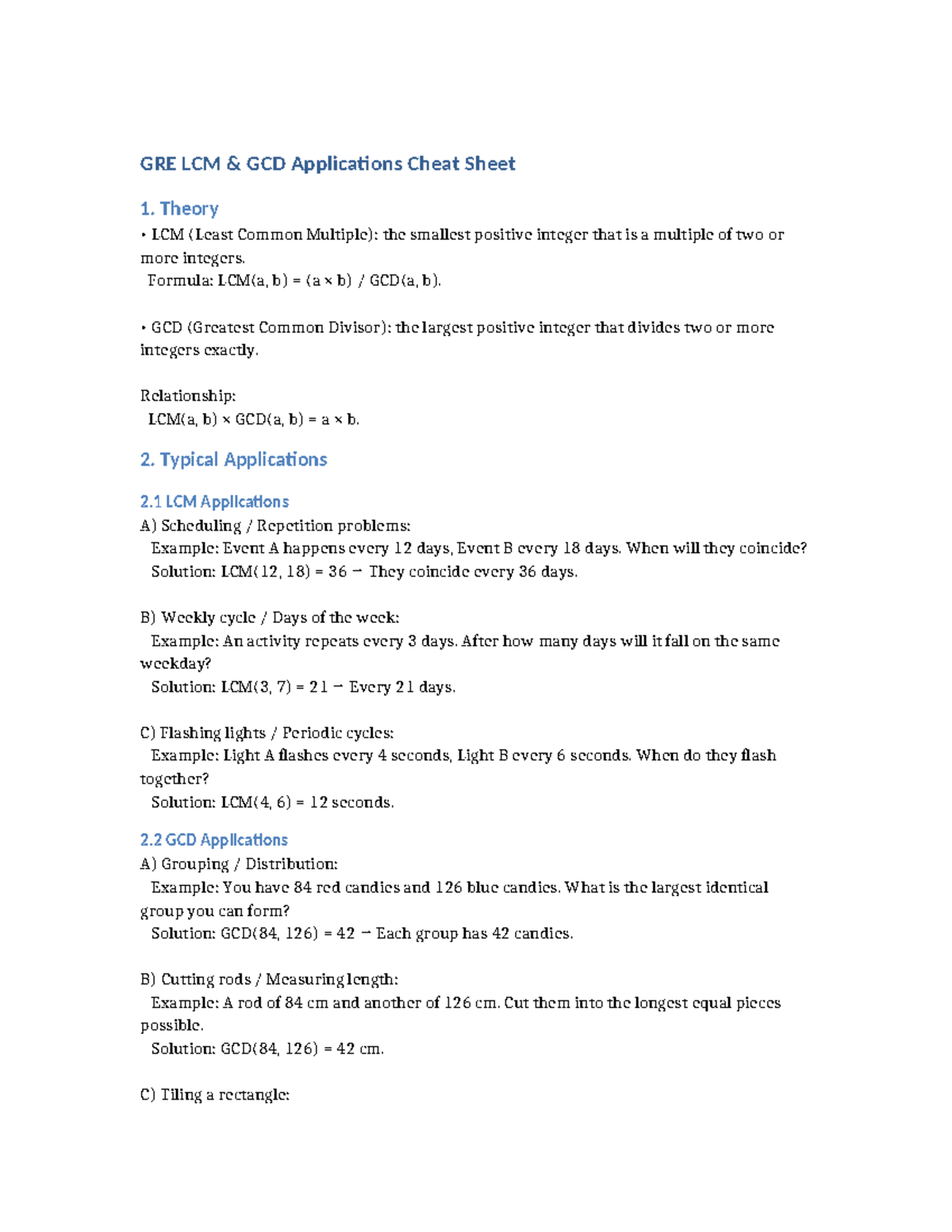
Problem Scenario: Traffic Light A changes every $45$ seconds, while Traffic Light B changes every $60$ seconds. If both change simultaneously at 12:00 PM, when will they next change together?
- Calculate $\text{lcm}(45, 60)$:
- $45 = 3^2 \times 5$
- $60 = 2^2 \times 3 \times 5$
- $\text{lcm}(45, 60) = 2^2 \times 3^2 \times 5 = 4 \times 9 \times 5 = 180 \text{ seconds}$
- Result: They will synchronize again after $180$ seconds (3 minutes), at 12:03 PM.
3. Programmatic Implementation
In modern software development, calculating GCD and LCM must prevent arithmetic overflow. In languages with fixed-width integers (such as C++ or Java), multiplying $a \times b$ prior to division can exceed the maximum integer threshold.
To prevent overflow, divide before multiplying: $$\text{lcm}(a, b) = \left( \frac{a}{\gcd(a, b)} \right) \times b$$
Python 3 Example
Python's standard library standardizes GCD and LCM routines within the built-in Python math module:
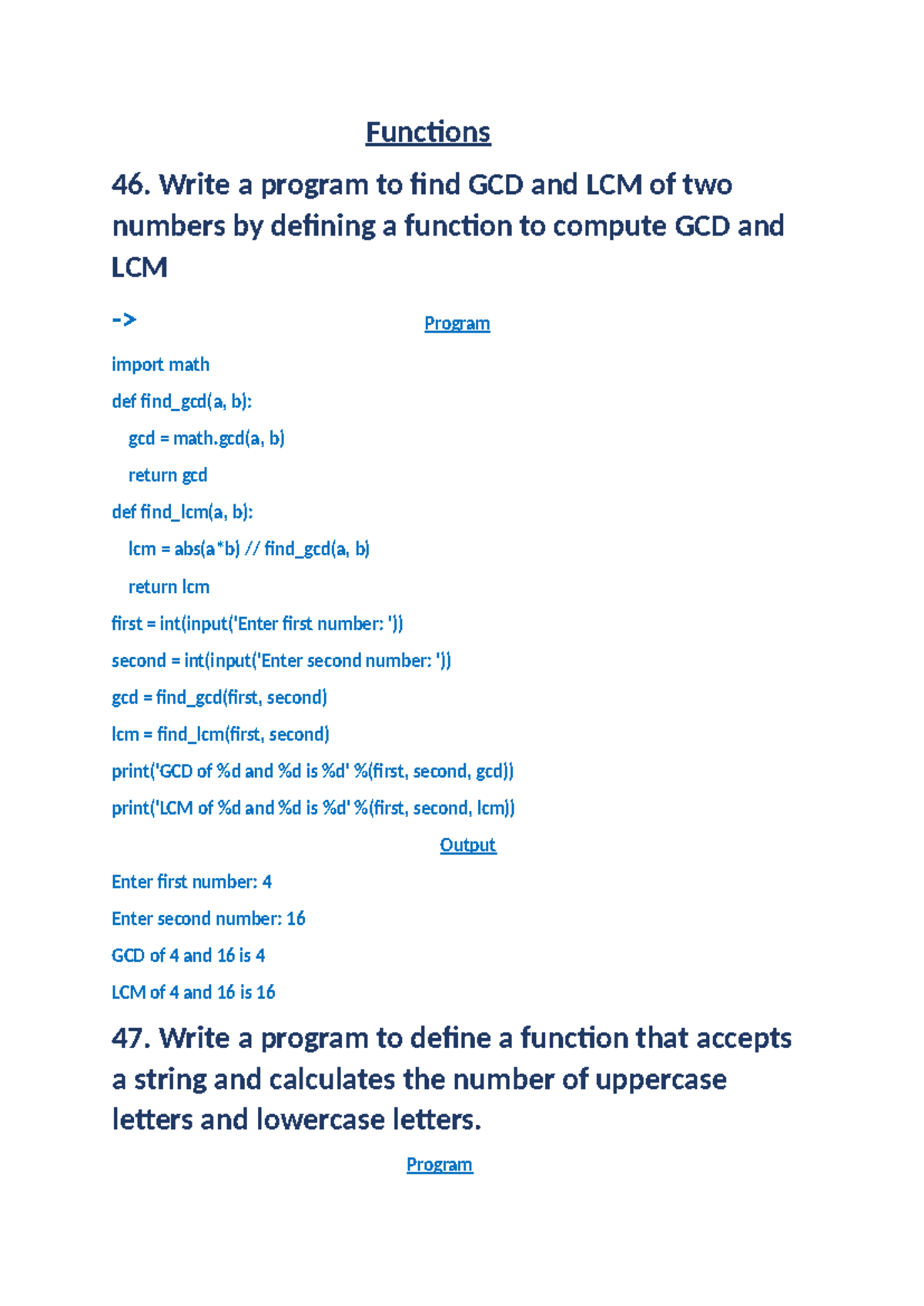
import math a = 252 b = 105 # Built-in math functions gcd_val = math.gcd(a, b) lcm_val = math.lcm(a, b) print(f"GCD of {a} and {b} is: {gcd_val}") # Output: 21 print(f"LCM of {a} and {b} is: {lcm_val}") # Output: 1260 # Manual Euclidean Algorithm implementation def custom_gcd(x: int, y: int) -> int: while y: x, y = y, x % y return abs(x) def custom_lcm(x: int, y: int) -> int: if x == 0 or y == 0: return 0 return abs(x // custom_gcd(x, y)) * abs(y)
Edge Cases and Potential Pitfalls
Negative Integers: By mathematical convention, GCD and LCM are evaluated over positive bounds. When dealing with negative inputs, take their absolute values: $$\gcd(-24, 36) = \gcd(24, 36) = 12$$
Handling Zero:
- $\gcd(a, 0) = |a|$ for any non-zero integer $a$, because every non-zero integer divides zero.
- $\gcd(0, 0)$ is mathematically undefined (or defined as $0$ in specific computing standards like POSIX/C99 for numerical convenience).
- $\text{lcm}(a, 0) = 0$ for any integer $a$, since $0$ is the only multiple shared with zero.
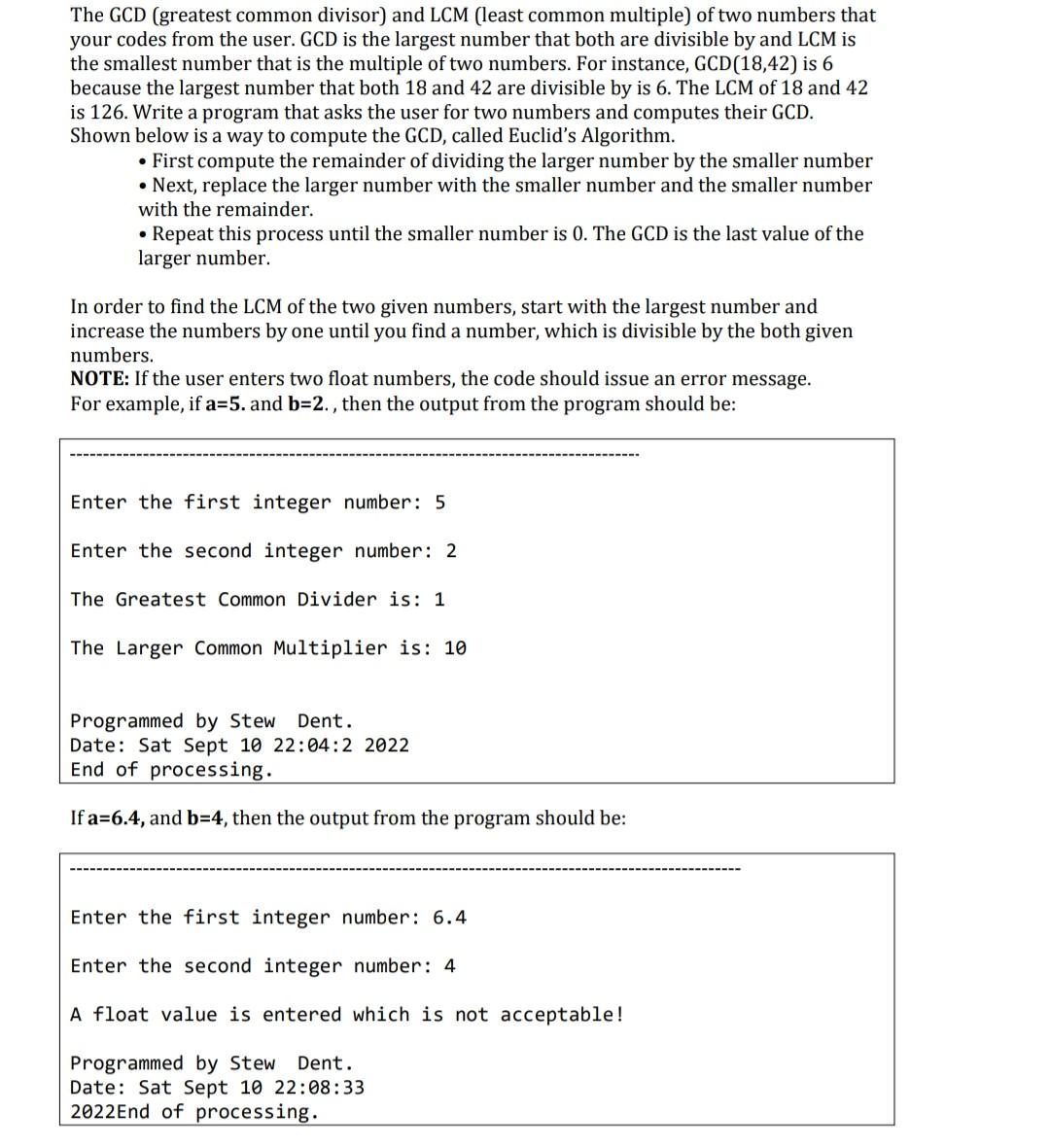
Floating-Point Arguments: GCD and LCM are inherently properties of discrete integer arithmetic. Attempting to compute GCD on standard floating-point numbers (such as $3.14$ or $2.718$) leads to precision issues. Convert fractional inputs to standard integers by clearing decimals through scaling prior to computation.
Frequently Asked Questions
What is the difference between HCF and GCD?
There is no operational difference. HCF (Highest Common Factor) and GCD (Greatest Common Divisor) refer to the exact same mathematical value. "HCF" is commonly taught in traditional British and Commonwealth curricula, whereas "GCD" is standard across computer science, higher mathematics, and American terminology.
Can the GCD of two numbers be larger than one of the numbers?
No. The GCD of two positive integers $a$ and $b$ can never exceed $\min(a, b)$. By definition, a factor cannot be larger than the integer it divides. The maximum possible value for $\gcd(a, b)$ occurs when one number is an exact multiple of the other, in which case the GCD equals the smaller number (e.g., $\gcd(6, 12) = 6$).
Can the LCM of two numbers be smaller than either number?
No. For positive integers $a$ and $b$, the LCM can never be smaller than $\max(a, b)$. Because the LCM must be a multiple of both values, it must be at least as large as the greater of the two inputs. The minimum possible value for $\text{lcm}(a, b)$ occurs when one number divides the other, in which case the LCM equals the larger number (e.g., $\text{lcm}(6, 12) = 12$).
How do you compute the GCD and LCM of three or more numbers?
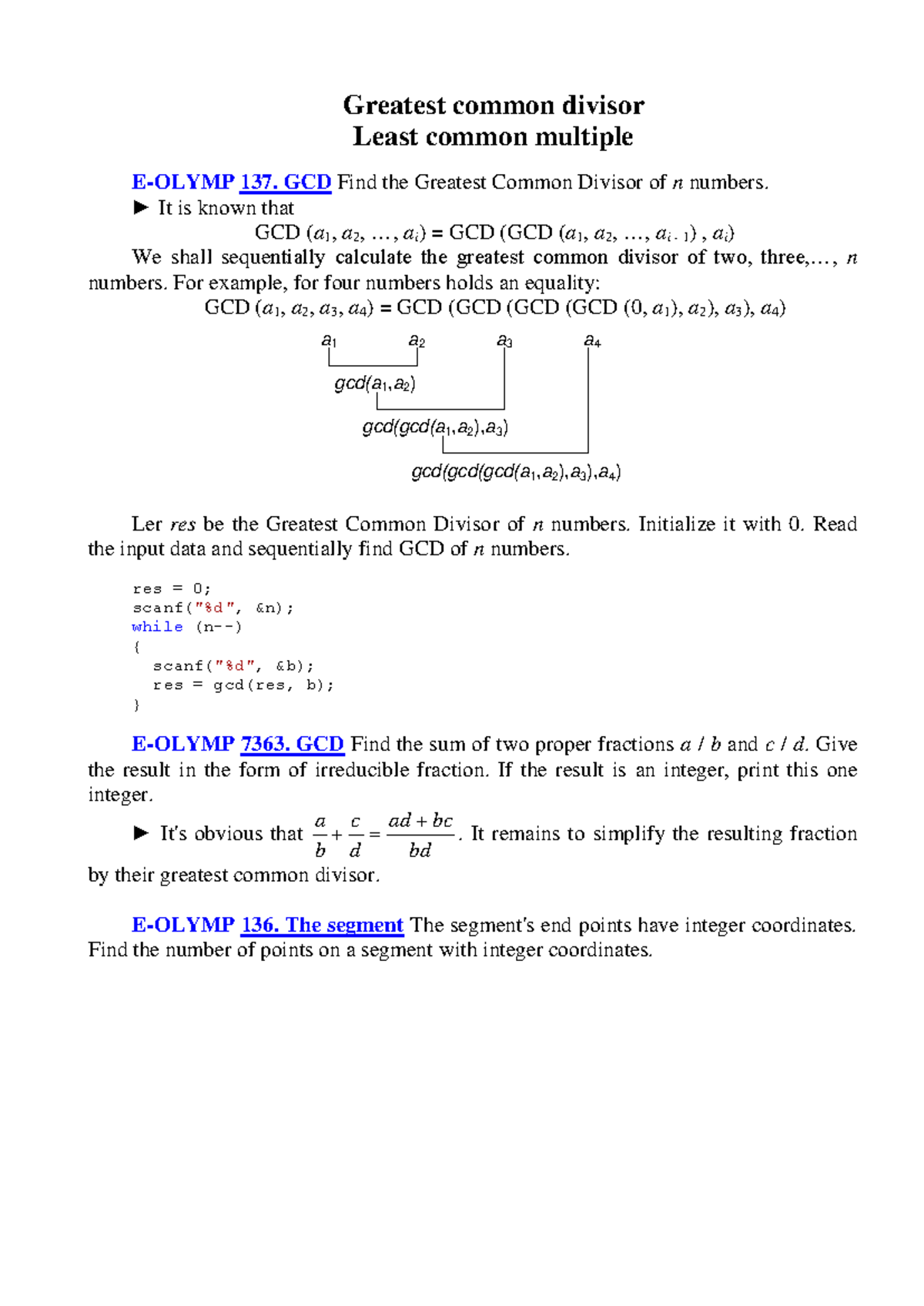
For multiple numbers, apply the properties iteratively:
- GCD: $\gcd(a, b, c) = \gcd(\gcd(a, b), c)$
- LCM: $\text{lcm}(a, b, c) = \text{lcm}(\text{lcm}(a, b), c)$
Alternatively, extract the prime factorizations for all inputs simultaneously and apply the lowest exponent rule (for GCD) or highest exponent rule (for LCM) across all factors.
Why does $\gcd(a, b) \times \text{lcm}(a, b) = a \times b$ fail for three numbers?
When working with three numbers ($a, b, c$), prime factors can be shared between just two of the numbers without being present in all three. Multiplying $a \times b \times c$ overcounts prime powers shared across pairs, causing the simple product relation to yield a value larger than $\gcd(a, b, c) \times \text{lcm}(a, b, c)$.
Summary and Next Steps
Mastering GCD and LCM requires selecting the right calculation approach for your goal:
- Use Prime Factorization when working with smaller numbers or analyzing integer factor composition theoretically.
- Use the Euclidean Algorithm when building algorithm workflows, handling large values, or writing production code.
- Use the identity $\text{lcm}(a, b) = \frac{|a \times b|}{\gcd(a, b)}$ to compute the LCM rapidly once you have calculated the GCD.
To deepen your understanding, practice implementing the Euclidean algorithm in your preferred programming language, or explore the Extended Euclidean Algorithm, which computes the linear coefficients $x$ and $y$ for Bézout's identity ($ax + by = \gcd(a, b)$).
Image Gallery