Which Receiver Is Better? How to Choose the Right Audio Receiver for Your Setup
Determining which receiver is better depends on your primary use case. For immersive home theater surround sound and modern video passthrough, an Audio/Video (AV) receiver is superior. For two-channel vinyl and high-resolution stereo m...
Determining which receiver is better depends on your primary use case. For immersive home theater surround sound and modern video passthrough, an Audio/Video (AV) receiver is superior. For two-channel vinyl and high-resolution stereo music, a dedicated stereo receiver provides cleaner amplification per dollar. Selecting the right model requires matching channel counts, power outputs, and connectivity features to your room and speakers.
Contents
Understanding the Core Distinction: AV Receivers vs. Stereo Receivers
Choosing the ideal audio receiver begins by understanding the fundamental engineering differences between an Audio/Video (AV) receiver and a traditional stereo receiver. While both units serve as the central hub for receiving audio signals, processing them, and amplifying them to drive passive loudspeakers, their internal architecture and operational priorities diverge significantly.
- Audio Source Signal
- Stereo Receiver
- 2.0 / 2.1 Channels
- Pure Audio Signal Path
- High Current / Ch
- Phono & Analog Focus
- Dedicated Hi-Fi / Music Listening
- AV Receiver
- 5.1 to 15.4+ Channels
- Dolby Atmos / DTS:X
- HDMI 2.1 Switching
- DSP Room Correction
- Spatial Home Theater & High-Frame Gaming
- Stereo Receiver
Stereo Receivers (2.0 or 2.1 Channels)
A stereo receiver is designed purely for two-channel audio reproduction. It incorporates a two-channel preamplifier, an AM/FM tuner (or network streaming module), and a two-channel power amplifier built into a single chassis.
Because stereo receivers do not need to house complex video-switching circuit boards, multi-channel Digital Signal Processors (DSP), or spatial audio decoders, manufacturers allocate build budgets toward higher-quality power transformers, larger capacitors, and discrete analog output stages.
- Primary Application: Critical music listening, vinyl playback, compact media stations, and high-fidelity 2.0 or 2.1 (with a dedicated subwoofer output) listening rooms.
- Key Advantage: Higher output power per channel, lower total harmonic distortion (THD), and simpler signal pathways at a given price point.
AV Receivers (Multichannel Audio and Video Hubs)
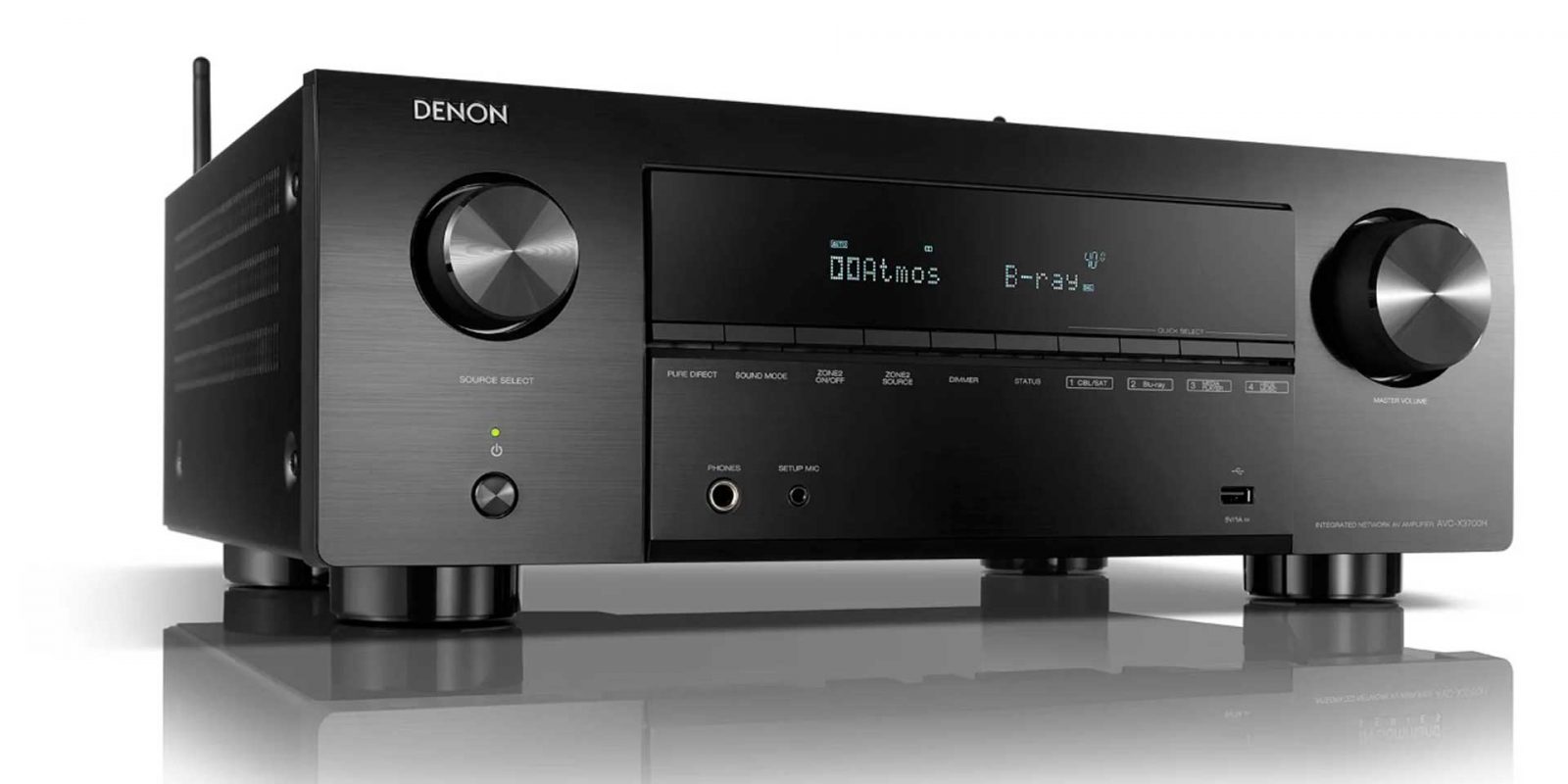
An AV receiver (AVR) functions as both a video switcher and a spatial audio processor. Modern AV receivers house anywhere from 5 to 15 internal channels of amplification, alongside advanced DSP chips capable of decoding object-based audio formats like Dolby Atmos and DTS:X.
AV receivers contain extensive HDMI routing sections that handle high-bandwidth video standards, dynamic High Dynamic Range (HDR) formats, and video scaling. They also feature active room-calibration hardware and software to harmonize output across multiple speakers in acoustically challenging spaces.
- Primary Application: Multichannel home theaters, media rooms, and modern gaming setups using consoles or gaming PCs.
- Key Advantage: Comprehensive video management, multi-speaker spatial rendering, active room correction, and sub-bass management for multiple subwoofers.
Technical Specifications: What Makes One Receiver Better Than Another?
Comparing receivers requires looking beyond marketing claims like "peak power" and evaluating verified technical specifications. Understanding these metrics helps ensure selected components drive your specific speakers effectively without clipping or distortion.
Power Output, Impedance, and Distortion
Amplifier power is commonly misrepresented on spec sheets. A rating of "100 Watts per Channel" may only apply when driving two channels into an 8-ohm load at 1 kHz with high allowable distortion.
When evaluating amplifier capability, look for continuous power ratings measured under strict parameters:
- Bandwidth: Look for power measurements taken across the full human hearing spectrum (20 Hz to 20,000 Hz), rather than a single 1 kHz tone.
- Load Impedance: Ensure the receiver is rated to handle your speaker system's nominal impedance. Speakers rated at 4 ohms require significantly higher current delivery than 8-ohm speakers. Operating a 4-ohm speaker on an unstable 8-ohm-only amplifier leads to thermal throttling or clipping.
- Total Harmonic Distortion (THD): High-fidelity amplifiers generally maintain THD levels below 0.08% across the audible frequency band at rated power.
- Channels Driven: Confirm whether the rated wattage applies with all channels driven simultaneously or only two channels driven. A 7-channel receiver rated at 100 WPC (2 channels driven) may deliver only 50–60 WPC continuous when driving all seven speakers at once.
Channel Configurations and Spatial Audio Processing
If your goal is an immersive cinema experience, the channel layout capability determines the receiver's ceiling for performance:
- 5.1 Channels: The traditional base layout, including Front Left, Center, Front Right, two Surround channels, and one Low-Frequency Effects (LFE) subwoofer channel.
- 7.1 Channels: Adds two Rear Surround speakers, improving back-of-room sound tracking.
- 5.1.2 to 9.4.6 Channels: Incorporates height/ceiling channels for object-based sound. The first trailing digit represents main ear-level channels, the middle digit represents subwoofers, and the final digit indicates height channels.
For immersive audio, modern AV receivers must support Dolby Laboratories Dolby Atmos and DTS:X decoding. Advanced processors also offer Auro-3D and IMAX Enhanced modes to upscale standard soundtracks.
- Spatial Audio Channel Layout:
- Front Speakers:
- Front Left
- Center
- Front Right
- Surround & Rear Speakers:
- Surround Left
- Surround Right
- Rear Left
- Rear Right
- Height Speakers (Ceiling):
- Height Left Front
- Height Right Front
- Height Left Rear
- Height Right Rear
- Listening Position:
- Listener
- Front Speakers:
HDMI Connectivity and Video Standards
For video-centric systems, HDMI capabilities dictate long-term usability. The current gold standard is HDMI 2.1a, certified for 48 Gbps bandwidth. This bandwidth is essential for carrying uncompressed 4K resolution at 120Hz or 8K at 60Hz.
Essential HDMI features to verify include:
- eARC (Enhanced Audio Return Channel): Transmits full-resolution, uncompressed audio formats (like Dolby TrueHD and DTS-HD Master Audio) directly from a smart TV app or connected TV source back to the receiver via a single HDMI cable.
- HDCP 2.3 Protection: The copy-protection protocol required for pass-through of 4K and 8K commercial media content.
- Gaming Features: Variable Refresh Rate (VRR), Auto Low Latency Mode (ALLM), and Quick Frame Transport (QFT) eliminate screen tearing and input lag when connected to modern gaming systems. Official specifications and compliance standards are maintained by the HDMI Licensing Administrator.
Acoustic Room Correction Technologies
A room's shape, flooring, and furniture heavily affect sound quality. Modern receivers use integrated measurement microphones and digital algorithms to compensate for boundary reflections, phase alignment issues, and standing waves.
| Room Correction Suite | Primary Receiver Brands | Key Strengths & Capabilities |
|---|---|---|
| Dirac Live | Onkyo, Integra, Pioneer, Denon, Marantz, Arcam | Advanced impulse response correction, phase alignment, highly customizable target curves. |
| Audyssey MultEQ XT32 | Denon, Marantz | High-resolution FIR filter calculation, dual-subwoofer calibration (Sub EQ HT), excellent low-end correction. |
| YPAO (R.S.C.) | Yamaha | Reflected Sound Control, early reflection calculation, fast automatic setup procedure. |
| Sony 360 Spatial Sound | Sony | Precise speaker position mapping, virtual channel synthesis for non-ideal room placement. |
Receiver Brand Ecosystems and Sound Profiles
While objective measurements define raw performance, major manufacturers tune their preamplifier output stages and component selections to yield distinct operational strengths.
- Receiver Brand Ecosystems
- Masimo Consumer (Denon / Marantz)
- Denon: Neutral / Value
- Marantz: Warm, HDAM analog stages
- Yamaha (AVENTAGE / RX-V)
- High-speed slew rates, natural sound, custom DSP modes
- Harman / Audio Control (Arcam / JBL Synthesis)
- Class G amplification, studio-grade DACs, reference performance
- Masimo Consumer (Denon / Marantz)
Denon and Marantz (Masimo Consumer)
Sharing a parent development platform, Denon and Marantz models offer shared features such as HEOS wireless streaming, Audyssey room correction, and optional Dirac Live upgrades on mid-to-high-tier units.
- Denon: Focuses on neutral, transparent sound reproduction and aggressive price-to-performance ratios. Denon receivers are widely praised for high feature density and dynamic punch in home cinema applications.
- Marantz: Differentiates itself by utilizing proprietary HDAM (Hyper Dynamic Amplifier Modules) in the analog preamp stage. This results in a warmer, smoother sound profile often favored by listeners who split time evenly between movies and two-channel music.
Yamaha
Yamaha divides its lineup into the entry-level RX-V series and the premium AVENTAGE (RX-A) series.
- Key Strengths: Known for operational reliability, heavy-duty transformers, and high-speed slew-rate amplifiers.
- Sonic Profile: Clean, detailed, and uncolored. Yamaha uses proprietary DSP soundfield modes designed to replicate real-world performance spaces, such as concert halls and theaters.
Onkyo, Integra, and Pioneer (Premium Audio Company)
These legacy brands share platform architectures managed under Premium Audio Company.
- Key Strengths: Leading the market in built-in value by offering fully licensed Dirac Live room correction out of the box on mid-tier AV receivers.
- Sonic Profile: Dynamic, forward, and cinema-focused with strong transient response for sound effects and action movie mixes.
Arcam, Anthem, and JBL Synthesis
These boutique brands target high-end home installations and enthusiast reference setups.
- Key Strengths: Focus on high-current power supplies, reference-grade Digital-to-Analog Converters (DACs), advanced internal shielding, and custom room correction platforms (such as Anthem Room Correction - ARC).
- Sonic Profile: Extremely clean, low-distortion amplification (often utilizing Class G or high-power Class AB designs) capable of effortlessly driving complex, low-impedance loudspeaker loads.
Head-to-Head Comparison: Stereo vs. Mid-Tier AV vs. Reference AV Receivers
Selecting the correct component requires weighing hardware capabilities against system demands. The following breakdown illustrates typical specifications across three major receiver categories:
| Feature / Metric | Dedicated Stereo Receiver | Mid-Tier AV Receiver (7.2 - 9.2 Ch) | Reference AV Receiver (11.2 - 15.4 Ch) |
|---|---|---|---|
| Primary Focus | Two-channel Hi-Fi music | Multichannel home cinema & gaming | Dedicated home theater rooms |
| Typical Power Output | 80W – 150W (2 ch driven, 8 ohms) | 80W – 125W (2 ch driven, 8 ohms) | 140W – 200W (2 ch driven, 8 ohms) |
| Amplifier Class | Class AB or Class D | Class AB | Class AB or Class G |
| Video Pass-Through | None or Basic HDMI ARC | Full 8K/60Hz, 4K/120Hz HDMI 2.1a | Multi-zone HDMI 2.1a, Independent Matrix |
| Spatial Audio Support | No (Stereo Downmix) | Dolby Atmos, DTS:X | Dolby Atmos, DTS:X Pro, Auro-3D, IMAX |
| Room Correction | Manual / Basic EQ | Audyssey MultEQ XT32 / YPAO R.S.C. | Dirac Live Full-Band + Bass Control |
| Multi-Subwoofer Control | Single Mono LFE Output | Dual Independent Sub Outputs | 4 Independent Sub Outputs with Spatial EQ |
| Preamplifier Outputs | Stereo Pre-Out / Main In | 7.2 to 9.2 Channel Pre-Outs | 11.2 to 17.2 Full Pre-Out Matrix |
| Internal Construction | Toroidal Transformer, Shielded Hi-Fi | Standard EI Transformer, Packed Chassis | Monolithic Amp Construction, Toroidal Core |
Scenario-Based Decision Guide: Which Receiver Should You Buy?
To resolve which receiver is best for your specific application, evaluate your primary listening habits, speaker hardware, and room geometry against the following common scenarios.
- What is your main focus?
- Movies / Gaming
- Choose AV Receiver with HDMI 2.1, eARC, & 7.1+ channels.
- Stereo Music
- Choose Integrated Stereo Amp with Phono & DAC inputs.
- Hybrid Space
- Choose Mid-Tier AVR with Pre-Outs or Zone 2 functionality.
- Movies / Gaming
Scenario A: Modern Home Theater & High-Frame-Rate Gaming
- Primary Goal: Surround sound for movies and high-performance gaming on current-generation consoles or PCs.
- The Better Choice: AV Receiver with HDMI 2.1 Support.
- Recommended Requirements: At least 7.2 channels to support a standard 5.1.2 Dolby Atmos layout. Ensure all HDMI ports support 40Gbps or 48Gbps pass-through with VRR and ALLM enabled. Look for integrated Dirac Live or Audyssey MultEQ XT32 to balance room reflection issues.
Scenario B: Pure Audiophile Vinyl and High-Res Streaming
- Primary Goal: Accurate two-channel music playback from turntables, CD players, or high-resolution network streamers.
- The Better Choice: Integrated Stereo Receiver / Amplifier.
- Recommended Requirements: High continuous power output with low total harmonic distortion (THD < 0.03%), a dedicated low-noise Moving Magnet (MM) or Moving Coil (MC) Phono stage, high-current power supplies capable of handling 4-ohm dips, and dedicated digital optical/coaxial inputs connected to an internal ESS Sabre or AKM DAC chip.
Scenario C: Multi-Room Living Space with Mixed Media Needs
- Primary Goal: Everyday TV audio, sports broadcasts, background streaming music, and audio distribution across secondary zones (e.g., patio, kitchen).
- The Better Choice: Network-Enabled AV Receiver with Multi-Zone Control.
- Recommended Requirements: A receiver featuring built-in multi-room wireless ecosystems like Denon HEOS, Yamaha MusicCast, or Apple AirPlay 2. Look for Zone 2 or Zone 3 powered speaker outputs that allow playing independent audio sources in secondary rooms while driving the primary TV setup.
Common Pitfalls to Avoid When Buying a Receiver
- Over-relying on Nominal Wattage Figures: Do not compare a receiver rated at "140W at 1kHz, 1 Channel Driven, 10% THD" against one rated at "100W at 20Hz–20kHz, 2 Channels Driven, 0.05% THD." The 100W unit provides significantly cleaner, more stable real-world power.
- Mismatches in Speaker Impedance and Sensitivity: Pairing low-sensitivity speakers (e.g., 84 dB @ 2.83V/1m) that drop down to 3.2 ohms with an entry-level receiver leads to overheating and clipping. Verify the amplifier section is stable down to 4 ohms if your speakers demand high current.
- Ignoring Thermal and Airflow Clearance: Modern AV receivers generate substantial heat, especially when driving multichannel speaker systems for extended periods. Placing a high-performance receiver in a tightly sealed cabinet without forced-air ventilation leads to thermal shutdown and shortened component lifespans. Allow at least 3 to 5 inches of clear space above the unit for natural convection cooling.
- Neglecting Independent Subwoofer Processing: If you plan to use two or more subwoofers to eliminate bass dips in your seating area, ensure the receiver features independent sub-outputs rather than an internal parallel Y-splitter. True independent outputs allow the receiver's room correction system to set delay, phase, and gain separately for each subwoofer.
Frequently Asked Questions
Is a 7.2 channel receiver better than a 5.1 channel receiver?
A 7.2 channel receiver is generally better because it offers greater setup flexibility and processing capability. In addition to driving a traditional 7.1 or 7.2 setup with rear surround speakers, a 7.2 receiver can be configured as a 5.2.2 system to support Dolby Atmos height channels. It also typically includes higher-grade processing components and better power supplies than entry-level 5.1 models.
Can I use an AV receiver strictly for stereo music listening?
Yes. Modern AV receivers feature a dedicated Pure Direct or Direct listening mode. Activating this mode bypasses internal video processing and DSP circuitry, sending analog or digital audio signals straight to the amplifier stage to minimize interference. However, a similarly priced dedicated stereo receiver often provides higher-quality power supplies and discrete output stages for pure music listening.
What is the difference between Class AB and Class D amplification in receivers?
Class AB amplification combines the low-distortion benefits of Class A designs with the higher efficiency of Class B. It is traditional, dynamic, and reliable, though it generates more heat and requires larger physical transformers. Class D amplification uses high-speed switching circuits, making it extremely power-efficient, cooler-running, and lightweight. High-end Class D implementations offer exceptional clarity and dynamic range in compact chassis designs.
Is Dirac Live room correction better than Audyssey or YPAO?
Dirac Live is widely considered superior by audio enthusiasts due to its ability to correct both frequency response and time-domain impulse response. This results in tighter impulse alignment, cleaner transient sound effects, and improved soundstage imaging. However, Audyssey MultEQ XT32 and Yamaha's YPAO R.S.C. remain highly effective, often proving easier to set up for non-technical users while requiring less manual target-curve tuning.
Do I need separate preamplifiers and power amplifiers instead of a receiver?
Separate components (a standalone AV processor paired with dedicated multi-channel power amplifiers) offer higher current delivery, lower noise floors, and modular upgrade paths. However, separates are considerably more expensive and require more rack space and cabling. An integrated receiver remains the best high-value solution for most home theaters, while separates are best reserved for dedicated reference rooms and demanding low-impedance loudspeaker systems.
Final Recommendation: Decision Matrix
To finalize your decision, follow this step-by-step checklist:
- Define Your Primary Media Content:
- If >60% Movies/Gaming: Focus on an AV Receiver with HDMI 2.1, eARC, and Dolby Atmos support.
- If >60% Two-Channel Music: Focus on an Integrated Stereo Receiver with dedicated analog phono stages and high-current power reserves.
- Audit Your Loudspeaker System:
- Check nominal impedance (ohms) and sensitivity ratings (dB). Ensure the receiver's amplifier stage is certified for 4-ohm stability if your speakers demand high current.
- Evaluate Video Requirements:
- For 4K/120Hz or 8K/60Hz gaming, ensure the receiver's HDMI board supports 48 Gbps passthrough on the specific input ports you plan to use.
- Select Room Calibration Needs:
- For rooms with difficult acoustics (hardwood floors, asymmetric walls, glass windows), prioritize receivers that offer Dirac Live or Audyssey MultEQ XT32 to correct phase alignment and standing waves.
Image Gallery