Yu Zidi Swimming Performance and Technique: A Comprehensive Analysis
Yu Zidi is a breakout Chinese swimmer who achieved national prominence as a pre-teen by competing in elite senior finals across individual medley and butterfly events. Her swimming performance is characterized by extraordinary stroke e...
Yu Zidi is a breakout Chinese swimmer who achieved national prominence as a pre-teen by competing in elite senior finals across individual medley and butterfly events. Her swimming performance is characterized by extraordinary stroke efficiency, high hip alignment, exceptional early vertical forearm catches, and seamless multi-stroke transition technique, making her a compelling study in modern hydrodynamic biomechanics.
Contents
Background and Rise in Elite Competitive Swimming
Yu Zidi emerged from China's competitive swimming pipeline to capture international attention during the 2024 Chinese National Swimming Championships. Competing at just eleven years old against established Olympic medalists such as Ye Shiwen and Yu Yiting, Yu achieved top-tier finishes in demanding events, including the 200-meter individual medley (IM), 400-meter IM, and 200-meter butterfly.
Her ability to maintain competitive splits against adult world-class athletes highlighted a rare combination of physical efficiency, aerobic conditioning, and tactical pacing. In major national finals, Yu consistently demonstrated that technical precision and hydrodynamic streamlining can narrow the gap created by physical strength and leverage differences between youth and adult competitors.
Her competitive profile centers on multi-stroke versatility. Unlike specialists who focus narrowly on single sprint distances, Yu’s core events require mastery over both short-axis strokes (butterfly and breaststroke) and long-axis strokes (backstroke and freestyle). Understanding her performance requires looking at both her race execution statistics and the specific biomechanical adaptations that allow her to generate high propulsion while minimizing resistive drag.
Core Stroke Mechanics and Technical Breakdown
Analyzing Yu Zidi’s stroke mechanics reveals a textbook application of modern biomechanics tailored for high-efficiency, multi-event racing. Her technical execution minimizes active drag, allowing her to preserve kinetic energy across long IM and butterfly distances.
- Hydrodynamic Body Alignment: High Hip & Spine Positioning
- Short-Axis Mechanics (Fly / Breast)
- Undulating core rhythm
- Low head position during breath
- Rapid hip snap & dynamic kick recovery
- Long-Axis Mechanics (Back / Free)
- High-elbow Early Vertical Forearm (EVF)
- Stable head rotation axis
- Continuous 6-beat kick stabilization
- Short-Axis Mechanics (Fly / Breast)
Butterfly Technique: Rhythm and Hydrodynamic Recovery
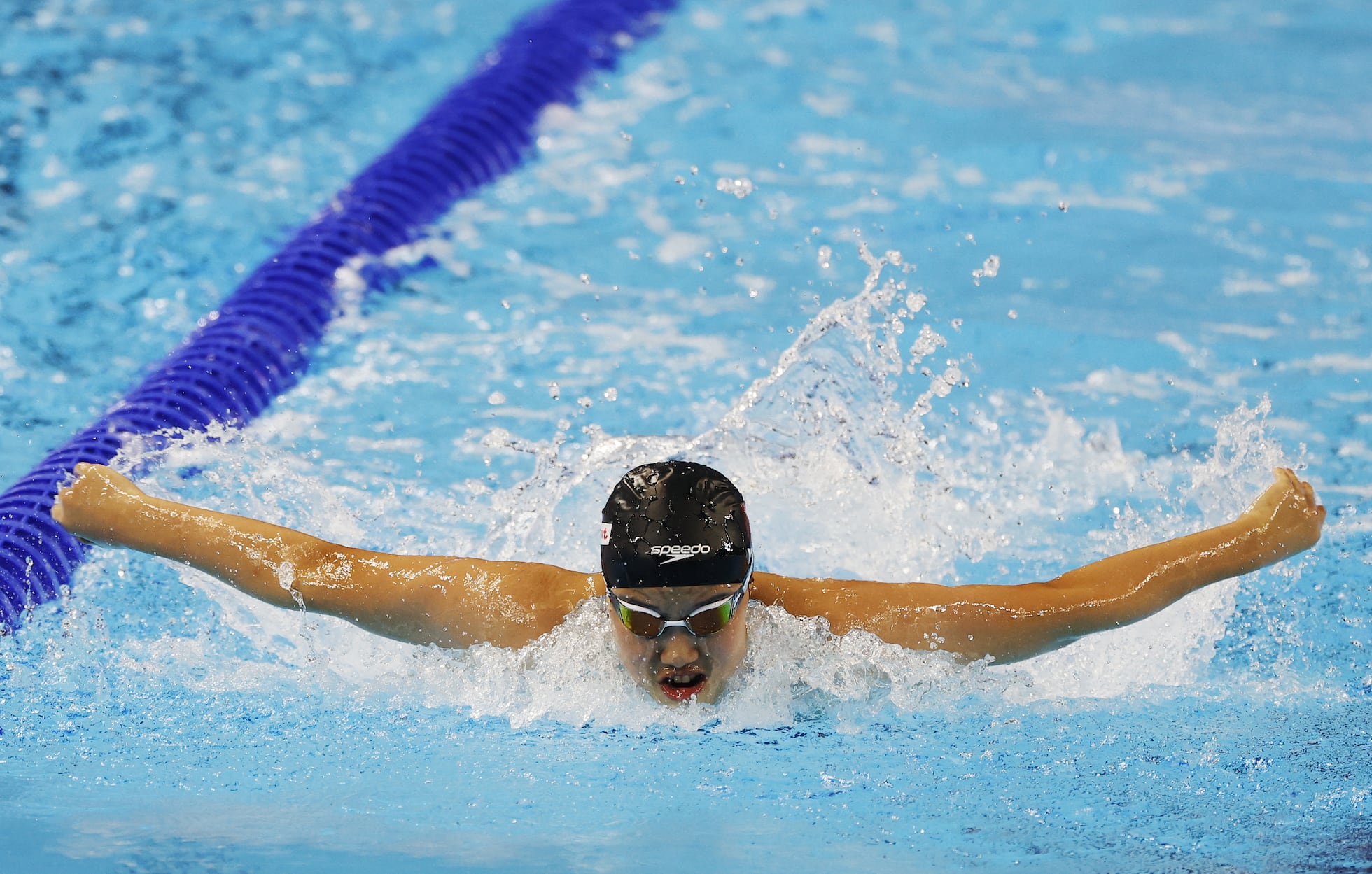
Yu Zidi’s butterfly stroke is distinguished by a flat body position that avoids excessive vertical oscillation. Many young swimmers drive their hips too deep, creating high frontal drag during the chest press and arm recovery. Yu keeps her shoulder-to-hip axis close to the surface, utilizing a refined thoracic undulation rather than an exaggerated lumbar flex.
- Catch Phase: She engages an Early Vertical Forearm (EVF) catch early in the entry phase, anchoring her forearms in the water to press backward rather than pushing downward.
- Head Position: During breathing cycles, her head stays low, lifting just enough for chin-level clearance above the surface. This maintains neutral spine alignment and prevents her hips from dropping.
- Kick Integration: Her second kick—executed during the hand exit—is sharp and compact, driving her body forward into a sleek horizontal glide during arm recovery.
Backstroke to Breaststroke Transition
In the individual medley, the transition from backstroke to breaststroke represents one of the most critical technical segments. Yu executes highly precise open turns and crossover turns, maintaining velocity into the wall and maximizing distance off the push-off.
Her backstroke pull path features a steady 90-degree elbow bend at the mid-stroke point, providing consistent propulsion through the pull-push phases. Upon approaching the turn wall, her stroke count awareness prevents gliding or short-stroking, ensuring peak momentum entering the rotation.
Breaststroke Efficiency in Medley Contexts
Breaststroke is often a vulnerable leg for IM swimmers who transition from long-axis strokes. Yu counters this by employing a modern narrow-knee kick profile. Rather than flaring her knees wide—which dramatically increases pressure drag—she pulls her heels toward her glutes while keeping her knees relatively close together, sweeping her feet outward and backward in a tight, propulsion-heavy wedge.
Her pull-out phase features a deep streamline, a patient delay before initiating the single butterfly kick, and a powerful underwater pull that elevates her body into a clean breakout.
Freestyle Anchor Mechanics
The final leg of her medley events showcases a high-cadence, steady freestyle technique. Yu relies on a neutral head posture, looking straight down at the pool bottom with minimal lateral movement during breathing. Her kick rate stays anchored to a consistent six-beat rhythm, stabilizing her torso against the torque generated by her arms.
Key Performance Indicators and Race Strategy
Yu Zidi’s performance relies on tactical discipline and mechanical consistency under pressure. Her pacing strategy is structured around stroke-rate preservation and wall efficiency.
Pacing Strategy in the 400m Individual Medley
The 400m IM is widely considered one of swimming's most taxing events. Yu approaches this race through calculated energy distribution:
- Butterfly Leg (First 100m): Operates at roughly 85–90% effort, prioritizing stroke length and rhythm over raw velocity to prevent early lactic acid accumulation.
- Backstroke Leg (Second 100m): Focuses on distance per stroke (DPS), utilizing core rotation to maintain speed while stabilizing breathing.
- Breaststroke Leg (Third 100m): Increases leg tempo, utilizing sharp hip extensions to make up ground or build a lead over less proficient breaststrokers.
- Freestyle Leg (Final 100m): Shifts to maximum kick cadence, leveraging aerobic capacity to maintain split times through the final 50 meters.
Turn Metrics and Streamline Execution
A significant portion of any short-course or long-course race is determined under the surface. Yu consistently achieves high efficiency out of turns by emphasizing three factors:
- Tight Streamline Alignment: Overlapping hands, squeezed elbows behind the ears, and locked core engagement reduce passive drag during the initial push-off.
- Underwater Dolphin Kicking: She maintains 4 to 6 powerful underwater dolphin kicks off every wall in backstroke, butterfly, and freestyle before initiating her breakout stroke.
- Breakout Timing: Her first arm pull begins precisely as her underwater momentum drops to match surface swimming velocity, avoiding the common mistake of breaking out too early or stalling underwater.
Comparative Overview of Yu Zidi's Event Profiles
The following table summarizes the key technical demands, performance characteristics, and strategic approaches Yu Zidi applies across her primary competitive events.
| Event | Primary Technical Focus | Key Biomechanical Feature | Strategic Approach | Performance Strength |
|---|---|---|---|---|
| 200m Individual Medley | Fast stroke transition & high tempo | Dynamic crossover turns & rapid breaststroke kick snap | Balanced pacing with aggressive breast-to-free acceleration | Minimizes transition speed loss between distinct stroke disciplines |
| 400m Individual Medley | Aerobic efficiency & energy preservation | Low-drag thoracic undulation & steady 6-beat freestyle kick | Controlled early legs (Fly/Back) with high-cadence closing split | Exceptional cardiovascular endurance and DPS maintenance under fatigue |
| 200m Butterfly | Sustainable rhythm & flat body alignment | Early Vertical Forearm (EVF) with minimal head lift on breath | Negative-splitting or even-pacing 50m intervals | Prevents hip drop and stroke break-down over the final 50 meters |
| 200m Freestyle | Continuous propulsive force & tight body rotational control | High-elbow catch with minimal head rotation during breath cycles | Steady build strategy, increasing kick cadence on second 100m | Superior hydrodynamic positioning resulting in lower active drag |
Developmental Trajectory and Biomechanical Considerations
Swimmers who excel at a young age face distinct physical and technical transition periods as they grow. Yu Zidi's technique provides a solid foundation for long-term athletic development because her speed is built on hydrodynamic efficiency rather than early muscular dominance.
Adapting to Physical Growth
As young athletes grow, their center of mass, limb lengths, and surface area change. Swimmers who rely solely on high stroke rates without proper mechanics often experience performance plateaus when their body proportions alter. Yu’s emphasis on:
- Distance Per Stroke (DPS): Capturing water early with the forearm ensures that as her physical strength increases, her propulsive output scales proportionally.
- Core Stability: Maintaining strong transverse abdominis and lumbar engagement protects against technique breakdown when muscle fatigue occurs.
- Joint Mobility: Flexible shoulder girdles and ankle plantarflexion allow for clean kick mechanics and low-resistance stroke recoveries.
Technical Adjustments for Senior Elite Competition
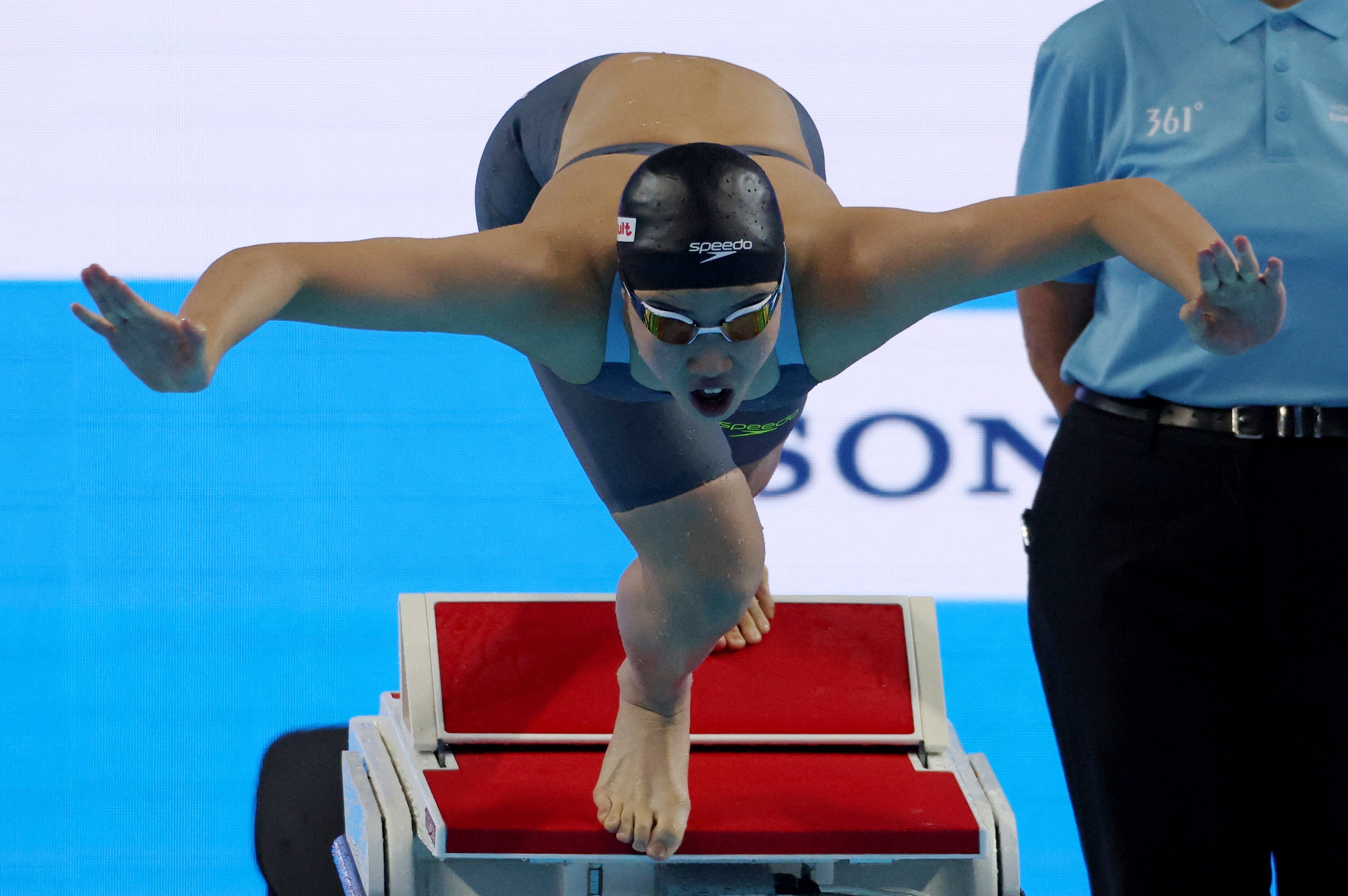
To remain competitive at world-championship and Olympic levels as she matures, ongoing technical refinements focus on explosive start reaction times, maximizing wall push-off force, and fine-tuning stroke tempo adjustments under high-stress race conditions.
Practical Lessons for Competitive Swimmers and Coaches
Yu Zidi’s technical execution offers valuable insights for swimmers looking to improve their medley and mid-distance performance.
1. Prioritize Hydrodynamic Streamlining Over Raw Power
Focus on keeping the body parallel to the surface. Lowering the head, pressing the chest slightly downward in freestyle and butterfly, and keeping the hips high reduces frontal drag far more effectively than pulling harder against high water resistance.
2. Master the Early Vertical Forearm (EVF)
Rather than pulling down with a straight arm, flex the elbow early in the catch phase to turn the forearm into a paddle. This anchors the arm in the water and pushes fluid backward rather than downward.
3. Drill Multi-Stroke Transitions
Practice turn transitions under race-pace conditions. Work specifically on crossover turns from backstroke to breaststroke and ensure underwater streamlining is maintained off every single wall.
4. Build a Sustainable Pacing Structure
In long medley and butterfly events, avoid sprinting the first quarter of the race. Establish a sustainable rhythm through stroke length, saving energy for kick acceleration in the second half of the race.
Frequently Asked Questions
What are Yu Zidi's primary competitive events?
Yu Zidi specializes in individual medley events (the 200m IM and 400m IM) and mid-distance butterfly (specifically the 200m butterfly), while also competing in mid-distance freestyle events such as the 200m freestyle.
How does Yu Zidi maintain high performance against older swimmers?
Her competitive edge comes from mechanical efficiency and low active drag. By maintaining high hip positioning, executing precise early vertical forearm catches, and minimizing resistance through clean streamlines and transitions, she generates higher speed per unit of energy expended compared to less technically refined competitors.
What is unique about Yu Zidi's butterfly stroke technique?
Yu’s butterfly technique features a low head breath, compact undulation, and high hip alignment. She avoids deep vertical dipping, allowing her to drive forward continuously with minimal stroke decay over longer distances.
Why are transition turns critical in Yu Zidi's IM performance?
Transitions between backstroke, breaststroke, and freestyle can easily cost tenths of a second if executed poorly. Yu uses refined crossover turns and tight streamline positions off the walls, enabling her to maintain forward velocity and preserve momentum through stroke changes.
How can young swimmers emulate Yu Zidi's technical style?
Young swimmers should focus on core alignment, head position control, ankle flexibility, and stroke length rather than simply increasing their arm turnover speed. Developing a strong kick rhythm and high-elbow catch early in training creates a strong foundation for long-term athletic progress.
Strategic Recommendations for Swimmers and Programs
To apply the technical lessons from Yu Zidi's swimming style to training programs, coaches and athletes should implement a structured approach:
- Integrate Video Analysis: Regularly film swimmers from underwater angles to evaluate head alignment, EVF catch entry, and hip height during stroke transitions.
- Incorporate Specific Transition Drills: Allocate dedicated set volume to practicing IM transition turns (Back-to-Breast crossover turns and Fly-to-Back open turns) under elevated heart-rate conditions.
- Emphasize Kick-to-Stroke Coordination: Use kickboard and streamlined kicking sets to build core stability, ensuring that leg drive directly supports upper-body stroke rhythm without disrupting horizontal alignment.
Image Gallery