How Spotify Charts Album Rankings Are Determined
Spotify calculates album chart rankings by aggregating the total chart-filtered streams of all individual tracks contained on an album within a specific daily or weekly measurement window. Unlike traditional music industry trade public...
Spotify calculates album chart rankings by aggregating the total chart-filtered streams of all individual tracks contained on an album within a specific daily or weekly measurement window. Unlike traditional music industry trade publications that convert streams into equivalent sales units, Spotify ranks albums strictly by stream volume while applying algorithmic filters to exclude inorganic listening patterns.
Contents
Core Mechanics of Spotify Album Chart Calculations
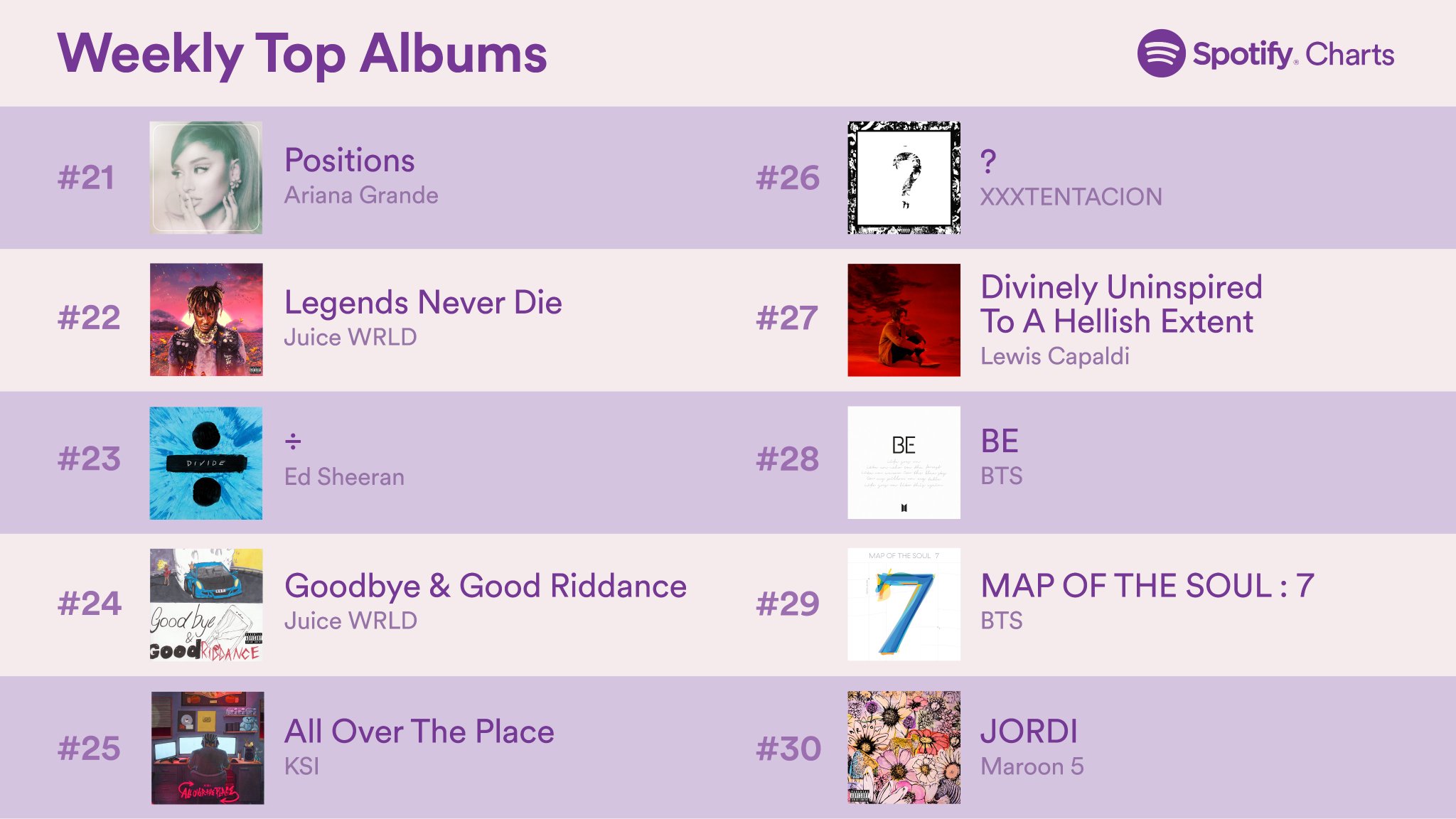
Understanding how Spotify ranks albums requires distinguishing between raw user activity and chart-accredited streaming volume. Spotify’s dedicated platform, Spotify Charts, publishes daily and weekly rankings for top albums both globally and across more than 70 specific country markets.
The fundamental formula behind an album's position on the Top Weekly Albums or Top Daily Albums chart rests on three core technical pillars: track-level stream aggregation, strict measurement windows, and stream filtering algorithms.
1. Track-Level Stream Aggregation
An album on Spotify does not possess a single, independent stream counter for the project as a whole. Instead, an album's total chart score is the direct sum of the filtered streams of every track included on that specific album release.
If an 11-track album accumulates 100,000 filtered streams on Track 1, 50,000 on Track 2, and 10,000 across each of the remaining 9 tracks within a 24-hour window, the album's daily chart total is:
$$100,000 + 50,000 + (9 \times 10,000) = 240,000 \text{ aggregate streams}$$
Every track play contributes equally to the total album volume on Spotify's native charts, regardless of whether the track is a lead single, an instrumental interlude, or a bonus track.
2. Time-Based Measurement Windows
Spotify operates on precise timeframes tied to Coordinated Universal Time (UTC):
- Top Daily Albums: Calculates stream totals over a rolling 24-hour period ending at 00:00 UTC. Daily charts update once per day to reflect the prior day's full streaming activity.
- Top Weekly Albums: Tracks streaming activity across a seven-day cycle starting on Friday at 00:00 UTC and closing the following Thursday at 23:59 UTC. This timeframe aligns directly with standard global music release days established by the International Federation of the Phonographic Industry (IFPI).
Streams occurring outside these precise time bounds drop out of the active chart window, meaning sustained longevity on the weekly chart requires continuous, week-over-week streaming volume rather than a single initial spike.
Filtered Streams vs. Unfiltered Stream Counts
One of the most frequent sources of confusion for listeners and artists is the discrepancy between the public stream counter displayed on the Spotify desktop app and the figures reported on Spotify Charts.
- Total Plays (Public Desktop Display) = Every play lasting 30+ seconds
- Spotify Fraud & Spam Filters Applied
- Filtered Streams (Spotify Charts Total) = Ranked Chart Volume
The Purpose of Stream Filtering
To maintain the integrity of its rankings against artificial inflation, Spotify applies proprietary filtering algorithms to determine chart-filtered streams. While any play lasting 30 seconds or longer increments the public-facing play counter on an artist's profile, not all 30-second plays count toward chart positioning.
Spotify’s filtering algorithms evaluate signals such as:
- Excessive Loop Frequency: Repeatedly looping a single track or album continuously over extended periods from a single account.
- Behavioral Anomaly Detection: Streams originating from accounts exhibiting non-human behavior patterns (e.g., listening for 24 consecutive hours without pausing or switching tracks).
- IP and Network Cluster Rules: High concentrations of streams originating from server farms, commercial VPN nodes, or suspicious IP pools commonly associated with streaming fraud networks.
- Account Authenticity: Listening patterns generated by newly registered accounts or free accounts operating in automated headless browsers.
Only streams deemed legitimate human activity by Spotify's anti-manipulation systems are credited toward an album's official chart total.
Spotify Charts vs. Industry Trade Charts (Billboard 200 & UK Official Charts)
Spotify's internal charts measure raw user engagement on Spotify alone. By contrast, official industry trade charts—such as the Billboard 200 in the United States or the Official Albums Chart in the United Kingdom—evaluate multi-platform market performance using standardized unit conversions.
The table below highlights how Spotify’s native album chart methodology differs from traditional trade chart rankings:
| Feature / Metric | Spotify Top Weekly Albums | Billboard 200 (US) | UK Official Albums Chart |
|---|---|---|---|
| Primary Metric | Filtered Spotify Stream Aggregate | Album Equivalent Units (ALU) | Chart Units |
| Data Sources | Spotify Platform Only | Spotify, Apple Music, Amazon, YouTube, Physical Sales, Digital Downloads | Multi-service Streaming, Physical Sales (Vinyl/CD), Digital Downloads |
| Stream-to-Unit Conversion | None (1 Filtered Stream = 1 Stream) | 1,250 Premium Streams = 1 Unit3,750 Ad-Supported Streams = 1 Unit | Stream Ratios applied after down-weighting top two tracks (Ratio: 1,000 premium / 6,000 free) |
| Physical / Purchase Inclusion | Excluded | Included (CD, Vinyl, Digital Sales via TEA) | Included (CD, Vinyl, Digital Sales via TEA) |
| Ad-Supported vs. Premium Weighting | Unweighted on native charts | Weighted heavily in favor of Premium streams | Weighted heavily in favor of Premium streams |
| Tracking Cycle | Friday 00:00 UTC – Thursday 23:59 UTC | Friday 00:00 EST – Thursday 23:59 EST | Friday 00:00 GMT – Thursday 23:59 GMT |
Streaming Equivalent Albums (SEA) Explained
To rank on publication-led trade charts like the Billboard 200, streams are converted into Streaming Equivalent Albums (SEA). Billboard applies a formula where 1,250 paid audio streams (from Spotify Premium, Apple Music, etc.) or 3,750 ad-supported streams equal one physical album sale.
Spotify’s internal charts do not use SEA ratios. On Spotify Charts, an ad-supported stream from a free user carries the exact same mathematical weight as a stream from a Premium subscriber, provided both streams pass Spotify’s chart filters.
Advanced Factors Influencing Album Rankings
Beyond raw stream totals and time windows, several operational rules govern how albums move through the Spotify Charts hierarchy.
- Release Strategy & Track Count
- Global Track Play Rollup
- ISRC Audio Variant Stream Matching
- Final Aggregated Album Chart Score
1. The Impact of Track Count (Album Length Dynamics)
Because Spotify ranks albums by summing total track plays, an album's track list length creates structural advantages and trade-offs:
- Long-Form Albums (18–25+ Tracks): Albums with high track counts accumulate more overall streams per full-album play-through. If 100,000 fans listen through a 20-track album, the project collects 2,000,000 aggregate streams.
- Short-Form Albums (8–10 Tracks): An 8-track album listened to by 100,000 fans yields only 800,000 aggregate streams. To compete with longer projects, shorter albums require significantly higher replay rates or mega-hit single support.
However, excessively long track counts run the risk of listener drop-off, which can diminish total stream volume if fans abandon the album midway through.
2. Multi-Version Album Aggregations (Deluxe & Expanded Editions)
Modern release strategies often involve dropping a standard album followed by a "Deluxe Edition," "Expanded Version," or "Anniversary Edition" containing additional bonus tracks.
Spotify handles track and album versioning using International Standard Recording Codes (ISRC) and internal metadata mapping:
- Identical ISRC Tracks: When a track on a deluxe album shares the exact same ISRC metadata as the track on the standard album, streams from both versions roll up into the same global track pool.
- Album Metadata Grouping: Spotify consolidates distinct album packages (e.g., standard vs. deluxe) on its charts when the core releases represent the same master project. Streams from bonus tracks on a deluxe edition increment the overall album's chart total, frequently providing a secondary chart surge following a deluxe release.
3. Regional vs. Global Aggregation
Spotify calculates separate daily and weekly charts for over 70 country markets alongside its global chart.
- Country Charts: Only streams generated by Spotify accounts registered within a specific geographical territory count toward that country’s Top Albums chart.
- Global Charts: Streams from all eligible geographic territories are aggregated into a single worldwide ranking.
An album can top a country-specific chart (such as the Top Weekly Albums UK) due to high local penetration, yet rank lower on the Global Top Weekly Albums chart if its streams are heavily concentrated in a single region.
Eligibility Criteria and Chart Exclusions
Not every audio upload on Spotify qualifies for entry onto the Spotify Album Charts. Spotify enforces strict metadata and content guidelines:
- Release Type Formatting: The release must be categorized in Spotify for Artists metadata as an Album or an EP. Standalone singles and multi-artist algorithmic playlists are excluded from album chart calculations.
- Compilations and Various Artists: Multi-artist compilation albums (such as multi-label film soundtracks or editorial curated brand compilations) may be subject to specific chart categorization rules to distinguish primary artist studio projects from commercial compilations.
- Minimum Play Thresholds: Projects must surpass baseline streaming volumes within a tracking window to appear on public 200-position chart manifests.
How Artists and Labels Optimize for Spotify Album Rankings
Understanding chart algorithms has fundamentally reshaped release mechanics across the global music industry. Labels and independent distribution partners rely on specific strategies to maximize stream aggregation during key tracking windows.
- Pre-Release Phase
- Pre-save campaign execution
- Strategic single deployment
- Release Day (Friday 00:00 UTC)
- Simultaneous global drop
- High-sequence track ordering
- Post-Release Phase
- Deluxe edition drop timing
- Playlist re-pitching
Strategic Release Timing
Because Spotify’s weekly tracking period begins precisely at 00:00 UTC on Friday, major artists synchronize their release times globally to capture the full 168 hours of the weekly tracking window. Dropping an album on a Tuesday or Wednesday forfeits up to five full days of potential weekly chart aggregation, placing the project at a severe handicap on that week's Top Weekly Albums chart.
Sequence Optimization and Lead Singles
Pre-released single tracks build momentum prior to an album's street date. Once the full album releases, plays on those established hit singles continue to aggregate into the album's total chart score.
Additionally, placing high-energy tracks or primary singles early in the album sequence maximizes completion rates during the first critical 30 seconds of play, ensuring streams meet the filter threshold required for chart accreditation.
Frequently Asked Questions
Do Spotify album charts count physical sales or digital downloads?
No. Spotify album charts measure streaming activity occurring exclusively within the Spotify platform. Physical CD, vinyl, cassette sales, and digital downloads on platforms like iTunes are not tracked by Spotify Charts, though they are counted by national industry charts like Billboard.
Why is there a difference between a track's public play count and its chart count?
The public play counter displayed on the Spotify app shows unfiltered lifetime plays lasting at least 30 seconds. Spotify Charts figures reflect only filtered streams—plays that have passed Spotify’s anti-spam, anti-bot, and behavior verification algorithms during a specific daily or weekly window.
Does listening to an ad-supported (Free) account count less on Spotify Charts than a Premium account?
No. On Spotify's native internal charts (charts.spotify.com), every verified, filtered stream carries an equal weight of one play regardless of whether it originates from a Free or Premium user. This differs from industry trade charts like Billboard, which assign higher numerical value to Premium streams.
How does Spotify treat deluxe editions with extra tracks?
Spotify aggregates streams across matching ISRC audio codes. Streams generated by core tracks on a deluxe edition combine with the standard edition's streams, while extra bonus tracks added to the deluxe version contribute additional streams to the total overall album project score.
What time of day do Spotify Weekly Charts update?
Spotify's weekly tracking cycle ends on Thursday evening at 23:59 UTC. The updated Top Weekly Albums charts for global and regional markets are typically calculated, verified, and published on Spotify Charts during the course of Friday.
Summary Action Plan for Creators and Analysts
To properly track or optimize album performance on Spotify Charts:
- Align Release Schedules: Target Friday at 00:00 UTC for project drops to maximize weekly chart window coverage.
- Monitor Filtered vs. Unfiltered Analytics: Use Spotify for Artists data to compare total audience reach against chart-accredited stream performance.
- Track ISRC Consistency: Ensure re-releases, standard editions, and deluxe variants share identical ISRCs for core tracks to consolidate stream aggregation.
- Distinguish Native Charts from Trade Charts: Apply SEA ratios (1,250 premium / 3,750 free streams) when calculating potential Billboard 200 positioning, but rely on raw filtered stream aggregation when analyzing Spotify's native Top Albums charts.
Image Gallery