Understanding Scoring in Football Rules: A Comprehensive Guide
Scoring in American football rules is achieved through four primary methods: touchdowns (6 points), field goals (3 points), safeties (2 points), and conversion attempts following a touchdown (1 or 2 points). While the objective is to o...
Scoring in American football rules is achieved through four primary methods: touchdowns (6 points), field goals (3 points), safeties (2 points), and conversion attempts following a touchdown (1 or 2 points). While the objective is to outscore the opponent, the specific requirements for ball placement and player possession vary significantly between each scoring type.
Contents
In the context of global sports, "football" can refer to multiple disciplines. This guide focuses on American gridiron football (NFL and NCAA standards). While association football (soccer) relies solely on goals worth one point each, American football features a tiered scoring system that rewards different levels of field progression and execution. As of 2026, these rules remain the bedrock of the sport, ensuring a balance between offensive drives, defensive stands, and special teams precision.
The Touchdown: The Primary Scoring Objective
The touchdown is the most valuable scoring play in football, awarded 6 points. It occurs when a player carries the ball into the opponent's end zone or catches a pass while legally within the boundaries of the end zone.
Breaking the Plane
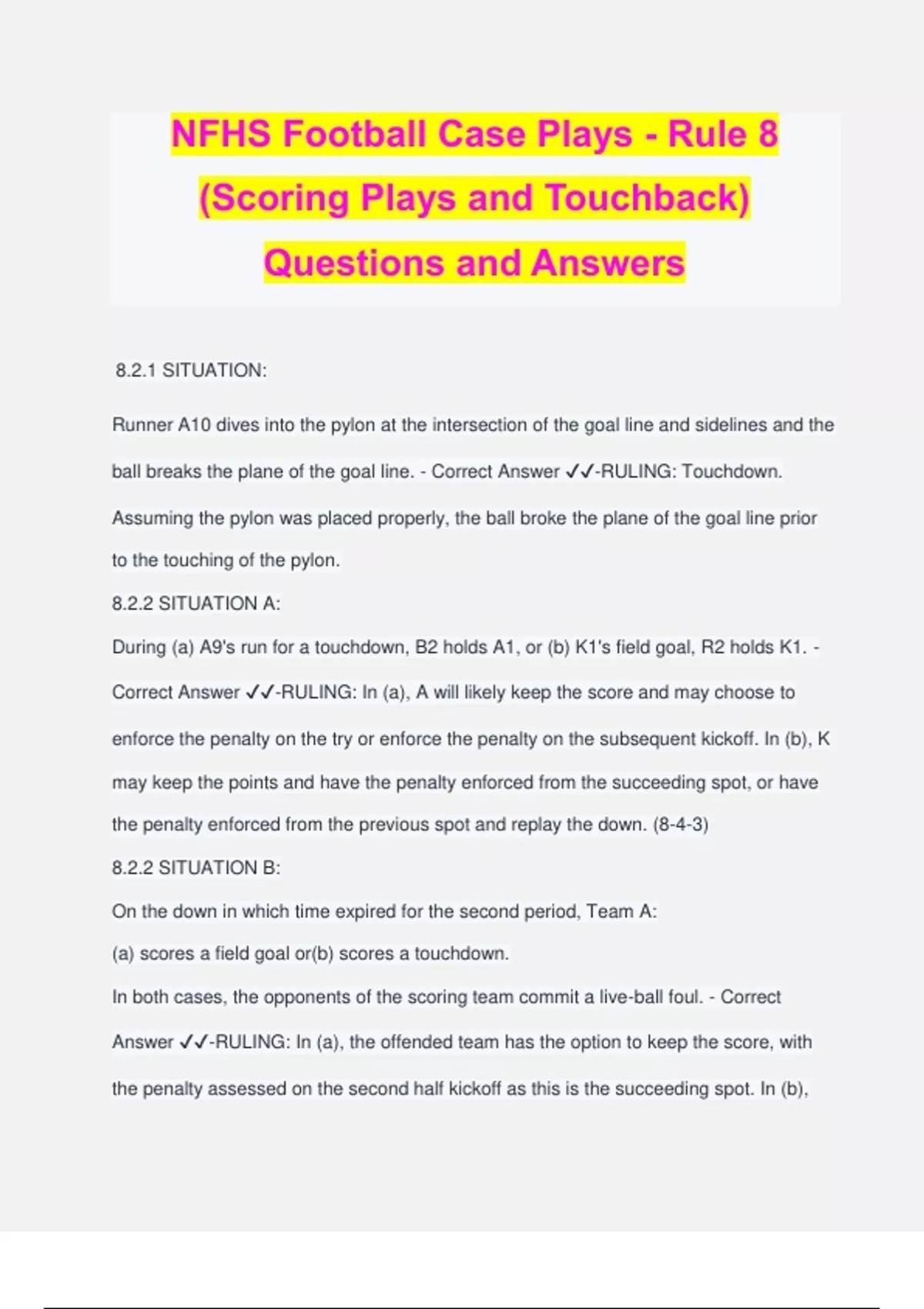
A critical technicality in football rules is the concept of "the plane." The goal line is considered an invisible vertical plane extending upward. To score a rushing touchdown, the ball must only touch or break this imaginary plane while in the runner's possession. The player’s entire body does not need to enter the end zone; only the tip of the ball must reach the leading edge of the goal line.
Requirements for a Receiving Touchdown
For a passing play, the rules are more stringent regarding player positioning. In the NFL, a receiver must have control of the ball and get two feet down (or any body part other than the hands, such as a knee or elbow) within the field of play or the end zone boundaries. In college football (NCAA), only one foot is required to be in bounds. If a player catches the ball while airborne, they must maintain control through the process of contacting the ground. If the ball bobbles or touches the turf before the player establishes complete control, the pass is ruled incomplete, and no points are awarded.
Defensive and Special Teams Touchdowns
Touchdowns are not reserved for the offense. A defensive player can score by recovering a fumble or intercepting a pass and returning it to the opposing end zone. Similarly, special teams units score touchdowns on kickoff or punt returns if the returner reaches the end zone without being tackled or stepping out of bounds.
The Try: Extra Points and Two-Point Conversions
Immediately following a touchdown, the scoring team is granted a "Try." This is a single play from scrimmage used to earn additional points. In 2026, the rules continue to differentiate the difficulty of these two options to balance risk and reward.
The Extra Point (Point After Touchdown)
The most common choice is the extra point (PAT), worth 1 point. The ball is snapped, held, and kicked through the goalpost uprights. In the NFL, the line of scrimmage for a kicked PAT is the 15-yard line, making it approximately a 33-yard kick. This distance was increased years ago to add a layer of difficulty to what was once a nearly guaranteed point.
The Two-Point Conversion
Teams seeking a larger advantage may "go for two." Instead of kicking, the offense attempts to run or pass the ball into the end zone from the 2-yard line (NFL) or 3-yard line (NCAA). If successful, they earn 2 points. This is tactically significant late in games when a team needs to bridge a specific scoring gap.
Defensive Conversions
A lesser-known rule involves the defense scoring during a Try. If the defense gains possession during a two-point conversion attempt or blocks an extra point kick and returns the ball to the opposite end zone, they are awarded 2 points. This rule highlights that the ball remains "live" during conversion attempts.
The Field Goal: Capitalizing on Field Position
When an offensive drive stalls near the opponent's end zone, teams often opt for a field goal, which is worth 3 points. A field goal is successful when the ball is place-kicked through the opponent's goalposts and over the crossbar.
Technical Execution
A field goal requires a "triple-threat" execution:
- The Long Snap: The center must snap the ball accurately to a holder usually 7 to 8 yards behind the line of scrimmage.
- The Hold: The holder must catch the ball and place it vertically on the ground, often spinning it so the laces face away from the kicker.
- The Kick: The kicker must strike the ball so it travels between the vertical uprights.
If a field goal is missed and the ball remains in the field of play, it can technically be returned by the defending team, though this is rare due to the risk involved. Most missed field goals result in the defending team taking possession at the spot of the kick or the 20-yard line, depending on the league and the distance of the attempt.
The Safety: Defensive Scoring
The safety is the rarest way to score in football, worth 2 points. Unlike other scoring methods, a safety is awarded to the defensive team.
Conditions for a Safety
A safety occurs in several specific scenarios:
- Downed in the End Zone: An offensive player carrying the ball is tackled in their own end zone.
- Fumbles Out of Bounds: If the offense fumbles the ball out of their own end zone, a safety is called.
- Offensive Penalties: Certain penalties committed by the offense in their own end zone, such as intentional grounding or offensive holding, result in a safety.
- Blocked Punts: If a punt is blocked and the ball goes out of the back of the end zone, it is a safety for the defending team.
Beyond the 2 points, a safety provides a significant strategic advantage: the team that gave up the points must "kick off" the ball to the scoring team via a free kick (usually a punt) from their own 20-yard line. This often results in the scoring team regaining excellent field position.
Summary of Scoring Values
To better understand the hierarchy of points, the following table breaks down each scoring method used in standard football rules as of 2026.
| Scoring Method | Points Awarded | Responsible Unit | Method of Execution |
|---|---|---|---|
| Touchdown | 6 | Offense/Defense/Special Teams | Carrying or catching the ball in the end zone. |
| Field Goal | 3 | Special Teams | Kicking the ball through the uprights during a scrimmage play. |
| Two-Point Conversion | 2 | Offense | Running or passing into the end zone after a touchdown. |
| Safety | 2 | Defense | Tackling the opponent in their own end zone or certain penalties. |
| Defensive Conversion | 2 | Defense | Returning a blocked/intercepted Try to the opposite end zone. |
| Extra Point (PAT) | 1 | Special Teams | Kicking the ball through the uprights after a touchdown. |
Specialized Scoring Scenarios and Nuances
While the primary points are straightforward, football rules contain several "edge cases" that can impact the scoreboard.
The Fair Catch Kick
An obscure rule that still exists in 2026 is the Fair Catch Kick. If a team catches a punt via a fair catch, they have the option to attempt a free kick (essentially a field goal without a rush from the defense) from the spot of the catch. If the kick goes through the uprights, it is worth 3 points. This is rarely seen but remains a viable strategy at the end of a half or game when time has expired.
Momentum and the Touchback
It is important to distinguish a safety from a touchback. If a defensive player intercepts a ball in the field of play and their momentum carries them into the end zone where they are downed, the ball is placed at the spot of the interception (no score). If the ball is kicked into the end zone (on a kickoff or punt) and downed, it is a touchback, and the offense starts at the 25-yard line (NFL/NCAA) with no points awarded to either side.
Forfeits and Scoring
In the event of a forfeit, football rules dictate a specific score. In the NFL, a forfeited game is recorded as a 2-0 victory for the winning team. This score is used because a safety is the only way to achieve two points without a preceding touchdown, making it the most "logical" minimum score for a game that was never played or completed.
Common Mistakes in Understanding Scoring
- The Goal Line Plane: Fans often think a player's feet must be in the end zone for a rushing touchdown. In reality, only the ball must break the plane.
- The "Caliper" Rule on Field Goals: If a ball hits the upright and bounces through, it counts. If it hits the upright and bounces back into the field or out of bounds without passing through the plane of the uprights, it is a miss.
- Fumble into the End Zone: If an offensive player fumbles the ball forward into the opponent's end zone and it goes out of bounds, no touchdown is scored. Instead, it is a touchback, and the defending team takes possession. This rule is often debated but remains a critical part of the 2026 rulebook.
Frequently Asked Questions
Can a game end in a 1-0 score?
No. In American football, there is no single-point scoring play that can occur independently. A 1-point conversion (PAT) can only happen after a 6-point touchdown. While a "one-point safety" is technically possible in very rare NCAA scenarios (where a team scores a safety against the opponent during a conversion attempt), the minimum score for the winning team would still involve the points from the touchdown that preceded the Try.
What happens if a player scores a touchdown as time expires?
If a team scores a touchdown to win the game as time expires, they are still required to attempt the extra point or two-point conversion in college football. In the NFL, the Try is only attempted if the points could mathematically impact the outcome of the game or a tie-breaking playoff scenario; otherwise, the game ends immediately.
Does a touchdown count if the player fumbles after crossing the line?
Yes, provided the player had firm control of the ball when it broke the plane of the goal line. Once the ball breaks the plane in the runner's possession, the play is instantly dead, and the touchdown is recorded. Any subsequent fumble is irrelevant.
Can the defense score more than 2 points on a single play?
The defense can score 6 points if they return an interception or fumble for a touchdown. They can also score 2 points via a safety or a defensive conversion. They cannot score 3 points (field goal) or 1 point (PAT) as those are strictly offensive/special teams scoring actions.
Is there a limit to how many points a team can score?
There is no theoretical limit to the number of points a team can score in a game. However, timing and possession naturally cap the scoring potential. The highest-scoring game in college history remains Georgia Tech’s 222-0 win over Cumberland in 1916.
Strategic Recommendation
When analyzing football scoring for competitive play or officiating, always prioritize the establishment of possession. Whether it is a catch in the end zone or a runner breaking the plane, the "status" of the ball in the player's hands is the most frequent point of contention in scoring reviews. For teams, the decision to "go for two" should be dictated by the "Success Probability vs. Points Needed" chart, a standard tool used by coaches in 2026 to determine if the risk of a two-point attempt outweighs the relative safety of a one-point kick.
Image Gallery