Complete Guide to the Los Angeles County Sheriffs Department Inmate Search for 2026
Locating an individual who has been arrested and booked within Los Angeles County requires navigating the unified database systems managed by the Los Angeles County Sheriff's Department (LASD). To perform a successful inmate search, yo...
Locating an individual who has been arrested and booked within Los Angeles County requires navigating the unified database systems managed by the Los Angeles County Sheriff's Department (LASD). To perform a successful inmate search, you must have specific identifying details such as the full legal name and date of birth, or the unique seven-digit Booking Number, and access the official LASD Inmate Information Center online portal or contact the Inmate Reception Center directly.
Contents
Understanding the Los Angeles County Jail System Infrastructure
The Los Angeles County jail system represents one of the largest municipal correctional networks in the United States, processing tens of thousands of individuals annually across multiple facilities, substations, and court lockups. Operating this massive network requires rigorous tracking protocols to maintain public transparency while ensuring the safety and constitutional rights of detained persons. Managed primarily by the LASD Custody Division, the system must balance rapid intake procedures with secure data management.
When an individual is taken into custody by local law enforcement agencies within the county—including the LAPD, smaller municipal police departments, or LASD patrol deputies—they are transported to a temporary holding facility or a primary booking center. Understanding this intake pipeline is essential for anyone attempting to locate a friend, family member, or client. Information does not appear in the public database instantaneously; deputies must complete fingerprinting, background checks, medical screenings, and administrative data entry before a booking record goes live.
Key Facilities within the LASD Custody Network
- Inmate Reception Center (IRC): Located in downtown Los Angeles, this serves as the central processing hub for all male inmates entering the county jail system.
- Century Regional Detention Facility (CRDF): Situated in Lynwood, this facility is the primary jail for female inmates arrested within Los Angeles County.
- Twin Towers Correctional Facility (TTCF): Houses male inmates with specialized medical, mental health, and high-security classification requirements.
- Pitchess Detention Center: Located in Castaic, this multi-facility complex houses lower-security male inmates and features various work-release and educational programs.
- Station Jails: Temporary holding facilities attached to local LASD patrol stations where individuals are typically held for less than 48 hours before release, transfer, or court appearance.
Prerequisites and Necessary Information for Your Search
Before initiating an online lookup or placing a telephone inquiry, gathering the correct data points significantly accelerates the process. Searching with vague information often yields zero results or returns multiple homonyms, complicating your efforts.
The LASD database requires specific identifiers to isolate a single record from a population of thousands of active inmates. Having the correct spelling of a person's legal name is non-negotiable; common misspellings or the use of nicknames will frequently result in a failed search query.
Essential Data Points Required
- Full Legal Name: First, middle, and last name. Pay careful attention to hyphenated surnames or junior/senior suffixes.
- Date of Birth: Formatted numerically (Month/Day/Year), this is the most reliable filter to separate individuals with identical names.
- Booking Number: A unique seven-digit numeric identifier assigned at the time of intake. If known, this bypasses all name-matching hurdles.
- Approximate Date of Arrest: Useful if the record has not yet been fully indexed or if the individual has already been transferred to a state prison or released.
Step-by-Step Guide to Using the LASD Online Inmate Information Center
The most direct method for locating an inmate is through the official Los Angeles County Sheriff's Department Inmate Information Center web portal. This digital service updates continuously as bookings, transfers, and releases occur throughout the day and night.
Official Access Note: Always verify you are using the official government web portal ending in a secure domain suffix to protect your personal privacy and avoid commercial third-party lookup services that charge unnecessary fees for public data.
Step 1: Navigate to the Official Portal
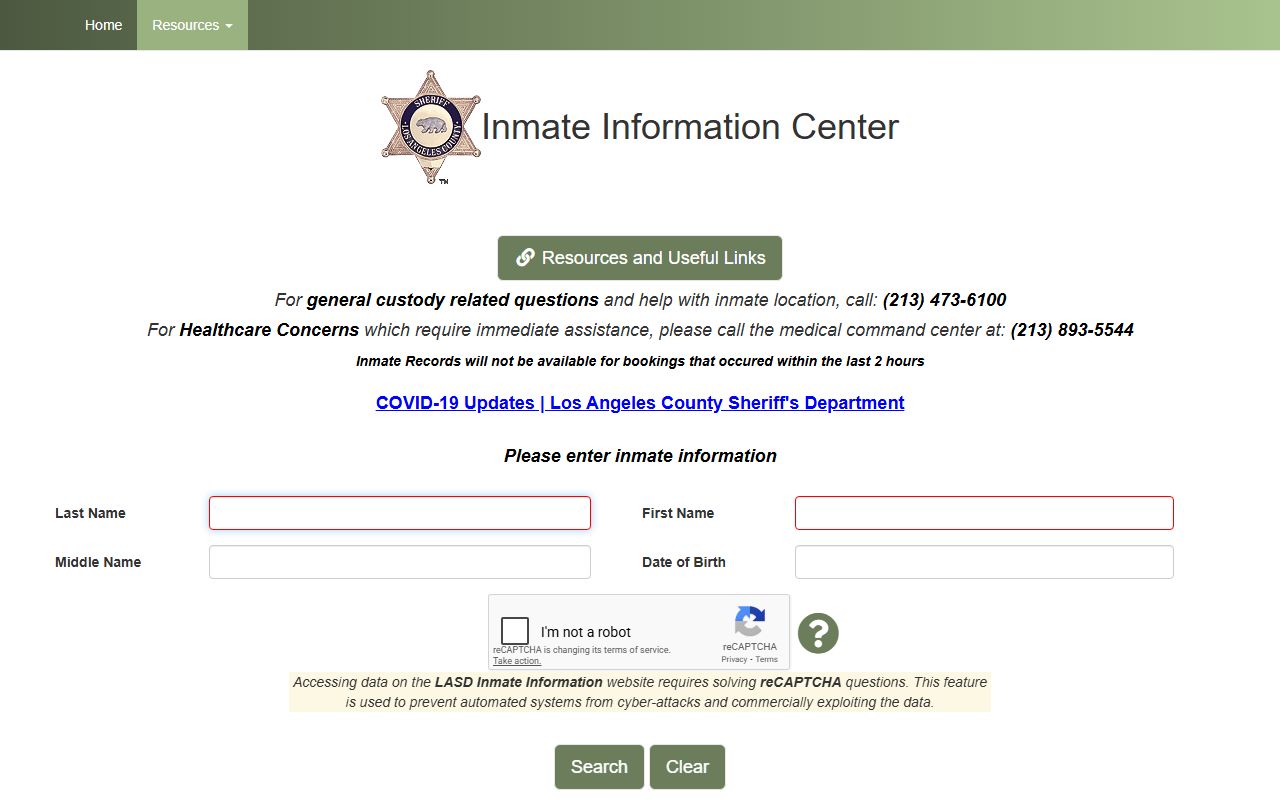
Open a secure web browser and navigate to the official Los Angeles County Sheriff's Department website, directing specifically to the Inmate Information Center page. Review the disclaimer regarding the accuracy and real-time nature of public safety records.
Step 2: Input Identifying Criteria
Locate the search form fields. You will be prompted to enter the inmate's last name, first name, and date of birth. While entering all fields provides the highest accuracy, entering only the last name and first initial can assist if you are unsure of minor spelling variations.
Step 3: Evaluate Search Results
The system will generate a table of matching profiles. Review the displayed columns carefully, which typically include:
- Full Inmate Name
- Booking Number
- Date of Birth
- Current Facility Location
- Projected Release Date or Court Date
- Bail Amount and Conditions
Step 4: Click for Detailed Custody Records
Select the specific row corresponding to the individual you are tracking. This opens a comprehensive profile view showing specific housing locations, visiting hours eligibility, upcoming court appearances, and detailed bail or bond specifications.
Evaluating Bail, Bond Options, and Release Procedures
Once you locate an inmate within the LASD database, understanding their financial release conditions becomes the primary objective. Bail amounts are established based on county bail schedules or set by a judge during an arraignment hearing.
Navigating the financial and administrative steps of securing a release requires strict adherence to institutional protocols. Delays often occur due to paperwork errors or failure to meet specific operational cut-off times at the jail facilities.
Comparison of Release Methods and Operational Realities
| Release Mechanism | Description | Advantages | Potential Risks and Limitations |
|---|---|---|---|
| Cash Bail | Full payment of the set bail amount paid directly to the court or facility cashier. | Fully refundable at the conclusion of court proceedings, minus minor administrative fees. | Requires massive immediate liquidity; funds are tied up for months or years until case resolution. |
| Bail Bond (Surety) | Utilizing a licensed bail bond agent who charges a non-refundable premium (typically 10%). | Requires only a fraction of the total bail amount; agent handles paperwork and logistics. | Premium fee is completely non-refundable; often requires collateral (property, vehicles) to secure the bond. |
| Own Recognizance (OR) | Release ordered by a judge without financial conditions, based on community ties. | Zero financial cost to the defendant or family. | Granted strictly for non-violent offenses and requires strict compliance with court appearance mandates. |
| Citation / Cite Out | Immediate release from a station jail with a written promise to appear in court at a later date. | Avoids physical booking and prolonged incarceration entirely. | Restricted strictly to minor misdemeanor offenses and low-level infractions. |
Troubleshooting Common Search Failures and System Limitations
When a search query yields no results, it does not automatically mean the individual is not in custody. Several structural and administrative factors commonly cause temporary delays in public database visibility.
- Recent Arrest Delay: If an arrest occurred within the last two to six hours, the arresting agency may still be completing field paperwork, transport, and initial intake processing. Records do not appear online until intake is finalized.
- Juvenile Records: Under California law, juvenile arrest and detention records are strictly confidential and are never published on public-facing inmate search portals.
- Medical or Protective Seclusion: In rare instances involving protective custody, high-profile security risks, or medical quarantines, specific booking details may be restricted from public view temporarily.
- Agency Discrepancies: If the arrest was executed by a municipal police department (such as the Santa Monica Police Department or Long Beach Police Department) rather than the LASD, the individual may be held in a local city jail rather than an LASD facility until transferred.
Frequently Asked Questions
How long does it take for a new arrest to show up in the LASD inmate search database?
New arrests typically appear in the online database within two to six hours after the booking process is completed at an intake facility. Complex booking procedures, medical clearances, or high-volume processing periods can occasionally extend this window up to 12 hours. If a significant amount of time has passed, contacting the Inmate Reception Center directly is recommended.
What should I do if the inmate search portal returns no results for a family member?
Verify the spelling of the legal name and confirm the date of birth. If the details are accurate, contact the local police department that executed the arrest to confirm whether the individual is still held in a municipal holding facility or has been transferred to an LASD booking center like the Inmate Reception Center (IRC).
Can I find out an inmate's housing location and upcoming court dates online?
Yes, the official LASD Inmate Information Center profile page for an individual displays their current facility housing assignment, visiting schedule eligibility, bail amounts, and scheduled court dates. This information updates dynamically as the inmate moves through the judicial process.
How do I contact the Inmate Reception Center (IRC) by phone for immediate inquiries?
You can contact the Inmate Reception Center directly by calling the main LASD custody division information line. Be prepared to provide the inmate's full legal name and date of birth to the staff member to expedite your inquiry regarding housing status, medical clearances, or release processing updates.
Are all jail facilities in Los Angeles County managed by the LASD?
No, while the LASD manages the largest county jail network, independent cities within Los Angeles County operate their own municipal police departments and holding facilities. Additionally, federal facilities (such as the Metropolitan Detention Center in Los Angeles) and state prisons operated by the California Department of Corrections and Rehabilitation (CDCR) operate entirely outside the jurisdiction of the LASD database.
Professional Assistance and Next Steps
Navigating the Los Angeles County correctional system can be complex and emotionally taxing. For up-to-date custody status checks, facility visitation guidelines, and official release protocols, always rely on the primary channels provided by law enforcement. To begin your lookup right away, visit the official Los Angeles County Sheriff's Department Inmate Information Center to securely search active records and review comprehensive booking details.
Image Gallery