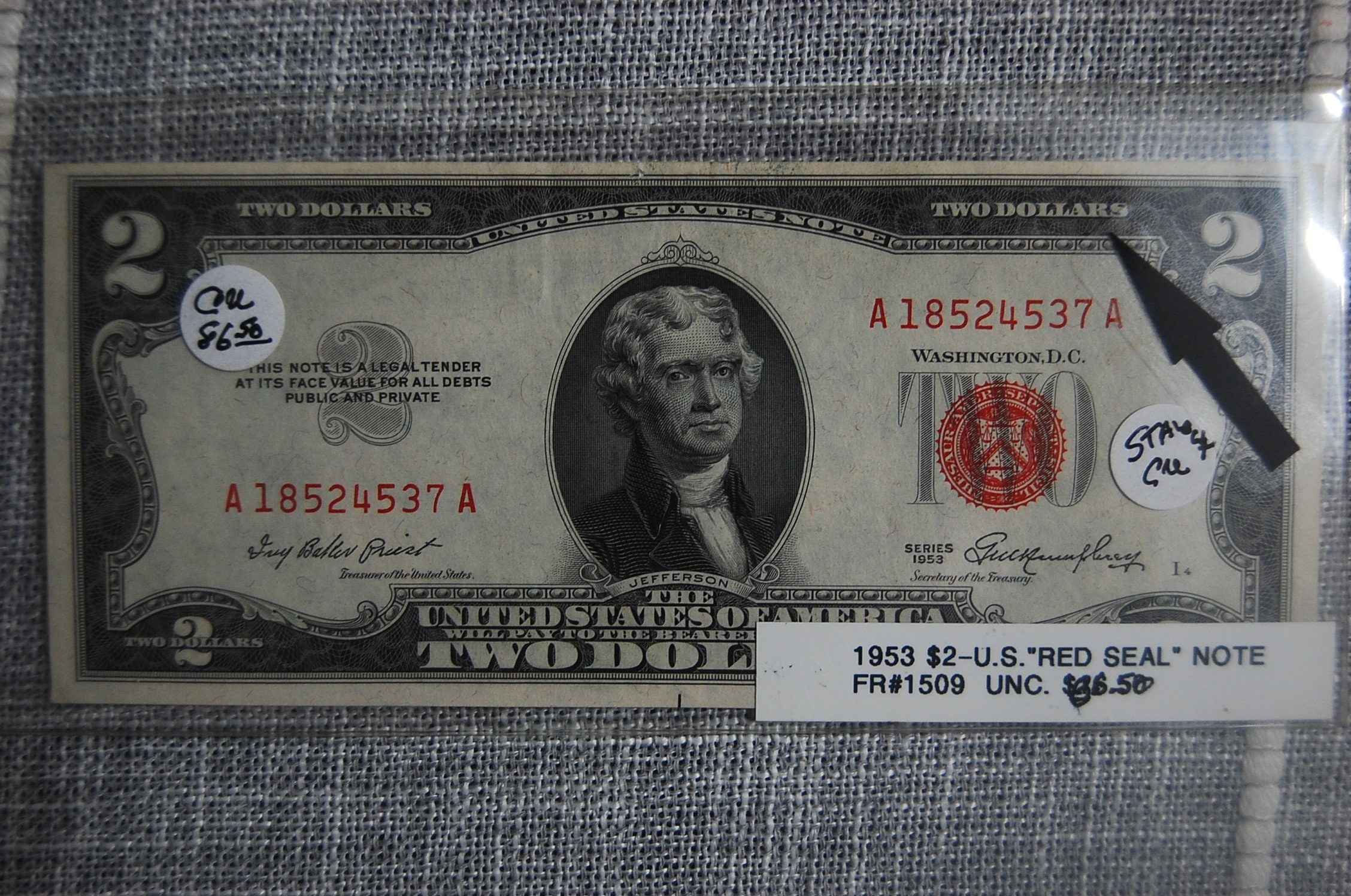
1953 2 Dollar Red Seal Value, Series Guide, and Collector Identification
A 1953 $2 red seal bill (a legal tender United States Note) is worth between $2.50 and $4 in typical circulated condition, while crisp uncirculated examples generally fetch $12 to $35. Exceptional specimens, such as replacement "star n...
A 1953 $2 red seal bill (a legal tender United States Note) is worth between $2.50 and $4 in typical circulated condition, while crisp uncirculated examples generally fetch $12 to $35. Exceptional specimens, such as replacement "star notes" or severe printing error varieties, can command values ranging from $40 to several hundred dollars depending on official PMG or PCGS Banknote grade.
Contents
Understanding the 1953 Red Seal $2 Bill: History and Currency Type
The 1953 $2 bill occupies a distinct place in American numismatic history. Unlike modern U.S. currency, which consists entirely of Federal Reserve Notes adorned with green Treasury seals and serial numbers, the 1953 series is a United States Note. Identifiable by its striking red Treasury seal and red serial numbers, this currency was issued directly by the federal government rather than through the Federal Reserve System.
The authority to issue United States Notes stems back to the Legal Tender Act of 1862 during the American Civil War. These notes represented a direct obligation of the United States Treasury, backed not by physical gold or silver deposits in a specific vault, but by the full faith and credit of the U.S. government. Congress mandated that a fixed sum of United States Notes ($322,539,016) remain in circulation, which led to periodic print runs of the $2 and $5 red seal denominations across mid-twentieth-century series.
The 1953 series marked a major technical shift in American currency production at the Bureau of Engraving and Printing (BEP). This was the first $2 series to feature a redesigned reverse motif showcasing Monticello, the historic Virginia estate of Thomas Jefferson. Jefferson’s portrait, based on the classic painting by Rembrandt Peale, occupies the center of the obverse portrait oval, establishing a visual layout that persisted until the bill was temporarily discontinued in 1966.
Technical Specifications and Key Identification Features
To evaluate a 1953 red seal $2 bill accurately, collectors and currency appraisers examine specific physical attributes and standardized identifiers.
KEY DESIGN ATTRIBUTES: 1953 $2 UNITED STATES NOTE
| Feature | Specification / Description |
|---|---|
| Denomination | Two Dollars ($2.00) |
| Obligation Type | Legal Tender United States Note |
| Seal Color & Style | Small Red Treasury Seal (Positioned on the Right Side) |
| Serial Number Color | Vivid Carmine Red |
| Obverse Subject | Thomas Jefferson (3rd U.S. President) |
| Reverse Subject | Monticello Estate, Charlottesville, Virginia |
| Physical Dimensions | Approximately 6.14 x 2.61 inches (156 x 66 mm) |
| Micro-Printing | Fine-line lathe work on borders and portrait oval |
The Shift from Large Seals to Small Seals
Prior to the 1953 series, small-size $2 United States Notes (such as the 1928 series) featured a large red Treasury seal positioned on the left side of the note, with the word "TWO" written out over the right side. Starting with the 1953 series, the Treasury modernized the layout:
- Right-Side Seal: The red Treasury seal was reduced in size and moved to the right side of the portrait.
- Left-Side Serial Placement: The left serial number was positioned directly above the stylized "TWO" graphic.
- Obligation Text: The top center header reads "UNITED STATES NOTE" while the bottom legal obligation clause reads "THIS NOTE IS A LEGAL TENDER AT ITS FACE VALUE FOR ALL DEBTS PUBLIC AND PRIVATE."
1953 Series Breakdown: Signature Combinations & Friedberg Numbers
In professional paper money collecting, notes are categorized using Friedberg Numbers (Fr. numbers), a cataloging system created by Arthur L. Friedberg and Ira S. Friedberg. The letter suffix printed next to the date (e.g., 1953A, 1953B) denotes a change in the executive leadership at the U.S. Treasury, specifically the Treasurer of the United States and the Secretary of the Treasury.
Every time a new Treasurer or Treasury Secretary took office, the BEP updated the series letter. Below is the detailed breakdown of all four variations within the 1953 printing run.
| Series | Friedberg # | Treasurer of the U.S. | Secretary of the Treasury | Production Period | Circulated Value Range | Uncirculated (CU/Gem) Value |
|---|---|---|---|---|---|---|
| 1953 Standard | Fr. 1509 | Ivy Baker Priest | George M. Humphrey | 1953–1957 | $2.50 – $5.00 | $15.00 – $35.00 |
| 1953A | Fr. 1510 | Ivy Baker Priest | Robert B. Anderson | 1957–1961 | $2.50 – $4.50 | $12.00 – $30.00 |
| 1953B | Fr. 1511 | Katheryn O'Hay Granahan | C. Douglas Dillon | 1961–1965 | $3.00 – $6.00 | $18.00 – $45.00 |
| 1953C | Fr. 1512 | Katheryn O'Hay Granahan | Henry H. Fowler | 1965–1966 | $4.00 – $8.00 | $25.00 – $60.00 |
Collector Note on Mintage Scarcity: While millions of 1953 and 1953A notes were produced, the 1953B and 1953C series saw smaller total press runs due to the transition toward the 1963 series. As a result, 1953B and 1953C notes in pristine, uncirculated grades command a noticeable price premium in today's numismatic market.
Red Star Notes: Identification and Market Premiums
A Star Note (or replacement note) is a bill printed by the Bureau of Engraving and Printing to replace an original sheet that contained printing defects or misprints discovered during quality control. Because two notes with the exact same serial number cannot be released into circulation, the defective note is destroyed and a replacement note is printed with a five-pointed star symbol inserted alongside the serial number.
For the 1953 $2 red seal series, the star symbol is located either at the beginning or the end of the red serial number sequence.
Star Note Valuation Matrix
Star notes are significantly scarcer than standard production runs. Their value scales exponentially based on physical condition:
- Circulated Star Notes (Good to Very Fine): $8.00 to $20.00Notes showing visible fold lines, soft paper, or light handling marks still carry a clear premium over standard notes.
- Choice Uncirculated Star Notes (Gem 63–64): $45.00 to $90.00Crisp notes with original paper wave, sharp corners, and zero folds or wallet bends.
- Superb Gem Star Notes (Grade 65+): $120.00 to $300.00+Certificated notes featuring exceptional centering, bright red ink saturation, and pristine paper quality verified by independent grading services like PMG or PCGS Banknote.
Official Grading Standards for Paper Currency
To accurately determine the fair market value of a 1953 $2 bill, numismatists rely on the standardized 70-point Sheldon scale adapted for paper money.
PAPER MONEY GRADING SPECTRUM
| Grade Level | Abbreviation | Visual & Physical Characteristics |
|---|---|---|
| Good / Fine | G 4 - F 12 | Heavy creasing, rounded corners, minor dirt, soft paper texture, no major tears or holes. |
| Very Fine | VF 20 - VF 35 | Moderate circulation marks, clear vertical/ horizontal folds, firm paper, bright colors. |
| Extremely Fine | EF 40 - EF 45 | Light handling, maximum of 1-3 minor folds, clean paper, strong eye appeal. |
| Uncirculated | UNC 60 - 62 | Strictly uncirculated, no folds, but may show off-center margins or light counting smudges. |
| Choice / Gem UNC | GEM 65 - 70 | Flawless paper surface, perfect centering, vivid red seal ink, crisp embossment on serials. |
Factors That Lower Value Signification
Even a rare star note or scarce series can lose up to 80% of its market value if affected by damage. When assessing your 1953 $2 bill, watch out for these defects:
- Pinholes and Rust: Common on vintage bills preserved with metal paperclips inside old family albums.
- Chemical Staining or Adhesive Tape: Any Scotch tape repairs drastically destroy collectibility.
- Tears and Corner Clips: Physical paper loss drops a bill straight into the lowest grading brackets.
- Washing or Pressed Treatment: Notes that have been chemically washed or ironed to fake an "uncirculated" crispness lose their natural embossing and paper shine, reducing their value to experienced collectors.
Notable Printing Errors and Unique Variations
While standard 1953 $2 bills are relatively affordable, notes displaying genuine factory printing errors represent high-value exceptions. The BEP’s mechanical production lines during the 1950s occasionally produced errors that bypassed quality inspectors.
Common Collector Errors
- Inverted Overprint (Inverted Seal/Serial Numbers): Occurs when the sheet passes upside down through the third printing stage (which applies the red serial numbers and seal). These rare error notes can fetch $500 to $2,500+ at major currency auctions.
- Misaligned or Cut Errors: Notes where the design of an adjacent bill is visible due to improper sheet cutting.
- Insufficient Inking or Blind Embossing: Notes missing entire sections of red ink or main black engraving plates.
- Foldover Errors: Occurs when a corner of the blank paper sheet folds over prior to entering the printing press, leaving an unprinted diagonal stripe across the note once unfolded.
How to Preserve, Grade, and Sell Your 1953 $2 Bill
If you inherited a 1953 red seal $2 bill or found one in a collection, proper handling and storage are critical to maintaining its value.
Storage Protocol:Always place paper currency in archival-grade, PVC-free currency sleeves made of rigid polyester (Mylar). PVC plasticizers react chemically with paper fibers over time, causing yellowing, ink bleeding, and permanent damage. Store currency flat in a cool, dry environment with low relative humidity.
Evaluating Certification Needs
For standard circulated notes valued under $20, third-party authentication fees (which typically range from $20 to $45 per note plus shipping) will exceed the value of the bill itself. Professional grading by third-party services is recommended if:
- The note appears completely uncirculated with sharp, square corners and zero fold lines.
- The bill is a scarce replacement Star Note in Choice or Gem condition.
- The bill exhibits a dramatic, genuine factory printing error.
Buying and Selling Best Practices
When liquidating or building a collection of mid-century United States Notes:
- Local Coin & Currency Shops: Best for quick appraisals and immediate cash sales, though expect wholesale offers (typically 50% to 70% of retail book value).
- Numismatic Auctions & Online Marketplaces: Ideal for rare star notes, high-grade certified notes, or error bills to reach specialized collectors willing to pay top market value.
- Avoid Spending at Face Value: A 1953 red seal note retains legal tender status at its face value of $2, but spending it at a retail register forfeits its historic numismatic premium.
Frequently Asked Questions
Are all 1953 $2 bills worth a lot of money?
No. Most standard circulated 1953 $2 red seal bills are worth between $2.50 and $5. Their value depends heavily on condition, signature combinations, and whether the note is a replacement star note.
What is the difference between a red seal $2 bill and a green seal $2 bill?
Red seal $2 bills are legal tender United States Notes issued directly by the U.S. Treasury, whereas green seal $2 bills (first introduced in 1976) are Federal Reserve Notes. Red seals indicate older mid-century issues backed by general government credit rather than Federal Reserve bank reserves.
How can I tell if my 1953 $2 bill is a star note?
Look closely at the red serial numbers printed on the front of the bill. If a five-pointed star symbol replaces either the leading or trailing letter in the serial number sequence, the bill is a replacement star note.
Is a 1953 red seal $2 bill backed by silver or gold?
No. While Silver Certificates featured blue seals and Gold Certificates featured yellow or orange seals, red seal notes were backed solely by the statutory obligation of the legal tender laws and the full faith and credit of the U.S. government.
Does a 1953 $2 bill have "In God We Trust" printed on it?
No. The national motto "In God We Trust" was first authorized for paper currency by Congress in 1955 and was added to $2 bills starting with the 1963 Series United States Notes.
Image Gallery