Workers Compensation Including Employers Liability Key Facts
Workers’ compensation and employers liability insurance function as a dual-layered financial safeguard that provides statutory benefits to injured employees while protecting the business from negligence-based lawsuits. As of 2026, this...
Workers’ compensation and employers liability insurance function as a dual-layered financial safeguard that provides statutory benefits to injured employees while protecting the business from negligence-based lawsuits. As of 2026, this coverage remains a mandatory legal requirement for nearly all businesses with employees, serving as the "exclusive remedy" that balances worker protection with corporate risk management.
Contents
The Dual Nature of the Workers’ Compensation Policy
A standard workers’ compensation insurance policy is almost always divided into two distinct sections: Part One (Workers’ Compensation) and Part Two (Employers Liability). Understanding the distinction between these two is critical for risk managers and business owners. While Part One handles the automatic, no-fault benefits dictated by state law, Part Two addresses the gaps where an employer might still be held legally liable for an injury despite the no-fault system.
In 2026, the complexity of the modern workplace—including remote work arrangements and specialized contracting—has made the interplay between these two parts more significant. If an employee is injured on the job, Part One pays for their medical bills and a portion of their lost wages regardless of who was at fault. However, if the employee or a third party alleges that the employer’s gross negligence caused the injury, they may step outside the no-fault system and file a lawsuit. This is where Part Two, Employers Liability, becomes the primary defense.
Part One: Workers’ Compensation Statutory Coverage
Part One of the policy is designed to fulfill the employer's obligations under state workers' compensation laws. Because these benefits are "statutory," there are typically no dollar limits on the amount the insurer will pay for medical expenses or the duration of those payments, provided the care is reasonable and necessary for a work-related injury.
Medical Benefits
Under current 2026 guidelines, medical benefits cover all "reasonable and necessary" treatments. This includes emergency room visits, surgeries, hospital stays, physical therapy, and prescription medications. In many jurisdictions, this also extends to psychological care if the mental health condition is directly linked to a physical workplace injury or, in specific cases like first responders, a traumatic event.
Indemnity (Wage Replacement) Benefits
When a worker is unable to perform their duties due to a job-related injury, indemnity benefits provide a financial bridge. These are usually calculated as a percentage of the worker’s average weekly wage (typically 66.6%). These benefits are categorized into:
- Temporary Total Disability (TTD): For workers who cannot work at all for a limited period.
- Permanent Partial Disability (PPD): For workers who have reached maximum medical improvement but have a lasting impairment (e.g., loss of a finger).
- Permanent Total Disability (PTD): For workers whose injuries prevent them from ever returning to the workforce.
Vocational Rehabilitation
If an injury prevents a worker from returning to their previous role, many state laws in 2026 require the insurer to pay for retraining or job placement services. This helps the worker transition into a different field that accommodates their physical limitations.
Part Two: Employers Liability Insurance
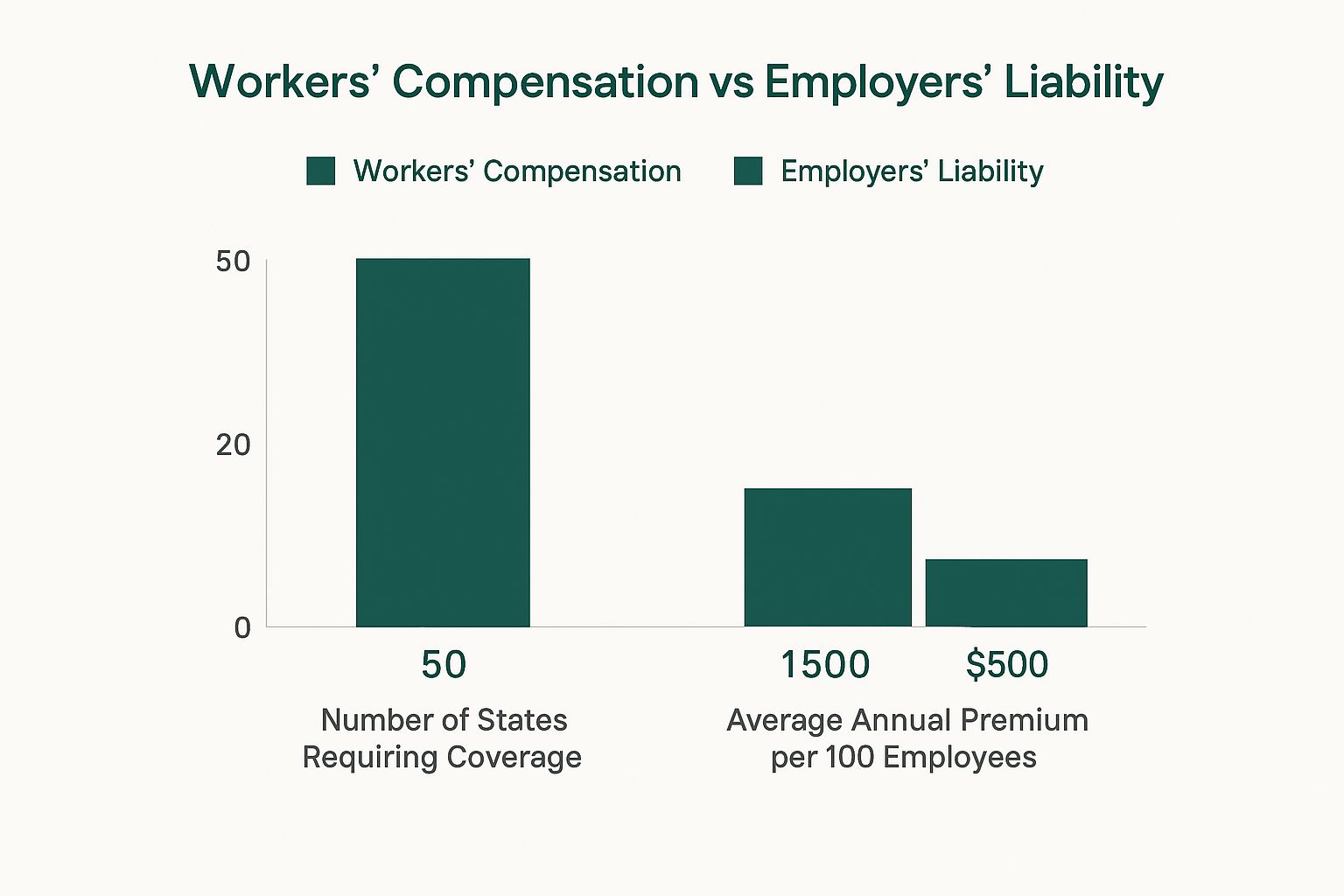
While Part One covers the "no-fault" aspect, Part Two (Employers Liability) covers the employer's legal liability for damages that fall outside the statutory benefit schedule. Unlike Part One, Employers Liability has specific policy limits (e.g., $100,000 per accident, $500,000 policy limit, $100,000 per employee for disease).
Why Employers Liability is Necessary
Even with the "exclusive remedy" doctrine—which generally prevents employees from suing their employers for work injuries—there are four common scenarios where an employer can be sued:
- Third-Party Over Actions: An injured employee sues a third party (such as an equipment manufacturer). That third party then sues the employer, claiming the employer’s negligence (e.g., poor maintenance) contributed to the accident.
- Dual Capacity: An employee is injured by a product manufactured by their own employer. In this case, the employer is liable both as an employer and as a manufacturer.
- Loss of Consortium: A spouse or family member of the injured worker sues the employer for the loss of companionship or services resulting from the injury.
- Consequential Bodily Injury: A family member suffers a physical ailment (such as a heart attack or severe stress-related illness) as a direct result of the employee’s injury.
Mandatory Requirements and Legal Framework
In the United States, workers’ compensation is regulated at the state level rather than the federal level. This creates a patchwork of requirements that businesses must navigate.
Monopolistic vs. Competitive States
Most states allow businesses to purchase insurance through private carriers. However, as of 2026, four states remain "monopolistic": Ohio, Washington, North Dakota, and Wyoming. In these states, employers must purchase workers' compensation directly from a state-operated fund. Notably, these state funds often do not include Employers Liability coverage, requiring businesses in those states to purchase a separate "Stop Gap" endorsement through their general liability carrier.
The NCCI and Classification Codes
The National Council on Compensation Insurance (NCCI) serves as the rating bureau for the majority of states. They maintain thousands of classification codes that describe different types of work. Each code is assigned a rate based on the historical risk of injury associated with that job. A high-rise window cleaner will always have a higher rate than a software developer because the statistical likelihood of a catastrophic claim is much higher.
| Feature | Workers' Compensation (Part 1) | Employers Liability (Part 2) |
|---|---|---|
| Basis of Coverage | Statutory / No-Fault | Tort / Negligence |
| Policy Limits | Unlimited (Statutory) | Stated Limits (e.g., $500k/$500k) |
| Who is Covered | The Injured Employee | The Employer (Defense/Damages) |
| Legal Recourse | Administrative Claim | Civil Lawsuit |
| Typical Benefits | Medical, Wages, Rehab | Legal Defense, Settlements |
Factors Influencing Premiums in 2026
The cost of a workers’ compensation policy is not arbitrary. It is calculated using a formula that rewards safety and penalizes frequent accidents.
The Experience Rating Modifier (E-Mod)
The Experience Modifier, or E-Mod, is a multiplier applied to a company's premium. An E-Mod of 1.0 is considered the industry average. If a company has fewer and less severe accidents than expected for its industry, its E-Mod might drop to 0.85, resulting in a 15% discount. Conversely, a poor safety record could lead to an E-Mod of 1.2, resulting in a 20% surcharge. In 2026, maintaining a low E-Mod is one of the most effective ways for a business to control its fixed operating costs.
Payroll Audits
Premiums are initially based on estimated payroll for the coming year. At the end of the policy period, the insurance carrier performs a payroll audit to determine the actual exposure. If the business hired more employees than expected, they might owe an additional premium. Conversely, if payroll decreased, they may receive a refund.
Common Exclusions and Limitations
It is a common misconception that workers’ compensation covers every injury that happens on company property. There are several key exclusions:
- Intentional Acts: If an employer intentionally causes harm to an employee, the "exclusive remedy" protection is voided, and the employer can be sued for unlimited damages.
- Intoxication: If it can be proven that the primary cause of the injury was the employee’s intoxication by drugs or alcohol, the claim may be denied.
- Horseplay: Injuries resulting from voluntary participation in non-work-related physical altercations or "pranks" are often excluded.
- Commuting: Under the "Going and Coming Rule," injuries sustained while traveling to or from work are generally not covered, though exceptions exist for traveling salespeople or those on special errands for the employer.
Frequently Asked Questions
Are remote workers covered under workers' compensation?
Yes, in 2026, most state laws recognize that if an employee is working from home for the benefit of the employer, the home office is considered a job site. However, the injury must occur during work hours and arise out of work-related activities. For example, tripping over a computer cord while reaching for a work phone is likely covered, but tripping over a pet while getting lunch in the kitchen may not be.
What is a "third-party over" claim?
A third-party over claim occurs when an injured worker sues a third party (like a machine manufacturer) for their injury. That third party then sues the worker's employer for contribution or indemnity, claiming the employer’s negligence contributed to the injury. Employers Liability insurance is what pays for the employer’s defense and any resulting judgment in these cases.
Can a business owner opt out of coverage?
In most states, owners, partners, and corporate officers can choose to exclude themselves from coverage to save on premiums. However, this means they will have no access to workers' compensation benefits if they are injured while performing work duties. Some states also have small-business exemptions for companies with fewer than three to five employees.
How does the 2026 labor market affect rates?
Increased wages across many industries have led to higher overall payrolls, which can increase total premiums. However, advancements in workplace safety technology and a shift toward more automated environments in 2026 have helped stabilize the frequency of claims, keeping the base rates per $100 of payroll relatively competitive.
What should an employer do immediately after an injury?
The employer must provide first aid or medical access immediately. Once the worker is stable, the employer should document the scene, gather witness statements, and report the claim to their insurance carrier as soon as possible. Delaying a report can lead to penalties and increased claim costs.
Practical Recommendations for 2026
To manage workers’ compensation and employers liability effectively, businesses should focus on prevention and documentation. Implementing a robust safety program is not just about compliance; it directly affects the Experience Modifier and, consequently, the company’s bottom line.
Ensure that your job descriptions are accurate and that employees are classified under the correct NCCI codes. Misclassification can lead to significant back-charges during an audit. Furthermore, if you operate in multiple states, verify that your policy includes an "Other States Insurance" endorsement to ensure coverage is active the moment an employee crosses state lines for work.
Disclaimer: This article is for informational purposes and does not constitute legal or financial advice. Workers’ compensation laws vary significantly by jurisdiction. Consult with a licensed insurance professional or legal counsel for specific compliance requirements in your area.
Image Gallery