Implementing a Federated Identity Management Solution for the 2026 Enterprise
A federated identity management solution is an architectural framework that allows users to access multiple applications and networks across different organizations using a single set of credentials. It establishes a standardized trust...
A federated identity management solution is an architectural framework that allows users to access multiple applications and networks across different organizations using a single set of credentials. It establishes a standardized trust relationship between an identity provider and various service providers, streamlining authentication while maintaining high-security standards across diverse ecosystems.
Contents
The Evolution of Identity in a Decentralized Landscape
As we move through 2026, the traditional boundaries of corporate networks have largely dissolved. The rise of multi-cloud environments, remote-first work cultures, and intricate supply chain integrations has rendered localized identity silos obsolete. Federated Identity Management (FIM) has emerged as the essential bridge, allowing an identity managed by one "home" organization to be recognized and trusted by external partners, SaaS providers, and internal sub-entities.
The core problem FIM solves is the proliferation of passwords and the resulting "identity fatigue." For the enterprise, it mitigates the risk of credential theft, as there are fewer targets for attackers to exploit. For the user, it provides a seamless single sign-on (SSO) experience that traverses organizational boundaries.
Core Components of Federated Identity Management
To understand how a federated identity management solution operates, one must distinguish between the three primary actors involved in every transaction. The interaction between these entities is governed by strict protocols that ensure data integrity and privacy.
1. The User (Principal)
The user is the entity—typically a human employee, a contractor, or even an automated machine process—attempting to access a resource. In a federated model, the user does not provide credentials directly to the application they wish to use. Instead, they interact with a trusted intermediary.
2. The Identity Provider (IdP)
The IdP is the authoritative source of truth. It holds the user's directory information and is responsible for authenticating the user’s identity. In modern 2026 deployments, IdPs like Microsoft Entra ID, Okta, or Ping Identity often incorporate biometric or hardware-based passwordless factors to verify the principal before issuing a digital "passport."
3. The Service Provider (SP) or Relying Party (RP)
The SP is the application or resource the user wants to access (e.g., Salesforce, AWS Console, or a partner’s proprietary portal). The SP does not see the user's password. Instead, it trusts the "assertion" or "token" sent by the IdP. If the IdP says the user is who they claim to be, the SP grants access based on the permissions associated with that identity.
Technical Protocols: The Language of Federation
Federation relies on standardized protocols to ensure that different systems can communicate securely. While several protocols exist, three dominate the current enterprise landscape.
SAML 2.0 (Security Assertion Markup Language)
SAML remains the backbone of enterprise federation. It uses XML-based tokens to exchange authentication and authorization data. Its primary strength lies in its maturity and its ability to handle complex enterprise requirements, such as passing specific user attributes (e.g., department, clearance level) to the service provider.
OpenID Connect (OIDC)
Built on top of the OAuth 2.0 framework, OIDC is the modern, JSON-based alternative to SAML. It is lighter and more mobile-friendly, making it the preferred choice for modern web applications and mobile apps. OIDC focuses on "Identity," while its underlying framework, OAuth, handles "Authorization."
OAuth 2.0
While often discussed alongside FIM, OAuth 2.0 is technically an authorization protocol, not an authentication one. It allows a service to act on behalf of a user without seeing their credentials. In a federated solution, OAuth is frequently used to manage API access and delegate permissions between integrated software suites.
Comparative Analysis of Federation Protocols
| Feature | SAML 2.0 | OpenID Connect (OIDC) | OAuth 2.0 |
|---|---|---|---|
| Data Format | XML | JSON | JSON |
| Primary Goal | Authentication & SSO | Identity Verification | API Authorization |
| Transport | Browser-based HTTP | RESTful APIs | RESTful APIs |
| Complexity | High (Enterprise-grade) | Moderate (Developer-friendly) | Moderate |
| Best Use Case | Legacy enterprise apps | Modern web & mobile apps | Granting third-party API access |
Strategic Benefits of Adopting FIM in 2026
Implementing a robust federated identity management solution is no longer a luxury; it is a prerequisite for security and operational scalability.
Enhanced Security and Risk Mitigation
By centralizing authentication at the IdP, organizations can enforce uniform security policies. In 2026, this includes Risk-Based Authentication (RBA), where the IdP analyzes signals such as IP reputation, device health, and behavioral patterns before granting access. If a login attempt looks suspicious, the IdP can trigger a mandatory Multi-Factor Authentication (MFA) challenge or block the request entirely, protecting every service provider in the federation simultaneously.
Improved User Experience and Productivity
"Password fatigue" is a major contributor to shadow IT, where employees use unapproved software because they cannot remember their corporate credentials. FIM eliminates this hurdle. A single login at the start of the day grants the user access to every tool in their arsenal, from cloud storage to CRM systems, without requiring repeated credential entry.
Regulatory Compliance and Auditing
Regulations such as GDPR, CCPA, and evolving 2026 data sovereignty laws require strict control over who can access sensitive data. FIM solutions provide a centralized audit log. Admins can see exactly when a user accessed which application and from where. Furthermore, when an employee leaves the company, disabling their account at the IdP automatically revokes their access across all federated service providers, ensuring no "orphan accounts" remain active.
Implementation Workflow: Moving Toward Federation
Transitioning to a federated model requires a systematic approach to ensure that legacy systems are not broken and security is not compromised.
- Directory Cleanup: Before federating, ensure your primary user directory (e.g., Active Directory or LDAP) is accurate. Inconsistent user data leads to "failed assertions" where the Service Provider cannot map the incoming token to a local user record.
- Selection of the Hub IdP: Choose a primary Identity Provider that supports modern protocols and offers high availability. In 2026, many organizations opt for a hybrid approach, using a cloud-based IdP that syncs with an on-premises directory.
- Establishing Trust via Metadata: To link an IdP and an SP, you must exchange metadata. This metadata contains the public keys used to sign assertions and the specific "endpoints" (URLs) where tokens should be sent.
- Attribute Mapping: Define what information the SP needs. Does the application just need an email address, or does it require a "Role" attribute to determine if the user is an Admin or a Viewer?
- Provisioning with SCIM: While FIM handles login, the System for Cross-domain Identity Management (SCIM) handles the creation and deletion of accounts. Integrating SCIM with your FIM solution ensures that user accounts are automatically created in the SP the first time they log in (Just-in-Time provisioning).
Common Challenges and Troubleshooting
Despite its benefits, FIM is not without its hurdles. Implementation teams often encounter issues related to clock skew, certificate expiration, and browser cookie policies.
- Clock Skew: SAML assertions are time-sensitive. If the server time on the IdP and the SP differ by more than a few minutes, the assertion will be rejected. Organizations should use Network Time Protocol (NTP) to keep all systems synchronized.
- Certificate Management: The trust between IdP and SP is maintained via digital certificates. If these certificates expire, the federation breaks, and users are locked out. Modern FIM solutions in 2026 provide automated certificate rotation to prevent this.
- Deep Linking Issues: Sometimes users click a link to a specific resource within an application. If they aren't logged in, the FIM solution must be able to redirect them to the IdP and then back to the exact page they were looking for, rather than just the application's homepage.
The Future of FIM: Decentralized Identity (DID)
As we look toward the latter half of 2026, a new paradigm called Decentralized Identity or Self-Sovereign Identity (SSI) is beginning to integrate with federated models. In this setup, the user holds their own "verifiable credentials" in a digital wallet. Instead of a central IdP "owning" the identity, the user presents signed proofs to the Service Provider. While still maturing, many enterprise FIM solutions are adding support for these decentralized standards to enhance privacy and reduce the liability of holding massive user databases.
Frequently Asked Questions
What is the difference between SSO and Federated Identity?
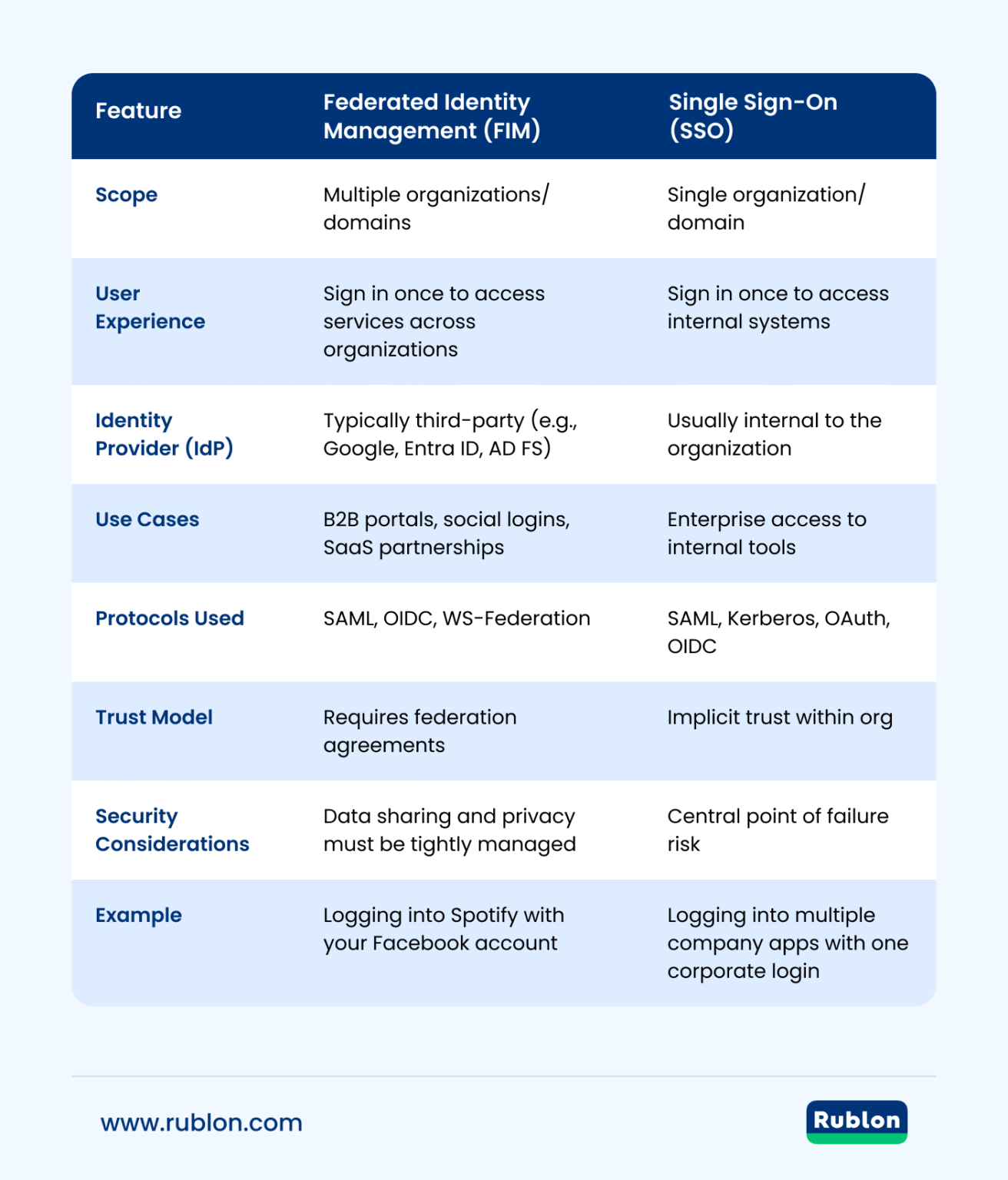
Single Sign-On (SSO) is the user experience of logging in once to access multiple applications within a single domain. Federated Identity is the underlying technology that allows this to happen across different domains and organizations. Federation is essentially "SSO beyond the firewall."
Is a federated identity solution secure enough for government use?
Yes, most modern FIM solutions support the Federal Information Processing Standards (FIPS) and are compatible with high-assurance identity levels (IAL3) and authentication levels (AAL3). When combined with hardware security keys, federation is the preferred method for secure government and defense integrations.
What happens if the Identity Provider (IdP) goes down?
If the IdP is unavailable, users generally cannot log in to any federated service providers. This is known as a "Single Point of Failure." To mitigate this, enterprise-grade FIM solutions use geographically redundant data centers and high-availability clusters to ensure 99.99% or higher uptime.
Does FIM work with legacy applications that don't support SAML or OIDC?
For legacy applications that rely on older methods like header-based authentication or LDAP, organizations use "Identity Proxies" or "Gateways." These tools sit in front of the legacy app, speak SAML/OIDC to the IdP, and then translate the identity into a format the legacy app understands.
Can I use multiple Identity Providers at once?
Yes, this is known as "IdP Discovery" or "Home Realm Discovery." When a user visits a service provider, the SP asks for their email address and, based on the domain (e.g., @company-a.com vs @company-b.com), redirects the user to the correct IdP for authentication.
Strategic Recommendation
For organizations operating in the 2026 business environment, the transition to a federated identity management solution is a critical step in achieving a Zero Trust security posture. Start by identifying your most critical SaaS applications and move them toward OIDC or SAML-based federation. Prioritize IdP vendors that offer robust support for passwordless authentication and SCIM provisioning to maximize both security and administrative efficiency.
Image Gallery