How IBM Watson Supercomputer Shapes AI Research
The IBM Watson supercomputer acts as a cornerstone of modern AI research by providing the massive parallel processing power, natural language processing (NLP) capabilities, and hybrid cloud architecture required to accelerate complex d...
The IBM Watson supercomputer acts as a cornerstone of modern AI research by providing the massive parallel processing power, natural language processing (NLP) capabilities, and hybrid cloud architecture required to accelerate complex data modeling. By enabling researchers to analyze unstructured data at scale, Watson serves as a vital testbed for developing generative models, predictive analytics, and enterprise-grade machine learning frameworks.
Contents
The Evolution of Watson in Research Contexts
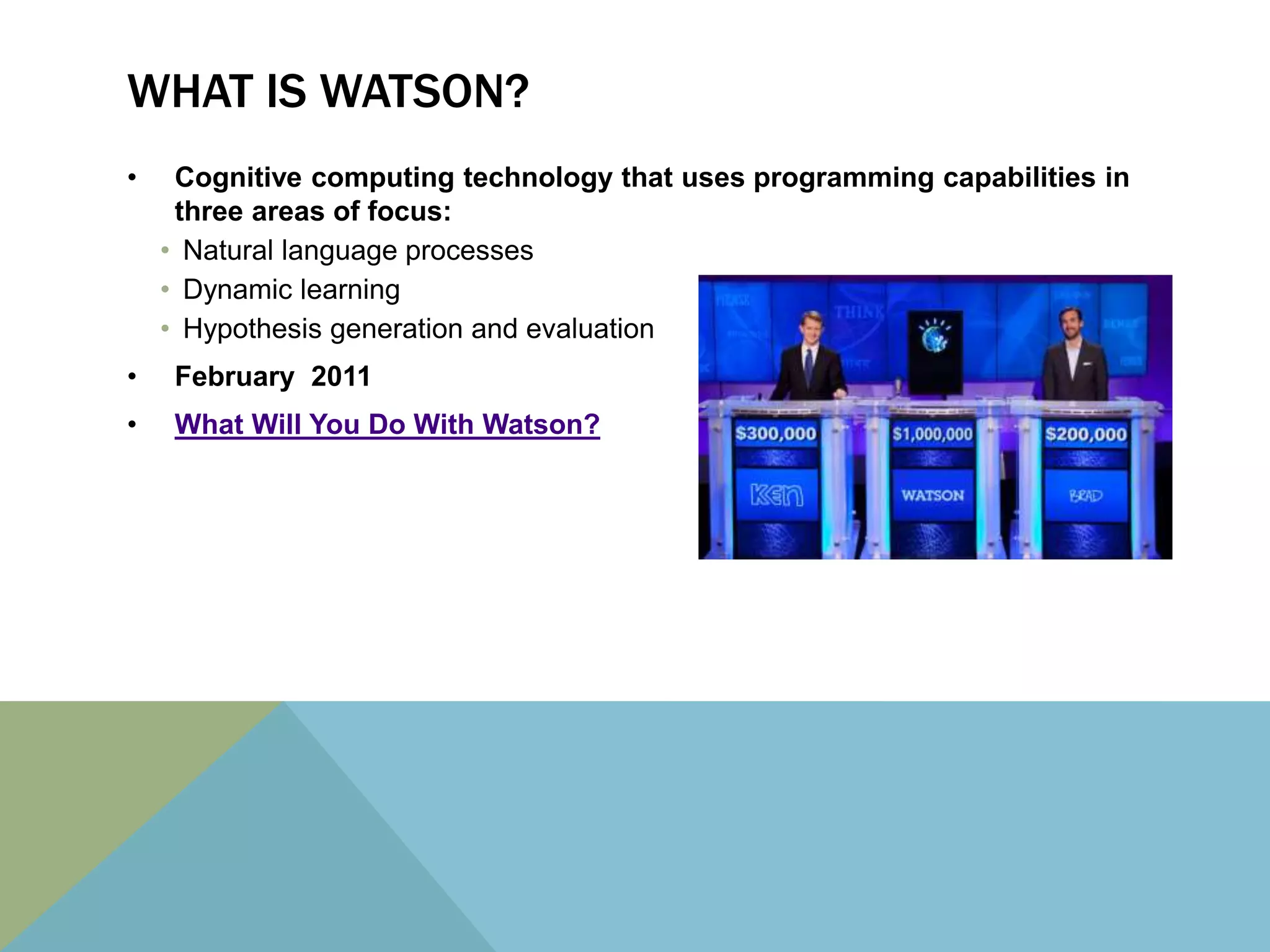
While often identified in popular culture by its victory on Jeopardy! in 2011, the architecture that evolved from the original Watson project has shifted significantly. It transitioned from a singular hardware configuration into a multi-modal, cloud-based platform. In 2026, the term "Watson" refers to a robust ecosystem of AI services designed to support research in medicine, material science, and climate modeling.
The primary way Watson shapes AI research is through its mastery of unstructured information. Most data in scientific research—such as clinical notes, environmental sensor logs, and historical archives—resides in text or image formats that traditional databases cannot interpret efficiently. Watson’s architecture, characterized by its deep-learning inference engines, allows researchers to ingest these massive, disparate datasets and identify latent patterns that would remain hidden to manual observation.
Architectural Pillars Shaping AI Development
The influence of the Watson ecosystem on AI research rests on three technical pillars: high-performance computing (HPC) integration, neuro-symbolic AI, and data governance.
1. High-Performance Computing (HPC) Integration
Watson-backed research environments leverage hybrid cloud infrastructures. By offloading computational tasks from local laboratory servers to IBM’s massive supercomputing clusters, researchers can iterate on neural network training cycles in days rather than months. This speed is critical for training foundation models where the number of parameters has reached trillions in recent years.
2. Neuro-Symbolic AI Frameworks
One of the most profound impacts of the Watson initiative is its push into neuro-symbolic AI. Unlike purely statistical models that are prone to "hallucinations," the Watson-derived approach combines neural networks (which are excellent at pattern recognition) with symbolic AI (which follows predefined logic and rules). This allows researchers to build AI systems that are both powerful and verifiable—a requirement for safety-critical fields like aerospace engineering and oncology.
3. Data Governance and Explainability
AI research often hits a "black box" wall where results cannot be audited. The Watson ecosystem emphasizes explainable AI (XAI) tools. By providing lineage documentation for data inputs and confidence scoring for every output, the platform enables academic and industrial researchers to validate their methodologies, ensuring compliance with strict ethics and transparency standards.
Practical Applications in Scientific Discovery
Researchers utilize the Watson supercomputing environment to bridge the gap between theoretical models and empirical results.
- Drug Discovery: By analyzing molecular structures and chemical interaction literature, the platform helps pharmaceutical researchers predict binding affinities, significantly reducing the timeline for early-stage drug candidates.
- Climate Modeling: The system integrates satellite imagery, atmospheric pressure data, and historical weather patterns to simulate granular regional climate impacts, providing more accurate projections than legacy modeling software.
- Materials Science: Researchers use the platform to simulate how new composite materials will behave under extreme conditions, allowing for rapid prototyping in the automotive and energy sectors.
Comparative Landscape of Computational AI Platforms
| Platform Feature | IBM Watson (Hybrid Cloud) | Traditional Local Clusters | Public Cloud AI Services |
|---|---|---|---|
| Data Privacy | High (Encrypted/On-prem options) | Very High | Variable |
| Scalability | Massive / Dynamic | Limited by Hardware | Near-Infinite |
| XAI Integration | Native | Manual Implementation | Limited/Add-on |
| Specialization | Enterprise/Scientific | General Purpose | Broad/Consumer |
Implementation Considerations for Research Teams
Integrating a supercomputing platform like Watson into a research pipeline requires a significant shift in operational strategy. Teams must first assess their data readiness. Watson functions best when data is curated, cleaned, and standardized. Without a solid data engineering pipeline, the computational speed of the supercomputer is often wasted on "dirty" data.
Cost remains a critical factor. Researchers must navigate cloud consumption models, which can fluctuate based on the intensity of GPU usage. It is standard practice to utilize "burst" computing—using the supercomputer for the intensive training phases and shifting to lighter, more cost-effective cloud instances for inference and monitoring.
Frequently Asked Questions
Does Watson require coding in a specific language? While the underlying infrastructure is built on C++ and optimized for Linux-based environments, most researchers interface with Watson using Python and R through specialized APIs. This ensures accessibility for scientists who may not be systems engineers.
How does Watson differ from generic generative AI models? Generic generative models are primarily designed for language fluency. Watson is specifically engineered for "precision AI," meaning it prioritizes accuracy, citation, and data lineage—essential requirements for scientific research where error margins are tight.
Can individual researchers access these supercomputing resources? Access is generally provided through IBM’s partner programs, university academic alliances, or direct enterprise subscriptions. Individuals interested in using these tools should explore the IBM Academic Initiative, which provides discounted access for qualified researchers.
What is the role of Watson in AI ethics? Watson provides toolkits for bias detection and fairness assessment. These tools analyze datasets for representative gaps, allowing researchers to adjust their training methodologies before the model is deployed in real-world scenarios.
Is the platform compatible with open-source AI tools? Yes. The current architecture is designed for interoperability with major open-source frameworks like PyTorch and TensorFlow, ensuring that researchers are not locked into proprietary codebases.
Recommendations for Future Integration
To leverage the capabilities of high-performance supercomputing in your research, start by identifying the specific computational bottleneck in your workflow. If your issue is the speed of iteration, focus on the GPU-accelerated cloud nodes. If your challenge is the veracity of the data, utilize the platform’s built-in data governance and metadata tagging features.
Before committing resources, verify that your data security requirements match the multi-tenant architecture of your chosen deployment. For most teams, the optimal path is a pilot program focusing on a discrete, high-impact research question, allowing you to calibrate the cost and performance balance before scaling to larger, multi-year projects.
Image Gallery