Life Insurance Third Party Administrators: A Comprehensive Guide to TPA Operations and Outsourcing
Life insurance third party administrators (TPAs) are specialized service organizations that perform administrative functions for insurance carriers, including policy issuance, premium collection, and claims processing. By leveraging a...
Life insurance third party administrators (TPAs) are specialized service organizations that perform administrative functions for insurance carriers, including policy issuance, premium collection, and claims processing. By leveraging a TPA, insurance companies can modernize legacy systems, reduce operational overhead, and improve the policyholder experience through advanced technology and specialized expertise without the need for significant internal capital investment.
Contents
The life insurance industry has undergone a radical transformation by 2026. As carriers face increasing pressure to modernize their infrastructure and lower expense ratios, the role of Life Insurance Third Party Administrators (TPAs) has shifted from simple "back-office support" to essential strategic partners. These entities manage the complex technical and administrative lifecycles of life insurance policies and annuities, acting as the operational engine for both established "blue chip" carriers and newer InsurTech entrants.
The Role and Scope of Life Insurance TPAs
A Third Party Administrator is an entity that processes insurance claims or certain aspects of employee benefit plans for a separate entity. In the specific context of life insurance, a TPA provides a "Business Process as a Service" (BPaaS) model. This means they provide both the people (the administrative staff) and the technology (the Policy Administration System or PAS) required to manage a book of business.
The scope of a TPA's work typically covers the entire "cradle-to-grave" lifecycle of a policy. This includes:
- New Business Processing: Managing applications, coordinating medical exams, and executing initial underwriting requirements based on the carrier's guidelines.
- Policy Servicing: Handling address changes, beneficiary updates, policy loans, and partial withdrawals.
- Billing and Collections: Managing premium notices, processing electronic funds transfers (EFT), and handling "lapse" notices when premiums are unpaid.
- Claims Adjudication: Verifying death certificates, conducting anti-fraud checks, and distributing death benefits to beneficiaries.
- Regulatory Compliance: Ensuring that all communications and processes adhere to the specific regulations of the jurisdiction where the policy was issued.
By 2026, most leading TPAs have integrated advanced automation to handle high-volume, low-complexity tasks, such as automated address updates or simple term life underwriting, while reserving human intervention for complex claim disputes or specialized universal life policy adjustments.
Strategic Drivers for TPA Adoption in 2026
The decision to move to a TPA model is rarely driven by a single factor. Instead, it is a response to several intersecting market pressures.
Legacy System Mitigation
Many life insurance companies still operate on mainframes and software languages developed decades ago, such as COBOL. Maintaining these systems is increasingly expensive and risky due to a shrinking pool of qualified developers. TPAs allow carriers to "lift and shift" these legacy blocks of business onto modern, cloud-native platforms without the carrier having to build a new system themselves.
Speed to Market
When a carrier wants to launch a new product—such as an Indexed Universal Life (IUL) policy or a new rider for an annuity—building the administrative framework in-house can take years. A TPA often has pre-configured modules for these products, allowing the carrier to go from product concept to market launch in a fraction of the time.
Focus on Core Competencies
Insurance carriers are increasingly viewing themselves as "risk and investment managers" rather than "software and call center managers." By outsourcing the administrative "plumbing" to a TPA, the carrier can focus its resources on product design, investment strategy, and distribution channel relationships.
Key Services and Technical Operations
To understand the value of a life insurance TPA, one must look at the specific technical functions they manage. Modern TPAs utilize an API-first approach, allowing their systems to communicate seamlessly with the carrier’s financial reporting tools and the agent’s sales portals.
1. Data Migration and Conversion
One of the most critical services a TPA provides is the migration of existing data. This involves moving thousands (or millions) of policy records from a carrier’s old system to the TPA’s platform. This process requires rigorous data cleansing and reconciliation to ensure that every policy’s cash value, death benefit, and cost basis remain accurate to the penny.
2. Digital Customer Portals
In 2026, policyholders expect 24/7 digital access. TPAs provide the "white-label" portals where customers can view their policy status, download annual statements, or submit a claim. These portals are often integrated with AI-driven chatbots that can resolve 60-70% of customer inquiries without requiring a human representative.
3. Claims and Payout Management
The moment of truth in life insurance is the claim. TPAs manage this sensitive process by coordinating with medical examiners, legal teams, and funeral homes. They ensure that the carrier remains compliant with "Unclaimed Property" laws and "Social Security Death Master File" (SSDMF) searches, which are required to proactively identify deceased policyholders.
Comparing In-House Administration vs. TPA Models
Deciding whether to keep operations in-house or move to a TPA involves a detailed cost-benefit analysis. The following table highlights the primary differences between these two approaches as of 2026.
| Feature | In-House Administration | Third Party Administrator (TPA) |
|---|---|---|
| Capital Expenditure | High (Initial investment in hardware/software) | Low (Pay-per-policy or subscription fee) |
| Operational Control | Full control over every process and staff member | Shared control; governed by Service Level Agreements (SLAs) |
| Technology Upgrades | Carrier's responsibility; often delayed by budget | TPA's responsibility; usually continuous and cloud-based |
| Scalability | Slow; requires hiring and training new staff | High; TPA can scale resources rapidly across multiple clients |
| Data Security | Managed by internal IT department | Specialized security teams; often SOC 2 Type II compliant |
| Cost Structure | Fixed costs (Salaries, office space, maintenance) | Variable costs (Costs scale with the number of policies) |
Regulatory and Compliance Framework
Life insurance TPAs are not unregulated entities. In the United States, they are primarily regulated at the state level. Most states have adopted versions of the NAIC (National Association of Insurance Commissioners) Third-Party Administrator Model Act.
Key regulatory requirements for TPAs include:
- Licensing: TPAs must be licensed in every state where they perform administrative functions or where the policyholders reside.
- Fiduciary Responsibility: TPAs must maintain separate accounts for premium collections and claim payments; they cannot commingle these funds with their own operating capital.
- Record Retention: Specific mandates require TPAs to maintain policy records for a set number of years (often 5 to 7) after the policy has terminated.
- Audits: Carriers are legally required to conduct periodic audits of their TPAs to ensure compliance with underwriting and claims-paying guidelines.
For legal or financial advice regarding specific TPA contracts or regulatory standing, organizations should consult with legal counsel specializing in insurance law.
Challenges and Risks in the TPA Relationship
While the benefits are significant, the TPA model introduces specific risks that carriers must manage.
1. Transition Risk: The period of moving data from the carrier to the TPA is the most vulnerable phase. Errors in data mapping can lead to incorrect premium billing or, in worst-case scenarios, the wrongful lapse of a policy.
2. Loss of Brand Connection: Because the TPA manages the call center, the policyholder’s primary interaction with the "brand" is actually with a TPA employee. If the TPA’s service quality is poor, it reflects directly on the insurance carrier’s reputation.
3. Dependency and Lock-in: Once a carrier has moved its entire book of business to a TPA's proprietary platform, moving it back or switching to another provider is a massive, multi-year undertaking. This creates a "vendor lock-in" scenario where the carrier is dependent on the TPA's financial stability and technological roadmap.
FAQ: Frequently Asked Questions
Is a TPA the same as an insurance broker?
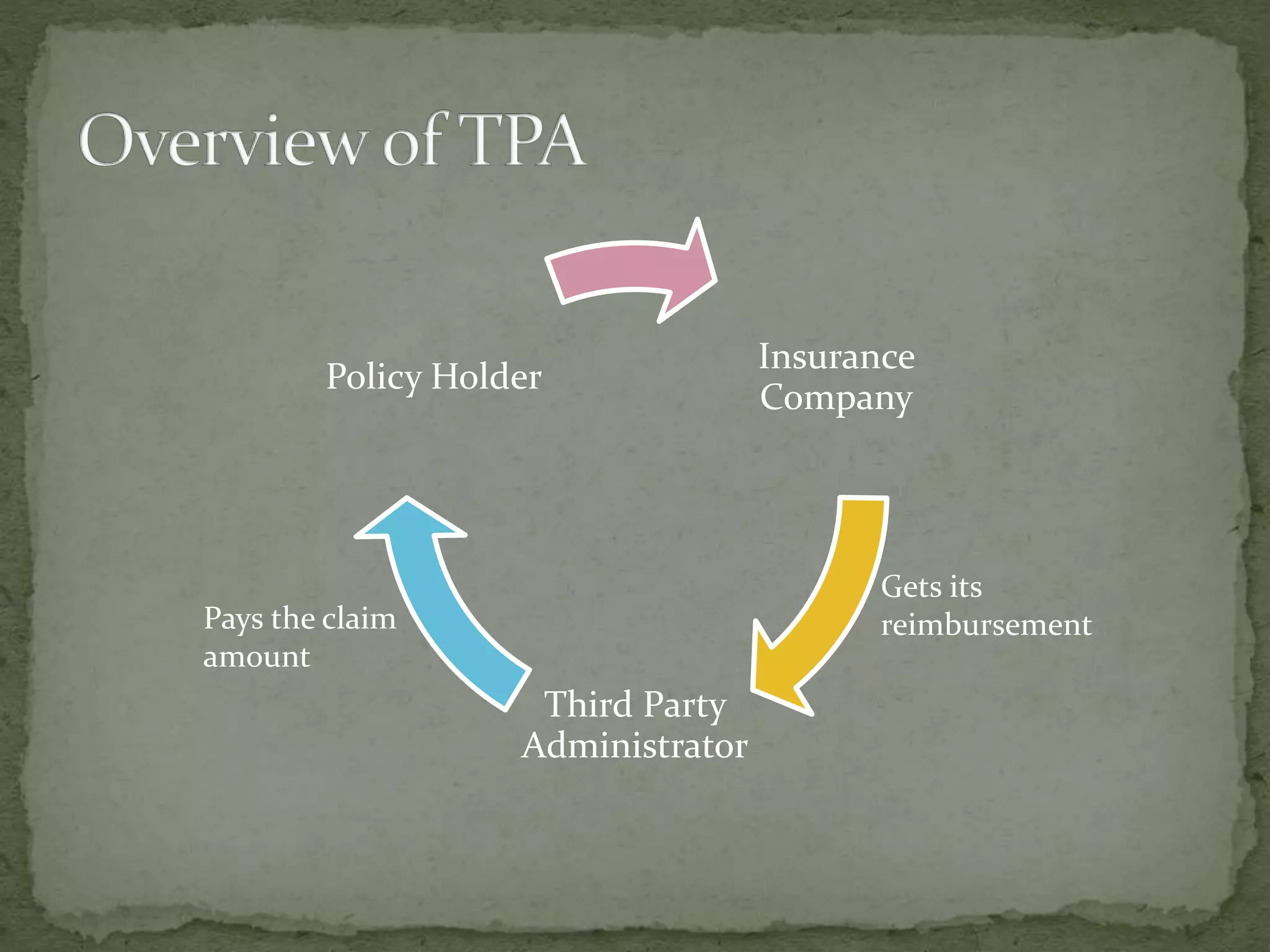
No. An insurance broker is an intermediary who helps a customer buy a policy and represents the customer's interests. A TPA is a service provider hired by the insurance company to manage the administrative tasks after the policy is already sold.
How do TPAs make money?
TPAs typically charge a fee based on the volume of work. This might be a "per policy per month" (PPPM) fee, a percentage of premiums collected, or a flat fee for specific services like claim processing or new business underwriting.
Can a TPA deny my life insurance claim?
Technically, a TPA adjudicates the claim based on the criteria established by the insurance carrier. While the TPA processes the paperwork and makes the recommendation, the ultimate liability for the claim remains with the insurance carrier. If a claim is denied, the carrier is the entity legally responsible for that decision.
Are TPAs common in the life insurance industry?
Yes, they have become increasingly common. As of 2026, it is estimated that over 40% of the "closed blocks" (policies no longer being sold but still in force) in the United States are managed by TPAs rather than the original issuing carriers.
Do TPAs handle reinsurance?
TPAs often assist with the data reporting required for reinsurance, but they are not reinsurers themselves. They track which policies are subject to reinsurance treaties and ensure that the appropriate data is sent to the reinsurance partner for premium payment or claim reimbursement.
Practical Recommendation
For insurance organizations considering a TPA partnership in 2026, the focus should be on interoperability and transparency. A TPA should not be a "black box" where data goes in and reports come out. Instead, look for providers that offer real-time data access through APIs and robust dashboarding.
Before signing a contract, conduct a thorough due diligence process that includes:
- System Demonstrations: Ensure their Policy Administration System can handle the complexities of your specific products (e.g., variable universal life or complex riders).
- Cybersecurity Verification: Review their SOC 2 reports and data encryption standards, as TPAs are high-value targets for data breaches.
- Disaster Recovery Plans: Verify their ability to maintain operations in the event of major technical failures or regional catastrophes.
Image Gallery