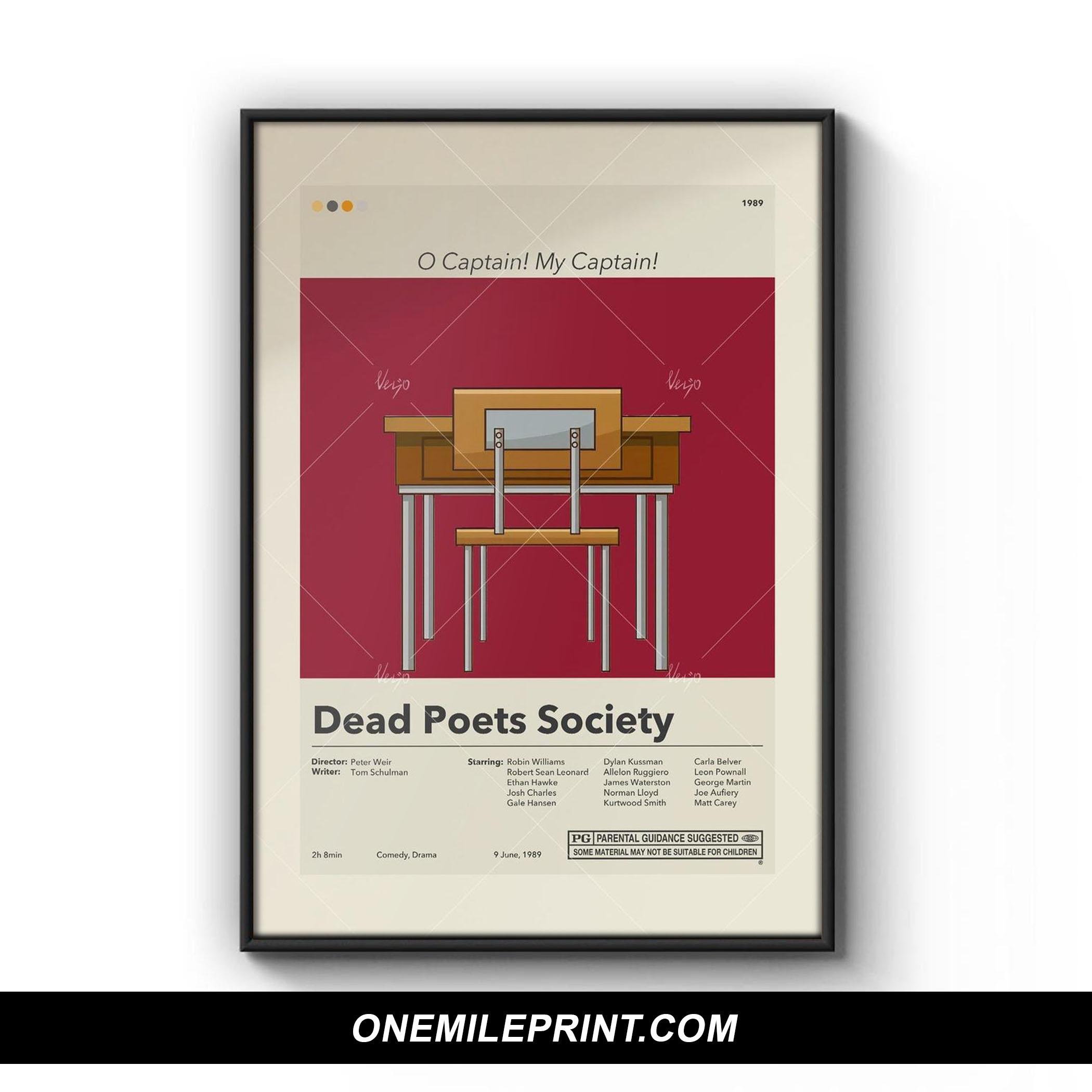
Dead Poets Society Summary: How a Classroom Revolt Unfolds at Welton Academy
Set in 1959 at the all-boys Welton Academy, Dead Poets Society follows nonconformist English teacher John Keating as he inspires his students to challenge rigid academic tradition through poetry and the philosophy of carpe diem ("seize...
Set in 1959 at the all-boys Welton Academy, Dead Poets Society follows nonconformist English teacher John Keating as he inspires his students to challenge rigid academic tradition through poetry and the philosophy of carpe diem ("seize the day"). The film chronicles how an intellectual awakening turns into a quiet classroom revolt, culminating in a tragic conflict between free thought and institutional oppression.
Contents
The Rigid Foundation: Welton Academy in 1959
Welton Academy, a prestigious Vermont prep school, operates under four unrelenting pillars: Tradition, Honor, Discipline, and Excellence. To the students, these pillars represent an oppressive pipeline designed solely to funnel sons of elite families into Ivy League universities, medical schools, and corporate law firms.
- Welton Academy Pillars:
- TRADITION
- HONOR
- DISCIPLINE
- EXCELLENCE
- Rigid Academic Pipeline to Ivy League / Elite Careers
The story focuses on a core group of upperclassmen navigating this environment:
- Neil Perry (Robert Sean Leonard): A driven student burdened by the intense expectations of his overbearing father, Mr. Perry.
- Todd Anderson (Ethan Hawke): Neil’s painfully shy roommate, living in the shadow of his successful older brother.
- Knox Overstreet (Josh Charles): A romantic teenager infatuated with Chris Noel, a girl dating a local star athlete.
- Charlie Dalton (Gale Hansen): An outspoken, wealthy rebellious student who later adopts the pseudonym "Nuwanda."
- Richard Cameron (Dylan Kussman): A strict conformist who prioritizes grades and institutional rules above personal conviction.
- Steven Meeks and Gerard Pitts: Intellectually curious students who construct a working radio and join the group's endeavors.
Under the strict gaze of Headmaster Gale Nolan (Norman Lloyd), the curriculum at Welton is mechanical, reliant on rote memorization, repetitive drills, and strict behavioral compliance.
Enter John Keating: Pedagogical Disruption and Carpe Diem
The status quo shifts when John Keating (Robin Williams), a Welton alumnus who previously taught at the Chester School, arrives as the new English master. Keating introduces an unconventional teaching methodology rooted in Romanticism and self-examination.
On his first day, Keating leads the boys out of their traditional classroom and into the school’s trophy hallway. Pointing to faded photographs of past alumni from decades earlier, Keating whispers the Latin phrase Carpe Diem—"Seize the day, boys. Make your lives extraordinary." He reminds them that the young men in those photos are now buried beneath the ground, urging the boys to contemplate their own mortality and purpose.
| Traditional Pedagogy | Keating's Methodology |
|---|---|
| Rote Memorization | Critical Self-Examination |
| Mathematical Verse Analysis | Emotional Resonance |
| Rigid Authority Compliance | Individual Expression |
| Fear-Based Motivation | Passion and Mortality Awareness |
Destruction of the Pritchard Scale
Keating’s second lesson directly challenges academic orthodoxy. He instructs student Neil Perry to read aloud the introduction to their poetry textbook, written by fictional critic Dr. J. Evans Pritchard, Ph.D. The introduction outlines a mathematical system for scoring poetry, plotting an equation on a Cartesian grid where importance is measured along one axis and execution along another to calculate total aesthetic value.
Keating dismisses this mathematical approach to art as "excrement." He commands the students to tear the introduction out of their textbooks entirely. After initial hesitation, led by Charlie Dalton and Neil Perry, the students rip the pages from their books. Keating explains that poetry is not a mathematical formula; it is a human pursuit driven by passion, love, beauty, and expression.
The Rebirth of the Dead Poets Society
Fascinated by Keating’s past, Neil Perry locates an old school yearbook in the library, discovering that Keating belonged to an unsanctioned group called the Dead Poets Society. When questioned, Keating reveals that the group was dedicated to "sucking the marrow out of life"—a phrase adapted from Henry David Thoreau’s Walden. The members would gather at night in an off-campus cave near the woods to read poetry by Walt Whitman, Percy Bysshe Shelley, Lord Byron, and Lord Tennyson.
Inspired by Keating's philosophy, Neil decides to secretively revive the society. Joined by Todd, Knox, Charlie, Cameron, Meeks, and Pitts, the boys sneak out of their dormitories past midnight, navigating through fog-shrouded woods to an old Indian cave.
Within the cave, the boys read classic literature, compose their own verses, share music, and engage in philosophical debate. The cave serves as an ideological counterweight to Welton Academy: a space where free thought, uninhibited creativity, and emotional vulnerability can flourish outside institutional oversight.
Escalation: Personal Awakenings and Institutional Friction
As the Dead Poets Society meets, Keating's lessons continue to challenge conformity inside the school grounds:
- Standing on Desks: Keating stands atop his teacher's desk to demonstrate that individuals must constantly remind themselves to view the world from different perspectives. He forces the boys to take turns standing on the desk to break visual and mental habits.
- The Walking Exercise: In the school courtyard, Keating has three boys march in step. As they inevitably match each other's cadence, Keating stops them to illustrate how easily human beings succumb to peer pressure and conformity. He instructs them to find their own personal rhythm, even if it diverges from the crowd.
| Desk-Standing Scene | Walking Exercise |
|---|---|
| Physical shift to view world through altered perspective. | Critique of physical conformity and peer pressure rhythms. |
These pedagogical methods spark transformative personal developments for the boys:
Knox Overstreet’s Pursuit of Romance
Knox gains the courage to pursue Chris Noel, attending a party at her boyfriend’s house, writing her poetry, and visiting her high school in public defiance of social boundaries.
Todd Anderson’s Awakening
Todd, crippled by social anxiety, experiences an intellectual breakthrough. Forced by Keating to improvise a poem in front of the class while staring at a portrait of Walt Whitman, Todd delivers an emotional verse on truth and identity, discovering his inner voice for the first time.
Charlie Dalton’s Radicalization
Charlie embraces carpe diem recklessly. Rechristening himself "Nuwanda," he paints a lightning bolt on his chest in red ink, invites two local girls to the cave, and anonymously publishes an article in the school newspaper, The Welton Gazette. The article demands that women be admitted to Welton in the name of sexual equality.
Headmaster Nolan calls an emergency school assembly to investigate the newspaper article. During the assembly, Charlie interrupts Nolan by producing an illegal telephone extension in the auditorium, claiming he is receiving a call from God requesting female admission at Welton. Nolan paddled Charlie in his office, demanding the names of other society members. Charlie refuses to betray his friends, but institutional tension escalates rapidly.
The Climax: Artistic Expression, Parental Tyranny, and Tragedy
The tension between individual autonomy and institutional control reaches its breaking point through Neil Perry. Neil discovers a passion for theater and secretly auditions for the role of Puck in a local production of William Shakespeare’s A Midsummer Night's Dream at the Baltimore Theatre. He lands the lead role, experiencing immense joy.
However, Neil’s controlling father, Mr. Perry, discovers his son's involvement shortly before opening night. Mr. Perry orders Neil to quit the play immediately, declaring that acting is a distraction from Neil's planned path toward medical school. Desperate, Neil seeks advice from Keating. Keating advises Neil to be honest with his father about his passion for acting. Neil lies to Keating, claiming his father gave him permission to perform.
- Neil performs as Puck in play
- Mr. Perry attends performance and confronts Neil
- Mr. Perry announces transfer to Braden Military School
- Neil commits suicide using his father's revolver overnight
On opening night, Neil delivers an acclaimed performance as Puck, witnessed by his friends, Keating, and an enraged Mr. Perry. Immediately after the play, Mr. Perry removes Neil from the theater, takes him home, and announces that he is removing him from Welton Academy to enroll him in Braden Military School for ten years, followed by Harvard Medical School.
Unable to express his feelings to his cold, domineering parents, Neil retreats to his father's study late that night. He places his crown of woven twigs from his Puck costume on his head, opens his father's locked desk drawer, takes out a revolver, and takes his own life.
Sacrificial Scapegoating and the Investigation
Neil’s suicide plunges Welton Academy into crisis. Unwilling to examine how their rigid high-pressure demands contributed to the tragedy, Neil’s parents and Headmaster Nolan launch an investigation to find a scapegoat outside the institution.
Richard Cameron, driven by self-preservation, immediately confesses the existence of the Dead Poets Society to Headmaster Nolan. Cameron blames John Keating for Neil’s death, arguing that Keating’s unorthodox teaching manipulated Neil into disobeying authority.
- Investigation & Scapegoating:
- Richard Cameron:
- Cooperates fully with Nolan
- Claims Keating is responsible
- Advises peers to save themselves
- Todd Anderson & Others:
- Pressured individually by parents/Nolan
- Forced to sign official statement
- Confronted with expulsion if they refuse
- Richard Cameron:
Cameron confronts the remaining members of the society, advising them to sign an official document laying sole responsibility on Keating to protect their academic futures. When Charlie Dalton punch Cameron in the face for his betrayal, Charlie is immediately expelled from Welton Academy.
One by one, the remaining boys are brought into Nolan’s office accompanied by their parents. Todd Anderson resists, knowing Keating is innocent, but under heavy emotional pressure from his father and the threat of expulsion, he signs the paper blaming Keating. Keating is quietly dismissed from his position without a formal hearing.
The Ultimate Classroom Revolt: "O Captain! My Captain!"
The emotional climax of the film occurs in the English classroom. With Keating terminated, Headmaster Nolan personally takes over the English class to return it to traditional standards.
Nolan instructs the students to open their textbooks to the introduction by Dr. J. Evans Pritchard—the very section Keating had commanded them to rip out. Because the students no longer have the introduction in their books, Nolan forced them to read Pritchard's mathematical theory aloud from Cameron’s copy.
During the lesson, John Keating quietly enters the back of the classroom to retrieve his personal books and belongings from his office. The air in the room is heavy with silence, guilt, and tension.
As Keating gathers his things and walks toward the exit door at the back of the room, Todd Anderson breaks his silence. Ignoring Nolan's sharp orders to remain quiet, Todd stands up and calls out directly to Keating:
"Mr. Keating! They forced us to sign it, believe me! It's true!"
Nolan angrily demands quiet and threatens Todd with immediate expulsion. Keating looks at Todd and replies softly, "I believe you, Todd."
Nolan orders Keating to leave the premises immediately. As Keating turns toward the door, Todd makes a decisive choice. Rejecting fear, institutional pressure, and compliance, Todd steps onto the top of his wooden desk, turns to his former teacher, and speaks the words Keating taught them from Walt Whitman's poem:
"O Captain! My Captain!"
- Nolan enforces reading of Pritchard intro: Traditional Order Restored
- Keating enters to collect belongings: Tension builds
- Todd Anderson stands on desk: "O Captain! My Captain!" (First Act)
- Nolan threatens immediate expulsion: Institutional Retaliation
- Knox, Pitts, Meeks, & others stand up: Collective Classroom Revolt
- Cameron & minority remain seated: Structural Divide Highlighted
Nolan screams at Todd to sit down under penalty of expulsion. For several seconds, Todd stands alone on his desk, looking at Keating. Then, Knox Overstreet rises and stands atop his desk. One by one, Steven Meeks, Gerard Pitts, and over half the students in the class stand atop their desks, raising their physical height above Headmaster Nolan's desk level.
While a few students—including Richard Cameron—remain seated out of fear or compliance, the majority of the class stands atop their desks in open, silent defiance of the headmaster. Nolan’s attempts to regain control fail as he stands helpless in the middle of the room, shouting impotent threats.
Keating looks up at the boys standing on their desks, visibly moved. He smiles and speaks his final line to the class:
"Thank you, boys. Thank you."
Character Trajectories and Plot Resolutions
The following table summarizes the initial status, key act of nonconformity, and final narrative outcome for the primary students of Welton Academy:
| Character | Initial Status at Welton | Key Act of Revolt / Nonconformity | Final Narrative Outcome |
|---|---|---|---|
| Neil Perry | High-achieving, dutiful son burdened by father's expectations. | Performs as Puck in A Midsummer Night's Dream against father's orders. | Commits suicide after being threatened with military school; catalyst for school investigation. |
| Todd Anderson | Extensively anxious, shy, living in brother's academic shadow. | Speaks out against Nolan; leads the desk-standing revolt ("O Captain! My Captain!"). | Conquers his fear, claims his personal voice, and openly defies institutional authority. |
| Charlie Dalton ("Nuwanda") | Brash, wealthy, seeking excitement. | Publishes unauthorized article; plays telephone prank on Nolan; punches Cameron. | Expelled from Welton Academy after refusing to scapegoat Keating. |
| Knox Overstreet | Quiet student assigned to family friend’s house. | Pursues Chris Noel publicly despite social barriers and physical threats. | Gains romantic confidence and breaks out of his passive social persona. |
| Richard Cameron | Rule-bound, focused on academic standing and grades. | Cooperates with Nolan's investigation; betray's Keating to save his record. | Remains seated during final revolt; secures status at the cost of personal integrity. |
| Steven Meeks | Mathematically gifted, intellectually curious. | Builds radio in dorm; participates fully in cave poetry readings. | Stands on desk in final revolt, prioritizing human connection over pure academic obedience. |
| Gerard Pitts | Quiet, tall student, often insecure. | Helps build radio; attends cave meetings; stands up in class. | Stands on desk in final revolt, overcoming passive hesitation. |
Core Thematic Analysis
1. Romanticism vs. Realism (Utilitarianism)
Dead Poets Society establishes a stark contrast between two competing worldview systems:
- Welton Academy's Utilitarian Realism: Education is seen purely as a transactional vehicle for material security, prestige, and career advancement. Art, literature, and emotion are only valuable if they can be measured, cataloged, or monetized.
- Keating’s Romantic Idealism: Literature and poetry are essential to human existence. As Keating tells his class: "We don't read and write poetry because it's cute. We read and write poetry because we are members of the human race. And the human race is filled with passion. Medicine, law, business, engineering—these are noble pursuits and necessary to sustain life. But poetry, beauty, romance, love—these are what we stay alive for."
2. Conformity vs. Individual Autonomy
The film demonstrates how institutional pressure creates conformity. Welton's architecture, uniforms, and rigid routines are designed to strip away individual quirks.
Keating's walking lesson directly highlights this mechanism: individuals naturally modify their behavior to match the crowd even when no explicit command has been issued. The tragedy of Neil Perry highlights the extreme danger of absolute parental and institutional tyranny, where an individual's autonomy is completely suppressed.
| Welton Institutionalism | Keating's Romanticism |
|---|---|
| Conformity & Uniformity | Individual Expression |
| Material Career Goals | Passion & Intellectual |
| Rote Calculation | Free Thinking |
3. The Double-Edged Nature of Carpe Diem
While carpe diem serves as an inspiring catalyst for personal growth, the film presents a nuanced view of its application. Uncritical or reckless interpretation of nonconformity—as seen in Charlie Dalton's public pranks—can lead to severe immediate consequences.
Furthermore, seizing the day within an uncompromising, rigid system requires immense moral courage. The tragic outcome for Neil demonstrates that inspiring young people to think for themselves without providing them with structural agency can lead to dangerous conflicts with authority.
Frequently Asked Questions
What is the main message of Dead Poets Society?
The film explores the tension between institutional conformity and individual self-expression. It emphasizes the importance of critical thinking, emotional authenticity, and pursuing personal passions while acknowledging the steep social and personal costs that defying established authority can bring.
Why did Neil Perry commit suicide?
Neil’s suicide is caused by absolute emotional despair resulting from his father's suffocating control. After experiencing creative fulfillment playing Puck in A Midsummer Night's Dream, his father removes him from Welton and mandates ten years of strict military and medical schooling. Feeling completely stripped of his autonomy with no path forward to live authentically, Neil takes his life.
What does "O Captain! My Captain!" signify in the final scene?
"O Captain! My Captain!" is the title of a famous 1865 poem by Walt Whitman written upon the death of President Abraham Lincoln. In the film, the phrase serves as a sign of respect and loyalty from the students to John Keating. By standing on their desks and speaking the phrase, the boys declare that Keating is their true teacher and leader, publicly rejecting Headmaster Nolan’s authority.
Was Mr. Keating responsible for Neil's tragedy?
The film portrays Keating as an inspiring force, not the cause of Neil's death. While Keating taught Neil to love poetry and acting, he explicitly advised Neil to speak openly with his father to resolve the conflict. Neil lied to Keating, claiming his father had consented to the performance. The primary causes of the tragedy were Mr. Perry’s refusal to listen to his son and Welton's oppressive environment.
What does the tearing of the Pritchard textbook introduction symbolize?
Tearing out Dr. J. Evans Pritchard’s introduction symbolizes the rejection of rigid, overly analytical approaches to human emotion and art. It marks the students' first physical act of defiance against arbitrary authority, asserting that art cannot be reduced to a mathematical formula or an administrative rubric.
Final Perspective and Legacy
Dead Poets Society remains a profound exploration of education, youth, and nonconformity. By tracing how John Keating's literary lessons transform a group of compliant prep school boys into independent thinkers, the film shows that true education is not about forcing compliance, but inspiring individuals to think for themselves. The final classroom revolt proves that while institutions can dismiss individual teachers, genuine intellectual awakening cannot be easily erased once students learn to view the world from their own perspective.
Editorial Category Metadata:
Image Gallery